
Asiatic Lion Conservation & Naturalist Specialist Tour5N/6D
Asiatic Lion Conservation & Naturalist Specialist Tour
Start & City : Ahmedabad
best deal price
₹
Without GST ₹88,515
per person on twin sharing
Choose your departure city, dates, and add guests to secure your tour.
Hurry, as seats fill up, prices rise! Book now!
1. Choose your departure date
Highlights
Take four jeep safaris across the trip, more than a standard two or three-safari stop, to raise the odds of a real sighting and give the forest time to show more than lions.
Visit the Sasan Gir Museum for the conservation history, and Devalia, the 412-hectare Gir Interpretation Zone built to ease pressure on the core safari area.
Sit through two guide-led naturalist sessions: one on Maldhari coexistence and lion density, one on Gir's population numbers and Project Lion's new Barda satellite population.
Learn the real figures: 287 lions in 1936, 523 in 2015, 674 in 2020, 891 in 2025, and the IUCN's 2024 move of the Asiatic lion from Endangered to Vulnerable.
Drive through Junagadh, former seat of the Nawabs whose early protection kept Gir's lions alive when the species was being shot out everywhere else in Asia.
Hear the Barda story first-hand: five translocated lionesses, natural breeding, and 17 lions counted there in 2025, the first satellite population under Project Lion.
Travel privately, one guide and driver for the whole trip, not folded into a shared group safari schedule.
Close the trip with a dedicated naturalist Q&A dinner on your last evening in Gir.
Essence of Journey
The experiences that capture the true spirit of the entire trip.
| Day | Route | Distance | Major Highlights |
|---|---|---|---|
| Day 1 | Arrive Ahmedabad | ~20 km | Airport pickup, conservation briefing |
| Day 2 | Ahmedabad to Sasan Gir | ~375 km, 7 to 7.5 hrs | Drive via Junagadh, Sasan Gir Museum |
| Day 3 | Sasan Gir | ~60 km local | Dawn safari, Devalia Interpretation Zone |
| Day 4 | Sasan Gir | ~40 km local | Naturalist session: coexistence and census, afternoon safari |
| Day 5 | Sasan Gir | ~40 km local | Dawn safari, Kamleshwar area, open afternoon |
| Day 6 | Sasan Gir to Ahmedabad | ~375 km, 7 to 7.5 hrs | Drive via Junagadh, departure |
| Total road distance | about 850 km | Approximate and rounded, including local drives |
About
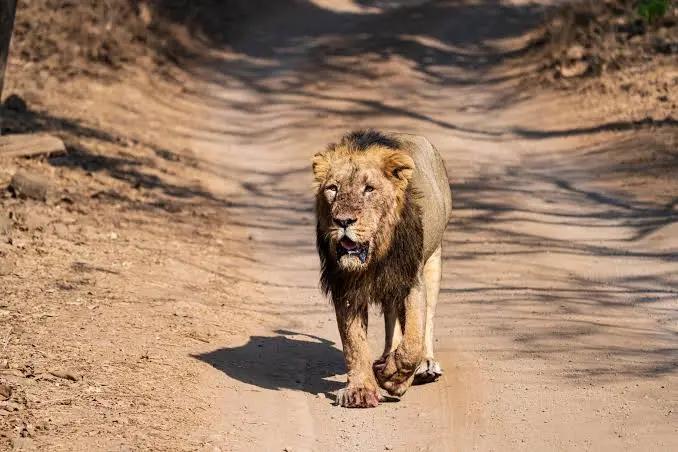
This is a 6-day private Gir lion safari and conservation tour in Gujarat, India. You spend four nights in Sasan Gir, the only place in the world where Asiatic lions still live in the wild. The trip includes four jeep safaris, the Devalia Interpretation Zone, the Sasan Gir Museum and two sessions with a naturalist guide on how these lions were saved. Prices start at about INR 88,500 per person (twin sharing).
A hundred years ago, the Asiatic lion was almost gone. These lions once roamed from the Middle East to eastern India. By the early 1900s, hunting had wiped them out everywhere except one dry forest in western India. The 1936 count found just 287.
Today, the 2025 census counted 891 wild lions in Gujarat. It's one of the great comeback stories in wildlife conservation, and Gir is where it happened.
Most visitors give Gir a single safari and move on. This trip is different. You stay four nights, go out on four safaris at different times and in different zones, and travel with a naturalist who explains what you're seeing: the lions, the forest, the herders who live alongside them, and the work still being done to keep the species safe.
Who Is This Lion Safari For?
This tour suits you if you:
Want to see wild lions in Asia, not only in Africa
Prefer time and depth over rushing through several parks
Are curious about the conservation story, not just the photo
Enjoy wildlife photography and want better light and more chances
Want a private, well-organised trip with a guide who knows the forest
If you're hoping to combine Gir with beaches and sightseeing, ask us about our broader Gujarat wildlife tours instead. This one is focused on purpose.
The Asiatic Lion's Comeback in Numbers
Your naturalist walks you through these figures in detail. Here's the short version:
| Year | Wild lions counted | What it means |
|---|---|---|
|
1936 |
287 |
Near extinction. Gir is the last refuge. |
|
2015 |
523 |
Steady recovery under protection. |
|
2020 |
674 |
Lions spread beyond the forest into wider Saurashtra. |
|
2025 |
891 |
Strongest count in modern history, including 17 lions at Barda. |
The Asiatic Lion's Comeback in Numbers
Because nearly all Asiatic lions still live in one connected landscape, a single disease outbreak could threaten the whole population. That's why Project Lion has started a second, "satellite" population at Barda Wildlife Sanctuary near Porbandar. Your guide explains how it works. (Barda itself isn't visited on this trip.)
ACCOMMODATION CATEGORIES
Tier labels follow the standard of the room and the property, not a star count. Where a property is named, it is a real hotel we plan to use. The ground team confirms every property before each departure.
| Destination | Nights | Premium | Luxury | Ultra-Luxury |
|---|---|---|---|---|
|
Ahmedabad |
1 |
Novotel Ahmedabad |
Hyatt Regency Ahmedabad |
House of MG, heritage hotel |
|
Sasan Gir |
4 |
The Fern Gir Forest Resort |
Woods at Sasan |
The Postcard Gir Wildlife Sanctuary |
Gir Lion Safari Accommodation Categories
What Else Will I See in Gir?
Lions are the headline, but Gir is a rich dry deciduous forest with plenty more to spot:
Mammals: leopards, spotted deer (chital), sambar, nilgai (blue bull), four-horned antelope, chinkara, wild boar and jungle cats
Reptiles: mugger crocodiles, especially around Kamleshwar Dam
Birds: hundreds of species, from crested serpent eagles and paradise flycatchers to waterbirds on the reservoirs
Gir Lion Safari Tour Price
| Tier | Per couple | Per person | Standard |
|---|---|---|---|
|
Premium |
Rs.177,030 to Rs.191,192 |
Rs.88,515 to Rs.95,596 |
Standard rooms and best-available hotel |
|
Luxury |
Rs.243,558 to Rs.263,043 |
Rs.121,779 to Rs.131,521 |
Superior rooms and named lodges |
|
Ultra-Luxury |
Rs.355,950 to Rs.384,426 |
Rs.177,975 to Rs.192,213 |
Suites and the best property at Gir |
Gir Lion Safari Tour Price
The upper figure allows for date and season variance of about 8%. Prices are indicative and confirmed on request.
WHY BOOK THIS WITH BIZAREXPEDITION
A 6-day Gir lion naturalist expedition, planned and run by BizareXpedition from start to finish.
Built for depth, not a day trip. Four safaris and two structured naturalist sessions, against the one or two safaris most Gir add-ons offer. The naturalist content is written into the itinerary, not left to whichever guide you happen to get.
The numbers, stated plainly. 287 lions in 1936 to 891 in 2025, the 2024 IUCN downgrade to Vulnerable, and Project Lion's Rs.2,927 crore ten-year programme are in the itinerary itself, each sourced, not asserted.
Honest about what we do not arrange. There is no staged visit to a Maldhari settlement here. We talk about their role in Gir's conservation story in a naturalist session instead of turning someone's home into a stop on your itinerary.
A route kept as given. The sheet's direct Ahmedabad-Gir-Ahmedabad loop needs no correction: at about 375 km each way, it is a long single day at either end, not a multi-day drive, and the plan uses it exactly as written.
Different from our general Gir trips. BizareXpedition also runs a broader Gir wildlife tour paired with general sightseeing. This one is narrower and deeper on purpose, built for travellers who want the conservation story, not a beach add-on.
A registered company, not a middleman. BizareXpedition Services Pvt. Ltd. (CIN U63090UR2016PTC007433), headquartered in Haridwar, plans and runs the trip itself.
Best Time for a Gir Lion Safari
| Season | Months | What to expect |
|---|---|---|
|
Peak |
Late November to February |
Gir is open, cool mornings for safaris, highest sighting activity reported in this window. |
|
High |
About 20 December to 5 January |
Fuller lodges and higher rates. Book safari permits early. |
|
Shoulder |
16 October to mid-November, and March to 15 June |
Gir is open; hotter by April and May, with sightings sometimes easier near waterholes in the dry heat. |
|
Closure |
16 June to 15 October |
Gir safaris are closed for the monsoon and cub-rearing season. This trip is not sold in this window. |
Gir Lion Safari Best Time to Visit
PRACTICAL NOTES
Safari permits and zones. Permits are released online roughly 90 days ahead and sell out in season; we book as soon as the trip is confirmed. Which zone you are allotted on a given safari, including whether it covers the Kamleshwar area, is set by the forest department on the day, not guaranteed in advance.
Devalia's closing day. Devalia, the Gir Interpretation Zone, is closed every Wednesday. Where this falls on Day 3, the visit moves to Day 4 or 5 instead.
Gir safari rules. Vehicles stay on the permit route, occupants stay seated, and a licensed guide and driver accompany every safari. Tripod and seating rules are set by the forest department and confirmed at booking, not promised.
Sightings are never guaranteed. Four safaris, across different zones and times of day, give meaningfully better odds than one or two, but no safari park anywhere can promise a lion.
No staged community visits. We do not arrange a tourist stop at a Maldhari settlement. Their role in Gir's story is covered in a guide-led naturalist session instead.
Alcohol. Gujarat is a dry state. Foreign visitors can get a free temporary tourist liquor permit, usually within about a day.
Dress. Mornings are cool in winter even though Gujarat is warm by day; bring a light jacket for dawn safaris from November to February.
Long driving days. Days 2 and 6 are seven to 7.5 hours by road, the only two long days on this trip; every other day is spent inside Gir.
Connectivity. Mobile data works in Sasan Gir village and is weak inside the park.
Vegetarian food. Gir's lodges serve largely vegetarian Kathiawadi food by local custom; non-vegetarian options are more limited than in Ahmedabad.
Responsible Wildlife Travel
Gir's lions survive partly because the Maldhari herders who live in the forest have tolerated, and even revered, them for generations. We think their story deserves respect. That's why we don't arrange tourist visits to Maldhari homes. Instead, your naturalist covers their role in Gir's conservation in a dedicated session.
We also follow forest department rules on every safari and keep group sizes small, so your visit adds to Gir's protection rather than pressure on it.
Booking Summary
Dept. City :
--
Dept. Date :
--
Traveller :
Adults: 2, Child: 0, Infant: 0
Rooms :
--
Basic Price :
--
Total Cost
--
GST
--
Grand Total
--
Itinerary (Day Wise)
A hundred years ago the Asiatic lion was almost extinct, with only a few hundred left in one dry forest in western India. In 2025 the census counted 891. This 6-day private trip takes you to Sasan Gir, where that comeback happened, and gives you enough time to see it properly. After a night in Ahmedabad you drive through Junagadh, whose Nawabs first protected these lions, and then spend four nights in Gir. You go out on four jeep safaris at different times and in different zones, which gives you a far better chance of good sightings and lets you see the leopards, crocodiles and birdlife as well. A naturalist guide stays with you throughout and leads two sessions on how the herders and lions share the land, what the census numbers mean and why Project Lion is starting a second population at Barda. On your last evening there’s a relaxed Q&A dinner before you drive back to Ahmedabad.
Day 1
ARRIVE AHMEDABAD | THE CONSERVATION STORY BEGINS
Route: Arrive Ahmedabad airport, transfer to hotel, about 20 km
Your naturalist guide meets you at Sardar Vallabhbhai Patel International Airport for the private transfer to your hotel.
Over dinner, your guide sets out the story this tour is built around: how the Asiatic lion, once spread from the Middle East to eastern India, survived the twentieth century in a single forest in Gujarat. The IUCN moved the Asiatic lion from "Endangered" to "Vulnerable" in 2024, the first downgrade in the subspecies' modern conservation history, and that is the arc this trip follows, not just a lion count.
Note: This is a specialist, naturalist-led tour, not a general wildlife-plus-beach itinerary. Every day in Gir is built around conservation content, not sightseeing for its own sake.
Experience of the Day
Airport pickup and check-in
Dinner briefing: the Asiatic lion's recovery story
Food
Recommended: Dinner at the hotel.
Must-Try: Gujarati thali: dal, kadhi, farsan and sweets.
Activities to Do
Rest and settle in
Conservation briefing over dinner
Day 2
AHMEDABAD TO SASAN GIR | INTO THE ONLY LION FOREST ON EARTH
Route: Ahmedabad to Sasan Gir via Junagadh, about 375 km, 7 to 7.5 hours by road
The direct road south runs through Junagadh, a city that sat at the edge of the old Gir forest for centuries under its Nawabs, who protected the lions here when shikar parties elsewhere were shooting them to extinction across the rest of their Asian range. A short stop in Junagadh breaks the drive; the Mahabat Maqbara's domes are worth ten minutes if your guide has the time in hand.
You reach Sasan Gir by late afternoon. Before dinner, visit the Sasan Gir Museum, a small but useful orientation stop: taxidermy, photographs and information panels on the lion's life cycle, the forest's other wildlife, and the conservation history that runs from the first sanctuary notification in 1965 through to today.
Experience of the Day
Drive through Junagadh, former seat of the Nawabs who first protected Gir's lions
Sasan Gir Museum: life cycle, conservation history, taxidermy and photographs
Food
Recommended: Dinner at the lodge.
Must-Try: Bajra rotla with jaggery and ghee, and sev tameta.
Activities to Do
Drive to Sasan Gir
Sasan Gir Museum
Optional Nearby Excursions
Mahabat Maqbara in Junagadh, a short stop if time allows
Day 3
SASAN GIR | FIRST SAFARI AND THE INTERPRETATION ZONE
Route: Sasan Gir local, safari zones and Devalia, about 60 km in all
Your first safari runs at dawn, when the forest is coolest and lions are most often moving. A licensed forest guide travels with the vehicle, which stays on the route set by your permit; the zone you are allotted is decided by the forest department on the day, not chosen by us.
In the afternoon, visit Devalia, officially the Gir Interpretation Zone: a 412-hectare fenced section of the same forest, 12 km from Sasan, created so visitors without a main-zone permit can still see Gir's habitats and wildlife at close range. For a conservation-focused visit it is worth the stop in its own right, not a consolation prize: it exists specifically to ease pressure on the core safari zones, and your naturalist guide can speak more freely here about habitat management than is possible from a moving safari jeep.
Note: Devalia is closed on Wednesdays. Where your Day 3 falls on a Wednesday, this visit is moved to Day 4 or 5 instead.
Experience of the Day
Dawn jeep safari
Devalia, the Gir Interpretation Zone
Guide-led discussion on habitat management
Food
Recommended: Dinner at the lodge.
Must-Try: Kathiawadi sev tameta and bajra rotla.
Activities to Do
Dawn safari
Devalia Interpretation Zone
Day 4
SASAN GIR | COEXISTENCE AND THE SECOND LION POPULATION
Route: Sasan Gir local, safari zone, about 40 km
Gir's lions share this forest with the Maldharis, pastoralist herders who have lived here for generations and regard the lion with religious reverence rather than fear. Livestock loss is compensated by the forest department, and research has found lion density is actually higher in areas where Maldhari settlements remain than where they have been moved out, since the herds support a larger prey base. Your guide covers this in a morning session rather than as a drive-by stop; there is no organised tourist visit to a Maldhari settlement, and we do not arrange one, so as not to turn someone's home into a photo stop.
The second strand of the morning session is Gir's population math and what comes after it. The lion count has gone 287 in 1936, 523 in 2015, 674 in 2020, 891 in the most recent, 2025 census, recovering from a near-wipeout a century ago. All of Gir's wild lions still live in one contiguous landscape, which is itself a risk: a single disease outbreak or disaster could threaten the whole population. Project Lion, the Union Government's dedicated lion conservation programme, has approved funding of roughly Rs.2,927 crore over ten years, including a National Referral Centre for Wildlife in Junagadh district. Its most visible result so far is at Barda Wildlife Sanctuary, about 190 km west near Porbandar, where five lionesses were translocated under forest department monitoring and have since bred naturally; the 2025 census counted 17 lions there, now recognised as the first satellite population under Project Lion. Barda is not part of this itinerary, but it is very much part of the story your guide will walk you through.
The Human Story
A folk saying among the Maldharis holds that a lion taking a cow once a year is simply the forest's share of the herd. Six generations of some families have stayed in Gir by choice, after being offered resettlement.
Experience of the Day
Naturalist session: Maldhari coexistence and the Gir lion census, 1936 to 2025
Afternoon jeep safari
Food
Recommended: Dinner at the lodge.
Must-Try: Bajra rotla with smoked aubergine and garlic chutney.
Activities to Do
Naturalist session
Afternoon safari
Day 5
SASAN GIR | A LAST SAFARI AND KAMLESHWAR
Route: Sasan Gir local, safari zone, about 40 km
Your fourth and final safari runs at dawn. If your permit zone that day includes the area around Kamleshwar Dam, often called Gir's lifeline for how much of the forest's wildlife depends on it, you will likely see mugger crocodiles and waterbirds on its banks along with whatever else the morning brings; which zone you are allotted is set by the forest department, not guaranteed in advance.
The rest of the day is open. Rest at the lodge, go through your safari photographs with your guide, or ask any remaining questions about the conservation programme you have been hearing about all week. In the evening, a closing dinner closes out the naturalist sessions with a final Q&A.
Experience of the Day
Dawn jeep safari, Kamleshwar area if the permit allows
An open afternoon
Closing dinner and naturalist Q&A
Food
Recommended: A farewell dinner at the lodge.
Must-Try: Kathiawadi thali, the region's full home-style spread.
Activities to Do
Dawn safari
Open afternoon
Closing Q&A dinner
Day 6
SASAN GIR TO AHMEDABAD | DEPARTURE
Route: Sasan Gir to Ahmedabad via Junagadh, about 375 km, 7 to 7.5 hours by road
The drive back to Ahmedabad is the trip's other long day. Book onward or international flights after about 7:00 pm to leave a comfortable margin.
You leave with four safaris, a museum visit, an interpretation-zone tour and two naturalist sessions behind you, and a clearer picture of what it actually took, and still takes, to keep one forest from being the last chapter in the Asiatic lion's story rather than a footnote in it.
Experience of the Day
Road transfer to Ahmedabad
Onward or international departure
Food
Recommended: Breakfast at the lodge.
Must-Try: Lunch on the road.
Activities to Do
Drive to Ahmedabad
Departure
Tour Information
Your complete guide to a hassle-free and enjoyable trip.
Inclusion
Exclusion
Payment Terms
Important factors to consider before your trip!
Cancellation
Need To Know
Be Responsible Traveller
- Minimize Plastic Use : Bring a reusable water bottle, shopping bag, and utensils to reduce the need for single-use plastics. Many destinations have water refill stations and eco-friendly stores.
- Support Local and Sustainable Businesses : Eat at local restaurants, buy souvenirs from local artisans, and choose tour operators that prioritize sustainable practices and support the local community.
- Respect Wildlife and Natural Habitats : Avoid disturbing wildlife or their natural habitats. Stick to designated paths and observe animals from a distance without feeding or touching them.
- Dispose of Waste Properly : Follow local guidelines for recycling and waste disposal. If facilities aren't available, carry your waste with you until you can dispose of it responsibly.
- Educate Yourself and Others : Learn about the local environment, culture, and customs. Respect local practices and traditions, and share your knowledge about responsible travel with others.
- Choose Sustainable Activities : Engage in eco-friendly activities such as hiking, snorkeling, or visiting national parks. Avoid activities that exploit animals or damage the environment.
- Leave No Trace : Follow the principle of "Leave No Trace," which means leaving natural areas as you found them. Pack out all trash, avoid picking plants, and refrain from carving or writing on rocks or trees.
- Plant Trees Whenever Possible : Participate in local tree-planting initiatives or plant trees in your own community. Trees absorb carbon dioxide, provide oxygen, and help support biodiversity, making them vital for a healthy environment.
Connect
Share Itinerary
Email Itinerary
Frequently Asked Questions (FAQs) & People Also Ask — Asiatic Lion Conservation & Naturalist Specialist Tour
We help you prepare for your trip and ensure an effortless and enjoyable travel experience.
What makes this an Asiatic lion conservation tour rather than a general Gir safari trip?
Four safaris instead of one or two, a museum visit, the Devalia Interpretation Zone, and two guide-led naturalist sessions on the census history, Maldhari coexistence and Project Lion. The conservation content is built into the days, not left to chance.
Is this the same as your other Gir itineraries?
No. BizareXpedition also runs a broader Gir trip paired with general Gujarat sightseeing. This one is narrower on purpose: six days, all in Ahmedabad and Gir, built for travellers who want the conservation story in depth.
How many lions are there, and is a sighting guaranteed?
The 2025 census counted 891 lions across Gujarat, up from 674 in 2020 and 287 in 1936. No safari anywhere can guarantee a sighting; four safaris in different zones give you meaningfully better odds than one or two.
What is Project Lion, and does this trip visit Barda?
Project Lion is the Union Government's dedicated Asiatic lion conservation programme, with roughly Rs.2,927 crore approved over ten years. Barda Wildlife Sanctuary, about 190 km from Gir, is its most visible result so far: five translocated lionesses have bred naturally, and the 2025 census counted 17 lions there. Barda is not part of this itinerary; your naturalist guide covers it in the Day 4 session.
Can I visit a Maldhari settlement?
We do not arrange this. Maldhari families live and work in Gir; turning a visit to their home into a tourist stop is not something we offer. Their role in the forest's conservation story is covered in a guide-led session instead.
Is the Asiatic lion still endangered?
The IUCN moved the Asiatic lion from Endangered to Vulnerable in 2024, reflecting decades of recovery, though the population still lives in one connected landscape, which is itself a risk your guide explains.
What is Devalia, and is it a lesser version of the real safari?
Devalia, the Gir Interpretation Zone, is a 412-hectare fenced section of the same forest, created to ease pressure on the core safari zones. It is a genuine part of the conservation infrastructure, not a consolation stop, and this itinerary treats it that way.
Can I use a tripod on a Gir safari?
We cannot promise it. Tripod and seating rules are set by the forest department and confirmed at booking; a beanbag on the door frame is the usual alternative.
Why is the drive to Gir seven hours each way?
It is the direct road distance, about 375 km via Junagadh, and the sheet's own route runs straight there and back. It is the trip's one long day at each end; every day in between is spent in Gir.
When is the best time to go?
Late November to February for cool safari mornings and the highest reported sighting activity. Gir is closed to safaris from 16 June to 15 October for the monsoon and cub-rearing season.
How much does the tour cost?
This 6-day tour costs about Rs.177,030 to Rs.191,192 per couple at the Premium tier, or Rs.88,515 to Rs.95,596 per person. Luxury is Rs.243,558 to Rs.263,043 per couple and Ultra-Luxury Rs.355,950 to Rs.384,426. Figures are indicative.
BizareXpeditionTMReviews
Let's go, pack up, and hit the road!
Similar Tour Packages
Explore other exciting options for your next adventure!
Trusted Paths, Bold Journeys — Inside BizareXpedition
From humble beginnings to a trusted name in the industry, BizareXpedition's story is one of purpose-driven growth, community connection, and a relentless pursuit of excellence that speaks for itself.














Asiatic Lion Conservation & Naturalist Specialist Tour
best deal price
Without GST
₹88,515
per person on twin sharing
Book Now