
Gujarat Textile & Design Trail for Collectors7N/8D
Gujarat Textile & Design Trail for Collectors
Start & City : Ahmedabad
best deal price
₹
Without GST ₹82,719
per person on twin sharing
Choose your departure city, dates, and add guests to secure your tour.
Hurry, as seats fill up, prices rise! Book now!
1. Choose your departure date
Highlights
Visit the Calico Museum of Textiles in Ahmedabad, widely held to be the finest collection of historic Indian textiles anywhere, by confirmed appointment.
Watch Bhujodi's Vankar weavers work extra-weft wool on a 500-year-old technique, 8 km from Bhuj.
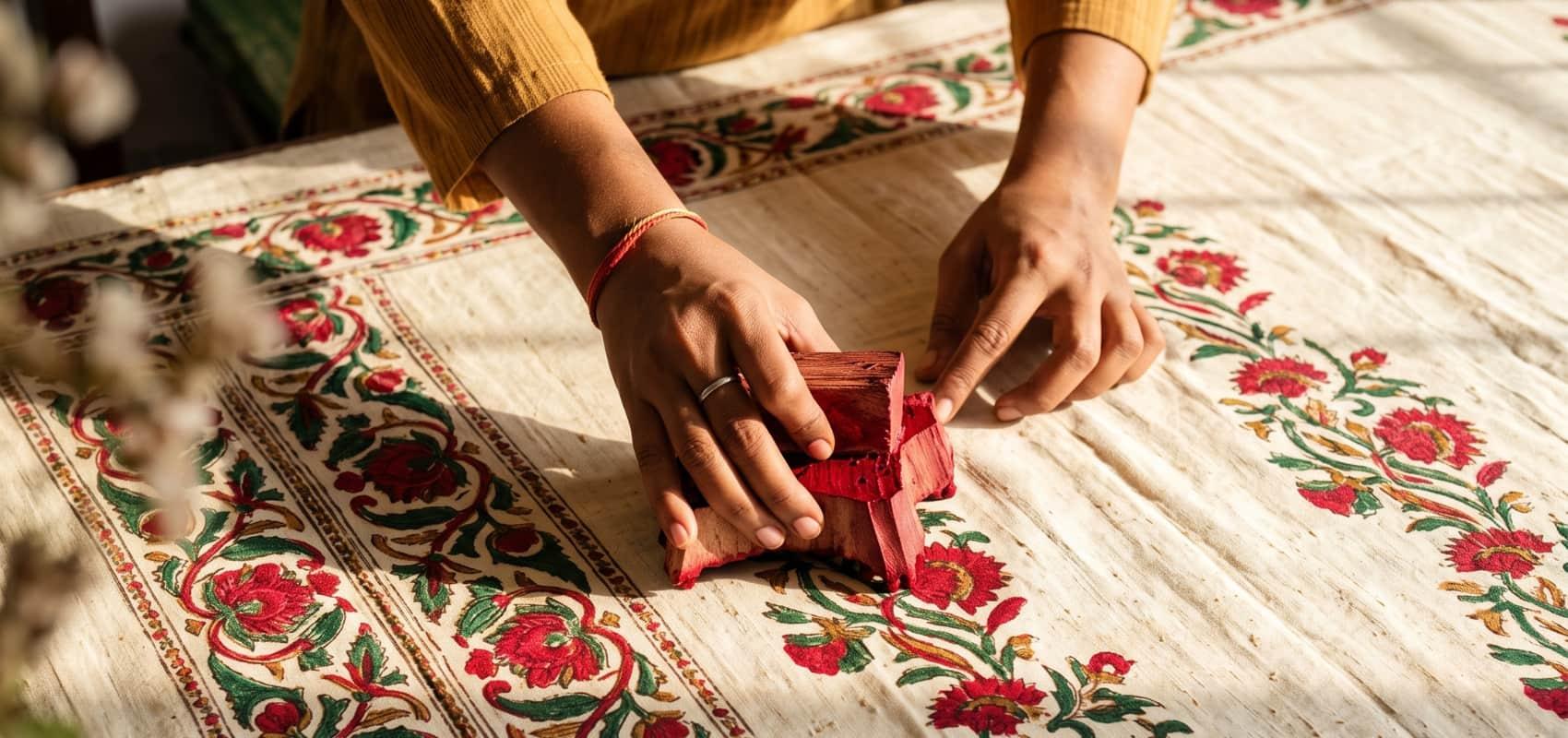
Meet the Khatri family at Ajrakhpur for a 16-stage natural-dye block-printing process that runs two to three weeks per length of cloth.
See Rogan art at Nirona with the family of Padma Shri awardee Abdul Gafur Khatri, whose work was presented by the Indian Prime Minister to the US President in 2014.
Meet the Salvi family in Patan, the only Patola workshop still using entirely natural dyes, and understand the real order process for a sari that takes six months to weave.
Visit a working zari unit in Surat's old city, the Mughal-era "Zari City" and still a GI-tagged, living craft today.
Hear the Tanchoi story: a brocade weave invented in Surat in 1856, now made in Banaras, told as part of Surat's own textile history, not glossed over.
Travel privately throughout, with a guide who can broker introductions a solo visitor would not get at the workshop door.
Essence of Journey
The experiences that capture the true spirit of the entire trip.
| Day | Route | Distance | Major Highlights |
|---|---|---|---|
| Day 1 | Arrive Ahmedabad | ~20 km | Calico Museum of Textiles, by appointment |
| Day 2 | Ahmedabad to Bhuj | ~340 km, 6 to 6.5 hrs | Aina Mahal |
| Day 3 | Bhuj craft villages | ~100 km local | Bhujodi, Ajrakhpur, Nirona |
| Day 4 | Bhuj to Patan | ~295 km, 5.75 to 6 hrs | Rani ki Vav, time allowing |
| Day 5 | Patan | ~10 km local | Salvi family, Patan Patola Heritage Museumy |
| Day 6 | Patan to Surat | ~385 km, 6.5 to 7 hrs | Long transfer day |
| Day 7 | Surat | ~25 km local | Zari unit visit, old-city markets |
| Day 8 | Surat to Ahmedabad | about 1,335 km~267 km, 4 to 4.5 hrs | Departure |
| Total road distance | about 1,335 km | Approximate and rounded, including local drives |
About
This is an 8-day private Gujarat textile tour for collectors, designers and serious craft lovers. You visit the Calico Museum in Ahmedabad, spend time with Ajrakh printers, Bhujodi weavers and Rogan artists in Kutch, meet a Patola double-ikat weaving family in Patan, and see Surat's zari thread-makers at work. A specialist textile guide travels with you throughout. Prices start at about INR 83,000 per person (twin sharing).
Gujarat has more living textile traditions packed into one state than almost anywhere in the world. Tie-dye, block printing, extra-weft weaving, double ikat, metallic-thread work. Many of these crafts are still made by the same families who have practised them for hundreds of years.
The problem for most visitors is access. Turn up at a village workshop on your own and you might see a few finished pieces for sale. Arrive with a guide the family knows, and you're invited in to watch the dyeing, ask questions at the loom, and understand why one length of cloth takes three weeks to make.
That's what this trip is built around. Not generic "artisan visits", but named families and real workshops: the Vankar weavers of Bhujodi, the Khatri block printers of Ajrakhpur, the Khatri Rogan painters of Nirona and the Salvi Patola weavers of Patan. We're also honest about what you can buy on the spot and what has to be ordered, sometimes years in advance.
Who Is This Textile Tour For?
You'll get the most from this trip if you:
Collect Indian textiles, or want to start collecting with real knowledge
Work in fashion, interiors, textile design or a museum, and want to see techniques at the source
Care about buying directly from makers, so your money reaches the artisan
Prefer slow, meaningful visits over ticking off sights
It's probably not the right fit if you're looking for a general Gujarat sightseeing holiday, or if long road days are hard for you. Three days include 6–7 hours of driving, because Kutch, Patan and Surat sit at opposite corners of the state.
ACCOMMODATION CATEGORIES
Tier labels follow the standard of the room and the property, not a star count. Where a property is named, it is a real hotel we plan to use. The ground team confirms every property before each departure.
| Destination | Nights | Premium | Luxury | Ultra-Luxury |
|---|---|---|---|---|
|
Ahmedabad |
1 |
Novotel Ahmedabad |
Hyatt Regency Ahmedabad |
House of MG, heritage hotel |
|
Bhuj |
2 |
Best available hotel, confirmed before departure (standard room) |
Best available hotel, confirmed before departure (superior room) |
Best available hotel, confirmed before departure (suite or heritage stay) |
|
Patan |
2 |
Best available hotel, confirmed before departure (standard room) |
Best available hotel, confirmed before departure (superior room) |
Best available hotel, confirmed before departure (suite) |
|
Surat |
2 |
Best available hotel, confirmed before departure (standard room) |
Best available hotel, confirmed before departure (superior room) |
Best available hotel, confirmed before departure (suite) |
Gujarat Textile & Design Trail Accommodation Categories
What Makes This Trip Special
The Calico Museum of Textiles. Widely regarded as the finest collection of historic Indian textiles anywhere, with handmade pieces up to 500 years old. It's by appointment only and hard to get into, so we book your session for you.
Ajrakh at Ajrakhpur. The Khatri family's ancestors brought this block-printing craft from Sindh in the 1500s. You'll see stages of a 16-step natural-dye process using natural ingredients such as myrobalan, tamarind seed, alum, turmeric, iron and jaggery.
Bhujodi weaving. The Vankar community works a 500-year-old extra-weft technique that gives plain cloth a raised, almost embroidered texture, in wool, cotton and silk.
Rogan art at Nirona. A roughly 400-year-old Persian-origin painting technique using castor-oil paint pulled into fine threads. It's kept alive by the family of Padma Shri awardee Abdul Gafur Khatri. No two pieces are ever the same.
Patan Patola. A royal silk double ikat, where both warp and weft are tie-dyed before weaving so the pattern matches perfectly on both sides. Only a handful of places on earth make true double ikat. The Salvi family is the one most often cited as still using entirely natural dyes.
Surat zari. Gold and silver metallic thread, made in Surat since Mughal times and GI-tagged since 2010. Watch thread being drawn, plated and wound in a working unit in the old city.
Heritage along the way. Bhuj's 18th-century Aina Mahal (Hall of Mirrors) and Patan's Rani ki Vav, a UNESCO World Heritage stepwell carved over seven levels.
Gujarat's Textile Crafts at a Glance
A quick guide to the crafts you'll see, and what you can realistically take home.
| Craft | Where | What it is | Can you buy on the trip? |
|---|---|---|---|
|
Ajrakh |
Ajrakhpur, Kutch |
Natural-dye block printing, often deep indigo and red |
Yes, directly from the workshop |
|
Bhujodi weaving |
Bhujodi, Kutch |
Extra-weft handloom shawls and textiles |
Yes, directly from weavers |
|
Rogan art |
Nirona, Kutch |
Hand-painted cloth using thickened castor-oil paint |
Yes, from the family studio |
|
Bandhani |
Across Kutch |
Fine tie-dye with tiny resist dots |
Yes, in Bhuj's markets |
|
Patola |
Patan |
Double ikat silk; identical on both sides |
Order only. Wait of about 2 years |
|
Zari |
Surat |
Gold and silver metallic thread and trims |
Yes, trims and borders where the unit allows |
Gujarat's Textile Crafts at a Glance
Buying Textiles: What to Expect
Collectors often ask us this first, so here's the straight answer.
Most crafts can go home with you. Ajrakh, Bhujodi weaves, Rogan paintings, Bandhani and zari trims are all available to buy directly from makers.
A Patola sari cannot. The Salvi family makes each one to order. A single sari takes around six months to weave, prices run from about INR 1 lakh to 10 lakh (roughly INR 100,000–1,000,000), and the usual waiting list is about two years. We explain the process and can help you place an order before you leave.
Purchases are separate from the tour price. You pay the artisan or family directly. That's the point: your money goes straight to the maker.
Bring cash. Smaller family workshops often can't take cards. Cash or a direct bank transfer is usually easiest.
Shipping is possible. For larger textiles or framed Rogan pieces, your guide can help arrange courier shipping from the workshop (charged separately).
3-TIER PRICING SUMMARY
| Tier | Per couple | Per person | Standard |
|---|---|---|---|
|
Premium |
Rs.165,438 to Rs.178,673 |
Rs.82,719 to Rs.89,336 |
Standard rooms and best-available hotels |
|
Luxury |
Rs.237,762 to Rs.256,783 |
Rs.118,881 to Rs.128,391 |
Superior rooms and named properties in Ahmedabad |
|
Ultra-Luxury |
Rs.351,918 to Rs.380,071 |
Rs.175,959 to Rs.190,035 |
Suites and heritage stays where available |
Gujarat Textile & Design Trail 3-Tier Pricing Summary
The upper figure allows for date and season variance of about 8%. A Patola order, if placed, is paid directly to the Salvi family and is not part of this tour cost. Prices are indicative and confirmed on request.
WHY BOOK THIS WITH BIZAREXPEDITION
An 8-day Gujarat design and craft tour collectors use to go straight to the source, planned and run by BizareXpedition from start to finish.
Named families, not generic craft stops. The Vankars, the Khatris of Ajrakhpur and Nirona, and the Salvis of Patan are specific families this itinerary is built around, not a placeholder "local artisan visit."
Honest about what you can buy, and when. Ajrakh, Rogan and Bhujodi weaves can go home with you. A Patola sari cannot: we explain the roughly two-year order process plainly on Day 5, rather than implying you will walk out with one.
Different from our Kutch craft trip. BizareXpedition also runs a shorter Kutch handicraft immersion focused on Bhuj's villages alone. This trip adds Patan's Patola and Surat's zari trade for a full state-wide collector's circuit, not a single-region stop.
A route kept as given. The sheet's Ahmedabad-Bhuj-Patan-Surat order needed no correction: each leg is a confirmed single day on the road, and the loop closes efficiently toward Ahmedabad for your departure.
A registered company, not a middleman. BizareXpedition Services Pvt. Ltd. (CIN U63090UR2016PTC007433), headquartered in Haridwar, plans and runs the trip itself.
BEST TIME FOR A GUJARAT TEXTILE TOUR
| Season | Months | What to expect |
|---|---|---|
|
Peak |
Late October to March |
Cool, dry weather for travel and for workshop visits; the most comfortable season for the three long driving days. |
|
Shoulder |
April to early June |
Hot by midday in Kutch, Patan and Surat; workshop visits are best scheduled for morning. |
|
Monsoon |
Mid-June to September |
Heavy rain across Gujarat can affect road travel times, especially the Patan-Surat leg. Workshops stay open; travel days need more buffer. |
|
Festival note |
Varies by year |
Rann Utsav season (roughly Nov-Feb) brings more visitors to Kutch generally, though this trip does not route through the Rann itself. |
Gujarat Textile & Design Trail Season Adjustments
PRACTICAL NOTES
Calico Museum booking. By email appointment only, no walk-ins, maximum group size per session, no photography inside. We book this as part of planning your trip; exact session depends on your arrival flight.
Patola is an order, not a purchase. A finished Patan Patola sari is not available off the shelf. The Salvi family sells directly, by website or WhatsApp, prices from about Rs.1 lakh to Rs.10 lakh, with a wait of about two years. We help place the order; delivery happens after you are home.
What you can actually buy on the trip. Ajrakh textiles at Ajrakhpur, woollen weaves at Bhujodi, Rogan paintings at Nirona, and zari trim or embroidered fabric in Surat can all go home with you.
Shipping larger pieces. For bulkier textiles or framed Rogan work, ask your guide about courier shipping from the workshop; this is arranged case by case and is not included in the tour cost.
Three long driving days. Days 2, 4 and 6 run six to seven hours by road. This is the trade-off for a genuine state-wide textile circuit rather than a single-region stop.
Departure routing. Day 8 defaults to a road transfer to Ahmedabad for the widest range of international connections. Surat's own airport runs a limited, seasonal international schedule, including a Sharjah service reported to resume in November 2026; ask us if that suits your routing.
Photography at workshops. Ask before photographing artisans at work, and expect some restrictions, particularly at the Calico Museum, where photography is not allowed at all.
Alcohol. Gujarat is a dry state. Foreign visitors can get a free temporary tourist liquor permit, usually within about a day.
Cash and payment. Workshop purchases are often easiest in cash or by direct bank transfer; card facilities are not guaranteed at smaller family workshops.
Connectivity. Mobile data is reliable in Ahmedabad, Bhuj, Patan and Surat, and weaker in the craft villages themselves.
Booking Summary
Dept. City :
--
Dept. Date :
--
Traveller :
Adults: 2, Child: 0, Infant: 0
Rooms :
--
Basic Price :
--
Total Cost
--
GST
--
Grand Total
--
Itinerary (Day Wise)
Gujarat may have more living textile traditions than anywhere else in the world, and many are still made by the same families who have practised them for centuries. This 8-day private trip takes you straight to them, with a specialist textile guide the families already know. You start at Ahmedabad’s Calico Museum, one of the finest collections of historic Indian textiles, by booked appointment. In Kutch you watch the Khatri family work through the many stages of natural-dye Ajrakh printing, sit with Vankar weavers at their looms in Bhujodi, and see the rare Rogan painting kept alive by a Padma Shri family in Nirona. In Patan you meet the Salvi family, who weave Patola double-ikat silk, and visit the Rani ki Vav stepwell. The trip ends in Surat among the old city’s gold and silver zari makers. Along the way you’ll learn what you can buy straight from the makers and what has to be ordered and waited for.
Day 1
ARRIVE AHMEDABAD | THE CALICO MUSEUM OF TEXTILES
Route: Arrive Ahmedabad airport, transfer to hotel, about 20 km
Your guide meets you at Sardar Vallabhbhai Patel International Airport for the transfer to your hotel.
Subject to your flight timing, this afternoon is set aside for the Calico Museum of Textiles, widely considered the finest collection of historic Indian textiles anywhere, with handmade pieces up to 500 years old, including Kashmiri shawls that took three years to weave. Visits are by appointment only, booked by email well ahead of your trip, with a maximum group size; we confirm your session as part of planning this tour, and if the timing does not allow a Day 1 visit, we move it to a later Ahmedabad stop instead.
Note: The Calico Museum does not take walk-ins, and photography inside is not permitted. This is a look-and-learn stop, not a buying one; nothing here is for sale.
Experience of the Day
Airport pickup and check-in
Calico Museum of Textiles, by confirmed appointment
Food
Recommended: Dinner at the hotel.
Must-Try: Gujarati thali: dal, kadhi, farsan and sweets.
Activities to Do
Calico Museum of Textiles
Settle in
Day 2
AHMEDABAD TO BHUJ | INTO KUTCH
Route: Ahmedabad to Bhuj, about 340 km, 6 to 6.5 hours by road
The road runs north-west into Kutch, a region whose isolation between the Gulf of Kutch and the Rann shaped a textile tradition distinct from the rest of Gujarat: Bandhani tie-dye, Ajrakh block printing and Bhujodi's extra-weft wool weaving all developed here, largely independent of the court workshops that shaped Patan's silk tradition.
You reach Bhuj by mid-afternoon, with time to see the Aina Mahal, commissioned around 1750 by Rao Lakhpatji and designed by Ram Singh Malam, a Kutchi craftsman who spent 18 years training in Europe, before the two full craft-village days ahead.
Experience of the Day
Drive to Bhuj
Aina Mahal, Bhuj's Hall of Mirrors
Food
Recommended: A Kutchi thali at a family-run restaurant in Bhuj.
Must-Try: Kutchi dabeli, the sweet-spicy potato roll with peanuts and pomegranate.
Activities to Do
Drive to Bhuj
Aina Mahal
Day 3
BHUJ CRAFT VILLAGES | BHUJODI, AJRAKHPUR AND NIRONA
Route: Bhuj, Bhujodi, Ajrakhpur, Nirona circuit, about 100 km local
Bhujodi, 8 km from Bhuj, is a 500-year-old weaving centre run by the Vankar community, believed to descend from Marwada weavers of Rajasthan's Meghwal community who settled in Kutch generations ago and originally wove for the Rabari herding community in exchange for wool. Watch the extra-weft technique that raises a bold, almost embroidered texture on plain cloth, in wool, cotton and silk, dyed with indigo, alizarin and iron rust among other natural colours.
At Ajrakhpur, meet the Khatri family, who trace the Ajrakh block-printing craft back to ancestors who brought it from Sindh in the sixteenth century. The family relocated here from Dhamadka after the 2001 Bhuj earthquake. A full length of Ajrakh cloth goes through a sixteen-stage natural-dye process over two to three weeks, using myrobalan, tamarind seed, alum, turmeric, lime, iron and jaggery; your visit catches one or two stages of a cycle that is almost never finished in a single day.
Nirona closes the day with Rogan art, a roughly 400-year-old Persian-origin fabric-painting technique now kept alive by a handful of families, most prominently that of Padma Shri awardee Abdul Gafur Khatri, whose Tree of Life design was presented by the Indian Prime Minister to the US President in 2014. Castor-oil paint is pulled into fine threads by hand and pressed onto cloth; no two finished pieces are identical.
Note: These are working family workshops, not performances staged for visitors. Buying from the artisan you watch is welcomed and is the most direct way your money reaches the maker.
The Human Story
Patola, Bandhani and Ajrakh each took centuries to reach the form you see today, carried by families who taught the next generation inside the same rooms you are standing in.
Experience of the Day
Bhujodi: Vankar extra-weft wool weaving
Ajrakhpur: Khatri family Ajrakh block printing, natural-dye demonstration
Nirona: Rogan art with the Khatri family
Food
Recommended: Lunch at a Bhujodi weaver's home, arranged in advance.
Must-Try: Kutchi khichdi with ghee and buttermilk.
Shopping
Direct purchase at each workshop: woollen shawls at Bhujodi, Ajrakh textiles at Ajrakhpur, Rogan paintings at Nirona.
Activities to Do
Bhujodi weaving
Ajrakhpur block printing
Nirona Rogan art
Day 4
BHUJ TO PATAN | FROM KUTCH TO THE PATOLA LOOMS
Route: Bhuj to Patan, about 295 km, 5.75 to 6 hours by road
The road leaves Kutch and crosses into north Gujarat, a landscape of a different textile order entirely: Patan's Patola is a royal silk tradition, double ikat, where both warp and weft threads are tie-dyed before weaving so the pattern is identical on both faces of the cloth, a technique practised in perhaps three or four places on earth.
You reach Patan in the evening, with the Rani ki Vav stepwell, a UNESCO World Heritage Site since 2014, worth a sunset visit if your arrival time allows; its seven subterranean levels of carved sandstone are unrelated to textiles but are a short walk from where you are staying.
Experience of the Day
Drive to Patan
Rani ki Vav at sunset, time allowing
Food
Recommended: Dinner at the hotel.
Must-Try: North Gujarati thali with gathiya and khaman.
Activities to Do
Drive to Patan
Rani ki Vav
Day 5
PATAN | THE SALVI FAMILY AND THE DOUBLE IKAT
Route: Patan local, about 10 km
Patan Patola is made today by a handful of families; the Salvi family is the one most cited as still using entirely natural dyes, a claim no other Patola workshop in India currently makes. Ten family members run the business, including Rahul and Rohit Salvi, among the few weavers alive who can execute the full double-ikat process. Tying the pattern into the threads alone takes three to four months for a six-yard sari; the whole piece, from design to finished cloth, takes around six months and eight weavers working five days a week.
The family runs the Patan Patola Heritage Museum, opened in 2014, with live demonstrations of the tying and weaving process. Be realistic about buying here: the family sells directly, by website or WhatsApp rather than through a shop, prices run from about Rs.1 lakh to Rs.10 lakh depending on complexity, and the ordinary wait for a finished sari is about two years. This is a trip to see the craft and place an order, not to walk out with a saree in hand; we explain the order process and can help place one before you leave.
Note: If immediate, in-hand purchases matter to you, Bhuj and Ajrakhpur on Day 3 are where that happens; a Patola order is a different kind of commitment, explained plainly here rather than oversold.
Experience of the Day
Patan Patola Heritage Museum: live double-ikat demonstration
Meeting the Salvi family workshop
Understanding the order and waiting-list process
Food
Recommended: Lunch near the Patola house.
Must-Try: Patan's own dal wada and sev.
Shopping
Patola orders placed directly with the Salvi family; expect a wait of about two years for delivery.
Activities to Do
Patola workshop visit
Heritage museum
Optional Nearby Excursions
A second look at Rani ki Vav by daylight
Day 6
PATAN TO SURAT | NORTH GUJARAT TO THE ZARI CITY
Route: Patan to Surat, about 385 km, 6.5 to 7 hours by road
This is the trip's longest single drive, running back down the same north-south corridor that passes near Ahmedabad before continuing south to Surat. It is a full day in the car by design: Patola and Zari are a full state apart, and there is no shorter way to connect them by road.
Surat is a different kind of textile city from anything earlier in this trip: not a craft village but India's largest centre for man-made fibre weaving and diamond processing, and historically Mughal India's main west-coast trading port.
Experience of the Day
Long transfer day, Patan to Surat
Food
Recommended: Dinner at the hotel.
Must-Try: Surati locho and ponk, if in season.
Activities to Do
Drive to Surat
Day 7
SURAT | ZARI, AND THE MARKETS
Route: Surat local, about 25 km
Surat earned the name "Zari City" under Mughal rule for its gold and silver metallic-thread work, still a living, GI-tagged craft today (tagged in 2010), concentrated in old-city suburbs including Mahidharpura and Saiyedpura. Visit a working zari unit to see thread drawn, electroplated and wound before it is woven into sari borders and embellishment; Surat's roughly 500 registered units and several thousand household operations make this the craft's largest surviving centre in India.
In the afternoon, Sahara Darwaja and the old city's wholesale cloth markets are worth a walk for anyone who wants to see Gujarat's textile trade at full commercial scale, mostly embroidery and machine-made fabric rather than handloom. One story worth knowing before you go: Tanchoi, the brocade weave now associated with Banaras, was actually developed here. Parsi merchant Jamsetjee Jejeebhoy sent three weavers from Surat's Joshi family to China around 1856 to learn the technique from a teacher named Chhoi; "tan," from the Gujarati for three, plus his name gave the weave its own. Production in Surat itself declined by the early twentieth century and shifted to Banaras, where it is made today; we mention it plainly as a lost thread in Surat's own textile story, not something you can still watch woven here.
Experience of the Day
Working zari unit visit, Mahidharpura or Saiyedpura
Sahara Darwaja and the old city wholesale cloth markets
The Tanchoi story: a Surat invention now made in Banaras
Food
Recommended: Dinner at a Surati restaurant.
Must-Try: Surati undhiyu, the winter vegetable mix, if in season.
Shopping
Sahara Darwaja for embroidery and fabric by length; zari trim and borders direct from a unit, where the owner allows it.
Activities to Do
Zari unit visit
Textile market walk
Day 8
SURAT TO AHMEDABAD | DEPARTURE
Route: Surat to Ahmedabad, about 267 km, 4 to 4.5 hours by road
The drive north returns you to Ahmedabad for international connections, the most reliable routing for most overseas itineraries. Surat's own airport runs a limited, seasonal set of international routes, including a Sharjah service reported to resume in November 2026; if your onward journey connects through the Gulf, ask us whether flying out of Surat directly works for your dates instead of the road transfer.
You leave with four workshop families met in person, a two-year Patola order in motion if you chose to place one, and a textile and design story that runs from Bhujodi's looms to a name woven into Surat's own forgotten chapter of a weave the world now calls Banarasi.
Experience of the Day
Road transfer to Ahmedabad
Onward or international departure
Food
Recommended: Breakfast at the hotel.
Must-Try: Lunch on the road.
Activities to Do
Drive to Ahmedabad
Departure
Optional Nearby Excursions
Fly out via Surat's seasonal Sharjah service, for Gulf-routed connections
Tour Information
Your complete guide to a hassle-free and enjoyable trip.
Inclusion
Exclusion
Payment Terms
Important factors to consider before your trip!
Cancellation
Need To Know
Be Responsible Traveller
- Minimize Plastic Use : Bring a reusable water bottle, shopping bag, and utensils to reduce the need for single-use plastics. Many destinations have water refill stations and eco-friendly stores.
- Support Local and Sustainable Businesses : Eat at local restaurants, buy souvenirs from local artisans, and choose tour operators that prioritize sustainable practices and support the local community.
- Respect Wildlife and Natural Habitats : Avoid disturbing wildlife or their natural habitats. Stick to designated paths and observe animals from a distance without feeding or touching them.
- Dispose of Waste Properly : Follow local guidelines for recycling and waste disposal. If facilities aren't available, carry your waste with you until you can dispose of it responsibly.
- Educate Yourself and Others : Learn about the local environment, culture, and customs. Respect local practices and traditions, and share your knowledge about responsible travel with others.
- Choose Sustainable Activities : Engage in eco-friendly activities such as hiking, snorkeling, or visiting national parks. Avoid activities that exploit animals or damage the environment.
- Leave No Trace : Follow the principle of "Leave No Trace," which means leaving natural areas as you found them. Pack out all trash, avoid picking plants, and refrain from carving or writing on rocks or trees.
- Plant Trees Whenever Possible : Participate in local tree-planting initiatives or plant trees in your own community. Trees absorb carbon dioxide, provide oxygen, and help support biodiversity, making them vital for a healthy environment.
Connect
Share Itinerary
Email Itinerary
Frequently Asked Questions (FAQs) & People Also Ask — Gujarat Textile & Design Trail for Collectors
We help you prepare for your trip and ensure an effortless and enjoyable travel experience.
Is this a genuine gujarat textile trail for collectors, or a general sightseeing trip with a few craft stops?
It is built specifically for collectors and designers: named weaver families, an honest account of what can be bought on the spot versus ordered, and a route chosen to connect Patan, Kutch and Surat's living textile traditions rather than general sightseeing.
What does a patola bandhani ajrakh tour actually include?
Patan's double-ikat Patola with the Salvi family, Ajrakh block printing with the Khatri family at Ajrakhpur, and Bhujodi's extra-weft wool weaving with the Vankar community, plus Rogan art at Nirona and zari craft in Surat.
Can I buy a Patola sari and take it with me?
No. The Salvi family's Patola saris are made to order, with a wait of about two years, and are sold directly by the family rather than through a shop. You can place an order and watch the process; delivery comes later.
What can I actually buy during the trip?
Ajrakh textiles, Bhujodi weaves, Rogan paintings, and zari trim or embroidered fabric in Surat. All of these are paid directly to the artisan or family, not included in the tour cost.
Is this different from your Kutch handicraft tour?
Yes. BizareXpedition's Kutch handicraft trip covers Bhuj's villages alone. This is a wider, collector-focused circuit that adds Patan's Patola tradition and Surat's zari trade to the same Bandhani and Ajrakh villages.
Why are there three long driving days?
Patan, Kutch and Surat sit far apart across Gujarat, and each leg, 340 km, 295 km and 385 km, is a genuine single-day drive with no shorter route available. It is the trade-off for a true state-wide textile circuit.
Is the Calico Museum open to anyone who shows up?
No. It takes appointments only, booked by email ahead of time, with a capped group size and no photography inside. We book your session as part of planning the trip.
What is Surat zari, and can I see it made?
A Mughal-era gold and silver metallic-thread craft, GI-tagged since 2010 and still practised by about 500 registered units and several thousand household operations in Surat's old city. We visit a working unit on Day 7.
I've heard Tanchoi silk is from Banaras. Is that covered here?
Tanchoi was actually developed in Surat in 1856 by three Joshi-family weavers sent to China to learn the technique, and production shifted to Banaras by the early twentieth century. It is not a living craft in Surat today; we say so plainly rather than imply you can watch it woven here.
How do I get home from Surat?
The default is a road transfer back to Ahmedabad on Day 8 for the widest international connections. Surat's own airport has a limited, seasonal international schedule, including a Sharjah route; ask us if that fits your routing.
How much does the tour cost?
This 8-day tour costs about Rs.165,438 to Rs.178,673 per couple at the Premium tier, or Rs.82,719 to Rs.89,336 per person, not including any textile or Patola purchase. Luxury is Rs.237,762 to Rs.256,783 per couple and Ultra-Luxury Rs.351,918 to Rs.380,071. Figures are indicative.
BizareXpeditionTMReviews
Let's go, pack up, and hit the road!
Similar Tour Packages
Explore other exciting options for your next adventure!
Trusted Paths, Bold Journeys — Inside BizareXpedition
From humble beginnings to a trusted name in the industry, BizareXpedition's story is one of purpose-driven growth, community connection, and a relentless pursuit of excellence that speaks for itself.














Gujarat Textile & Design Trail for Collectors
best deal price
Without GST
₹82,719
per person on twin sharing
Book Now