
Heritage Luxury Hotel Rajasthan Tour9N/10D
Heritage Luxury Hotel Rajasthan Tour
Start & City : Delhi
best deal price
₹
Without GST ₹2,37,300
per person on twin sharing
Choose your departure city, dates, and add guests to secure your tour.
Hurry, as seats fill up, prices rise! Book now!
1. Choose your departure date
Highlights
Watch the Taj Mahal turn from grey to pink to ivory in the first twenty minutes of sunrise light, then leave Agra with the whole Agra–Jaipur road ahead of you.
Walk through Fatehpur Sikri, the red sandstone capital Akbar founded in 1571 and left about fourteen years later, with the 54-metre Buland Darwaza gateway still standing.
Look down into Chand Baori at Abhaneri, a stepwell of 3,500 steps in 13 tiers, built around 800–900 CE beside the Harshat Mata temple.
Spend two nights in a Jaipur heritage hotel — Alsisar Haveli (1892), Jai Mahal Palace (1745) or Rambagh Palace, by tier — with Amber Fort in the morning and the City Palace in the afternoon.
Watch the sun go down over Pushkar’s holy lake from the lakeside terrace of Pushkar Palace, or from the rooftop pool at Gulaab Niwaas Palace.
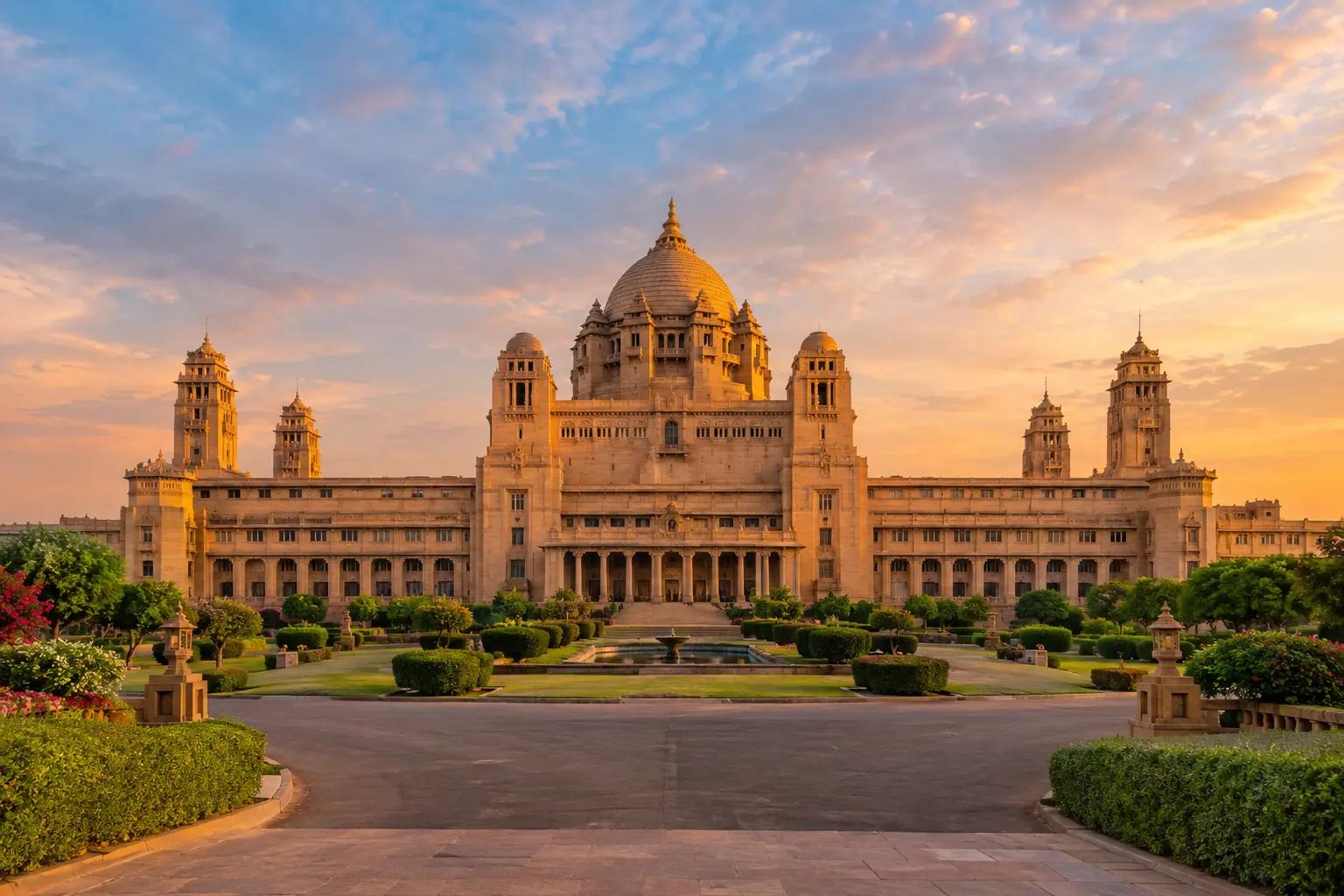
Walk the museum wing of Umaid Bhawan Palace in Jodhpur, begun in 1929 to give famine-hit workers a wage and split three ways today: hotel, museum and royal family home.
Stop at Ranakpur, where 1,444 marble pillars hold up a Jain temple begun in 1389 and no two pillars carry the same pattern.
Cross Lake Pichola by boat, past the City Palace and the Taj Lake Palace, a royal island retreat built in 1743–46.
Essence of Journey
The experiences that capture the true spirit of the entire trip.
| Day | Route | Distance | Major Highlights |
|---|---|---|---|
| Day 1 | Arrive Delhi | — | Airport pickup, check-in, evening briefing |
| Day 2 | Delhi → Agra | ~230 km / ~4 hrs | Agra Fort, Mehtab Bagh at sunset |
| Day 3 | Agra → Fatehpur Sikri → Abhaneri → Jaipur | ~250 km / 5–6 hrs plus stops | Taj Mahal at sunrise, Fatehpur Sikri, Chand Baori |
| Day 4 | Jaipur | Local | Amber Fort, City Palace, Jantar Mantar, Hawa Mahal |
| Day 5 | Jaipur → Pushkar | ~140 km / 2.5–3 hrs | Free morning, Pushkar lake ghats and Brahma Temple, sunset |
| Day 6 | Pushkar → Jodhpur | ~190 km / 4–5 hrs | Mandore Gardens on the way, afternoon at the hotel |
| Day 7 | Jodhpur | Local | Mehrangarh Fort, Jaswant Thada, Umaid Bhawan museum, Blue City |
| Day 8 | Jodhpur → Ranakpur → Udaipur | ~155 km + ~94 km / 5–6 hrs plus stop | Ranakpur Jain temple, arrive Udaipur |
| Day 9 | Udaipur | Local | City Palace, Jagdish Temple, Lake Pichola boat ride |
| Day 10 | Depart Udaipur | — | Transfer to Udaipur airport or railway station |
About
This heritage hotel Rajasthan tour is a private 10-day trip from Delhi to Udaipur, with the Taj Mahal on the way. You sleep in real palaces, havelis and royal guesthouses in Jaipur, Pushkar, Jodhpur and Udaipur, and every hotel is named before you book. There are three hotel tiers, a private car and driver throughout, and English-speaking guides at every stop. Prices start from about Rs.118,600 per person (twin sharing, Premium tier).
In Rajasthan you can do both. Many of the old royal homes, noble mansions and maharaja guesthouses are now hotels, and some are still partly lived in by the families who built them. You have breakfast in a courtyard that was designed for a prince. You swim in a pool under carved sandstone. You come back from a busy day of forts and bazaars to somewhere that feels like part of the trip, not a break from it.
We built this tour around that idea. The sightseeing is excellent: the Taj Mahal at sunrise, Amber Fort, Mehrangarh, the marble temple at Ranakpur and the lakes of Udaipur. But the hotels are the reason the trip feels different, so we give you enough time to enjoy them.
What Is a Heritage Hotel in Rajasthan?
A heritage hotel in Rajasthan is a former palace, fort, haveli (a noble family’s mansion) or royal guesthouse that now takes paying guests. The building keeps its old architecture, art and character, while rooms have modern comforts such as air conditioning, private bathrooms and Wi-Fi.
Examples on this tour include Alsisar Haveli in Jaipur, built in 1892 as a noble family’s city home; Jai Mahal Palace, dating to 1745 and once the residence of the Prime Minister of Jaipur; and Ajit Bhawan in Jodhpur, built in 1927. At the top end, Umaid Bhawan Palace is still partly the home of Jodhpur’s royal family.
One honest note: because these are old buildings, no two rooms are quite the same. Some have stairs and no lift, and room sizes vary. That is part of the charm, but tell us early if anyone needs a ground-floor room.
Who This Rajasthan Luxury Tour Is For
First-time visitors to India who want the Taj Mahal and the best of Rajasthan in one smooth, private trip.
Couples and honeymooners looking for a romantic stay in a palace in India, with lake views and rooftop dinners.
Families who want a private car, a guide at every stop and hotels with space and pools.
Travellers who hate rushing. Three cities get two nights each, so you are not packing a suitcase every morning.
Lovers of history and architecture who would rather sleep inside the story than look at it from a coach window.
ACCOMMODATION CATEGORIES
Tier names only, no star ratings. Agra’s top hotel is a Mughal-style building, not a historic palace, and Pushkar has fewer heritage hotels than Jaipur or Udaipur. Where a cell names a category instead of a hotel, the ground team confirms the property at booking.
| Destination | Premium | Luxury | Ultra-Luxury |
|---|---|---|---|
|
Delhi (1N) |
Premium business hotel in central Delhi |
The Claridges, New Delhi |
The Imperial (opened 1936, Art Deco) |
|
Agra (1N) |
Hotel with a Taj Mahal view |
Luxury hotel with a Taj Mahal view |
The Oberoi Amarvilas (Mughal-style, 600 m from the Taj) |
|
Jaipur (2N) |
Alsisar Haveli (built 1892) |
Taj Jai Mahal Palace (1745) |
Rambagh Palace |
|
Pushkar (1N) |
Pushkar Palace (lakeside) |
Gulaab Niwaas Palace |
Top suite at Gulaab Niwaas Palace (best available in Pushkar) |
|
Jodhpur (2N) |
Pal Haveli |
Ajit Bhawan (1927) |
Umaid Bhawan Palace |
|
Udaipur (2N) |
Jagat Niwas Palace (lakeside haveli hotel) |
Taj Fateh Prakash Palace |
Taj Lake Palace |
Heritage Luxury Hotel Rajasthan Accommodation Categories
Why This Palace Stay Tour Is Different
Every hotel is named, at every tier
Many luxury tours promise a “heritage hotel or similar” and leave you guessing. We list the real property in each city for each tier, so you know exactly where you are staying before you pay.
We tell you where there is no palace
Agra has no historic palace hotel, so we don’t pretend it does. Your stay there is chosen for its Taj Mahal view, and at the top tier it is The Oberoi Amarvilas, built in Mughal palace style about 600 metres from the Taj. Pushkar has fewer heritage hotels than Jaipur or Udaipur, so we use its two best: Pushkar Palace on the lake, and Gulaab Niwaas Palace on a sand dune above the town.
No wasted driving days
The route runs one way, from Delhi to Udaipur. Every long drive is broken by something worth seeing: Fatehpur Sikri and the Chand Baori stepwell between Agra and Jaipur, Mandore Gardens before Jodhpur, and the Ranakpur temple between Jodhpur and Udaipur.
Time to actually enjoy the hotels
A palace is wasted if you only sleep in it. You get a free morning in Jaipur and an afternoon at your hotel in Jodhpur, plus two nights each in Jaipur, Jodhpur and Udaipur.
A guide by your side at the sensitive places
At Pushkar’s holy lake, strangers sometimes hand visitors flowers and lead them into a paid ritual. Your guide walks the ghats with you, so you can say no with confidence, or arrange a real blessing with the price agreed first.
Rajasthan Heritage Hotel Tour Price
| Tier | Hotel Category | Package Price | Per Person |
|---|---|---|---|
|
Premium |
Restored havelis and ancestral palaces; Taj-view hotel in Agra |
Rs.237,300 – Rs.256,200 |
Rs.118,600 – Rs.128,100 |
|
Luxury |
Palace hotels: Jai Mahal, Gulaab Niwaas, Ajit Bhawan, Fateh Prakash |
Rs.390,300 – Rs.421,600 |
Rs.195,200 – Rs.210,800 |
|
Ultra-Luxury |
Suites at The Imperial, Amarvilas, Rambagh, Umaid Bhawan, Taj Lake Palace |
Rs.890,600 – Rs.961,800 |
Rs.445,300 – Rs.480,900 |
Heritage Luxury Hotel Rajasthan 3-Tier Pricing Summary
Rates are indicative and modelled on BizareXpedition’s current Rajasthan package pricing reference, not a live quote. The final price varies within the range with exact hotel and suite availability on your dates, and is highest around Christmas, New Year and the Pushkar Camel Fair.
WHY BOOK THIS WITH BIZAREXPEDITION
Six hotel stops, named properties at every tier, one direction of travel.
Every hotel is named. The Accommodation table names the real property at each tier: Alsisar Haveli (built 1892 as a Shekhawat family’s Jaipur home), Jai Mahal Palace (1745, once the Prime Minister’s residence), Rambagh Palace, Ajit Bhawan (1927), Umaid Bhawan Palace, Taj Fateh Prakash Palace and the Taj Lake Palace.
Agra and Pushkar are described as they are. Agra has no historic palace hotel, so the stay is a Mughal-style hotel 600 metres from the Taj Mahal. Pushkar’s stays are Pushkar Palace, an ancestral palace facing the lake, and Gulaab Niwaas Palace, a Rajput–Mughal style hotel on a sand dune above the town.
Three stops on the Agra–Jaipur road, all on Day 3. Sunrise at the Taj Mahal, then Fatehpur Sikri and the Chand Baori stepwell, then Jaipur by early evening. Leaving Agra by mid-morning reaches Chand Baori well before it closes.
A guide beside you at Pushkar’s ghats. On Day 5 your guide walks the lake steps with you. If a stranger offers flowers, you can say no. Any blessing you do want is arranged by the guide, with the amount agreed first.
Time to use the hotels. Two nights each in Jaipur, Jodhpur and Udaipur, a free morning in Jaipur on Day 5, and an afternoon at the hotel on arrival in Jodhpur on Day 6.
Direct ground operator. BizareXpedition Services Pvt. Ltd. (CIN U63090UR2016PTC007433), based in Haridwar, runs this route itself, with hotels, vehicle and guides booked directly.
BEST TIME FOR TOUR
| Season | Window | Impact |
|---|---|---|
|
Peak |
November – February |
Cool, dry days across the whole route, the most comfortable window for palace stays and long sightseeing days. Palace hotels book out early around Christmas and New Year, so book two to three months ahead. The Pushkar Camel Fair falls around Kartik Purnima in October–November, changes date each year, and fills Pushkar’s hotels. |
|
Shoulder |
October, March |
Warm days and pleasant evenings. Good availability at the palace hotels. |
|
Summer |
April – June |
Daytime heat often passes 40°C. Sightseeing moves to early morning and late afternoon, and the palace pools are the main reason to stay in at midday. |
|
Monsoon |
July – September |
Humid, with irregular rain. Udaipur’s lakes and the Aravalli hills near Ranakpur look their best after rain. Some rural stretches of road are slower. |
Heritage Luxury Hotel Rajasthan Season Adjustments
PRACTICAL NOTES
Heritage hotels are old buildings.
Some havelis and palaces have stairs, uneven floors and no lift, and room sizes vary. Tell us in advance if anyone in the group needs a ground-floor room or has limited mobility, and we will match the property.
Taj Mahal Fridays.
The Taj Mahal is closed to general visitors on Fridays, and the sunrise visit is planned around that.
Pushkar is a holy town.
Dress modestly, remove shoes at the ghats and follow the guide’s advice about photography at the temple. Say no to flowers offered by strangers on the steps.
Ranakpur dress code.
Covered shoulders and knees are expected at the Jain temple. The guide briefs you on the drive.
Who can visit which palace.
Umaid Bhawan Palace’s museum wing is open to the public on its own ticket. The Taj Lake Palace takes no day visitors, and its boat runs for resident guests.
Tipping.
Tips for drivers, guides and hotel staff are at your discretion. A common range is Rs.500–1,000 per day for the driver and guide combined, and small change for hotel porters.
Connectivity.
Wi-Fi is available at all the hotels. Indian SIM cards and eSIMs work across the whole route.
Booking Summary
Dept. City :
--
Dept. Date :
--
Traveller :
Adults: 2, Child: 0, Infant: 0
Rooms :
--
Basic Price :
--
Total Cost
--
GST
--
Grand Total
--
Itinerary (Day Wise)
On this private 10-day trip from Delhi to Udaipur, the hotels are as much a part of the journey as the forts. You see the Taj Mahal at sunrise. On the road to Jaipur you stop at Fatehpur Sikri and the Chand Baori stepwell. Then you spend two nights in a Jaipur haveli or palace, with Amber Fort and the City Palace close by. In Pushkar you stay by the holy lake. Jodhpur gives you Mehrangarh Fort and the museum at Umaid Bhawan Palace. On the drive south you stop at the marble Jain temple at Ranakpur, where no two of the 1,444 pillars are carved alike. The trip ends in Udaipur with a boat ride on Lake Pichola. Each tier names its hotel in every city before you book, so you know exactly where you'll sleep. Jaipur, Jodhpur and Udaipur each get two nights, which leaves you time to enjoy your hotel.
Day 1
ARRIVE DELHI | WELCOME TO INDIA
Route: Delhi airport → Delhi hotel
Your driver meets you at arrivals and takes you straight to the hotel. Nothing is scheduled for the rest of the day. Check in, rest and settle in.
In the evening your guide comes to the hotel for a short briefing on the nine days ahead: the drives, the hotels and what each day covers. At The Imperial, opened in 1936 and designed by an associate of Edwin Lutyens, the hotel’s own art collection is worth a slow walk before dinner.
Experience of the Day
Private pickup and transfer to the hotel
Evening briefing with your guide
Food
Recommended:
A quiet first dinner at the hotel, kept light after a long flight
Activities to Do
Rest and adjust to the time zone
Walk the hotel’s public rooms if energy allows
Day 2
DELHI → AGRA | AGRA FORT & MEHTAB BAGH AT SUNSET
Route: Delhi → Agra (~230 km / ~4 hrs)
The drive south is on the expressway and reaches Agra around lunchtime. After a rest at the hotel, the afternoon is at Agra Fort, the red sandstone fortress-palace from which the Mughal emperors ruled before the capital moved to Delhi.
At sunset you go to Mehtab Bagh, a garden directly across the Yamuna from the Taj Mahal, for the first look at the monument. Sunrise tomorrow is the main visit.
Note on Agra hotels: Agra has no historic palace hotel. The Oberoi Amarvilas (Ultra-Luxury) is built in Mughal palace style and sits 600 metres from the Taj Mahal. The Premium and Luxury hotels are chosen for their Taj Mahal views.
Experience of the Day
Agra Fort, courtyards and the palace rooms
Mehtab Bagh at sunset, first view of the Taj Mahal
Food
Recommended:
Dinner at the hotel, or a rooftop restaurant with a Taj Mahal view
Must-Try:
Petha, Agra’s translucent pumpkin sweet
Bedai with spiced potato curry for breakfast
Shopping — Where & What to Buy
Marble inlay work, the craft that decorated the Taj Mahal, from a family workshop
Activities to Do
Trace the Mughal rooms inside Agra Fort
Photograph the Taj Mahal from the far bank of the river
Day 3
AGRA → JAIPUR | SUNRISE TAJ MAHAL, FATEHPUR SIKRI & CHAND BAORI
Route: Agra → Taj Mahal (sunrise) → Fatehpur Sikri (~37 km) → Abhaneri → Jaipur (~250 km / 5–6 hrs plus stops)
The Taj Mahal opens about half an hour before sunrise. The marble seems to change colour as the light shifts from grey to soft pink to ivory-white. The effect is real. The marble is slightly translucent, and low sunlight scatters through it differently as the sun rises.
Fatehpur Sikri is next, about an hour away. Akbar founded it in 1571 and moved the court there. He left in 1585, and the usual explanation is that the water supply failed. The Buland Darwaza gateway rises 54 metres, the Panch Mahal has five storeys and 176 columns, and Salim Chishti’s white marble tomb stands in the mosque courtyard.
The road continues to Abhaneri and Chand Baori, a stepwell of 3,500 steps in 13 tiers, about 30 metres deep, built around 800–900 CE. The temple of Harshat Mata stands beside it. Jaipur is about two hours further, and you arrive in the early evening.
Note on timing: The Taj Mahal is closed to general visitors on Fridays. If Day 3 falls on a Friday, the Taj visit and Agra Fort swap days. Chand Baori closes in the late afternoon, so the drive leaves Agra by mid-morning.
Experience of the Day
Sunrise at the Taj Mahal
Fatehpur Sikri, Buland Darwaza and the palace courts
Chand Baori stepwell at Abhaneri
Evening arrival at the Jaipur hotel
Food
Recommended:
A roadside or hotel lunch near Fatehpur Sikri
Dinner at the Jaipur hotel
Must-Try:
Fresh lime soda at the Fatehpur Sikri gate
Activities to Do
Watch the Taj Mahal colours change at sunrise
Climb to the Buland Darwaza for the view over the ruined city
Look down the 13 tiers of Chand Baori from the rim
Day 4
JAIPUR | AMBER FORT, CITY PALACE, JANTAR MANTAR & HAWA MAHAL
Route: Jaipur hotel → Amber Fort → City Palace → Jantar Mantar → Hawa Mahal
Amber Fort, built in the late 1500s on a ridge above Maota Lake, is the first stop. Guests go up by private jeep. Elephant rides here have drawn well-documented welfare criticism, including a PETA India campaign and a government committee’s recommendation to use electric vehicles instead.
The City Palace is in the old city and is still partly the home of Jaipur’s royal family. Its courtyards, textile museum and armoury are open to visitors. Next door, Jantar Mantar is a UNESCO World Heritage observatory built between 1728 and 1734. Its Samrat Yantra sundial tells time to within about two seconds.
Hawa Mahal, built in 1799, has 953 small windows so the royal women could watch the street below without being seen. It is a screen one room deep, best seen from across the road.
Note on shopping: The only shopping stop on the day is one artisan workshop, which is in the inclusions. The rest of the time is sightseeing, and you are free to browse Johari Bazaar and Bapu Bazaar on your own.
Experience of the Day
Amber Fort by private jeep, courtyards and the mirrored Sheesh Mahal
City Palace courtyards, textile museum and armoury
Jantar Mantar and its stone instruments
Hawa Mahal from across the street
Food
Recommended:
Lunch at a local restaurant near the City Palace
Must-Try:
Pyaaz kachori, a fried onion-stuffed snack
Dal baati churma
Ghewar, the honeycomb sweet of Rajasthan
Shopping — Where & What to Buy
Block-printed textiles and blue pottery, from the artisan workshop in the inclusions
Silver and gem jewellery in Johari Bazaar, for browsing
Activities to Do
Spot the mirrored ceiling of the Sheesh Mahal in Amber Fort
Compare the sundial and observatory instruments at Jantar Mantar
Count the windows of Hawa Mahal from the street
Optional Nearby Excursions
Nahargarh Fort at sunset for a view over the city
Day 5
JAIPUR → PUSHKAR | A FREE MORNING, THEN THE HOLY LAKE
Route: Jaipur → Pushkar (~140 km / 2.5–3 hrs)
The morning is free at the hotel: the gardens at Jai Mahal Palace, breakfast on a terrace at Alsisar Haveli, or a last walk through Rambagh Palace’s grounds. The drive to Pushkar leaves late morning.
Pushkar is a small holy town built around a lake, with bathing ghats on every side. The Brahma Temple stands here, one of very few temples in India dedicated to Brahma. Most restaurants in town are vegetarian. In the late afternoon your guide walks you to the ghats, and you stay at the lake for sunset.
Note on the lake ghats: Strangers on the ghat steps may hand you flowers and lead you into a paid ‘puja’ that ends with a demand for money per family member. You can say no politely. Your guide stays with you at the lake. If you want a genuine blessing, the guide arranges it with a priest and agrees the amount first. Remove shoes at the ghats and dress modestly.
Experience of the Day
Late-morning drive to Pushkar
Brahma Temple and the lake ghats
Sunset over the holy lake
Food
Recommended:
A vegetarian thali in the town, near the lake
Must-Try:
Malpua, the fried syrup pancake Pushkar is known for
Shopping — Where & What to Buy
Silver jewellery and colourful textiles along the bazaar lane by the lake
Activities to Do
Watch the evening prayers at the ghats
Walk the lake edge at sunset
Optional Nearby Excursions
Savitri Mata Temple on the hilltop above the town, by ropeway or on foot
Day 6
PUSHKAR → JODHPUR | THE ROAD TO THE BLUE CITY
Route: Pushkar → Ajmer → Mandore → Jodhpur (~190 km / 4–5 hrs)
The road runs through Ajmer and reaches Mandore, the old capital of the Marwar kings before Jodhpur was founded. Mandore Gardens has the royal cenotaphs, a stop of about an hour.
Jodhpur is reached by early afternoon. The afternoon is free at the hotel. Ajit Bhawan, built in 1927 as a private residence for the brother of Jodhpur’s Maharaja, sits in its own gardens and serves bread baked each night by village women at its Dhani restaurant.
Experience of the Day
Drive via Ajmer to Mandore
Mandore Gardens and the royal cenotaphs
Afternoon at the hotel
Food
Recommended:
Dinner at the hotel, or a rooftop restaurant facing Mehrangarh Fort
Must-Try:
Mirchi bada, a fried chilli fritter
Makhaniya lassi, a saffron-butter lassi
Activities to Do
Photograph the cenotaphs at Mandore Gardens
Watch Mehrangarh Fort light up from a rooftop after dark
Day 7
JODHPUR | MEHRANGARH, JASWANT THADA, UMAID BHAWAN & THE BLUE CITY
Route: Jodhpur hotel → Mehrangarh Fort → Jaswant Thada → Blue City walk → Umaid Bhawan Palace museum
Mehrangarh Fort rises out of a cliff, and its sandstone walls are the same colour as the rock below. The museum inside holds one of India’s best-kept royal collections, from palanquins to weapons. Jaswant Thada, the white marble memorial nearby, is cut from marble sheets thin enough to glow amber in sunlight.
The afternoon covers the old city, where the houses below the fort are washed blue, and then Umaid Bhawan Palace. Maharaja Umaid Singh began it in 1929 partly so famine-hit workers would have wages. It took until 1943, using up to about 3,000 workers at the peak. The sandstone blocks are interlocked without mortar. Today the palace is split three ways: a hotel wing, a public museum wing and the royal family’s own home.
Note on Umaid Bhawan: The museum wing is open to the public on its own ticket, so you can visit whichever tier you stay in. The hotel wing is for resident guests.
Experience of the Day
Mehrangarh Fort and its museum
Jaswant Thada marble memorial
Blue City lanes on foot
Umaid Bhawan Palace museum
Food
Recommended:
Lunch at a rooftop cafe in the old city
Must-Try:
Mawa kachori, a sweet stuffed pastry
Laal maas, if you eat meat
Shopping — Where & What to Buy
Lac bangles, bandhani textiles and spices around the Clock Tower and Sardar Market
Activities to Do
Notice the wall colour that matches the cliff at Mehrangarh
Look for the glow in Jaswant Thada’s thin marble panels
Find the vintage cars and clocks in the Umaid Bhawan museum
Optional Nearby Excursions
An evening drive to a viewpoint over the Blue City
Day 8
JODHPUR → UDAIPUR | RANAKPUR’S 1,444 PILLARS
Route: Jodhpur → Ranakpur (~155 km / 2.5 hrs) → Udaipur (~94 km / 2 hrs)
The drive south reaches Ranakpur by late morning. The Jain temple here was begun in 1389 and took about fifty years to finish. A Porwal merchant, Seth Dharna Shah, funded it under the patronage of Rana Kumbha of Mewar. It is dedicated to Rishabhanatha, the first Tirthankara, whose four-faced white marble image sits in the main shrine.
The temple holds 1,444 marble pillars, and no two are carved alike. After the visit and a lunch stop, the road continues to Udaipur, arriving by early evening.
Note on Ranakpur: The temple asks for modest dress, with covered shoulders and knees. Visiting hours for non-Jains are set by the temple trust, and the guide times the stop around them.
Experience of the Day
Ranakpur Jain temple and its carved pillars
Drive into Udaipur, arriving in the early evening
Food
Recommended:
A garden lunch at a heritage hotel near Ranakpur
Must-Try:
A Mewari-style thali in the evening
Activities to Do
Look for a pillar pattern you have not seen on another
Watch the light move across the marble domes
Day 9
UDAIPUR | CITY PALACE, JAGDISH TEMPLE & LAKE PICHOLA
Route: Udaipur hotel → City Palace → Jagdish Temple → Lake Pichola boat ride
The City Palace overlooks Lake Pichola and was built up over nearly 400 years by successive Mewar rulers, so its style changes from wing to wing. Part of the palace complex is now a hotel. Shiv Niwas Palace was a royal guesthouse, and Fateh Prakash Palace was built by Maharana Fateh Singh. The royal family still lives in the complex.
The Jagdish Temple, finished in 1651, is a short walk away. It has a three-storey spire and 32 marble steps up to the main shrine. In the late afternoon the boat ride crosses Lake Pichola, past the City Palace ghats, Jag Mandir island and the
Taj Lake Palace, which Maharana Jagat Singh II built between 1743 and 1746 as a private island retreat.
Note on Taj Lake Palace: The Taj Lake Palace is reached only by the hotel’s own boat and does not take day visitors. Ultra-Luxury guests staying there see it from the inside. Guests at other tiers see it from the lake.
Experience of the Day
City Palace courtyards and museum
Jagdish Temple, 1651
Lake Pichola boat ride at golden hour
Taj Lake Palace seen across the water
Food
Recommended:
A lakeside rooftop dinner with a view of the illuminated palaces
Must-Try:
Dal baati churma in the Mewari style
Laal maas or safed maas, if you eat meat
Shopping — Where & What to Buy
Miniature paintings and puppets in the lanes near the City Palace
Activities to Do
Photograph the City Palace ghats from the water
Climb the Jagdish Temple steps and look for the brass Garuda image
Optional Nearby Excursions
Saheliyon ki Bari gardens on Fateh Sagar Lake
A hands-on Rajasthani cooking class arranged on request
Day 10
DEPART UDAIPUR | END OF TRIP
Route: Udaipur hotel → Udaipur airport or railway station
Check out after breakfast and take a private transfer to the airport or railway station. Udaipur has direct flights to Delhi and Mumbai, which usually makes onward international travel simpler than returning to Jaipur.
Experience of the Day
Private transfer to the airport or railway station
Food
Recommended:
Breakfast at the hotel before check-out
Activities to Do
A last look at Lake Pichola from the hotel before check-out
Tour Information
Your complete guide to a hassle-free and enjoyable trip.
Inclusion
Exclusion
Payment Terms
Important factors to consider before your trip!
Cancellation
Need To Know
Be Responsible Traveller
- Minimize Plastic Use : Bring a reusable water bottle, shopping bag, and utensils to reduce the need for single-use plastics. Many destinations have water refill stations and eco-friendly stores.
- Support Local and Sustainable Businesses : Eat at local restaurants, buy souvenirs from local artisans, and choose tour operators that prioritize sustainable practices and support the local community.
- Respect Wildlife and Natural Habitats : Avoid disturbing wildlife or their natural habitats. Stick to designated paths and observe animals from a distance without feeding or touching them.
- Dispose of Waste Properly : Follow local guidelines for recycling and waste disposal. If facilities aren't available, carry your waste with you until you can dispose of it responsibly.
- Educate Yourself and Others : Learn about the local environment, culture, and customs. Respect local practices and traditions, and share your knowledge about responsible travel with others.
- Choose Sustainable Activities : Engage in eco-friendly activities such as hiking, snorkeling, or visiting national parks. Avoid activities that exploit animals or damage the environment.
- Leave No Trace : Follow the principle of "Leave No Trace," which means leaving natural areas as you found them. Pack out all trash, avoid picking plants, and refrain from carving or writing on rocks or trees.
- Plant Trees Whenever Possible : Participate in local tree-planting initiatives or plant trees in your own community. Trees absorb carbon dioxide, provide oxygen, and help support biodiversity, making them vital for a healthy environment.
Connect
Share Itinerary
Email Itinerary
Frequently Asked Questions (FAQs) & People Also Ask — Heritage Luxury Hotel Rajasthan Tour
We help you prepare for your trip and ensure an effortless and enjoyable travel experience.
What is a heritage hotel in Rajasthan?
A heritage hotel is a former palace, fort, haveli or royal guesthouse that now takes paying guests. On this tour Alsisar Haveli was built in 1892 as a noble family’s Jaipur home, Jai Mahal Palace dates to 1745, Ajit Bhawan was built in 1927, and Shiv Niwas Palace in Udaipur began as a royal guesthouse.
How many days do you need for a Rajasthan heritage hotel tour?
Ten days is enough for six stops with real time in the hotels. Jaipur, Jodhpur and Udaipur get two nights each, and Delhi, Agra and Pushkar get one. A shorter trip means dropping a city.
What is the difference between the Premium, Luxury and Ultra-Luxury tiers?
Each tier changes the hotel in every city. Premium uses restored havelis and ancestral palaces, Luxury uses palace hotels such as Jai Mahal Palace and Ajit Bhawan, and Ultra-Luxury books suites at Rambagh Palace, Umaid Bhawan Palace and the Taj Lake Palace. You can mix tiers, for example Ultra-Luxury in Udaipur only.
Can you stay in a palace in Agra?
No, Agra has no historic palace hotel. The Oberoi Amarvilas is built in Mughal palace style and sits 600 metres from the Taj Mahal, and it is this tour’s Ultra-Luxury stay there. Premium and Luxury guests stay in hotels chosen for their Taj Mahal views.
Is the Pushkar puja at the lake a scam?
A ‘puja’ offered by strangers who hand you flowers on the ghat steps often ends with a demand for money for each family member named. Praying at the lake is fine, and you can decline. Your guide stays with you and arranges any blessing you want, with the amount agreed first.
Can I visit Umaid Bhawan Palace or the Taj Lake Palace without staying there?
You can visit Umaid Bhawan Palace’s museum wing on a separate ticket. The Taj Lake Palace does not take day visitors, so you see it from a boat on Lake Pichola unless you are a resident guest.
Is the Taj Mahal open on Fridays?
No, the Taj Mahal is closed to general visitors on Fridays. If Day 3 falls on a Friday, the Taj visit and Agra Fort swap days, so you still see both.
Are Fatehpur Sikri and Chand Baori on the way from Agra to Jaipur?
Yes, both are on the Agra–Jaipur road. Fatehpur Sikri is about 37 km from Agra, and Chand Baori at Abhaneri is about two hours further on. With a sunrise Taj visit first, Day 3 is a full day of about 250 km of driving.
What is the best time to visit Rajasthan for a palace hotel tour?
November to February is the best window, with cool, dry days of comfortable sightseeing. October and March are also good. April to June is very hot, often above 40°C.
Do heritage hotels have air conditioning and modern bathrooms?
Yes, all the hotels on this route have air conditioning, en-suite bathrooms and Wi-Fi. Because the buildings are old, room size, stairs and lifts vary, so tell us about mobility needs in advance.
How much does a heritage hotel tour of Rajasthan cost?
The modelled price for this 10-day tour is Rs.237,300–Rs.256,200 per couple at Premium, Rs.390,300–Rs.421,600 at Luxury and Rs.890,600–Rs.961,800 at Ultra-Luxury, on a twin-sharing basis. These are indicative ranges, not a live quote.
BizareXpeditionTMReviews
Let's go, pack up, and hit the road!
Similar Tour Packages
Explore other exciting options for your next adventure!
Trusted Paths, Bold Journeys — Inside BizareXpedition
From humble beginnings to a trusted name in the industry, BizareXpedition's story is one of purpose-driven growth, community connection, and a relentless pursuit of excellence that speaks for itself.














Heritage Luxury Hotel Rajasthan Tour
best deal price
Without GST
₹2,37,300
per person on twin sharing
Book Now