
Premium India in Depth Tour Package13N/14D
Premium India in Depth Tour Package
Start & City : Delhi
best deal price
₹
Without GST ₹1,40,000
per person on twin sharing
Choose your departure city, dates, and add guests to secure your tour.
Hurry, as seats fill up, prices rise! Book now!
1. Choose your departure date
Highlights
Sunrise at the Taj Mahal — watch the marble shift from grey to blush pink to ivory white as the sun comes up, before the crowds arrive
Amber Fort's Sheesh Mahal — the mirrored palace hall that once turned a single candle flame into a thousand points of light
Mehrangarh Fort, Jodhpur — one of India's most formidable forts, standing 125 metres above the Blue City
Kumbhalgarh's Great Wall — a 36-km fortified wall, second in length only to the Great Wall of China, and far less crowded
Ranakpur Jain Temple — 1,444 intricately carved marble pillars, no two exactly alike
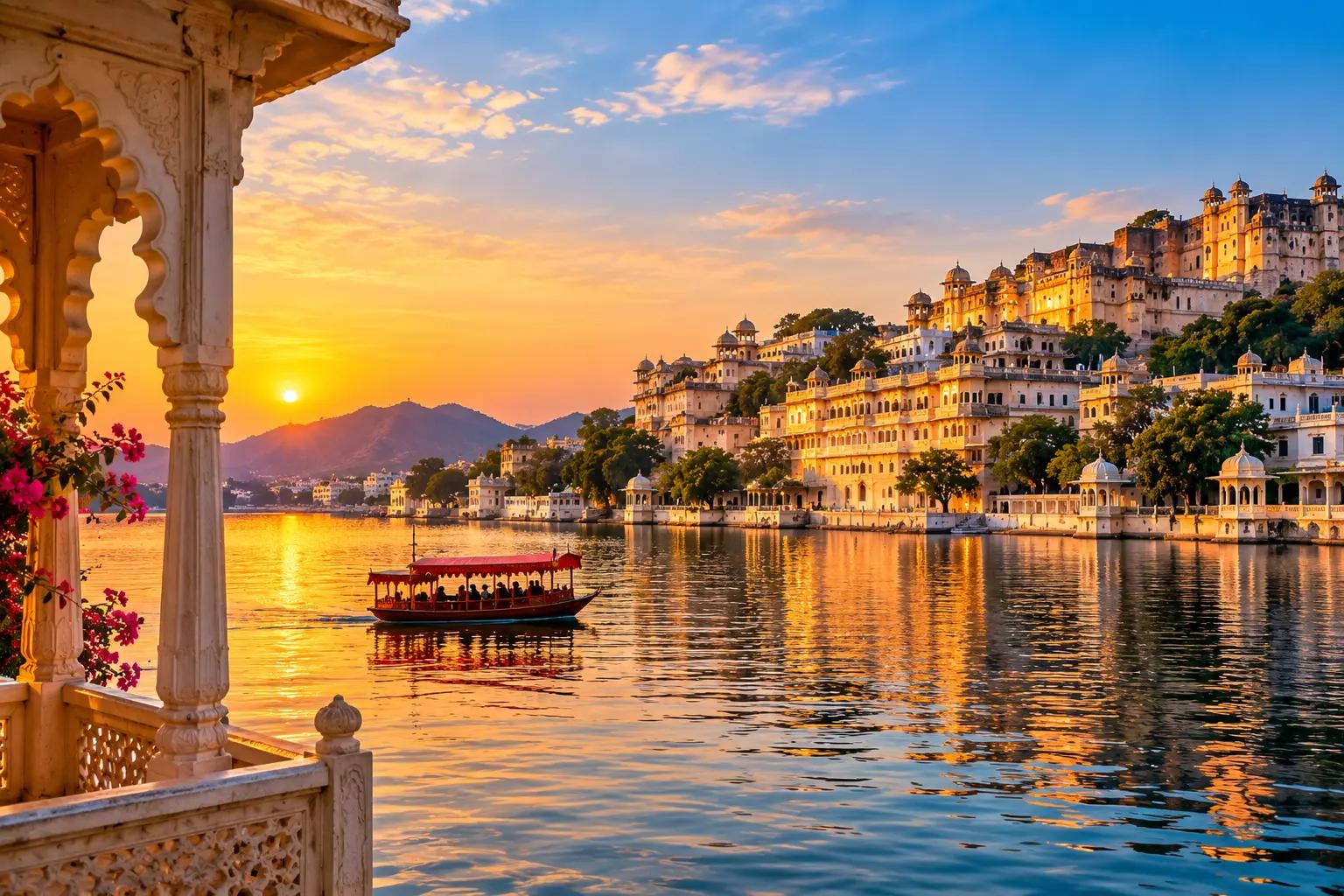
Sunset cruise on Lake Pichola, Udaipur, with the City Palace and Lake Palace lit up against the sky
Shikara ride on Nakki Lake, Mount Abu, Rajasthan's only hill station
Dilwara Temples — marble carved so fine it looks translucent in the light
Essence of Journey
The experiences that capture the true spirit of the entire trip.
| Day | Route | Distance | Major Highlights |
|---|---|---|---|
| Day 1 | Arrival at Delhi | — | Private airport pickup, transfer to hotel, evening at leisure. |
| Day 2 | Delhi Heritage Full Day | — | Jama Masjid, Chandni Chowk, Humayun's Tomb, Qutub Minar, India Gate. |
| Day 3 | Delhi – Agra | 233 Kms / 4 Hrs | Drive to Agra; afternoon Agra Fort. |
| Day 4 | Agra – Fatehpur Sikri – Jaipur | 240 Kms / 5.5 Hrs | Sunrise Taj Mahal; Fatehpur Sikri en route to Jaipur. |
| Day 5 | Jaipur Heritage — Day 1 | — | Amber Fort, Jaigarh Fort, City Palace. |
| Day 6 | Jaipur Heritage — Day 2 | — | Jantar Mantar, Hawa Mahal, Johari Bazaar, Nahargarh sunset. |
| Day 7 | Jaipur – Jodhpur | 335 Kms / 6 Hrs | Drive to the Blue City. |
| Day 8 | Jodhpur Heritage Day | — | Mehrangarh Fort, Jaswant Thada, Umaid Bhawan, Blue City walk. |
| Day 9 | Jodhpur – Kumbhalgarh – Ranakpur – Udaipur | 265 Kms / 6.5 Hrs | Kumbhalgarh Fort and Ranakpur Jain Temple en route to Udaipur. |
| Day 10 | Udaipur Heritage Day | — | City Palace, Jagdish Temple, Saheliyon ki Bari, Lake Pichola sunset cruise. |
| Day 11 | Udaipur – Mount Abu | 185 Kms / 4.5 Hrs | Drive up into the Aravalli hills. |
| Day 12 | Mount Abu Full Day | — | Dilwara Temples, Guru Shikhar, Achalgarh, Nakki Lake. |
| Day 13 | Mount Abu – Udaipur | 185 Kms / 4.5 Hrs | Return transfer; free evening in Udaipur. |
| Day 14 | Udaipur Departure | — | Fateh Sagar Lake (time permitting), airport / railway drop. |
About
If you've been searching for a Premium India tour package that goes beyond the usual Golden Triangle checklist, this is it. The Premium India in Depth Tour Package is a private, 14-day, 13-night journey through Delhi, Agra, and the heart of Rajasthan — built for travellers who want to see the forts and palaces everyone talks about, and the ones most operators skip.
This isn't a bus tour with thirty strangers and a fixed lunch stop. It's a fully private India in depth tour, with your own vehicle, your own driver, and your own pace, from the moment you land in Delhi to the moment you're dropped off in Udaipur.
And while most "Rajasthan in a week" itineraries stop at Jaipur, Jodhpur, and Udaipur, and call it complete. But this one keeps going — into the Aravalli hills, to the 36-kilometre ramparts of Kumbhalgarh, the marble forest of Ranakpur, and the cool hill station of Mount Abu — before looping back to Udaipur. It's the difference between visiting Rajasthan and actually understanding it.
Cost & What's Included
Pricing runs across three comfort tiers, so you can choose based on the kind of stay you want — not just the sights you'll see.
| Tier | Per Couple (Shoulder – Peak Season) | Per Person (Shoulder – Peak Season) |
|---|---|---|
|
Premium |
₹2,75,310 – ₹2,97,335 |
₹1,37,655 – ₹1,48,667 |
|
Luxury |
₹3,96,270 – ₹4,27,972 |
₹1,98,135 – ₹2,13,986 |
|
Ultra-Luxury |
₹7,21,350 – ₹7,79,058 |
₹3,60,675 – ₹3,89,529 |
Premium India in Depth 3-Tier Pricing Summary
Note: Rates vary with season and hotel availability — please get in touch for a current quote and any live offers.
Two narrative threads run through the fourteen days: Mughal India's marble and symmetry at Agra, and Rajput India's sandstone forts and lake palaces from Jaipur to Udaipur — before the pace changes altogether in the cool forested hills above Mount Abu, where the Aravalli Range's granite peaks and the translucent marble of the Dilwara Temples close the circuit on an entirely different register. This is a custom itinerary built for the traveller who wants the comprehensive Rajasthan India tour, not the abbreviated one.
| Destination | Premium | Luxury | Ultra-Luxury |
|---|---|---|---|
|
Delhi (x2 nights) |
Premium heritage-district hotel |
Luxury hotel (Taj / Oberoi / ITC) |
The Imperial / Oberoi New Delhi |
|
Agra (x1 night) |
Premium hotel near the Taj |
Luxury hotel (Courtyard / ITC Mughal) |
Oberoi Amarvilas |
|
Jaipur (x3 nights) |
Premium heritage hotel |
Luxury palace hotel (ITC / Marriott) |
Oberoi Rajvilas / Samode Palace |
|
Jodhpur (x2 nights) |
Premium haveli-style hotel |
Luxury fort hotel (Raas Jodhpur) |
Umaid Bhawan Palace (Taj) |
|
Udaipur (x3 nights) |
Premium lake-view boutique |
Luxury lake palace hotel (Fateh Prakash) |
Oberoi Udaivilas / Taj Lake Palace |
|
Mount Abu (x2 nights) |
Premium hill resort |
Luxury heritage resort (Connaught House) |
Cama Rajputana Club Resort (heritage suite) |
Premium India in Depth Accommodation Categories
Places You'll Explore
A quick look at what makes each stop worth the drive — this is a genuine Rajasthan India comprehensive tour, not a highlights reel.
Delhi. Old and New India side by side — Jama Masjid and Chandni Chowk's chaos of alleys, then the calm of Humayun's Tomb, Qutub Minar, and India Gate.
Agra & Fatehpur Sikri. Home to the Taj Mahal, Agra Fort, and the abandoned red-sandstone city of Fatehpur Sikri, built and deserted within a single generation.
Jaipur. The Pink City — Amber Fort, Jaigarh Fort, the City Palace, Hawa Mahal, and the astronomical instruments of Jantar Mantar, alongside some of Rajasthan's best bazaars.
Jodhpur. The Blue City, watched over by Mehrangarh Fort — plus Jaswant Thada's marble cenotaph and the still-lived-in Umaid Bhawan Palace.
Kumbhalgarh & Ranakpur. The wall, the fort, and the temple that most first-time visitors to Rajasthan never see — this stretch alone sets an in-depth tour apart from a standard circuit.
Udaipur. The City of Lakes — City Palace, Jagdish Temple, Saheliyon ki Bari, and Lake Pichola at sunset.
Mount Abu. Rajasthan's one hill station — Dilwara Temples, Guru Shikhar (the Aravallis' highest point), Achalgarh Fort, and Nakki Lake.
Best Time to Visit
October to March is the sweet spot for a Rajasthan India comprehensive tour like this one — comfortable enough for full days of sightseeing in Jaipur, Jodhpur, and Udaipur, and cool enough to enjoy Mount Abu without the summer haze.
| Season | Months | What to Expect |
|---|---|---|
|
Peak |
December – early January |
Coolest, driest weather; book well ahead |
|
High |
October–November, February–March |
October–November, February–March |
|
Shoulder |
September, April |
Warmer days, thinner crowds, lower rates |
|
Avoid for this circuit |
May – September (monsoon) |
Hot on the plains; humid; not ideal for a packed touring pace |
Best time to Visit - Premium India in Depth Tour Package
How to Reach
By Air. The tour begins in Delhi — Indira Gandhi International Airport (DEL) has direct connections from most major global hubs. It ends in Udaipur, whose Maharana Pratap Airport (UDR) has regular domestic flights to Delhi, Mumbai, and other Indian cities for your onward journey.
By Rail. Delhi and Udaipur are both well connected on India's rail network, if you'd rather add a train leg before or after the tour.
Within the Tour. You won't need to arrange a thing — your private vehicle and driver handle every transfer between cities, from Delhi to Agra, Jaipur, Jodhpur, Kumbhalgarh, Ranakpur, Udaipur, and Mount Abu, door to door.
Getting to India: International Flight Connections
| Flying From | Typical Journey | Notes |
|---|---|---|
|
London / UK |
~8.5–9.5 hrs direct |
Direct services from Heathrow on multiple carriers |
|
New York / US East Coast |
~14–16 hrs, often one stop |
Some seasonal direct services also operate |
|
Los Angeles / US West Coast |
~17–19 hrs, one stop |
Via Europe or the Gulf |
|
Sydney / Australia |
~12–14 hrs direct, or one stop via Gulf/Singapore |
Direct seasonal services available |
|
Continental Europe |
~8–10 hrs direct |
Frankfurt, Paris, and other hubs connect well |
International Flight Connections - Premium India in Depth Tour Package
Once you land, you won't be navigating any of this alone: your private driver meets you at Delhi airport arrivals, and the same door-to-door pickup happens at every stop on the circuit, including your final send-off from Udaipur.
Note: Flight times are approximate and vary by airline, season, and route — please confirm exact schedules with your airline or travel agent when booking
Planning Your Trip From Abroad
A few practical essentials that matter most to first-time visitors from overseas:
Currency. The Indian Rupee (₹/INR) is the only legal tender. ATMs are widely available in all the cities on this route, and major hotels, restaurants, and shops accept international cards; carry some cash for markets, small vendors, and tips.
Connectivity. A local SIM or eSIM (available at Delhi airport or through your hotel) is the easiest way to stay connected. 4G coverage is reliable in Delhi, Agra, Jaipur, Jodhpur, and Udaipur; it can be patchier on the hill roads up to Mount Abu.
Electricity. India runs on 230V with Type C, D, and M sockets — pack a universal adaptor, as UK/US/EU plug types will need one.
Time zone. India Standard Time (IST) is a single time zone across the country, at GMT+5:30 — worth noting since it doesn't align to the hour with most Western time zones.
Health & travel insurance. No specific vaccinations are currently mandatory for most international travellers to India, but requirements can change, so check with a travel health clinic or your GP a few weeks before departure. Comprehensive travel insurance covering medical care and trip interruption is strongly recommended.
Food & water. Stick to bottled or filtered water (provided throughout this tour) and freshly cooked food at reputable places — your guide and driver can point you to places that are both safe and excellent.
Language. English is widely spoken in hotels, at monuments, and by your guides throughout; Hindi is the main local language, and a little goes a long way with market vendors.
Emergency numbers. 112 is India's single emergency number for police, fire, and ambulance services nationwide.
PRACTICAL NOTES
Safety: Rajasthan is one of India's most heavily-toured states and is generally safe for international visitors, including solo and women travellers, when using a private vehicle and vetted accommodation as this itinerary does. Standard urban-travel precautions apply, as they would in any major tourist destination.
Drinking water: Tap water is not recommended for drinking. Bottled or filtered water is provided in the vehicle and at hotels throughout.
Dress code: Modest dress (shoulders and knees covered) is expected at temples, most notably Ranakpur and Dilwara; carry a light shawl or scarf for both men and women.
Tipping: Not mandatory but customary for drivers and guides; ₹300–500 per day per guide and ₹200–300 per day for the driver is a reasonable guide.
Photography: Permitted at most sites; some temples, including Ranakpur and Dilwara, charge a separate camera/phone fee and restrict photography inside the inner sanctum.
Connectivity: 4G coverage is reliable in all cities on this route; Mount Abu's hill roads have patchier signal in stretches. A local SIM or international roaming plan is recommended.
WHY BOOK THIS WITH BIZAREXPEDITION
Not just another bespoke itinerary assembled from a template — three reasons this journey is built and run differently.
A direct ground operator, not a reseller.
BizareXpedition™ Services Pvt. Ltd. (CIN: U63090UR2016PTC007433) is a registered Indian ground operator headquartered in Haridwar, Uttarakhand, running its own vehicles, drivers, and guide relationships across Rajasthan — not a booking layer reselling another operator's ground arrangements with a commission added on top.
Three genuinely different service tiers, not one itinerary with a price sticker changed.
Premium, Luxury, and Ultra-Luxury are real, separately built accommodation tiers — from heritage boutique properties up to palace hotels such as the Oberoi Udaivilas and Umaid Bhawan Palace — so the choice is an actual comfort decision, not a marketing label attached to the same rooms.
The only researched circuit that goes as far as Mount Abu.
Across the named premium operators benchmarked for this itinerary, none extended a Rajasthan and Taj Mahal circuit to Kumbhalgarh, Ranakpur, and Mount Abu. This document's closing third is territory most comparable premium India tour packages simply don't cover.
Booking Summary
Dept. City :
--
Dept. Date :
--
Traveller :
Adults: 2, Child: 0, Infant: 0
Rooms :
--
Basic Price :
--
Total Cost
--
GST
--
Grand Total
--
Itinerary (Day Wise)
This 14-day journey takes you from Delhi’s busy old lanes to the quiet beauty of Rajasthan’s Aravalli hills. See the Taj Mahal in the soft light of sunrise, wander through Jaipur and Jodhpur’s historic streets, and watch Udaipur glow over Lake Pichola at sunset. The journey then slows down in Kumbhalgarh, Ranakpur and Mount Abu, giving you a quieter side of Rajasthan that most classic tours miss. It’s a trip made for travellers who want to experience India beyond the usual highlights, with time to actually take it all in.
Day 1
ARRIVAL AT DELHI
Route: Delhi International Airport – Hotel
Delhi opens the circuit gently. There's no sightseeing scheduled today — after a long-haul arrival, the only plan is to check in, settle into the city's rhythm, and rest. For travellers arriving from Europe or North America, this unhurried first evening is deliberate: it keeps the fourteen days that follow from starting on the back foot.
Day 2
DELHI HERITAGE FULL DAY
Route: Jama Masjid – Chandni Chowk – Humayun's Tomb – Qutub Minar – India Gate
The morning belongs to Old Delhi: the red sandstone courtyard of Jama Masjid, India's largest mosque, followed by a cycle-rickshaw ride through the packed lanes of Chandni Chowk, still trading in spices, silver, and wedding cards from the same shopfronts it has for generations.
The afternoon shifts register entirely. Humayun's Tomb — a Mughal garden-tomb built a full seventy years before the Taj Mahal, and its clearest architectural ancestor — sets up the visual grammar the Taj Mahal will complete two days from now: a domed structure on a raised plinth, centred in a formal charbagh garden. The day closes with the Qutub Minar's soaring 73-metre minaret and a drive past India Gate as the city's lights come up.
Day 3
DELHI – AGRA
Route: Delhi – Agra (233 Kms / 4 Hrs) – Agra Fort
A half-day's drive down the Yamuna Expressway brings the circuit to Agra by early afternoon, leaving time for Agra Fort before the light softens. The fort's red sandstone ramparts hide a sequence of white marble palaces built by successive Mughal emperors, ending at the Musamman Burj — the octagonal tower where Shah Jahan spent his final years under house arrest, with an unobstructed view down the river to the tomb he had built for his wife.
Day 4
AGRA – FATEHPUR SIKRI – JAIPUR
Route: Sunrise Taj Mahal – Fatehpur Sikri – Jaipur (240 Kms / 5.5 Hrs)
The Taj Mahal is timed for the gates opening at sunrise, and that timing is not simply for the cooler air or the thinner crowds. The white marble the entire mausoleum is built from is fine-grained and faintly translucent, threaded with traces of other minerals, so it doesn't just reflect low-angle morning light — it absorbs a little of it and lets it glow back out. That's the real mechanism behind the monument's famous colour-shift: grey in the half-light before dawn, blush pink as the sun clears the horizon, and a warm ivory-white by mid-morning. See it any later in the day, under flat overhead sun, and the marble reads as simply white — the same building, but with the one effect that makes it worth arriving early stripped out entirely.
From there the road runs through Fatehpur Sikri, the red sandstone capital Akbar built and then abandoned within fifteen years once its wells ran dry — a ghost city preserved almost exactly as it was left — before continuing on to Jaipur, the Pink City, by evening.
Day 5
JAIPUR HERITAGE — DAY 1
Route: Amber Fort – Jaigarh Fort – City Palace
Amber Fort was sited deliberately on a ridge above Maota Lake, giving its garrison both a defensible height and a secure water supply the fort could draw on even under siege — the same lake that today throws the fort's honey-coloured sandstone walls back in reflection each morning. Inside, the Sheesh Mahal — the Mirror Palace — takes that same practical logic and turns it decorative: thousands of small convex glass and mirror fragments are set into the stucco at slightly different angles, so a single candle flame, multiplied across every facet, once lit the chamber like a hall of stars. It was built for a queen who, tradition holds, wanted to see the night sky without stepping outside her rooms.
The afternoon continues to Jaigarh Fort, built explicitly to guard Amber and never taken in battle, and then City Palace, still partly home to Jaipur's royal family and open in part as a museum of Rajput and Mughal-influenced court life.
Day 6
JAIPUR HERITAGE — DAY 2
Route: Jantar Mantar – Hawa Mahal – Johari Bazaar – Nahargarh sunset
Jantar Mantar's stone astronomical instruments, built in the 1730s, can still be read to the minute by a guide who knows what to point out — the Samrat Yantra sundial alone is accurate to within two seconds. From there it's a short walk to Hawa Mahal, the five-storey pink sandstone screen built so the palace women could watch the street below through 953 small windows without being seen themselves, and on into Johari Bazaar's jewellery lanes. The day closes with the drive up to Nahargarh Fort for sunset over the Pink City spread out below.
Day 7
JAIPUR – JODHPUR
Route: Jaipur – Jodhpur (335 Kms / 6 Hrs)
A full day on the road west, out of Jaipur's agricultural belt and into the drier country that announces the edge of the Thar Desert. Jodhpur's skyline, dominated by Mehrangarh Fort on its rock outcrop, is visible from well outside the city.
Day 8
JODHPUR HERITAGE DAY
Route: Mehrangarh Fort – Jaswant Thada – Umaid Bhawan – Blue City walk
Mehrangarh Fort sits on a sheer 125-metre rock outcrop, its sandstone walls running up to 36 metres high and over 20 metres thick in places — thick enough that the fort has never been conquered by direct assault in its nearly six-hundred-year history. Inside, the museum holds one of India's best palace collections of royal howdahs, weapons, and miniature painting.
Jaswant Thada, a marble cenotaph as luminous as a smaller-scale Taj, sits a short drive below the fort. The afternoon includes Umaid Bhawan Palace — still a private royal residence and a Taj hotel — and a walking section through the blue-washed lanes of the old city below the fort walls.
Day 9
JODHPUR – KUMBHALGARH – RANAKPUR – UDAIPUR
Route: Kumbhalgarh Fort – Ranakpur Jain Temple – Udaipur (265 Kms / 6.5 Hrs)
Kumbhalgarh's wall doesn't run in a straight line anywhere along its 36 kilometres — it was built to trace the contour of the Aravalli ridgeline exactly, climbing and turning with the terrain instead of cutting across it. That was the point: an attacking force could never get a straight, full-speed run at any single stretch of wall, because the ridge itself kept breaking their line into switchbacks under constant sightlines from the ramparts above. The fort inside that wall was breached only once in its history — not by force, but by betrayal: a traitor cut off its water supply, and it was thirst, not an army, that finally opened the gates to Akbar's combined Mughal force.
Ranakpur's Jain temple complex, reached within the hour, is a complete change of register — a forest of 1,444 individually carved marble pillars supporting a soaring, light-filled hall, with the layout arranged so that the central shrine to Adinatha stays visible from almost any point among them. Both stops sit well off the standard Jaipur–Jodhpur–Udaipur run, which is exactly why the operators researched for this itinerary don't include either.
Day 10
UDAIPUR HERITAGE DAY
Route: City Palace – Jagdish Temple – Saheliyon ki Bari – Lake Pichola sunset cruise
Udaipur earns its reputation as Rajasthan's most romantic city almost entirely from its setting: a cluster of white palaces around a lake, backed by the Aravalli hills. City Palace, the largest palace complex in Rajasthan, is followed by Jagdish Temple and the fountains of Saheliyon ki Bari, the "Garden of the Maidens." The day closes on the water — a sunset cruise across Lake Pichola past the Lake Palace and City Palace, both lit gold as the light drops.
Day 11
UDAIPUR – MOUNT ABU
The road climbs steadily out of Udaipur's lake country and up into the granite hills of the Aravalli Range, ending at Mount Abu — at just over 1,200 metres, Rajasthan's only hill station and a good ten degrees cooler than the desert plains below. The change in landscape, vegetation, and air is immediate and, for most guests on this itinerary, entirely unexpected of Rajasthan.
Day 12
MOUNT ABU FULL DAY
Route: Dilwara Temples – Guru Shikhar – Achalgarh – Nakki Lake
The Dilwara Temples, built between the 11th and 13th centuries, are famous for marble ceiling carving so fine in places that the stone becomes faintly translucent — a level of detail that reportedly took master craftsmen years per ceiling, working by the volume of marble dust removed rather than added. From there the road climbs to Guru Shikhar, the Aravalli Range's highest point, and on to the ruined hill fort of Achalgarh, before the day ends with a shikara ride on Nakki Lake, a spring-fed crater lake ringed by granite peaks and Mount Abu's centrepiece.
Day 13
MOUNT ABU – UDAIPUR
Route: Mount Abu – Udaipur (185 Kms / 4.5 Hrs)
A return descent from the hills to Udaipur, with the rest of the afternoon and evening free — an unhurried close to the circuit before the final departure day, and a good window for anything left on a guest's own list in Udaipur.
Day 14
UDAIPUR DEPARTURE
Route: Fateh Sagar Lake – Airport / Railway Drop
A last look at Fateh Sagar Lake if the flight schedule allows, then the private transfer to Udaipur airport or railway station, closing a fourteen-day arc from the Mughal north to the Aravalli hill country most Rajasthan itineraries never reach.
Tour Information
Your complete guide to a hassle-free and enjoyable trip.
Inclusion
Exclusion
Payment Terms
Important factors to consider before your trip!
Cancellation
Need To Know
Be Responsible Traveller
- Minimize Plastic Use : Bring a reusable water bottle, shopping bag, and utensils to reduce the need for single-use plastics. Many destinations have water refill stations and eco-friendly stores.
- Support Local and Sustainable Businesses : Eat at local restaurants, buy souvenirs from local artisans, and choose tour operators that prioritize sustainable practices and support the local community.
- Respect Wildlife and Natural Habitats : Avoid disturbing wildlife or their natural habitats. Stick to designated paths and observe animals from a distance without feeding or touching them.
- Dispose of Waste Properly : Follow local guidelines for recycling and waste disposal. If facilities aren't available, carry your waste with you until you can dispose of it responsibly.
- Educate Yourself and Others : Learn about the local environment, culture, and customs. Respect local practices and traditions, and share your knowledge about responsible travel with others.
- Choose Sustainable Activities : Engage in eco-friendly activities such as hiking, snorkeling, or visiting national parks. Avoid activities that exploit animals or damage the environment.
- Leave No Trace : Follow the principle of "Leave No Trace," which means leaving natural areas as you found them. Pack out all trash, avoid picking plants, and refrain from carving or writing on rocks or trees.
- Plant Trees Whenever Possible : Participate in local tree-planting initiatives or plant trees in your own community. Trees absorb carbon dioxide, provide oxygen, and help support biodiversity, making them vital for a healthy environment.
Connect
Share Itinerary
Email Itinerary
Frequently Asked Questions (FAQs) & People Also Ask — Premium India in Depth Tour Package
We help you prepare for your trip and ensure an effortless and enjoyable travel experience.
How many days do you need for a Rajasthan and Taj Mahal tour?
A comprehensive Rajasthan and Taj Mahal tour like this one needs 12 to 14 days to cover the Golden Triangle plus Jodhpur, Udaipur, and the Aravalli hill country properly. Shorter 7–8 day circuits can cover Delhi–Agra–Jaipur alone, but adding Jodhpur, Kumbhalgarh, Ranakpur, and Mount Abu — the "in depth" part of this itinerary — is what needs the extra week.
Is Rajasthan safe for tourists?
Yes — Rajasthan is one of India's most visited and best set up states for international tourism, and is generally safe for tourists, including solo and women travellers, when travelling with a private vehicle and vetted accommodation. The state has a well-developed tourism infrastructure precisely because it sees such high foreign visitor numbers, and ordinary urban-travel precautions are all that's typically needed.
Do I need a visa to visit India?
Most foreign nationals, including travellers from the UK, US, Europe, and Australia, need a visa to enter India, and the great majority apply online for an e-Visa rather than visiting an embassy in person. E-Visa processing is normally a matter of days, but requirements and eligible nationalities change, so check the current rules on India's official e-Visa portal or your nearest Indian consulate before booking flights.
Is the elephant ride at Amber Fort ethical?
No — this itinerary does not include it. Animal-welfare organisations including PETA and World Animal Protection have documented working elephants at Amber Fort in poor physical condition, including cases of tuberculosis, and campaign against the rides on welfare grounds. Guests on this itinerary are taken up to the fort's main gate by private vehicle instead, which is faster and avoids the issue entirely.
What's the best time of year to visit Rajasthan?
October to March is the best window for this itinerary, with December and early January the coolest and busiest. Rajasthan's summers (April–June) are extremely hot on the desert plains, and the monsoon (June–September) brings high humidity and occasional travel disruption, so the cooler months are when this circuit's pace — several sightseeing-heavy days back to back — is most comfortable.
What should I wear to visit Ranakpur or Dilwara temple?
Cover your shoulders and knees, and don't wear or carry leather — belts, wallets, and bags must be left at the entrance lockers at both Ranakpur and Dilwara. A light shawl or scarf works well for both men and women and is worth carrying for the whole Rajasthan leg of the trip, not just these two temples.
How do I avoid shopping scams on a Rajasthan tour?
Travel with a guide paid a fixed salary rather than a shopping commission, and treat any "government export scheme" or guaranteed-resale pitch as a red flag — no legitimate jewellery or handicraft purchase works that way. On this itinerary, the day-wise stops are fixed in advance and any further shopping is entirely optional and at the guest's own pace, so there's no unplanned detour to a commission shop to watch out for.
What's the difference between a private tour and a group/escorted tour of Rajasthan?
A private, privately guided tour uses your own vehicle, driver, and guide on your own schedule, with no other travellers and no fixed departure time each day; a group or escorted tour shares a coach and itinerary with other travellers on a fixed schedule. Private tours cost more per person but allow the pace, stops, and timing (sunrise at the Taj Mahal, for instance) to be set around the traveller rather than the group.
How much does a private, tailor-made Rajasthan and Taj Mahal tour cost?
For this fourteen-day itinerary, indicative pricing runs from roughly ₹2,75,310 per couple in the Premium tier up to roughly ₹7,79,058 per couple in the Ultra-Luxury tier during peak season, covering accommodation, private vehicle and driver, guiding, and entrance fees. See the Indicative Pricing Summary table above for the full breakdown by tier and season; this is a modelled estimate, not a live quote.
What's included in this Rajasthan and Taj Mahal itinerary?
Accommodation for all 13 nights with daily breakfast, a private air-conditioned vehicle and driver for the entire circuit, private guiding at every major heritage site, all monument entrance fees, the Lake Pichola sunset cruise, and the Nakki Lake shikara ride. International flights, visa fees, lunches and dinners, and personal expenses are not included — see the Inclusions & Exclusions table above for the complete list.
Can Mount Abu and Kumbhalgarh be combined with a Rajasthan and Taj Mahal circuit?
Yes, and this itinerary is built specifically to do it. Kumbhalgarh Fort, Ranakpur Jain Temple, and Mount Abu sit along a natural south-westerly extension from Udaipur, adding roughly three days to a standard Rajasthan and Taj Mahal route without requiring any backtracking, since the circuit simply continues from Udaipur rather than doubling back toward Delhi.
Is the Taj Mahal open every day?
The Taj Mahal is open every day except Fridays, when it's closed to the general public for prayers at the on-site mosque. Ignore anyone near the monument who claims it's closed for a holiday or VIP visit and tries to redirect you elsewhere — this is a well-documented scam, and Taj Mahal timings should only be confirmed through your hotel or guide.
BizareXpeditionTMReviews
Let's go, pack up, and hit the road!
Similar Tour Packages
Explore other exciting options for your next adventure!
Trusted Paths, Bold Journeys — Inside BizareXpedition
From humble beginnings to a trusted name in the industry, BizareXpedition's story is one of purpose-driven growth, community connection, and a relentless pursuit of excellence that speaks for itself.




























Premium India in Depth Tour Package
best deal price
Without GST
₹1,40,000
per person on twin sharing
Book Now