
Spiti Valley: The Middle Land — Buddhist Cold Desert14N/15D
Spiti Valley: The Middle Land — Buddhist Cold Desert
Start & City : Delhi
best deal price
₹
Without GST ₹1,07,415
per person on twin sharing
Choose your departure city, dates, and add guests to secure your tour.
Hurry, as seats fill up, prices rise! Book now!
1. Choose your departure date
Highlights
Stand inside Tabo Monastery's mud-brick assembly hall, founded in 996 CE and still holding murals painted within decades of that date – walls that have survived a millennium because Spiti's cold desert air rarely carries enough rain to dissolve sun-dried mud.
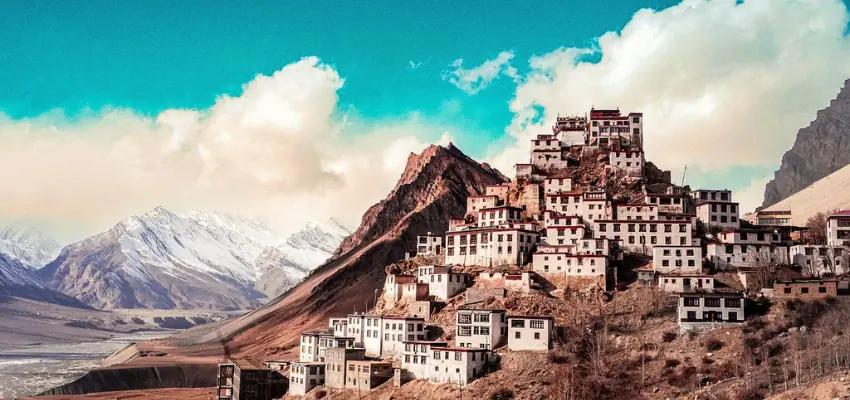
Walk the stacked, fort-like tiers of Key Monastery, rebuilt after Mongol raids, an 1841 attack and a 1975 earthquake, its narrow stairways between chambers a defensive layout as much as a religious one.
Cross Chicham Bridge, Asia's highest suspension bridge, opened in 2017 to replace a hand-pulled trolley cable that was, until then, the only way across the Sangla nullah gorge.
See genuine 160-million-year-old marine fossils at Langza, a reminder that this cold desert was once the floor of the Tethys Sea, long before the Himalaya pushed it skyward.
Spend a night at Mud village, gateway to Pin Valley National Park, where the valley narrows into some of Spiti's most dramatic rock formations.
Camp near Chandratal, the crescent-shaped “Moon Lake” at 4,300 metres, held in a natural basin behind a glacial moraine.
Meet Sangha Tenzin, India's only self-mummified Buddhist monk, preserved for roughly five centuries in a small shrine at Gue village.
Post a letter from Hikkim, the world's highest post office, before visiting Komic, one of the highest motorable villages anywhere.
Essence of Journey
The experiences that capture the true spirit of the entire trip.
| Day | Route | Distance | Major Highlights |
|---|---|---|---|
| Day 1 | Arrive Delhi | – | Airport reception, rest, orientation briefing |
| Day 2 | Delhi – Shimla | ~350 km | Kalka-Shimla mountain climb, Mall Road, Christ Church |
| Day 3 | Shimla – Sarahan | ~162 km | Narkanda, Hatu Peak views, Bhimakali Temple |
| Day 4 | Sarahan – Sangla Valley | ~84 km | Karcham, Sutlej-Baspa confluence, Kamru Fort |
| Day 5 | Sangla – Chitkul – Sangla | ~56 km (rt) | Chitkul, last inhabited village on the Baspa |
| Day 6 | Sangla – Kalpa | ~65 km | Reckong Peo (ILP formalities), Kinner Kailash views |
| Day 7 | Kalpa – Nako | ~105 km | Pooh, Khab viewpoint, Nako Lake and monastery |
| Day 8 | Nako – Tabo | ~62 km | Gue mummy, entering the Spiti river valley proper |
| Day 9 | Tabo – Dhankar – Mud | ~52 km | Tabo Monastery, Dhankar cliff-edge monastery, Pin Valley |
| Day 10 | Mud – Kaza | ~52 km | Pin Valley National Park views, settle into Kaza |
| Day 11 | Kaza local circuit | ~95 km | Key Monastery, Kibber, Chicham Bridge |
| Day 12 | Kaza local circuit | ~95 km | Hikkim post office, Langza fossils, Komic |
| Day 13 | Kaza – Chandratal | ~96 km | Kunzum Pass (4,551 m), Chandratal eco-camp |
| Day 14 | Chandratal – Manali | ~111 km | Batal, Chatru, Rohtang/Atal Tunnel corridor |
| Day 15 | Manali – Delhi | ~550 km | Departure transfer, international onward flight |
About
Spiti sits on the far side of the Himalaya, in the rain shadow where the monsoon never reaches. The result is a cold high-altitude desert of bare rock and wide brown valleys, dotted with whitewashed villages and monasteries that have stood since the tenth century. This Spiti Valley tour international guests book is a private, tailor-made itinerary, run at a pace that treats the region as a destination in its own right rather than a corridor to somewhere else – a private Spiti Valley tour and a Spiti Buddhist monastery tour for foreigners built specifically around Key and Tabo's ancient monasteries.
The circuit runs Delhi to Shimla, up through Kinnaur's river valleys, across the Kinnaur-Spiti Inner Line into Spiti itself, and back out over Kunzum Pass to Manali – the same entry-exit logic BizareXpedition uses on its own domestic Spiti circuits, because gaining altitude gradually through Kinnaur is safer than crossing the same height gap in one day from the Manali side. Fourteen nights across eleven stops means Sangla gets a second night so Chitkul is a proper day trip rather than a stop folded into a travel day, and Kaza gets three nights so its six high villages split cleanly across two unhurried days instead of one long loop. As a tailor-made Spiti Valley holiday, the whole route can be adjusted for a shorter stay, added nights, or a different season, but this document describes BizareXpedition's own recommended 14-night build.
For travellers researching a Ladakh alternative Himachal tour, the honest comparison is about scale and paperwork, not one place being simply “better.” Spiti's villages run on a homestay and small-guesthouse economy, so visitor numbers stay naturally lower than Ladakh's much larger hotel base can support. Foreign nationals also clear a single Inner Line Permit for the whole Kinnaur-Spiti stretch, rather than the separate area-specific permits Ladakh requires for Nubra and Pangong. Both are real, structural differences – not a claim that one region is objectively superior to the other. A Kinnaur-Spiti circuit for foreigners like this one, and a cold desert Himalaya tour more generally, suits travellers who want fewer fellow visitors more than a specific sight Ladakh lacks.
What is the Spiti Valley Middle Land tour?
The Spiti Valley Middle Land tour is a private, 15-day trip for international travellers through Spiti, a high-altitude Buddhist desert in India's Himachal Pradesh. It links Kinnaur's river valleys, the thousand-year-old monasteries of Tabo and Key, the high villages around Kaza and the lake at Chandratal, then leaves over Kunzum Pass to Manali.
"Spiti" is often translated as "the middle land", the country between India and Tibet. It sits behind the main Himalayan range, where the monsoon barely reaches. What you get is bare mountains, wide brown valleys, whitewashed villages and monasteries that have been in use since the tenth century.
Most Spiti trips sold in India run 7 to 10 days. This one runs 15, and those extra days are the difference between passing through Spiti and actually getting to know it.
Why take the slower, international-pace route
We run Spiti for Indian travellers too, usually on a tighter schedule. This version has been slowed down on purpose for guests flying in from abroad.
| Points | Typical Spiti tour | This international-pace tour |
|---|---|---|
|
Length |
7–10 days |
15 days |
|
Sangla and Chitkul |
Squeezed into one travel day |
Two nights in Sangla; Chitkul gets its own relaxed day |
|
Kaza's high villages |
Covered in about a day and a half |
Two full days, with three nights in Kaza |
|
Altitude gain |
Often fast, especially from the Manali side |
Gradual, over about a week through Kinnaur |
|
Arrival and departure |
Often not included |
Delhi airport transfers and briefing included |
Spiti International-pace route
Why go in through Kinnaur? Driving in from Shimla means you climb slowly, from about 2,200 m to Kaza at around 3,650 m, over seven days. Coming from Manali, you'd cross a similar height gap in a single day. The slow way is simply safer for your body.
What you'll experience
Tabo Monastery, founded in 996 CE. Its mud-brick hall still holds murals painted around that time, which have survived because Spiti gets so little rain
Key Monastery, stacked like a fortress on its hill. It has been rebuilt after raids, fires and a 1975 earthquake, and it's still home to a working community of monks
Dhankar Monastery, perched on a cliff above the meeting of the Spiti and Pin rivers
The Gue mummy, the naturally preserved body of the monk Sangha Tenzin, thought to be about 500 years old
Langza's marine fossils, left over from when this desert was the bed of the ancient Tethys Sea
Hikkim, often called the world's highest post office. You can send a postcard home from here
Chicham Bridge, one of the highest bridges in Asia, strung across a deep gorge near Kibber
A night near Chandratal, the crescent-shaped "Moon Lake" at about 4,300 m
Kinnaur's timber-and-stone heritage: Bhimakali Temple at Sarahan and Kamru Fort above Sangla
Chitkul, the last village on the road before the Tibetan border
Spiti or Ladakh? An honest comparison
Many travellers look at Spiti as a Ladakh alternative for a Himachal tour. Both are wonderful. They're just different trips.
| Points | Spiti Valley | Ladakh |
|---|---|---|
|
Visitor numbers |
Lower; mostly homestays and small guesthouses |
Higher; a much larger hotel base |
|
Permits for foreigners |
One Inner Line Permit process for the Kinnaur–Spiti stretch |
Separate protected-area permits for places such as Nubra and Pangong |
|
Getting there |
By road only, with a gradual climb through Kinnaur |
Direct flights to Leh (so you arrive at altitude straight away) |
|
Accommodation |
Simple and characterful; no five-star hotels |
A wider range, including upscale hotels in Leh |
|
Feel |
Quiet, remote, village-scale |
Busier, with more infrastructure and more choice |
Spiti or Ladakh
Our view: choose Spiti if you want fewer people and a slower, more personal trip. Choose Ladakh if you want more comfort, direct flights and a bigger menu of sights.
Who this private Spiti Valley tour suits
A great fit if you:
Are interested in Tibetan Buddhism, old monasteries and village life
Enjoy dramatic, empty landscapes more than busy tourist spots
Are happy with simple, clean rooms in the remote stretches
Can manage some long driving days on mountain roads
Think twice if you:
Need luxury hotels every night (they don't exist beyond Kalpa)
Have heart or lung conditions that make high altitude risky (please check with your doctor first)
Need a steady phone and internet connection throughout
WHY BOOK THIS WITH BIZAREXPEDITION
This circuit is built around the same Spiti that BizareXpedition already runs at domestic pace, slowed down and re-sequenced specifically for international guests.
An unhurried Kinnaur leg: BizareXpedition's own domestic Spiti circuit covers Sangla, Chitkul and the onward move to Kalpa in a single day. Here, Sangla gets two nights (Days 4-5), so Chitkul is its own relaxed day trip with time at Kamru Fort as well, instead of a stop squeezed into a transfer day.
Kaza's six high villages split across two full days: Key Monastery, Kibber and Chicham Bridge get Day 11 to themselves; Hikkim, Langza and Komic get Day 12. BizareXpedition's own domestic package covers Key, Kibber and Chicham on the same day it drives in from Mud, and the other three villages the day after – noticeably tighter than the three full Kaza nights booked here.
One Inner Line Permit process, handled end to end: BizareXpedition's ground team arranges the Kinnaur and Spiti permits together through Reckong Peo, so foreign guests travelling as a couple aren't the ones negotiating the official group-size rules at the permit office.
Honest accommodation labelling in an under-developed hotel market: Spiti beyond Kalpa has no five-star-class properties. Where a named boutique property couldn't be verified in time, the Accommodation table says so plainly rather than dressing up a guesthouse as something it isn't.
A single ground operator from Delhi to Delhi: The same private vehicle and BizareXpedition team manage permits, altitude pacing and every hotel handoff across all fourteen nights, with no resold or sub-contracted legs.
ACCOMMODATION CATEGORIES
Tier labels below are BizareXpedition's own Premium / Luxury / Ultra-Luxury categories, not star ratings. Spiti beyond Kalpa runs on a homestay and small-guesthouse economy with no five-star-class properties at any price, so “Ultra-Luxury” there means the best available option, not a five-star claim. Properties still pending ground-ops confirmation are flagged honestly rather than guessed.
| Destination | Nights | Premium | Luxury | Ultra-Luxury |
|---|---|---|---|---|
|
Delhi |
1 |
Radisson Blu Plaza, Airport |
ITC Maurya |
The Oberoi, New Delhi |
|
Shimla |
1 |
Clarkes Hotel |
Combermere by Big Sky |
Wildflower Hall, An Oberoi Resort |
|
Sarahan |
1 |
HPTDC Hotel Bushehr Regency |
Best available heritage guesthouse* |
Best available heritage guesthouse* |
|
Sangla / Rakcham |
2 |
Banjara Retreat, Sangla |
Banjara Camp, Sangla |
Best available riverside property* |
|
Kalpa |
1 |
Apple Blossom Kalpa |
Kinner Villa |
The Grand Kinnaur |
|
Nako |
1 |
Best available village guesthouse* |
Best available village guesthouse* |
Best available village guesthouse* |
|
Tabo |
1 |
Best available monastery-area guesthouse* |
Best available monastery-area guesthouse* |
Best available monastery-area guesthouse* |
|
Mud (Pin Valley) |
1 |
Registered village homestay |
Registered village homestay (private bath) |
Best available homestay* |
|
Kaza |
3 |
Sakya's Abode |
Kaza Continental |
Best available boutique property* |
|
Chandratal |
1 |
Seasonal eco-camp, standard tent |
Seasonal eco-camp, deluxe tent |
Seasonal eco-camp, best available tent* |
|
Manali |
1 |
The Himalayan, Naggar Road |
Span Resort & Spa |
Span Resort & Spa, river-view suite |
Spiti Valley Tour International Accommodation Categories
*Named boutique properties for Sarahan, Sangla's top tier, Nako, Tabo, Mud's top tier, Kaza's top tier and Chandratal's camp operator could not be verified in the time available and are flagged honestly rather than guessed – ground-ops to confirm before this package is quoted live. Chandratal's eco-camps sit roughly 1.5-2 km from the lake itself, in a designated zone; shoreline camping and kitchen waste were banned by the local Panchayat to protect the lake's ecology, and camp operating licences are reissued each season, so operator names are not fixed year to year.
3-TIER PRICING SUMMARY
| Tier | Per Couple (approx.) | Per Person (approx.) |
|---|---|---|
|
Premium |
Rs. 2,14,830 – 2,32,016 |
Rs. 1,07,415 – 1,16,008 |
|
Luxury |
Rs. 3,10,590 – 3,35,437 |
Rs. 1,55,295 – 1,67,718 |
|
Ultra-Luxury |
Rs. 4,44,780 – 4,80,362 |
Rs. 2,22,390 – 2,40,181 |
Spiti Valley Tour International 3-Tier Pricing Summary
Ranges cover normal date-to-date and season variance (base to approx. +8%). Rates are indicative and modelled for this document, not a confirmed live quote – BizareXpedition will confirm exact pricing against travel dates and current hotel/vehicle rates at the time of booking
SEASON ADJUSTMENTS
| Season | What to Expect |
|---|---|
|
Peak (Jul – mid-Sep) |
Kunzum Pass and the full loop reliably open; greenest Kinnaur scenery; Spiti's busiest homestay/guesthouse season – book well ahead. |
|
High (mid-Jun – Jun 30, mid-Sep – Sep 30) |
Kunzum Pass typically open; fewer crowds than peak; some late-monsoon cloud risk on the Kinnaur leg. |
|
Shoulder (early Jun) |
Kunzum Pass may still be under late snow-clearance work – confirm road status before finalising an early-June departure; Kinnaur and Spiti-via-Kinnaur are unaffected. |
|
Caution / Closure (Oct – May) |
Kunzum Pass and the Manali side close by snow; this exact loop (entering via Kinnaur, exiting via Manali) is not offered in this form outside roughly June-September. A Kinnaur-only out-and-back is possible in this window as a separate itinerary. |
|
Monsoon note (Jul – Aug) |
The Shimla-to-Kinnaur outer-Himalaya leg sees monsoon rain and occasional landslide-related delays; Spiti itself, in the rain shadow beyond Kinnaur, stays largely dry through the same weeks. |
Spiti Valley Tour International Season Adjustments
PRACTICAL NOTES
Safety & Altitude
The route gains altitude gradually through Kinnaur (Shimla ~2,200 m to Kaza ~3,650 m over seven days) rather than jumping straight to altitude from Manali, which is the safer direction for acclimatisation. Even so, mild headaches or breathlessness are common above 3,500 m; guests should drink plenty of water, avoid alcohol at altitude, and tell the guide immediately if symptoms worsen rather than push through them.
Inner Line Permit
Foreign nationals need an Inner Line Permit for Kinnaur beyond Jangi and for all of Spiti; lower Kinnaur (Kalpa, Sangla, Chitkul) needs none. Official rules ask for two or more foreign nationals for the Kinnaur permit and four or more for the Spiti permit, though officers at Reckong Peo commonly use discretion for couples and solo travellers – BizareXpedition's ground team manages this process but cannot guarantee discretion will be exercised on any given day.
Drinking Water
Bottled and filtered water is available in Kaza and the larger Kinnaur towns; in smaller villages (Nako, Tabo, Mud) guests should carry a personal filter bottle or purification tablets as backup.
Dress Code & Temperature
Layered clothing is essential – daytime sun at altitude can feel warm while night temperatures drop well below freezing even in July-August. Modest dress is expected inside monasteries; shoulders and knees should be covered.
Connectivity
Mobile network in Spiti is limited to BSNL and, in a few pockets, Jio – other carriers largely do not work beyond Kalpa. Coverage is patchy even where it exists, and Kaza's is the most reliable point on the route. Guests should not expect consistent internet access between Nako and Manali.
Photography
Photography is generally welcomed at monasteries, though some inner shrines and specific murals restrict flash or photography outright – the guide will flag these on-site. Ask before photographing individuals in villages and homestays.
Tipping
Not compulsory, but customary for driver and guide services on a private multi-day tour; guests typically tip at their own discretion at the end of the trip.
Booking Summary
Dept. City :
--
Dept. Date :
--
Traveller :
Adults: 2, Child: 0, Infant: 0
Rooms :
--
Basic Price :
--
Total Cost
--
GST
--
Grand Total
--
Itinerary (Day Wise)
This 14-night private journey goes from Delhi to Delhi. It climbs slowly from Shimla through Kinnaur's river valleys, so your body gets used to the altitude. You stop at Sarahan's Bhimakali Temple, spend two nights in Sangla with a relaxed day at Chitkul, and see Kinner Kailash from Kalpa. After crossing the Inner Line at Nako, you visit the Gue mummy, Tabo's 1,000-year-old monastery, cliff-top Dhankar and Pin Valley. Three nights in Kaza leave time for Key Monastery, Kibber, Chicham Bridge, the Langza fossils, Hikkim post office and Komic. The trip ends with a night near Chandratal and a drive over Kunzum Pass to Manali. BizareXpedition runs every leg with one private vehicle and one team, and handles all the permits.
Day 1
ARRIVE DELHI | Welcome & Orientation
Route: International arrival, Delhi
Arrival day is deliberately light. After a long-haul flight, the plan is check-in, rest, and a short evening briefing on the fourteen days ahead – altitude pacing, permit paperwork, and what to pack for a cold desert that can swing 25 degrees between midday sun and night.
A short evening walk or a visit to Humayun's Tomb or India Gate is offered for anyone not too tired from the flight, but nothing is scheduled that can't be skipped.
Experience of the Day
– Airport reception and private transfer to the hotel.
– Evening trip briefing: permits, altitude pacing, and packing check.
Food
Hotel dining room, or a short walk to one of Delhi's better-known North Indian restaurants for a first, easy meal.
Activities to Do
Rest and adjust to time zone.
Optional short evening visit to India Gate or Humayun's Tomb.
Day 2
DELHI TO SHIMLA | Into the Hills
Route: Delhi – Shimla, approx. 350 km, 7-8 hours
The drive climbs out of the Punjab plains and into the Shivalik foothills through the afternoon, reaching Shimla by early evening. The town was built as the summer capital of British India, and the Mall Road and Ridge still carry that colonial-era layout – timbered facades, a Gothic-revival church, and a working toy train line below.
Evening is free to walk the Ridge and Mall Road before dinner.
Experience of the Day
– Scenic drive from the plains into the Himalayan foothills.
– Evening walk on Shimla's Ridge and Mall Road.
Food
Recommended: a Himachali dham thali if available, or North Indian dining along the Mall. Bakeries near the Ridge are a local Shimla habit worth trying.
Activities to Do
Visit Christ Church and the Ridge.
Optional short walk to the Viceregal Lodge grounds.
Day 3
SHIMLA TO SARAHAN | Gateway to Kinnaur
Route: Shimla – Sarahan, approx. 162 km, 5-6 hours
The road passes Narkanda, a small apple-belt town with views toward Hatu Peak, then descends into the Sutlej valley through Rampur Bushahr, once the seasonal capital of the Bushahr kingdom. Sarahan itself sits on a ridge above the valley, its skyline dominated by the twin-towered Bhimakali Temple.
The Human Story
Bhimakali Temple is built in kath-kuni style – alternating layers of timber and dry stone, with no mortar. That construction isn't decorative: the wood layers let the whole structure flex slightly during an earthquake instead of cracking, which is the documented reason the temple survived the severe 1905 Kangra earthquake with only minor damage while stone structures nearby did not.
Experience of the Day
– Drive through Narkanda's apple orchards toward the Kinnaur border.
– Visit Bhimakali Temple, seat of the former Bushahr royal family's kuldevi.
Food
Local Himachali fare at the guesthouse; Sarahan's own apple orchards supply much of the fruit served here in season.
Activities to Do
Explore the Bhimakali Temple complex.
Evening viewpoint walk for the Srikhand range.
Day 4
SARAHAN TO SANGLA VALLEY | Entering the Baspa
Route: Sarahan – Sangla, approx. 84 km, 3-4 hours
At Karcham the road turns off the main Sutlej highway and follows the Baspa river into a noticeably greener valley – pine and deodar forest, terraced fields, and villages built in the same timber-and-stone style as Sarahan. Sangla is Kinnaur's largest Baspa-valley village, with Kamru Fort rising above it.
The Human Story
Kamru Fort has been in continuous use for over 1,500 years, built in the same kath-kuni style as Bhimakali Temple, and once served as the administrative seat of the old Bushahr kingdom before the capital moved to Sarahan and later Rampur. A Kamakhya Devi shrine still functions inside it today.
Experience of the Day
– Drive along the Baspa river into Sangla Valley.
– Visit Kamru Fort and its Kamakhya Devi shrine.
Food
Kinnauri rajma and buckwheat rotis are worth asking for here; apricot and walnut products from local orchards are common on guesthouse menus.
Activities to Do
Walk through Sangla village and the fort complex.
Riverside walk along the Baspa.
Day 5
SANGLA – CHITKUL DAY TRIP | India's Last Village
Route: Sangla – Chitkul – Sangla, approx. 56 km round trip, half-day
Chitkul is the last inhabited village on the Baspa before the road ends short of the Indo-Tibet border, and it keeps a slower pace even by Kinnaur's standards – wood-and-slate houses, a small wooden temple, and views straight up the valley toward the ridgelines beyond. This is a genuine half-day here, not a stop on the way to somewhere else, with the afternoon free back in Sangla afterward.
Experience of the Day
– Morning drive to Chitkul via Rakcham.
– Walk through the village and along the riverbank at the road's literal end.
– Return to Sangla for a free afternoon.
Food
Hindustan Ka Aakhri Dhaba ("India's Last Roadside Eatery") in Chitkul is a genuine, well-known stop – simple Maggi, tea and parathas at the very end of the motorable road.
Activities to Do
Photography along the Baspa at Chitkul.
Visit Chitkul's old wooden temple.
Day 6
SANGLA TO KALPA | Kinner Kailash
Route: Sangla – Reckong Peo – Kalpa, approx. 65 km, 2-3 hours
Reckong Peo is Kinnaur's district headquarters and the point where BizareXpedition's ground team completes the Inner Line Permit paperwork required for foreign nationals travelling beyond this point. Kalpa sits just above it, facing the Kinner Kailash massif across the valley.
The Human Story
Kinnauris regard Kinner Kailash as one of Lord Shiva's mountain abodes, distinct from the better-known Mount Kailash in Tibet, and Kalpa's own temples and viewpoints face the peak directly for that reason – the town's layout is oriented around the mountain, not the other way round. Kalpa was also home to Shyam Saran Negi, recognised as independent India's first voter, who cast a ballot in every election held here from 1951 until his death in 2022 at the age of 106.
Experience of the Day
– Complete Inner Line Permit formalities at Reckong Peo.
– Arrive Kalpa and take in the Kinner Kailash view at sunset.
Food
Kalpa's orchards produce some of Himachal's best-known apples; local guesthouses often serve apple-based desserts in season.
Shopping
Dried apricots, apple products and Kinnauri shawls are sold from small village shops around Kalpa and Reckong Peo.
Activities to Do
Sunset viewpoint for Kinner Kailash.
Short walk through old Kalpa village.
Day 7
KALPA TO NAKO | Crossing into the Cold Desert
Route: Kalpa – Pooh – Nako, approx. 105 km, 4-5 hours
The landscape changes fast on this drive: green terraced slopes give way within a couple of hours to the bare, folded rock of the rain-shadow zone. Nako is a small lake-village at roughly 3,660 metres, with four old temples clustered near the lake and a monastery said to hold a footprint left by Padmasambhava, the eighth-century Buddhist master credited with bringing Buddhism to Tibet.
Experience of the Day
– Drive from Kinnaur's green valleys into Spiti's cold desert terrain.
– Walk around Nako Lake and visit its cluster of old temples.
Food
Simple guesthouse fare; this is the point where thukpa, momos and butter tea start appearing more often on menus than Kinnauri dishes.
Activities to Do
Walk the lake circuit at Nako.
Visit Nako Monastery.
Day 8
NAKO TO TABO | The Ajanta of the Himalaya
Route: Nako – Gue – Tabo, approx. 62 km, 2-3 hours
A short detour at Gue village leads to India's only naturally self-mummified Buddhist monk, Sangha Tenzin, seated in a small shrine and estimated to date to around the 15th century; the body was buried by the 1975 earthquake and only rediscovered in 2004 during road construction. From Gue, the road drops into the Spiti river valley and reaches Tabo by early afternoon.
The Human Story
Tabo Monastery was founded in 996 CE by the translator Rinchen Zangpo, commissioned by King Yeshe-Ö of the Guge kingdom, and its main assembly hall still holds murals dated to the eleventh century – among the oldest surviving Buddhist paintings in the Himalaya. It is built of sun-dried mud brick with no wood or stone facade, which is not an accident of poverty: Spiti's cold desert gets so little rain that mud brick simply doesn't dissolve here the way it would in a wetter climate, which is the real reason a thousand-year-old mud structure still stands. Several travel sites and even some older BizareXpedition material describe Tabo as a UNESCO World Heritage Site – that is incorrect. The Archaeological Survey of India has proposed Tabo for UNESCO recognition, and protects it as a national monument, but it has never been formally inscribed on the World Heritage list.
Note on Tabo's UNESCO status: Tabo Monastery is ASI-protected and has been proposed for UNESCO World Heritage status, but is not currently inscribed. Guests will hear it called a "UNESCO site" locally and in some older material – this document corrects that plainly.
Experience of the Day
– Visit the Gue mummy shrine.
– Explore Tabo Monastery's assembly hall and its 11th-century murals.
Food
Tabo's monastery guesthouse and village cafes serve simple vegetarian thalis and butter tea; this is a good place to try Spitian barley-based dishes.
Activities to Do
Guided walk through Tabo's nine temples and chorten complex.
Evening walk around Tabo village.
Day 9
TABO TO MUD VILLAGE | Dhankar & Pin Valley
Route: Tabo – Dhankar – Mud, approx. 55 km, 3-4 hours
Dhankar was Spiti's former capital, and its monastery is built directly into a cliff edge above the confluence of the Spiti and Pin rivers – a defensive site as much as a spiritual one, chosen for the same sightline advantage that made it the seat of Spiti's old rulers. From Dhankar, the road turns south into the Pin Valley, narrowing between rock walls before reaching Mud, the last large village before Pin Valley National Park.
Experience of the Day
– Visit Dhankar Monastery, built on its cliff-edge site above the river confluence.
– Drive into the narrowing Pin Valley to Mud village.
Food
Home-cooked Spitian food at the village homestay – usually a set thali of local vegetables, barley or wheat bread, and tea.
Activities to Do
Evening walk around Mud village.
Views into Pin Valley National Park's approach.
Optional Nearby Excursions
A further drive or trek deeper into Pin Valley National Park can be arranged on request, weather and road conditions permitting.
Day 10
MUD TO KAZA | Spiti's Sub-Divisional Town
Route: Mud – Kaza, approx. 52 km, 2-3 hours
Kaza is Spiti's largest town and sub-divisional headquarters, sitting at roughly 3,650 metres on the Spiti river. It's an easy arrival day, with the afternoon free to acclimatise, walk the small market, and rest before the two full days of village-hopping that follow.
Experience of the Day
– Arrive Kaza and settle in for the three-night stay.
– Free afternoon to acclimatise and explore the town.
Food
Kaza has Spiti's widest choice of cafes and restaurants – momos, thukpa, and a handful of places serving Israeli and continental dishes for the backpacker crowd.
Shopping
Kaza's market street has shops selling pashmina shawls, dried apricots, sea buckthorn products and Tibetan handicrafts.
Activities to Do
Walk Kaza's main market street.
Rest and acclimatise ahead of the next two full touring days.
Day 11
KAZA LOCAL CIRCUIT | Key Monastery, Kibber & Chicham Bridge
Route: Kaza – Key – Kibber – Chicham – Kaza, approx. 95 km round trip
Key Monastery is Spiti's largest, its whitewashed buildings stacked in tiers up a conical hill above the river. From Kibber village, the road crosses Chicham Bridge – Asia's highest suspension bridge, opened in 2017 – into Chicham village on the far side of a deep gorge that, before the bridge, could only be crossed by a hand-pulled trolley cable.
The Human Story
Key Monastery's stacked, narrow-passage layout has a real defensive logic behind it, not just an aesthetic one. Founded in the 11th century and home to roughly 250 monks today, it was plundered by Mongol forces in the mid-17th century, sacked again during the 1821 Ladakh-Kullu wars, damaged by Dogra and Sikh forces in 1841, gutted by fire soon after, and further damaged in the 1975 earthquake – rebuilt each time. The tiered chambers connected by narrow stairways let monks retreat upward and seal off lower levels during a raid, which is why the building reads more like a small fortress than a single temple hall.
Experience of the Day
– Explore Key Monastery's tiered assembly halls.
– Visit Kibber village, one of the highest villages with a motorable road in this part of the Himalaya.
– Cross Chicham Bridge into Chicham village.
Food
A simple lunch stop in Kibber or back in Kaza – thukpa or a vegetable thali is the standard here.
Activities to Do
Photograph Key Monastery from the approach road.
Walk across Chicham Bridge.
Day 12
KAZA LOCAL CIRCUIT | Hikkim, Langza & Komic
Route: Kaza – Hikkim – Langza – Komic – Kaza, approx. 95 km round trip
Hikkim's post office, at roughly 4,440 metres, is the highest in the world still in operation, and posting a card from here is one of Spiti's small, genuine rituals. Langza is known for its large seated Buddha statue overlooking the valley and for marine fossils – ammonites from a sea floor that existed here roughly 160 million years ago, before the Himalaya's uplift pushed this ground to its current altitude. Komic, just beyond, is one of the highest motorable villages anywhere, home to the 500-year-old Lundup Tsemo Gompa.
Experience of the Day
– Post a letter or postcard from Hikkim's world's-highest post office.
– See the Buddha statue and fossil-bearing rock at Langza.
– Visit Komic and its centuries-old monastery.
Food
Tea and simple snacks are usually the extent of what's available in these small villages; a packed lunch from Kaza is the practical option.
Shopping
Fossil-hunting is common at Langza; buying a fossil is discouraged as it encourages removal of a finite geological resource from the site.
Activities to Do
Post a card from Hikkim.
Search the surface rock at Langza for ammonite impressions (without removing any).
Day 13
KAZA TO CHANDRATAL | Over Kunzum Pass
Route: Kaza – Kunzum Pass – Chandratal, approx. 96 km, 4-5 hours
Kunzum Pass marks the boundary between the Spiti and Lahaul valleys and is typically open only from around June to October; before and after that window it's closed by snow. From the pass, a side road drops toward Chandratal, the crescent-shaped “Moon Lake” at around 4,300 metres.
The Human Story
Chandratal's crescent shape comes from a glacial moraine that dammed a natural basin, and the lake has no obvious surface inlet or outlet – it's fed and drained largely underground through glacial melt and seepage, which is part of why its colour shifts through the day as suspended glacial silt catches the changing light.
Note on Chandratal camping rules: Camping directly on the lakeshore is banned; the local Panchayat restricted it after kitchen waste from lakeside camps was found to be affecting the lake's ecology. Eco-camps now operate roughly 1.5-2 km away, in a designated zone.
Experience of the Day
– Cross Kunzum Pass, the trip's highest point.
– Walk to Chandratal's shoreline for sunset.
– Stargazing from camp after dark, away from any light pollution.
Food
Simple camp-kitchen meals – dal, rice, sabzi and roti – served hot, which matters more than variety at this altitude.
Activities to Do
Sunset walk along Chandratal's shoreline.
Night-sky viewing from camp.
Day 14
CHANDRATAL TO MANALI | Back Across the Rohtang Corridor
Route: Chandratal – Batal – Chatru – Manali, approx. 111 km, 5-6 hours
The drive back to Manali passes through Batal and Chatru before rejoining the main Manali-Leh highway corridor, either through the Atal Tunnel (which bypasses Rohtang Pass and stays open considerably longer into winter) or over Rohtang itself when conditions allow. Manali arrives as a return to greenery, orchards and a far busier tourist town after nearly two weeks in Spiti's sparser landscape.
Experience of the Day
– Cross the Atal Tunnel / Rohtang corridor back into the Kullu valley.
– Evening free in Manali.
Food
Manali's Old Manali and Mall Road areas have a wide range of Himachali, North Indian and international options – a good place for a varied final dinner before Delhi.
Shopping
Old Manali and Manali Mall Road are well known for Himachali shawls, caps and woollens, along with Tibetan handicrafts.
Activities to Do
Visit Hadimba Temple, built in 1553.
Evening walk through Old Manali.
Day 15
MANALI TO DELHI | Departure
Route: Manali – Delhi, approx. 550 km, 10-12 hours by road
This is the trip's one long single-transfer day. The private vehicle covers it directly to Delhi airport, timed against the guest's international departure.
Note on Flight upgrade option: Kullu-Manali Airport at Bhuntar runs scheduled flights to Delhi (around 50 minutes) that can replace this road transfer. It is offered only as a separately-quoted optional upgrade, not built into the base itinerary or its costing, because small Himalayan airports like Bhuntar are prone to weather and low-cloud cancellations, and a missed flight here risks a missed international connection. The road transfer is the reliable default.
Experience of the Day
– Direct road transfer from Manali to Delhi.
– Drop at Delhi international airport for onward departure.
Food
En-route dhaba stops are built into the drive; nothing formal is planned given the distance covered.
Activities to Do
Rest during the transfer.
Tour Information
Your complete guide to a hassle-free and enjoyable trip.
Inclusion
Exclusion
Payment Terms
Important factors to consider before your trip!
Cancellation
Need To Know
Be Responsible Traveller
- Minimize Plastic Use : Bring a reusable water bottle, shopping bag, and utensils to reduce the need for single-use plastics. Many destinations have water refill stations and eco-friendly stores.
- Support Local and Sustainable Businesses : Eat at local restaurants, buy souvenirs from local artisans, and choose tour operators that prioritize sustainable practices and support the local community.
- Respect Wildlife and Natural Habitats : Avoid disturbing wildlife or their natural habitats. Stick to designated paths and observe animals from a distance without feeding or touching them.
- Dispose of Waste Properly : Follow local guidelines for recycling and waste disposal. If facilities aren't available, carry your waste with you until you can dispose of it responsibly.
- Educate Yourself and Others : Learn about the local environment, culture, and customs. Respect local practices and traditions, and share your knowledge about responsible travel with others.
- Choose Sustainable Activities : Engage in eco-friendly activities such as hiking, snorkeling, or visiting national parks. Avoid activities that exploit animals or damage the environment.
- Leave No Trace : Follow the principle of "Leave No Trace," which means leaving natural areas as you found them. Pack out all trash, avoid picking plants, and refrain from carving or writing on rocks or trees.
- Plant Trees Whenever Possible : Participate in local tree-planting initiatives or plant trees in your own community. Trees absorb carbon dioxide, provide oxygen, and help support biodiversity, making them vital for a healthy environment.
Connect
Share Itinerary
Email Itinerary
Frequently Asked Questions (FAQs) & People Also Ask — Spiti Valley: The Middle Land — Buddhist Cold Desert
We help you prepare for your trip and ensure an effortless and enjoyable travel experience.
How many days do you need for a Spiti Valley tour?
A Spiti Valley tour like this one needs about two weeks to cover it at a comfortable pace. Searches for Spiti Valley itinerary days most often land between 9 and 14, and this itinerary runs 14 nights from Delhi, including gradual acclimatisation through Kinnaur, two full days around Kaza's high villages, and a dedicated night at Chandratal – a shorter trip is possible but compresses the Kinnaur approach that keeps altitude gain gradual.
Is Spiti Valley a good alternative to Ladakh?
Spiti and Ladakh are different trips, not one simply better than the other. Spiti runs on a smaller homestay and guesthouse economy, so it naturally sees fewer visitors than Ladakh's larger hotel base can support, and foreign guests clear one Inner Line Permit for the whole Kinnaur-Spiti stretch rather than Ladakh's separate area permits for Nubra and Pangong. Both regions have centuries-old Buddhist monasteries; Spiti's cold-desert scenery and pace suit travellers who want fewer fellow visitors more than a specific set of sights Ladakh lacks.
Is Tabo Monastery a UNESCO World Heritage Site?
No – Tabo Monastery is not currently inscribed as a UNESCO World Heritage Site, despite being widely described as one. It is protected by the Archaeological Survey of India as a national monument and has been formally proposed for UNESCO recognition, but that listing has not yet happened. Founded in 996 CE, it remains one of the oldest continuously used Buddhist monastic sites in the Himalaya regardless of its UNESCO status.
Do foreign nationals need a permit to visit Spiti Valley?
Yes. Foreign nationals need an Inner Line Permit for Kinnaur beyond Jangi village and for all of Spiti, obtained at Reckong Peo; lower Kinnaur destinations like Kalpa, Sangla and Chitkul need no permit at all. BizareXpedition's ground team handles the paperwork as part of this package.
Is Spiti Valley safe for foreign or solo travellers?
Yes, Spiti is considered a safe destination for foreign and solo travellers, including women travelling alone, with the usual sensible precautions of any remote mountain region – informing someone of your route, carrying basic medical supplies, and not travelling after dark on mountain roads. This itinerary runs with a private vehicle, a dedicated driver, and a guide throughout, which covers the practical safety questions that come up most for this route.
What is the best time to visit Spiti Valley?
The best time to visit Spiti Valley on a full Kinnaur-to-Manali loop like this one is mid-June to late September, when Kunzum Pass is open and the whole circuit is drivable. July and August bring the greenest Kinnaur scenery, though the outer-Himalaya stretch before Kinnaur can see monsoon-related delays; Spiti itself, beyond the rain shadow, stays largely dry through the same weeks.
Does my phone work in Spiti Valley?
Only BSNL, and in a few pockets Jio, have any signal in Spiti – other Indian carriers and international roaming generally do not work beyond Kalpa. Coverage is patchy even on those networks, and Kaza has the most reliable connectivity on this route. Guests should plan for several days with no reliable internet or calls between Nako and Manali.
Will I get altitude sickness in Spiti Valley?
Mild symptoms – headache, breathlessness, poor sleep – are common above 3,500 metres and this itinerary's highest overnight point, Kaza, sits at roughly 3,650 metres. The route is built to gain altitude gradually through Kinnaur over about a week rather than reaching high altitude in a single day, which is the standard way to reduce the risk; guests should still drink plenty of water, avoid alcohol at altitude, and tell their guide immediately if symptoms worsen.
What's the difference between this tour and BizareXpedition's other Spiti packages?
This is BizareXpedition's international-pace Spiti circuit, built specifically for foreign guests who want more time in each place. BizareXpedition's own domestic Spiti packages cover the same core villages and monasteries in 7 to 10 days; this version runs 14 nights, adding a second Sangla night so Chitkul is its own day trip, splitting Kaza's six high villages across two full days instead of one, and bookending the route with Delhi arrival and departure transfers.
What is the Gue mummy, and can visitors see it?
The Gue mummy is the naturally self-mummified body of a Buddhist monk, Sangha Tenzin, believed to date to around the 15th century and preserved without any chemical treatment. It is displayed in a small shrine in Gue village, on the route between Nako and Tabo, and is open to visitors as part of this itinerary.
Is the Manali-Spiti road over Kunzum Pass open all year?
No. Kunzum Pass and the Manali side of this loop are typically open only from around June to October and close with the first heavy snowfall each year. This itinerary is built for that open window; outside it, Spiti is reachable only from the Kinnaur side as an out-and-back trip, not as the full loop described here.
Is vegetarian food easy to find in Spiti Valley?
Yes – vegetarian food is the default across Spiti, and most homestays and guesthouses serve simple thalis of local vegetables, lentils, and barley or wheat bread rather than a fixed menu. Kaza has the widest range of restaurant choice, including some catering specifically to vegetarian and vegan travellers.
BizareXpeditionTMReviews
Let's go, pack up, and hit the road!
Similar Tour Packages
Explore other exciting options for your next adventure!
Trusted Paths, Bold Journeys — Inside BizareXpedition
From humble beginnings to a trusted name in the industry, BizareXpedition's story is one of purpose-driven growth, community connection, and a relentless pursuit of excellence that speaks for itself.














Spiti Valley: The Middle Land — Buddhist Cold Desert
best deal price
Without GST
₹1,07,415
per person on twin sharing
Book Now