
Food Craft And Textile Tours India
Food Craft And Textile Tours India
India makes things by hand on a scale found almost nowhere else. In villages and old city lanes, families still carve wooden blocks for printing cloth, dye cotton with indigo and madder, weave silk on hand looms, shape clay, beat silver and paint with natural colours. Many of these skills have passed from parent to child for generations. India's food is just as varied: every region, and often every community, has its own spices, grains, cooking methods and festival dishes. A journey built around food and craft shows India from the inside, through the hands of the people who make it.
This page gathers our food, craft and textile journeys. You will find what these journeys mean to us, how we plan them, a guide to India's crafts and cuisines region by region, and the journeys you can book.
Who we are
BizareXpedition is a private travel company based in Haridwar, Uttarakhand, founded in 2016 by Deepika Negi. We plan private, tailor-made journeys across India, Nepal and Bhutan. Some of our most rewarding journeys are those built around a guest's passion, and food, textiles and crafts are among the most popular. Our guests include designers, collectors, home cooks, students and travellers who simply love beautiful things.
Our promise is India, arranged around you. On a craft or food journey, that means time with makers in their own workshops and kitchens, at a pace that allows real conversation and learning.
What craft and food mean to us
For us, a handmade textile or a home-cooked meal carries a story. A block-printed cloth from Bagru tells of the river water and the natural dyes used to make it. A Banarasi silk sari may take a weaver several weeks to finish. A Chettinad meal reflects a merchant community's travels across Southeast Asia. When guests meet the people behind these things, they see India in a new way.
These journeys also matter because they support the makers directly. Many crafts face pressure from machine-made goods. When travellers visit workshops, learn about the work and buy directly from artisans, more of the money stays with the families who keep the traditions alive. We plan visits that are welcome and fair to the people we visit.
For our guests, these journeys often become the most personal part of their time in India. They come home with a piece of cloth they watched being printed, a recipe they cooked themselves or a friendship with a craftsperson. These are memories, and objects, that last.
How we plan your journey
We begin by asking what you love: a particular craft, textiles in general, a regional cuisine, cooking, tea, coffee or spices. We ask whether you want to watch, learn or buy, and whether you collect or design. Then we shape a route around those interests.
Time in real workshops. We arrange visits to family workshops and cooperatives, with enough time to watch each stage of the work and ask questions.
Hands-on sessions. Try block printing, tie-dye, pottery, weaving or painting with a master craftsperson, and cook alongside home cooks and chefs.
Specialist guides. For serious textile lovers, we can arrange guides with deep knowledge of weaving, dyeing and regional styles.
Fair buying. We encourage buying directly from makers at fair prices, and we can arrange shipping for larger purchases.
Three levels of comfort. Each journey comes in Premium, Luxury and Ultra-Luxury versions, with the same route, vehicle and workshop visits.
A private vehicle and driver. Many craft villages are off the main roads, and your own vehicle makes them easy to reach.
Support throughout. Our team follows your journey and can add visits if a particular craft catches your interest.
India's crafts and cuisines, region by region
Rajasthan
Around Jaipur, the villages of Sanganer and Bagru are famous for hand block printing, and Jaipur is known for blue pottery, gem cutting and jewellery. Across the state you will find tie-dye called bandhej, leather shoes called mojaris, miniature painting and puppet making. Rajasthani food is rich and hearty, with dal baati churma, laal maas, ker sangri and sweets such as ghewar.
Gujarat
Gujarat is one of India's great textile regions. In Kutch, communities produce embroidery with mirror work, Ajrakh block printing in natural dyes, Rogan painting and handwoven shawls. In Patan, families weave Patola, a double ikat silk in which both warp and weft are dyed before weaving. Gujarati food is mainly vegetarian, served in thalis of many small dishes, with a famous Jain tradition of cooking.
Uttar Pradesh
Varanasi is famous for Banarasi silk brocade, woven with gold and silver thread. Lucknow is the home of chikankari, delicate white embroidery, and of Awadhi cuisine, with slow-cooked kebabs and biryanis once made for the Nawabs.
South India
Kanchipuram in Tamil Nadu weaves heavy silk saris prized for weddings. Karnataka is known for Channapatna's lacquered wooden toys and Mysore silk, and Andhra Pradesh for Kalamkari painted cloth and Etikoppaka toys. The food is a journey of its own: Hyderabadi biryani, fiery Chettinad cooking, Kerala's coconut-based curries and banana-leaf feasts. Kerala and Karnataka are also India's spice and coffee country.
The North East and the Himalaya
Assam produces muga and eri silk, and Nagaland, Manipur and Meghalaya have strong traditions of handwoven textiles with tribal patterns. Darjeeling and Assam are famous for tea. In the Kumaon hills, Almora is known for copperware, wool and local art.
| Region | Crafts | Food | Best months |
|---|---|---|---|
|
Rajasthan |
Block printing, blue pottery, bandhej, miniature painting |
Dal baati churma, laal maas, ghewar |
October to March |
|
Gujarat |
Kutch embroidery, Ajrakh, Rogan, Patola |
Gujarati thali, Jain cuisine |
November to February |
|
Uttar Pradesh |
Banarasi silk, chikankari |
Awadhi kebabs and biryani |
October to March |
|
South India |
Kanchipuram silk, Kalamkari, Channapatna toys |
Biryani, Chettinad, Kerala sadya |
November to March |
|
North East and Himalaya |
Muga and eri silk, tribal weaving, copperware |
Tea, momos, local dishes |
October to April |
Food, Craft & Textile Tours of India Regions
A day on a craft journey
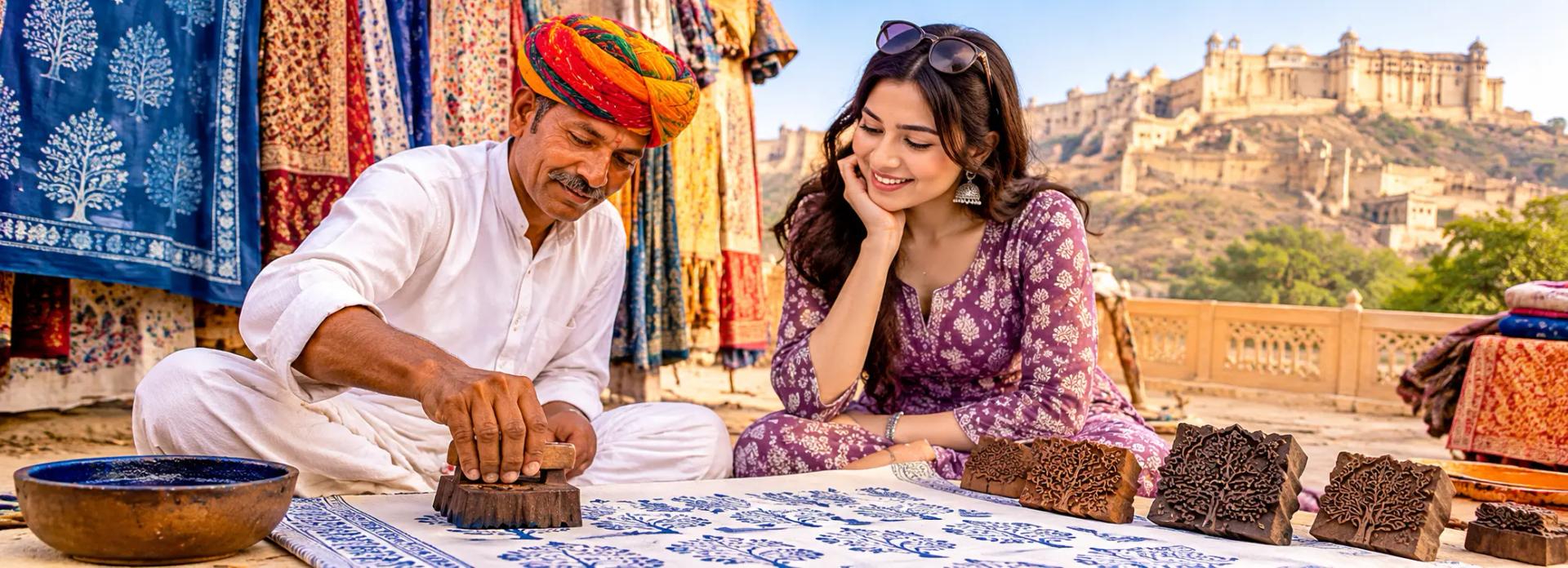
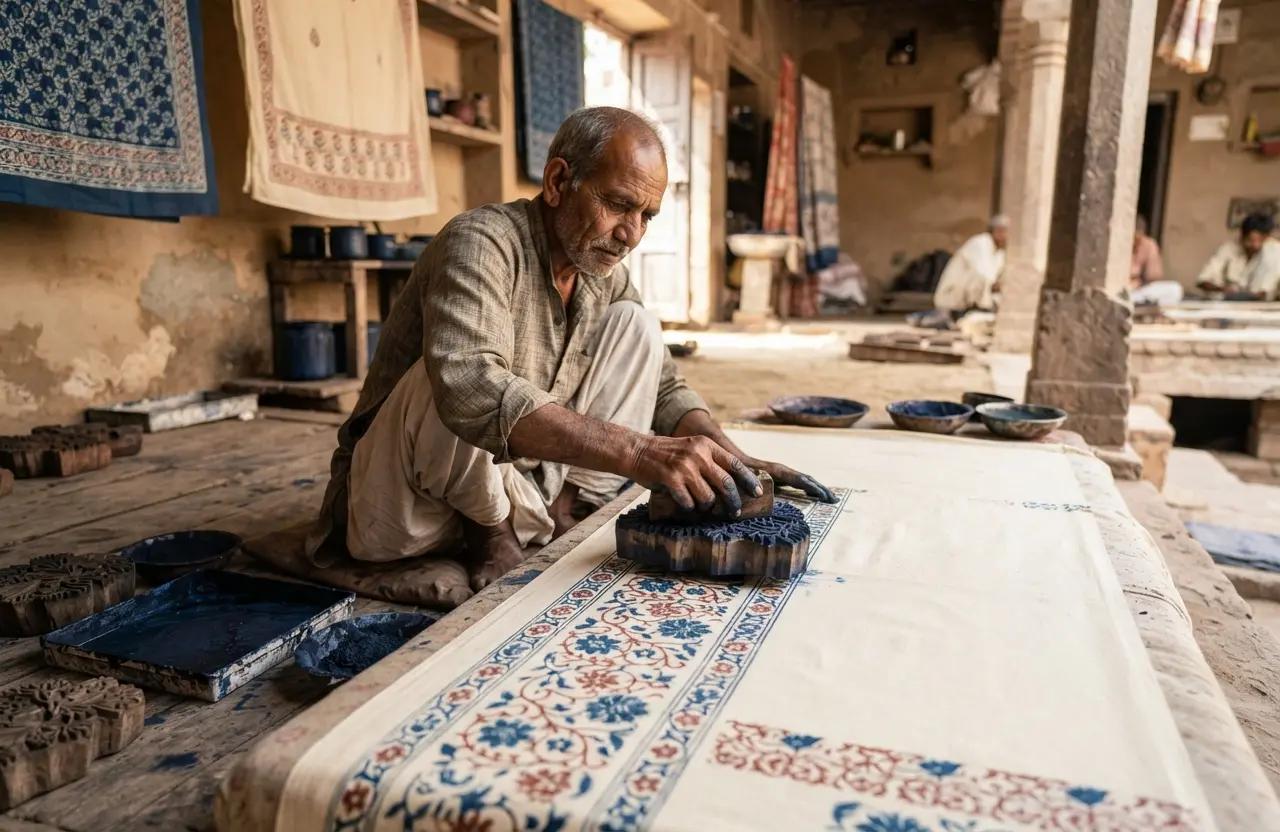
Imagine a morning in Bagru, near Jaipur. You arrive at a family workshop where cloth is drying in long lines in the sun. The master printer shows you his wooden blocks, carved by hand with tiny patterns, and explains how the colours are made from natural materials: indigo for blue, madder for red, iron and jaggery for black. You watch him press the block onto the cloth with a firm tap, again and again, each print lining up perfectly with the last. Then it is your turn, and you discover how much skill those easy movements hide.
After a simple lunch with the family, you visit the dye vats and the river where the cloth is washed. In the late afternoon you return to Jaipur, carrying a scarf you printed yourself and a deeper respect for every hand-printed cloth you will ever see.
Ways to experience food and craft
Cook with a family. Learn regional recipes in a home kitchen, from Rajasthani curries to Kerala fish moilee, and share the meal together.
Walk a market. Explore spice markets, vegetable bazaars and textile lanes with a local guide.
Visit tea, coffee and spice estates. See how tea is plucked in Darjeeling or Munnar, how coffee is grown in Coorg and how cardamom and pepper are harvested in Kerala.
Try a craft yourself. Join a block printing, pottery or weaving workshop.
Meet collectors and designers. Visit museums, textile collections and design studios in Ahmedabad, Jaipur and beyond.
Who these journeys suit
Food and craft journeys suit anyone curious about how things are made. Designers, artists and textile collectors come for specialist knowledge. Home cooks and food lovers come to taste and learn. Families enjoy hands-on workshops, and many travellers add a few craft visits to a wider journey.
Food and craft through the year
| Season | Where to go | Notes |
|---|---|---|
|
October to March |
Rajasthan, Gujarat, Uttar Pradesh, South India |
Best weather for village workshops |
|
December to February |
Kutch and Gujarat |
Peak craft and festival season |
|
March to May |
Tea gardens of Darjeeling and Assam |
First flush tea season |
|
Year-round |
City workshops and cooking classes |
Indoor activities in any season |
Food and craft through the year
What our guests take home
Guests return with treasures and stories: a hand-printed tablecloth, a silk scarf, a carved toy, a box of spices and the memory of the people who made them. Many say these journeys changed how they shop and cook at home, and gave them a deeper connection with India than any monument.
Combining craft and food with other themes
Craft and food fit naturally into many journeys. A Rajasthan heritage tour can include block printing and cooking classes. A Gujarat journey can combine Kutch crafts with the White Rann and Gir's lions. A Kerala holiday can add spice estates and cooking, and a Varanasi visit can include silk weavers. Tell us your plans and we will weave in the right visits.
India's great textiles at a glance
India's textile traditions are so many that even experts keep learning. Here are a few of the most famous, and where to see them made.
| Textile | What it is | Where |
|---|---|---|
|
Block printing |
Patterns printed by hand with carved wooden blocks |
Sanganer and Bagru, Rajasthan; Ajrakhpur, Gujarat |
|
Bandhani or bandhej |
Tie-dye made of thousands of tiny knots |
Gujarat and Rajasthan |
|
Patola |
Double ikat silk, dyed before weaving |
Patan, Gujarat |
|
Banarasi brocade |
Silk woven with gold and silver thread |
Varanasi, Uttar Pradesh |
|
Chikankari |
Fine white embroidery on light cotton |
Lucknow, Uttar Pradesh |
|
Kanchipuram silk |
Heavy silk saris with rich borders |
Kanchipuram, Tamil Nadu |
|
Kalamkari |
Cloth painted or printed with natural dyes |
Andhra Pradesh |
|
Muga and eri silk |
Wild silks with a natural golden or soft finish |
Assam |
India's great textiles at a glance
Spice, tea and coffee
India's spices drew traders across oceans for centuries, and many guests love to see where they grow. In Kerala's hills around Thekkady, spice gardens grow cardamom, pepper, cinnamon and nutmeg, and you can walk through them with a farmer. Coorg in Karnataka is coffee country, with plantation homestays and tastings. Tea lovers can visit the gardens of Darjeeling, Assam and Munnar, see the leaves plucked by hand and taste fresh tea at the factory. These visits combine food, nature and history in a single day.
Where you stay
On craft and food journeys, we choose hotels that add to the experience: heritage havelis in Jaipur's old city, restored homes in Ahmedabad, plantation bungalows in Coorg and tea estate stays in Darjeeling and Munnar. At each level of comfort, we look for places with character and good local food.
Shopping well
Buy at the source. Workshops and cooperatives often sell directly, and your money goes to the makers.
Learn to spot handmade. Hand block prints have small variations; machine prints repeat perfectly. Handwoven silk has a slightly uneven texture.
Ask about natural dyes. Many artisans are proud of their natural colours and happy to explain them.
Ship larger items. Carpets, furniture and large textile orders can be shipped home. We help you arrange it safely.
Regional cooking classes
Cooking with local hosts is one of the most popular parts of our food journeys, and every region teaches something different. In Jaipur or Udaipur, you might learn to make dal, a vegetable curry and fresh chapati on a home stove. In Lucknow, a cook may show you the slow dum method used for biryani. In Kerala, you can grind coconut and spices for a fish curry, and in Goa you can learn the secrets of a good xacuti. In Gujarat, a family can teach you a full vegetarian thali, with sweet, sour and spicy dishes in balance.
Classes are relaxed and friendly. You shop for ingredients in a local market with your host, cook together in the kitchen, and then sit down to eat what you made, often with the whole family. You leave with recipes, new skills and stories you can share at home.
Practical tips
Bring space in your luggage. You will probably buy more than you expect. We can arrange shipping for larger items.
Ask before photographing. Most artisans are happy to be photographed at work, but always ask first.
Understand the price. Handmade work takes time. Ask how long a piece took before you bargain.
Food safety. Eat freshly cooked food and drink filtered or bottled water. Our guides recommend trusted places.
Dietary needs. Tell us about allergies or dietary rules, and we will brief hosts and hotels.
Travelling with respect
We plan craft and food visits that are fair to the families involved, with fees paid for workshops and cooking sessions. We encourage guests to buy directly from makers, to avoid mass-produced copies sold as handmade, and to respect the time and privacy of the people who welcome them into their homes.
Start planning your journey
Tell us which crafts or cuisines interest you and when you would like to travel. We will send a first route with workshops, hotels at each level and an indicative price. You can reach us at info@bizarexpedition.com or on +91 95604 08806.
Best Selling food craft and textile tours india
Book exciting food craft and textile tours india with BizareXpedition Updated On: Nov 24, 2026
Frequently Asked Questions (FAQs) & People Also Ask — food craft and textile tours india Tour Packages
We help you prepare for your trip and ensure an effortless and enjoyable travel experience.