
Published On - Jul 18, 2026
Updated On - Sep 01, 2026
25 min
Kashmir: The Complete Travel Guide for 2026
Everything the other guides leave out — houseboat categories the government actually assigns, the gondola's real booking mechanics, an honest 2026 safety picture, and a cost breakdown built from what you'll genuinely spend, not what makes a good headline
I have driven the road from Srinagar to Sonamarg in a spring snow flurry one April, and I have sat on a Dal Lake houseboat deck in June with a cup of kahwa going cold in my hands because I could not stop looking at the water. Kashmir does this to people. It is the one Indian destination where the postcard and the reality are, improbably, the same place.
But the guides written about it mostly are not. Search "Kashmir travel guide 2026" and you will find fifteen versions of the same five paragraphs — Dal Lake is beautiful, Gulmarg has a gondola, go in April or go in winter, book early. All true. None of it tells you which houseboat category you are actually being sold, what the gondola's booking window really looks like on the ground, or what changed on the roads this year that makes 2026 genuinely different from 2024.
This guide is built to answer the questions you would only get by asking someone who has actually done the planning — the boring, specific, money-and-time-saving kind of detail that separates a good trip from a great one.
Kashmir at a Glance
| Detail | Information |
|---|---|
|
Best overall window |
Mid-March to late April — tulips, residual snow, and mid-range prices together |
|
Ideal trip length |
6–7 nights for Srinagar, Gulmarg, Pahalgam and Sonamarg without rushing |
|
Entry point |
Srinagar Sheikh ul-Alam International Airport (SXR), or the new Katra–Srinagar rail link |
|
Realistic budget (per person, 7 days) |
₹25,000 budget · ₹45,000 mid-range · ₹90,000+ luxury, excluding flights |
|
Permits needed |
None for Indian or foreign nationals in the standard tourist circuit (Srinagar–Gulmarg–Pahalgam–Sonamarg) |
|
Local transport rule |
Outside-state taxis cannot be used for in-valley sightseeing — you will need a registered local vehicle regardless of how you arrive |
Kashmir at a Glance
When to Go — And Why the Month Matters More Here Than Almost Anywhere Else
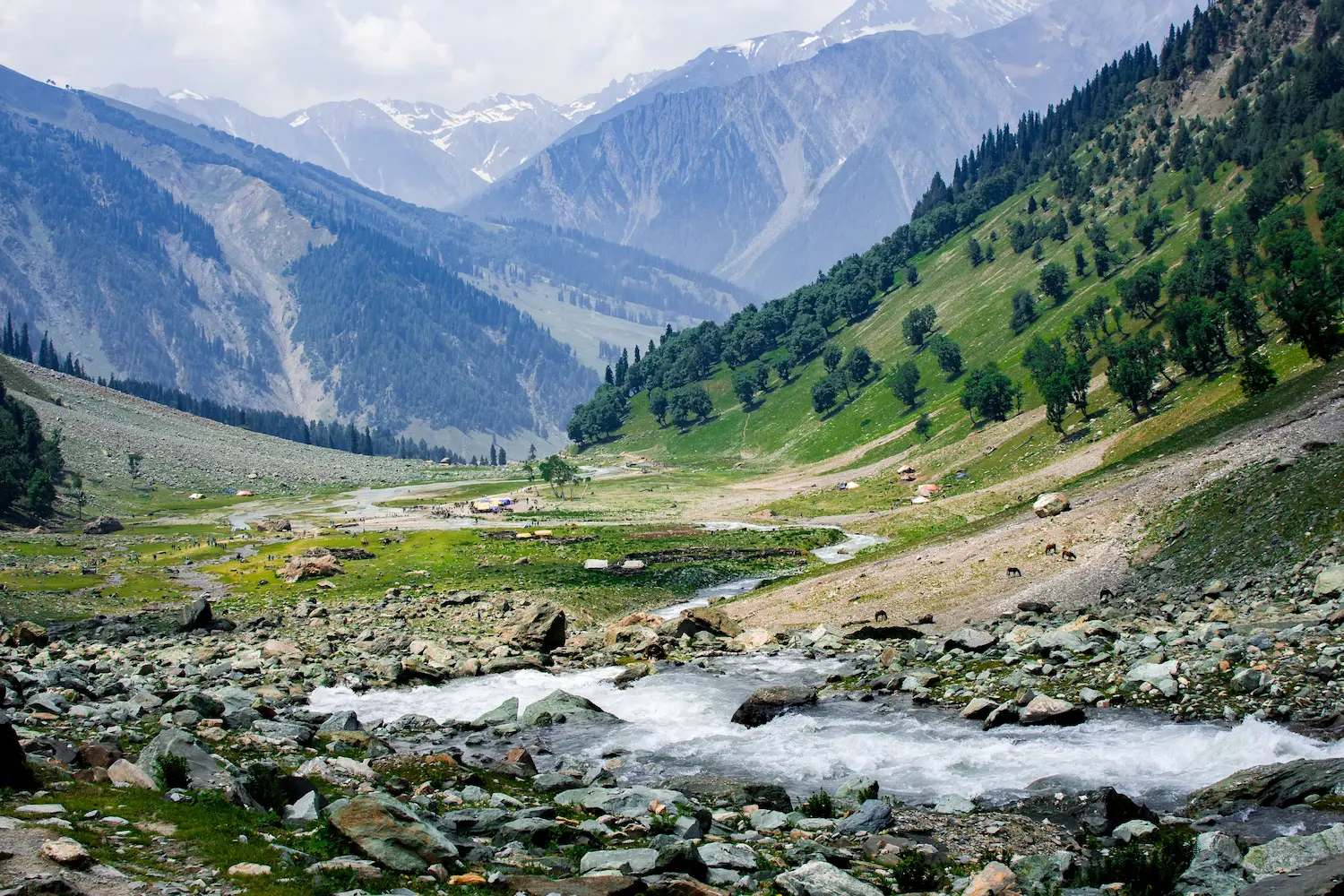
Kashmir does not have one travel season, it has four completely different destinations wearing the same name. A Gulmarg you visit in February — thigh-deep powder, the gondola queued with skiers — has almost nothing in common with the Gulmarg of June, a green bowl of a valley with picnicking families and a golf course. Choosing your month is not a minor scheduling detail here; it is the single decision that determines what trip you are actually taking.
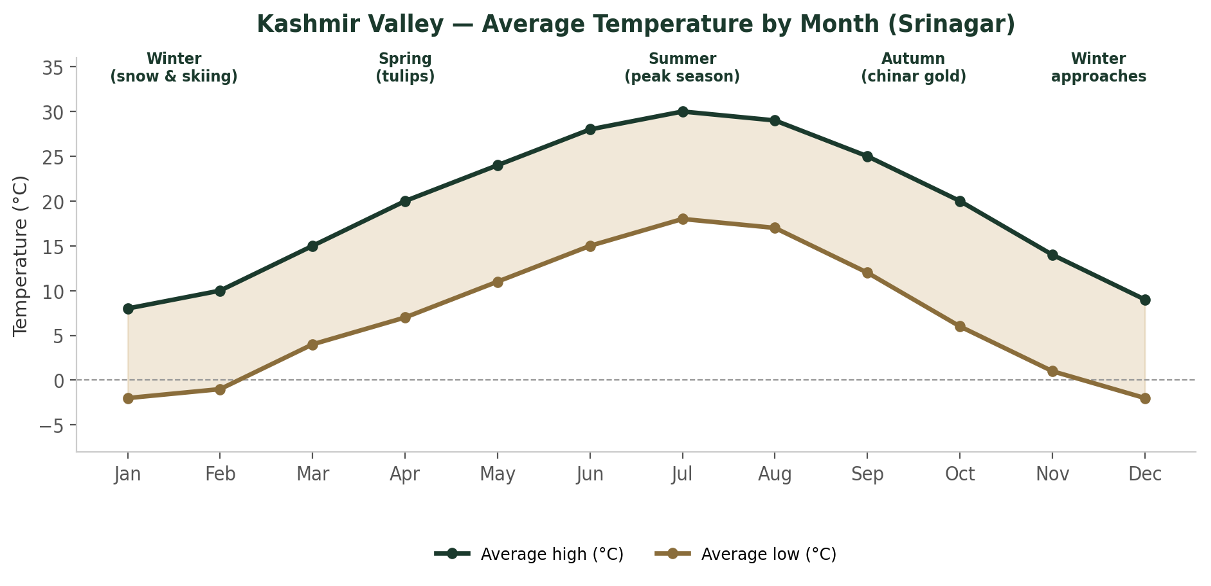
| Season | Months | What You Get | Trade-off |
|---|---|---|---|
|
Spring |
Mid-Mar – Apr |
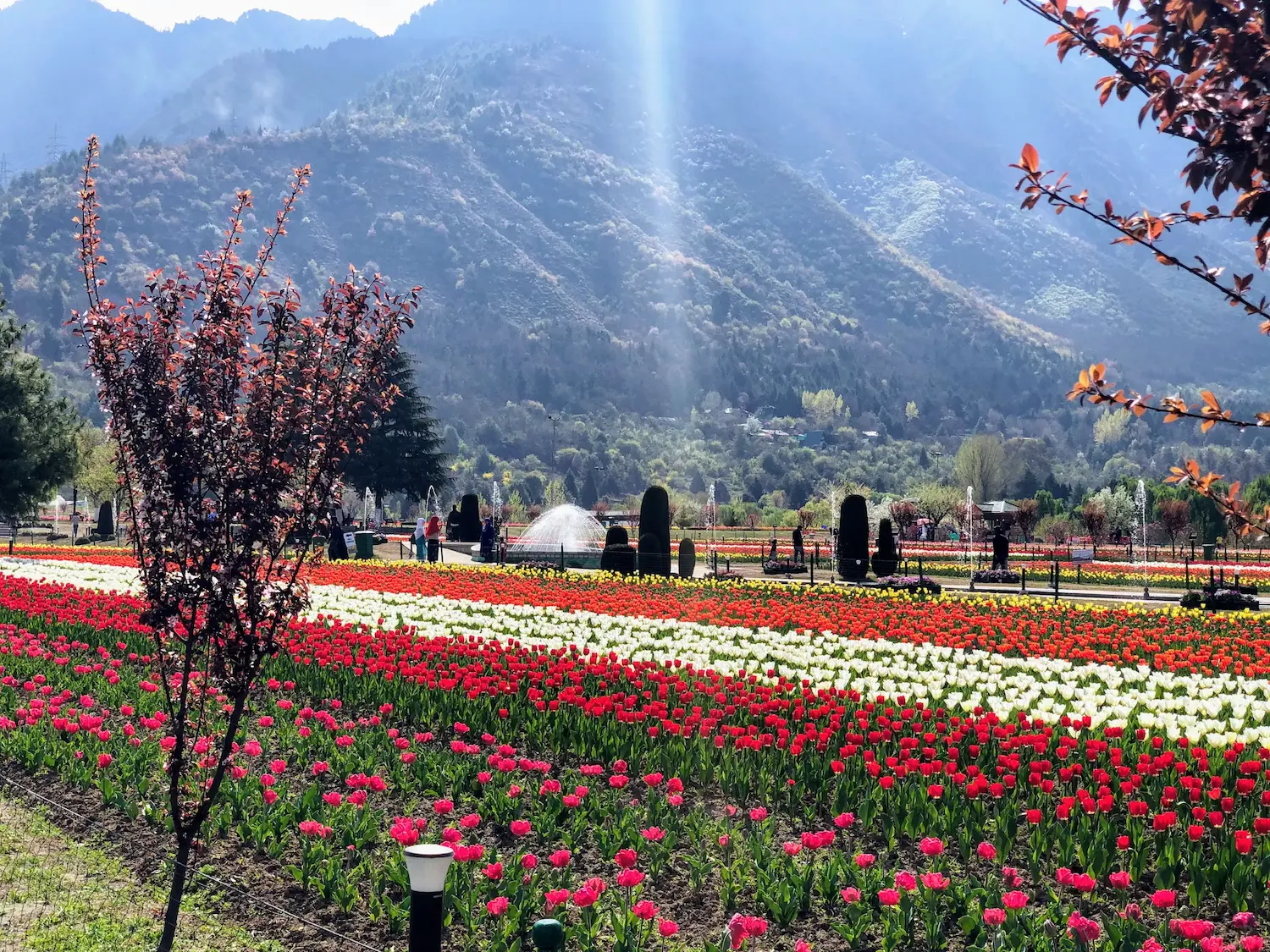
Tulip Garden in bloom (Asia's largest — 1.5M+ tulips), residual snow up high, mild days |
Books out 30–45 days ahead; prices climb fast once tulips open |
|
Early Summer |
May – Jun |
Every road open, all activities running, best for families |
Peak crowds and peak prices; school-holiday rush from mid-May |
|
Monsoon |
Jul – Aug |
Fewer tourists, lower prices, lush green valley — genuinely underrated |
Occasional landslide-related road delays; carry buffer days |
|
Autumn |
Sep – Oct |
Chinar trees turn gold and red, clear skies, thinning crowds — many operators' own pick for photography |
Sonamarg road typically closes by November; book shoulder-season deals early |
|
Winter |
Dec – Feb |
Gulmarg skiing at its best, snow-covered valley, romantic houseboat-with-bukhari evenings |
Sub-zero nights, some upper routes weather-dependent, heavier packing |
When to Go
If this is your first trip and you cannot decide: go in April. You get the tulips, the last of the snow on the peaks, and — unlike May or June — you are not fighting the entire country's summer holiday for a hotel room.
Getting There — What Changed in 2026
Two infrastructure shifts genuinely change the calculus this year, and most guides mention them only in passing.
The Katra–Srinagar rail link is now operational, giving travellers a scenic, weather-resilient alternative to the Jammu–Srinagar highway — useful if you are combining a Vaishno Devi visit with the valley, or simply want a backup if winter flights are delayed.
The Z-Morh Tunnel near Sonamarg has removed one of the valley's most reliable winter bottlenecks. Sonamarg, previously a summer-only excursion, is now far more accessible through the shoulder season and into early winter.
By air remains the fastest and most reliable route for most travellers — Srinagar Airport connects directly to all major Indian metros, with flight time under 90 minutes from Delhi. By road, NH44 from Jammu through the Jawahar Tunnel is scenic but weather-dependent; budget a full day and treat it as part of the experience, not a race.
The one rule almost nobody explains clearly: Kashmir's taxi unions restrict outside-state vehicles from in-valley sightseeing. Whether you fly, drive, or take the new train, you will still need to hire a registered local vehicle once you arrive — factor this into your cost planning from day one, not as a surprise at your hotel desk.
Where to Stay — The Houseboat Question Nobody Explains Properly
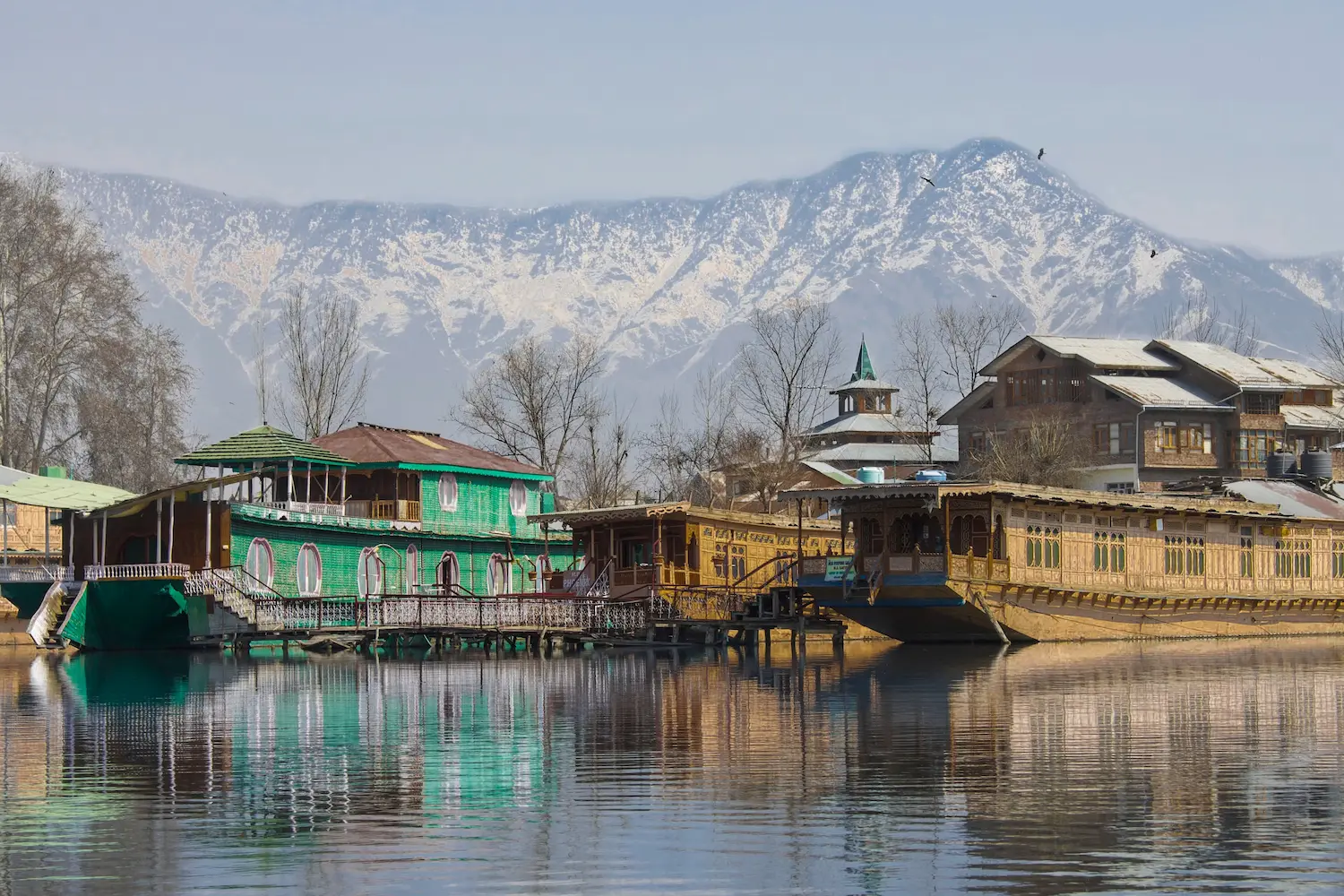
Every Kashmir guide tells you to stay on a houseboat. Almost none tell you that the Jammu & Kashmir Tourism Department has classified all 1,087 registered houseboats on Srinagar's lakes into five fixed categories — Deluxe, A, B, C, and D — with rate cards set by the Kashmir Houseboat Owners' Association. Knowing this before you book is the difference between paying a fair rate and paying whatever an enthusiastic tout quotes you on the ghat.
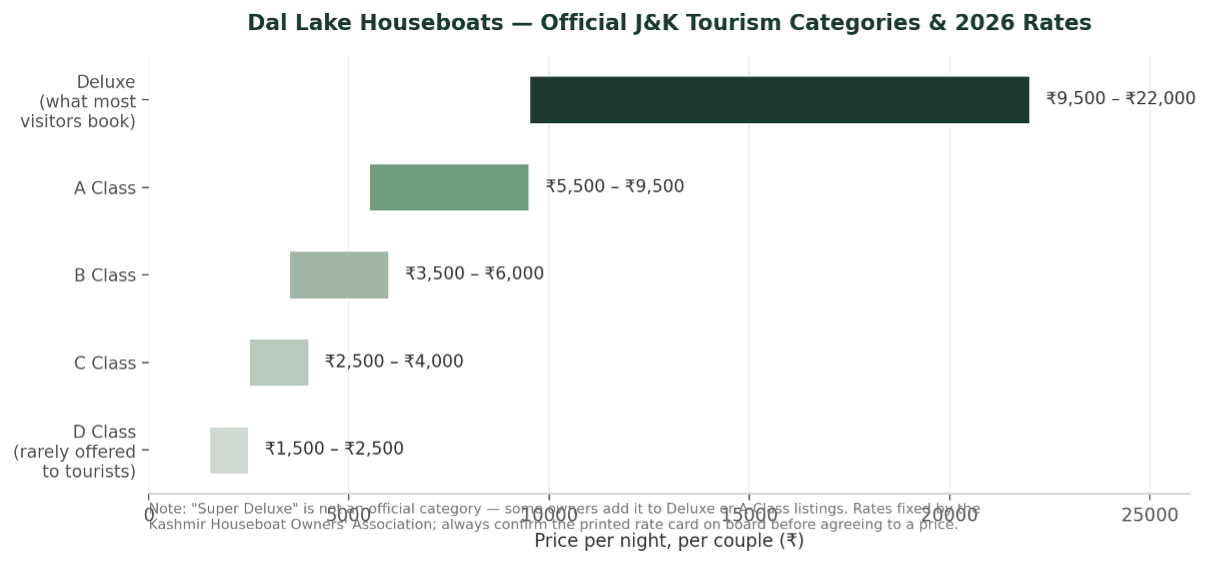
A genuinely useful fact most articles skip: there is no official "Super Deluxe" category. Some owners append it to a Deluxe or A-Class listing to justify a higher quote — ask to see the printed government rate card, which every registered houseboat is required to display.
702 of the 1,087 registered houseboats are on Dal Lake itself — lively, scenic, and the most touristed water in the valley.
Nigeen Lake, a short distance away, holds a smaller cluster and is consistently quieter — the better choice if you want the houseboat experience without the floating-market bustle.
Ask specifically for a mooring near Ghat 12–16 on Dal Lake if sunrise views matter to you; boats further down the row often face a neighbouring houseboat rather than open water.
If you would rather not gamble on a walk-up booking, this is exactly the kind of ground-level detail a private operator resolves before you land — matching the category, lake, and mooring to what you actually want rather than what's available that evening.
The Real Itinerary — Three Ways to Do Kashmir Properly
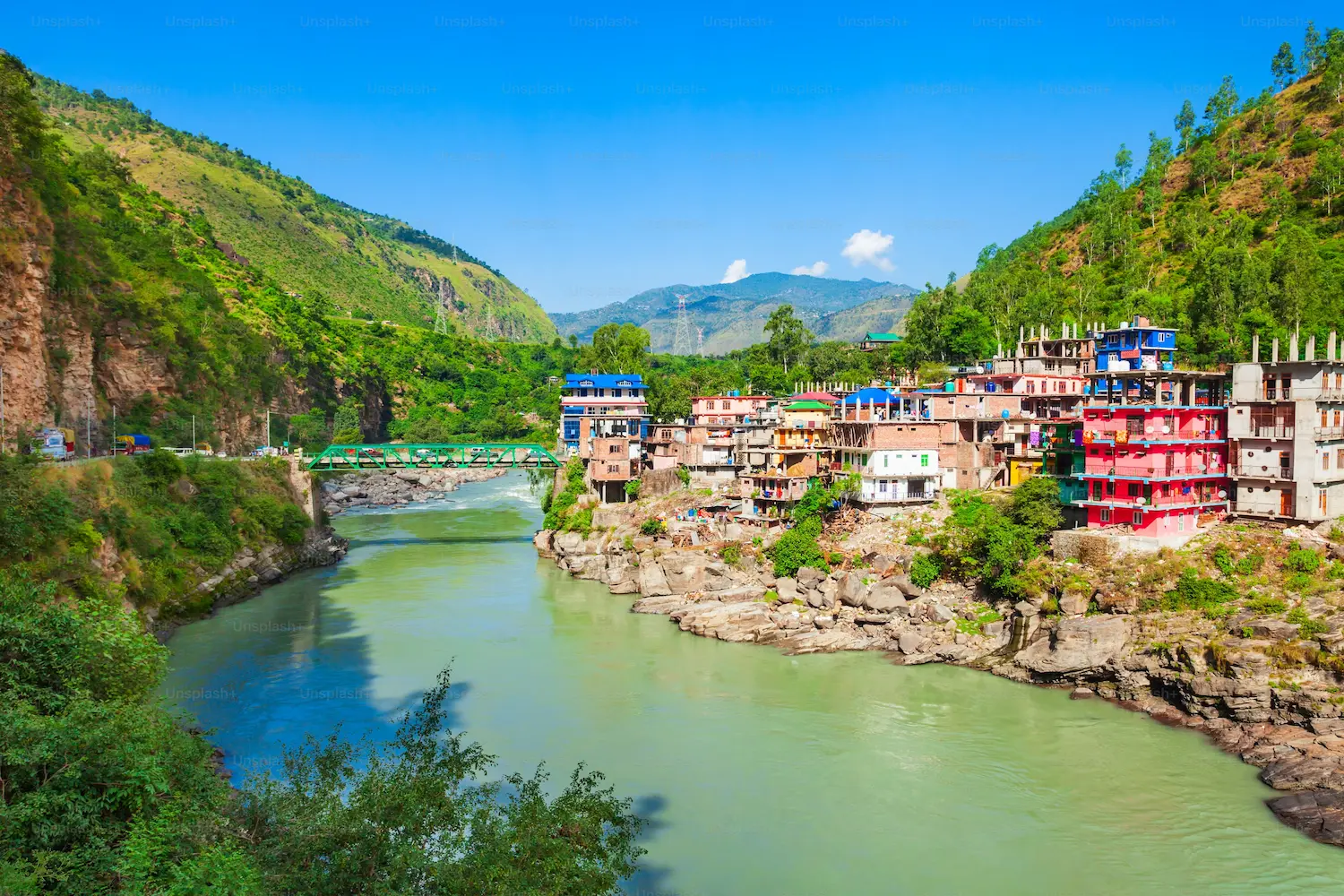
Kashmir rewards a slower pace than most first-time visitors plan for. Rushing Srinagar–Gulmarg–Pahalgam–Sonamarg into four days means four half-days of driving. Here is what actually fits comfortably.
| Duration | Route | Best For |
|---|---|---|
|
5 nights / 6 days |
Srinagar (2N) → Pahalgam (2N) → Gulmarg (1N) |
First-timers on a tighter schedule who still want all three core destinations |
|
6 nights / 7 days |
Srinagar (3N) → Sonamarg (1N) → Pahalgam (2N) → Gulmarg (1N) |
The benchmark itinerary — unhurried, covers everything, one night to spare for a houseboat upgrade |
|
9 nights / 10 days |
Srinagar (3N) → Gulmarg (2N) → Pahalgam (2N) → Sonamarg (1N) → Doodhpathri or Yusmarg (1N) |
Travellers who want the offbeat meadows most visitors never see, at a genuinely relaxed pace |
Three Ways to Do Kashmir Properly
A practical note on sequencing: put Gulmarg toward the end of your trip if you can. It sits at higher altitude than Srinagar, and giving your body a night in the valley first — as several operators now explicitly recommend — makes the gondola's upper station noticeably more comfortable.
The Gulmarg Gondola — A Practical Guide, Not Just a Photo Opportunity
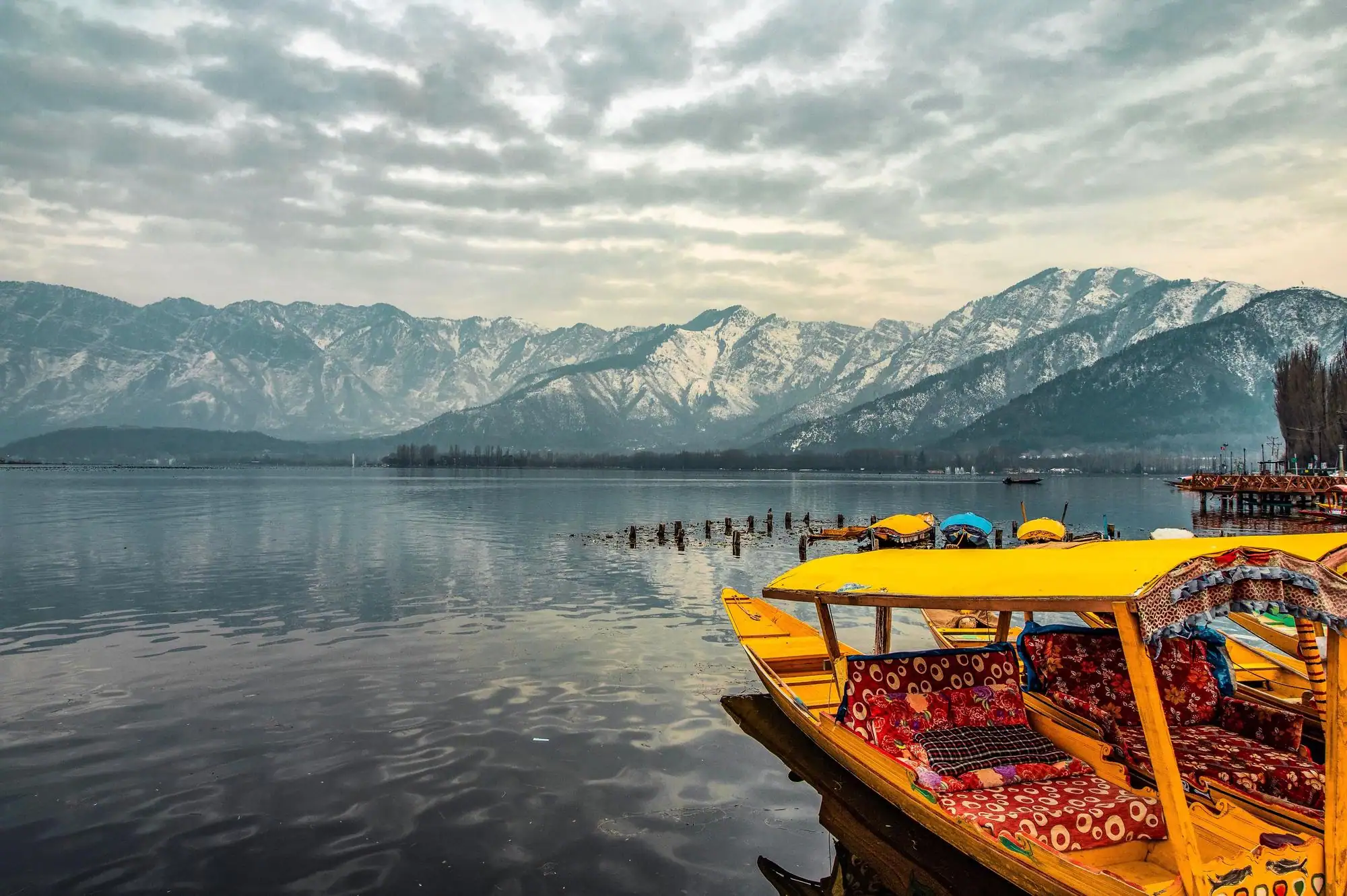
The gondola is the single most bottlenecked booking in Kashmir tourism, and the mechanics of getting a ticket have changed enough in the last two years that older guides are actively wrong about it.
| Detail | Phase 1 (Gulmarg → Kongdoori) | Phase 2 (Kongdoori → Apharwat) |
|---|---|---|
|
Altitude reached |
~2,650m |
~4,200m (Apharwat Peak) |
|
Standard ticket (2026) |
≈ ₹800 |
≈ ₹1,000 |
|
Tatkal ticket (next-day, released 5pm daily) |
≈ ₹1,110 |
≈ ₹1,310 |
|
Ride time |
10–15 minutes |
12–20 minutes |
|
Booking rule |
Book directly |
Requires your Phase 1 transaction ID — cannot be booked standalone |
The Gulmarg Gondola
As of 2026, there is no offline ticket counter — all bookings run through the official JKCCC portal, and only that portal. Booking through an unofficial "agent" site is the single most common tourist complaint associated with the gondola. Book 15–20 days ahead in peak windows (December–February and May–June); if you arrive without a booking, the Tatkal window opens for roughly five minutes each evening at 5pm for the following day — have your passenger details pre-filled and ready.
Phase 2 sits above 4,000 metres. Mild altitude effects are genuinely possible even on a short visit, particularly for children — the standard advice from operators is to hydrate well beforehand and descend if anyone feels unwell, rather than push through it for the view.
What Nobody Tells You
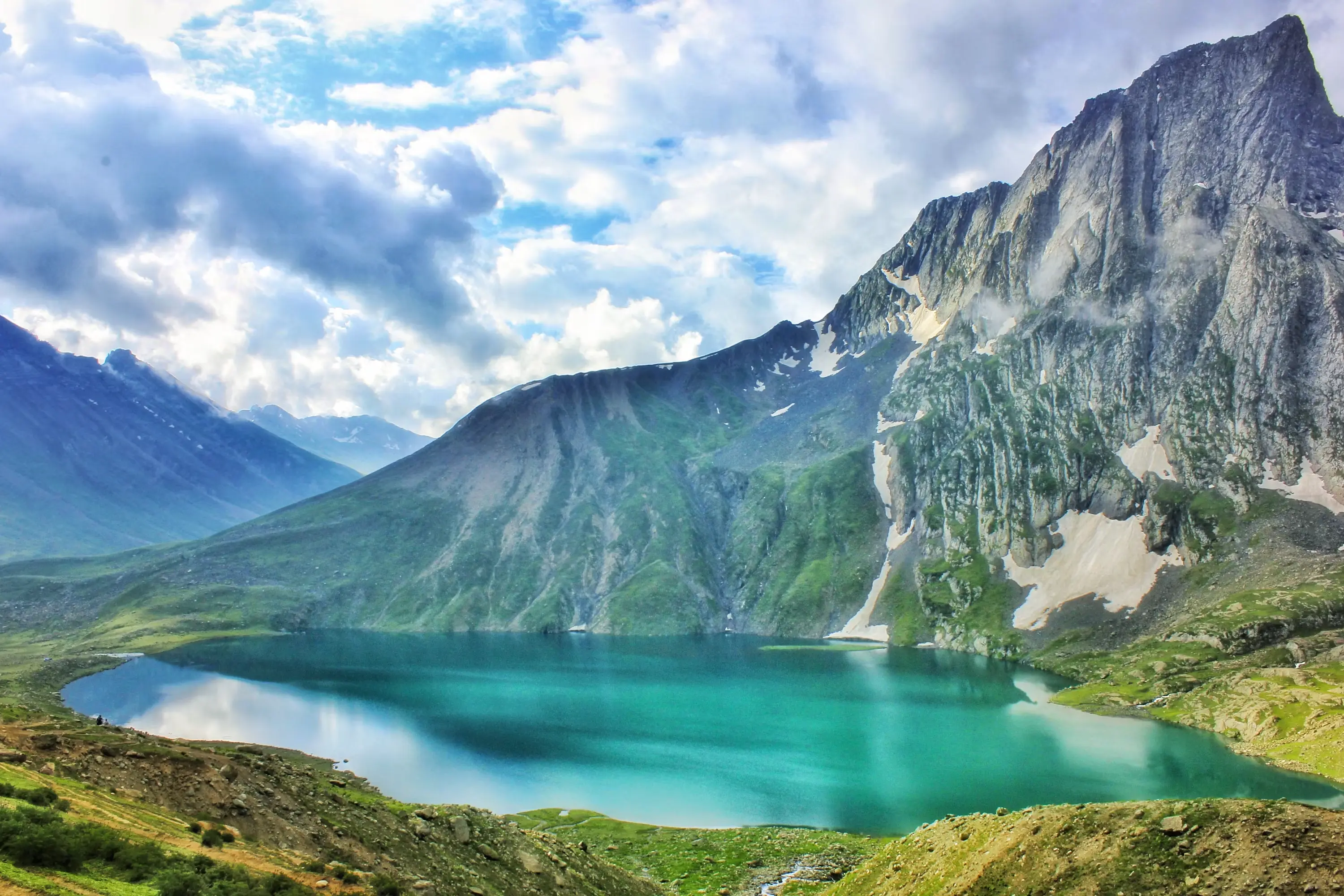
The Pashmina Test That Actually Works: Genuine pashmina is hand-spun from Changthangi goat undercoat and will pass through a ring roughly the size of a finger — that is the famous "ring test." But it is not foolproof; skilled fakes can pass it too. The more reliable check: ask for the GI (Geographical Indication) tag, introduced specifically to certify authentic Kashmiri pashmina, and buy from a shop that can show you the weaving in progress rather than a stall that only sells finished pieces. Lal Chowk and Polo View Market are both genuine shopping districts, but genuine location does not guarantee genuine product — the certification does.
Bargaining on a Houseboat Isn't Rude — It's Expected: The printed rate card is a ceiling, not a fixed price, particularly outside peak season. Politely asking to see the card and negotiating from there is standard practice, not an imposition.
The Bukhari Isn't Decorative: If you're visiting between November and March, the traditional wood-fired bukhari heater in your houseboat room is doing real work, not adding ambience — most Deluxe and A-Class boats charge a modest daily heating fee (historically around ₹1,800) on top of the room rate in winter months. Confirm this is included before you book, not after you're cold.
Safety in 2026 — An Honest Answer, Not a Reassurance
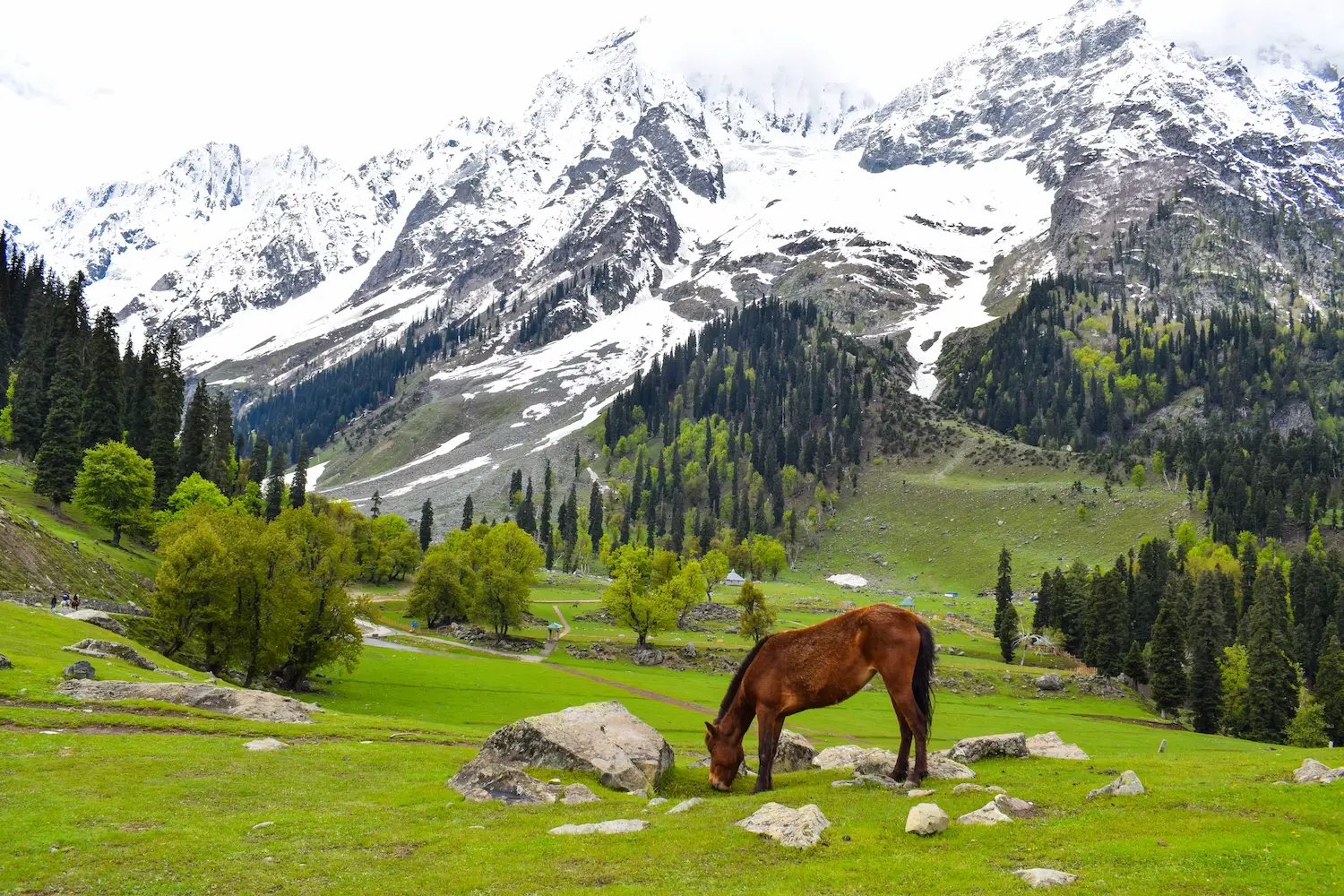
This deserves a direct answer rather than the vague optimism most tourism content defaults to. Jammu & Kashmir experienced a serious, widely reported attack on tourists in Pahalgam in 2025. It was, by every account, an exceptional event rather than a pattern — authorities responded immediately, and the response from Kashmir's own tourism-dependent communities was one of visible solidarity with visitors. It did not deter the valley's recovery: J&K recorded over 16 million visitors in 2025, with 2026 on track to be higher still.
What this means practically: the standard tourist circuit — Srinagar, Gulmarg, Pahalgam, Sonamarg — operates under a heavier and more visible security presence than before, with tourist police helplines, QR-based verification for registered activity operators in Pahalgam specifically, and monitored transport corridors. The overwhelming majority of travel disruptions reported in the last year have been weather-related, not security-related — road closures from snow or landslip, not incidents involving tourists.
Book through registered operators and licensed local guides — this is not a formality, it is how you access verified transport and current, accurate ground information.
Check the J&K Tourism Department's official advisories close to your travel date rather than relying on social media.
Build one buffer day into any itinerary over five nights — for weather, not security.
Avoid planning independent excursions into border-adjacent or unlisted areas; the standard tourist circuit has no such restrictions.
Solo female travel specifically: women travel Kashmir alone every season without major incident, and the practical advice is more cultural than security-related — Kashmir is a Muslim-majority valley without beach-resort norms, so covering shoulders and knees at religious sites, markets, and gardens makes for a noticeably smoother trip, not a required one.
What to Actually Eat
Kahwa — a green tea steeped with saffron, cinnamon, and crushed almonds — is Kashmir's welcome ritual, served on arrival at nearly every houseboat and homestay. It is not the same drink as the sweetened "Kashmiri chai" (noon chai) sold in Srinagar's markets, which is a salted pink tea, an entirely different and equally worth trying experience.
Wazwan, the traditional multi-course Kashmiri feast, is built almost entirely around meat — rista, rogan josh, and gushtaba are the dishes to specifically ask for if a houseboat or hotel offers a Wazwan evening, which most premium stays will arrange with advance notice rather than as a standing menu item.
What You Will Actually Spend
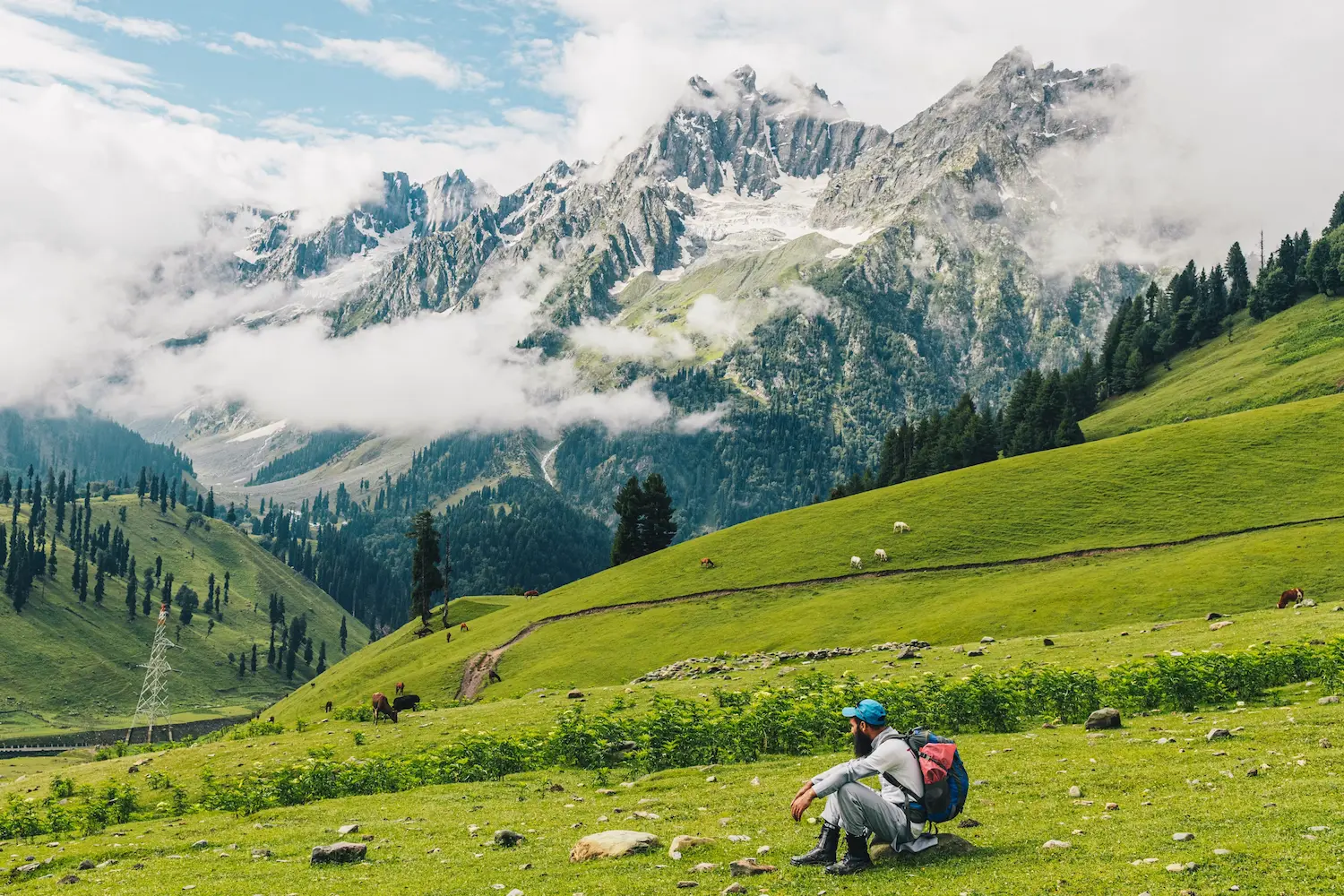
Most Kashmir cost guides quote a single number that means very little without context. Here is a realistic 7-day, per-person breakdown across three genuinely different ways to do this trip — excluding flights, which vary too widely by origin city to average meaningfully.
| Detail | Budget | Mid-Range | Luxury |
|---|---|---|---|
|
Stay |
Guesthouses, shared taxis |
3-star hotels, A-Class houseboat night |
Deluxe houseboat + boutique hill hotels |
|
Transport (in-valley) |
Shared taxis, buses |
Private taxi for transfers |
Private chauffeur throughout |
|
Food |
Local dhabas |
Mix of hotel dining and local restaurants |
Curated Wazwan evenings, premium dining |
|
Activities |
Minimal — Gondola Phase 1 only |
Gondola both phases, Shikara ride, garden entries |
Private Shikara at sunset, full activity access, no queue time |
|
Total per person (7D/6N) |
₹18,000 – ₹25,000 |
₹35,000 – ₹50,000 |
₹90,000+ |
What You Will Actually Spend
The gap between mid-range and luxury in Kashmir is less about hotel star ratings and more about what you don't have to deal with — gondola queues, taxi negotiations, and houseboat category guesswork all disappear when a private operator is handling ground logistics.
Quick Answers
Do I need permits to visit Kashmir?
No — neither Indian nor foreign nationals need special permits for the standard tourist circuit (Srinagar, Gulmarg, Pahalgam, Sonamarg). Permits apply only to specific border-adjacent zones outside normal tourist routes.
Is October a good time to visit?
Genuinely one of the best-kept-secret windows — golden chinar trees, clear skies, and thinning crowds, at prices well below the spring and summer peak
Can I do Kashmir and Ladakh in one trip?
Yes, via the Srinagar–Leh highway, open roughly June through September. It's a full high-altitude road trip in its own right and deserves 10+ days if you're combining both.
How many days do I actually need?
Five nights is workable if rushed; 6–7 nights lets you see Srinagar, Gulmarg, Pahalgam, and Sonamarg without back-to-back long transfers.
Are houseboats safe and comfortable in winter?
Yes, provided you confirm heating (the bukhari fee) is included — Deluxe and A-Class boats are well-equipped for cold-weather stays and it's a genuinely different, cosier experience than summer.
Before You Go
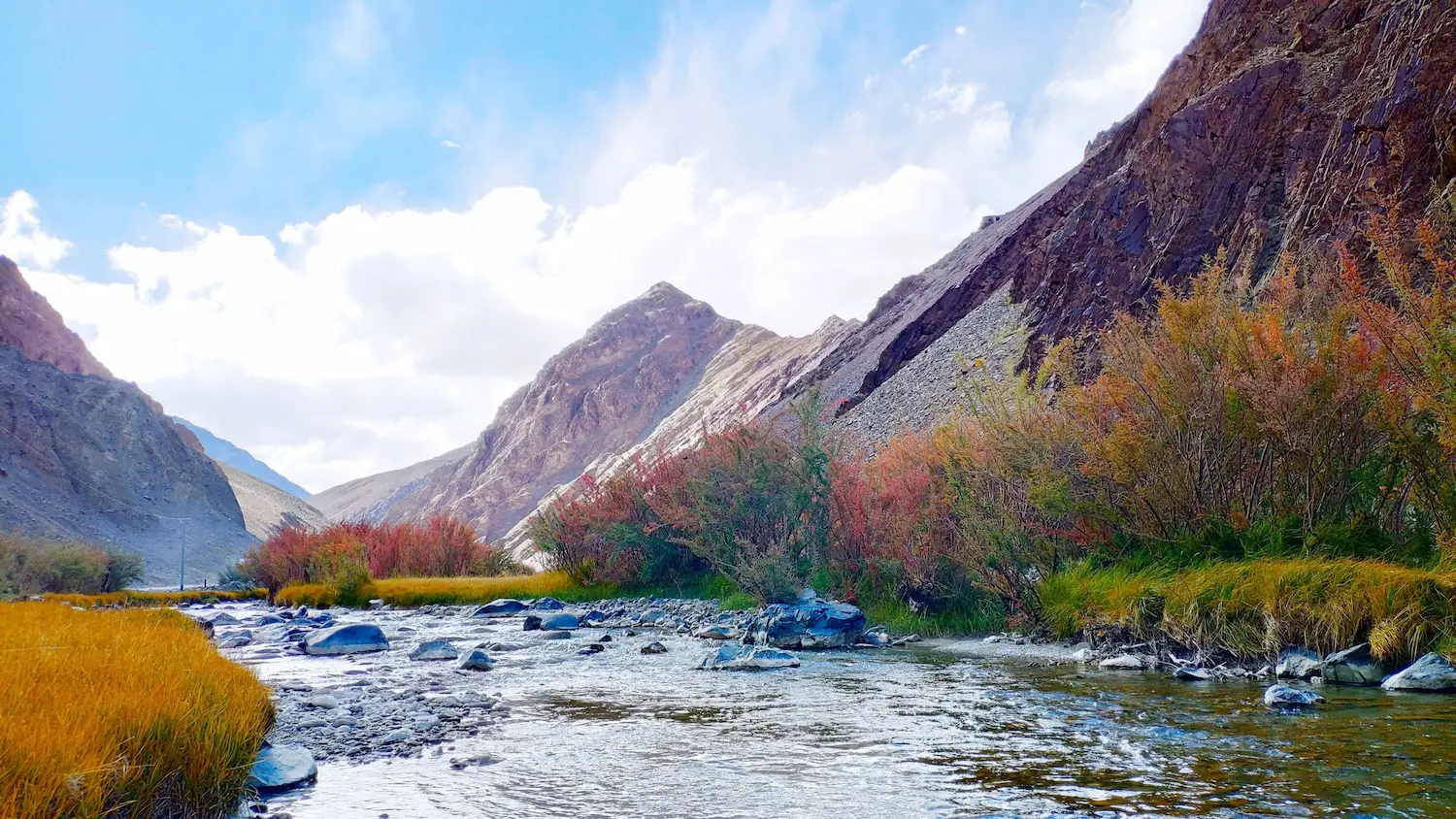
Kashmir is not a checklist destination, whatever the Instagram captions suggest. The valley rewards travellers who slow down enough to notice the difference between a Deluxe houseboat and an A-Class one, who book the gondola before they need it rather than after, and who treat the safety question with the same honesty this guide has tried to give it — informed, not anxious.
If you'd rather not manage the taxi-union rules, the gondola's tatkal window, and the houseboat rate cards yourself, that's precisely the ground-level work a private, no-group-coaches itinerary is built to absorb — from the sunset Shikara down to which mooring gets you the sunrise.
BizareXpedition's Kashmir Valley Classic — Srinagar, Gulmarg, Pahalgam and Sonamarg, privately guided, no group coaches — is built around exactly this itinerary. Ask us about the current houseboat and gondola booking windows before you plan your dates.
Best Selling Tour Packages
Explore other exciting options for your next adventure!