
Kerala Photography: Tea, Backwaters & Wildlife9N/10D
Kerala Photography: Tea, Backwaters & Wildlife
Start & City : Kochi
best deal price
₹
Without GST ₹90,657
per person on twin sharing
Choose your departure city, dates, and add guests to secure your tour.
Hurry, as seats fill up, prices rise! Book now!
1. Choose your departure date
Highlights
Photograph Fort Kochi's Chinese fishing nets twice: at work in the morning, and as silhouettes at sunset.
Watch a Kathakali actor paint his face from bare skin to full mask in the hour before the show, then shoot the performance.
Leave Munnar at 4 am by jeep for sunrise at Kolukkumalai, a tea estate above 2,100 metres whose factory still makes tea by the orthodox method on machines from the 1930s.
Photograph the endangered Nilgiri tahr on the grass slopes of Eravikulam National Park, which holds the largest population of this mountain goat in the world.
Take two Periyar Lake boats, the last of one afternoon and the first of the next morning, among the drowned trees left by the 1895 dam.
Sleep on a houseboat, then slip into the narrow Kuttanad canals by canoe at dawn, before the big boats start moving.
Stand on the quay at Vizhinjam fishing harbour at first light as the boats land the night's catch.
Shoot sunset from Kovalam's lighthouse headland, with the red-and-white tower above the curve of the beach.
Essence of Journey
The experiences that capture the true spirit of the entire trip.
| Day | Route | Distance | Major Highlights |
|---|---|---|---|
| Day 1 | Arrive Kochi, transfer to Fort Kochi | ~40 km, 1 to 1.5 hrs | Chinese fishing nets at sunset |
| Day 2 | Fort Kochi and Mattancherry | Local | Nets at work, Jew Town, Kathakali make-up and show |
| Day 3 | Fort Kochi to Munnar | ~140 km, 4 to 4.5 hrs | Cheeyappara and Valara falls, first tea-hill sunset |
| Day 4 | Munnar: Kolukkumalai and tea valleys | Jeep ~32 km each way | Sunrise at Kolukkumalai, orthodox tea factory, Tea Museum |
| Day 5 | Eravikulam, then Munnar to Thekkady | ~15 km + ~105 km, 3.5 hrs | Nilgiri tahr, afternoon Periyar boat |
| Day 6 | Thekkady (Periyar) | Local | First boat of the day, spice garden, Kalaripayattu |
| Day 7 | Thekkady to Alleppey houseboat | ~165 km, 4 to 4.5 hrs | Board at noon, backwater light, moor at dusk |
| Day 8 | Houseboat to Kovalam | ~158 km, 3.5 to 4 hrs | Dawn canoe in the narrow canals, lighthouse sunset |
| Day 9 | Kovalam: Vizhinjam and Poovar | Local, ~40 km | Fishing harbour at dawn, Poovar estuary at sunset |
| Day 10 | Kovalam to Thiruvananthapuram airport | ~15 km, 30 mins | Departure |
About
Most Kerala holidays are planned around hotel check-in times and sightseeing schedules.. This one is planned around the light. Our 10 days Kerala photography tour is designed for photographers who want to capture the state at its most beautiful. You get mist on the Munnar tea hills at dawn, elephants beside the drowned trees of Periyar Lake, a night on a backwater houseboat, and fishing boats landing their catch at first light. You travel with your own car and driver, and a local photography guide who knows exactly where to stand.
You don't need to be a professional. You just need to care about the pictures you bring home.
What Is This Tour?
The BizareXpedition Kerala Photography Expedition is a private, 10-day tour of South India's Kerala state, timed for sunrise and sunset. It covers Fort Kochi, the Munnar tea estates, Periyar Tiger Reserve, the Alleppey backwaters and the Kovalam coast. It includes hotels, a private vehicle, a local photography guide, park entries, two Periyar boat safaris, a houseboat night and a dawn canoe ride. Prices start at about ₹90,657 per person, twin sharing.
Four Kinds of Light in One Trip
Kerala packs a lot into a small space. Within about 730 km of driving, you move through four very different settings:
Harbour light in Fort Kochi. Chinese fishing nets at work in the morning, and as black shapes against the sunset.
Mountain mist in Munnar. Tea rows that look combed from above, and cloud filling the valleys below Kolukkumalai at sunrise.
Still water at Periyar and on the backwaters. Reflections, wading birds, and rice fields that sit below the level of the canal beside them.
Working light on the coast. The quay at Vizhinjam harbour at dawn, and sunset from Kovalam's lighthouse headland.
The route runs one way, hills first and coast last. You never double back, no drive is longer than about 165 km, and you fly out from Thiruvananthapuram, just 15 km from your last hotel.
What You'll Photograph
Kolukkumalai tea estate at sunrise. A 4 am jeep ride takes you up to one of the highest tea estates in the world, above 2,100 metres. On clear mornings the sun comes up over a sea of cloud, with tea bushes in the foreground. Afterwards you walk through a factory that still rolls tea on machines from the 1930s.
Nilgiri tahr in Eravikulam National Park. This endangered mountain goat lives only in the Western Ghats, and Eravikulam has the largest population anywhere. They often graze close to the path, so a 70–200 mm lens is enough.
Two boat safaris on Periyar Lake. Periyar Lake was made in 1895, when a dam flooded a forested valley. The dead tree trunks still stand in the water. You take the last boat of one afternoon and the first boat of the next morning, so you get both kinds of light and two chances to see elephants, gaur and sambar at the shore.
Kathakali make-up, start to finish. You watch an actor paint his face from bare skin to full mask in the hour before the show, then photograph the performance itself.
A houseboat night and a dawn canoe. Your private houseboat, known locally as a kettuvallam, cruises into Kuttanad, where farmers grow rice below sea level. At first light, a small canoe takes you into village canals that are too narrow for the big boats.
Vizhinjam harbour and Poovar estuary. You see the night's catch landed on the quay at dawn, then take a mangrove boat ride to the sandbar where the river meets the Arabian Sea for sunset.
ACCOMMODATION CATEGORIES
Tier labels follow the standard of the room and the property, not a star count. Named properties are subject to availability on your dates; where a room type is not available we offer the nearest equivalent and tell you before booking.
| Destination | Nights | Premium | Luxury | Ultra-Luxury |
|---|---|---|---|---|
|
Kochi (Fort Kochi) |
2 |
Forte Kochi |
Brunton Boatyard (CGH Earth) |
Taj Malabar Resort & Spa |
|
Munnar |
2 |
Fragrant Nature Munnar |
Windermere Estate |
Blanket Hotel & Spa |
|
Thekkady |
2 |
Poetree Sarovar Portico |
The Elephant Court |
Spice Village (CGH Earth) |
|
Alleppey backwaters |
1 |
Private deluxe houseboat, one bedroom |
Private premium houseboat with upper deck |
Spice Coast Cruises (CGH Earth) houseboat |
|
Kovalam |
2 |
Uday Samudra Leisure Beach Hotel |
The Leela Kovalam |
Niraamaya Retreats Surya Samudra |
Kerala Photography Tour Accommodation Categories
Note: houseboat names below Ultra-Luxury are assigned from BizareXpedition's checked fleet list closer to departure, since the individual boat changes with availability. This is flagged honestly rather than guessed
WHY BOOK THIS WITH BIZAREXPEDITION
A 10-day Kerala photography itinerary, planned and run by BizareXpedition from start to finish.
The light sets the clock. Day 4 starts at 4 am for Kolukkumalai. Day 5 starts with the first Eravikulam bus at 7:30 am. Day 6 takes the 7:30 am Periyar boat. Day 8 starts with a dawn canoe, and Day 9 with the harbour at first light. Midday is kept for rest, travel and editing.
Two boats on Periyar, not one. The 3:30 pm boat on Day 5 and the 7:30 am boat on Day 6 give you evening and morning light on the lake, and two chances at elephants on the shore.
A photography guide on the ground. A local guide who knows the vantage points joins you in Fort Kochi, Munnar, Thekkady, on the backwaters and in Kovalam. In the Ultra-Luxury tier the guide travels with you for the whole trip.
A route that runs one way. Hills first, coast last: Kochi, Munnar, Thekkady, Alleppey, Kovalam. No leg is longer than about 165 km, and you leave from Thiruvananthapuram instead of driving back to Kochi.
Clear rules, stated up front. Where a park closes, a camera is restricted or a drone is not allowed, the plan says so on the day it matters, and in the Practical Notes and FAQ below.
A registered company, not a middleman. BizareXpedition Services Pvt. Ltd. (CIN U63090UR2016PTC007433), headquartered in Haridwar, plans and runs this trip directly with its own ground team.
3-TIER PRICING SUMMARY
| Tier | Per Couple (approx.) | Per Person, twin sharing (approx.) |
|---|---|---|
|
Premium |
Rs.181,314 – Rs.195,819 |
Rs.90,657 – Rs.97,909 |
|
Luxury |
Rs.290,304 – Rs.313,528 |
Rs.145,152 – Rs.156,764 |
|
Ultra-Luxury |
Rs.460,404 – Rs.497,236 |
Rs.230,202 – Rs.248,618 |
Kerala Photography Tour 3-Tier Pricing Summary
Indicative pricing, modeled per couple. The range covers date and season variation. A final quote is given once dates, hotels and room types are confirmed.
Who This Tour Is For
This trip works well if you are:
A keen amateur or enthusiast photographer who wants good locations without the research
A couple or family where one person shoots seriously and the others enjoy the trip
A professional looking for a well-organised scouting or portfolio trip in South India
A first-time visitor to India who wants a private, well-supported way to travel
It is not a group workshop or a classroom course. If you want formal teaching, we can add a professional photography tutor at extra cost.
BEST TIME TO VISIT
| Season | Months | What It Means for Photography | Price Guide |
|---|---|---|---|
|
Peak |
December – January |
Clear, cool mornings; valley mist in Munnar; busiest time at Eravikulam and on the boats. |
+10% to +15% |
|
High |
October – November |
Post-monsoon green and full waterfalls; afternoon showers from the north-east monsoon. |
Base price |
|
High (with change) |
February – March |
Dry and clear; Eravikulam closed for tahr calving (Day 5 morning moves to Top Station). |
Base price |
|
Shoulder |
April – May |
Hot and hazy on long views; best months for animals at Periyar Lake. |
–5% to –10% |
|
Monsoon |
June – September |
Heavy skies, strong greens and big waterfalls; rain can stop boats; sea too rough to swim at Kovalam. |
–15% to –20% |
Kerala Photography Tour Season Adjustments
Neelakurinji, the shrub that turns Munnar's high slopes blue about once every 12 years, last flowered in 2018. The next mass bloom is expected around 2030.
PRACTICAL NOTES
Camera gear: A wide zoom (16-35 mm), a standard zoom (24-70 mm) and a telephoto (100-400 mm or similar) cover almost everything. Add a fast prime for Kathakali, a light tripod for Munnar, an ND filter for waterfalls, rain covers and a dry bag for the canoe.
Humidity: The coast is humid all year. Moving from an air-conditioned car into warm air fogs lenses. Take camera bags out of the car a few minutes early, and pack silica gel.
Drones: Do not plan to fly a drone. India requires every drone to be registered and flown by a pilot licensed by the DGCA, foreign licences are not accepted, and customs may hold a drone on arrival. Periyar Tiger Reserve and the area around Vizhinjam port are also restricted. If you need aerial footage, we can ask about a licensed local pilot.
Photographing people: Ask first, especially for close portraits of tea pickers, fishermen and women at the canal steps. Your guide will help. Please do not pay for photos; buy tea, fish or crafts instead where it fits.
Places where photography is restricted: No photography inside the Paradesi Synagogue or Mattancherry Palace. Eravikulam charges camera and video fees. Follow any sign or guard at the parks.
Safety: Kerala is one of India's easier states to travel in. Your driver and guide are with you on every shooting day, and our team is reachable 24 hours. At Kovalam, swim only in the flagged zones with lifeguards.
Drinking water: Drink bottled or filtered water only. Your vehicle carries a supply.
Dress code: Light cotton for the coast; a warm layer for Munnar mornings. Cover shoulders and knees at religious sites and remove shoes where asked.
Tipping: Not compulsory. As a rough guide: photography guide Rs.500–1,000 per day, driver Rs.300–500 per day, houseboat crew Rs.500–1,000 as a group, at your discretion.
Connectivity: Mobile data works in most places. Signal is weak inside Periyar and on parts of the backwaters.
Visa: Most nationalities can apply for an Indian e-Visa online before travel. Allow at least a week.
Booking Summary
Dept. City :
--
Dept. Date :
--
Traveller :
Adults: 2, Child: 0, Infant: 0
Rooms :
--
Basic Price :
--
Total Cost
--
GST
--
Grand Total
--
Itinerary (Day Wise)
This is a 10-day private Kerala trip for people who travel with a camera. We start in Fort Kochi, where you'll shoot the Chinese fishing nets at work in the morning and against the sky at sunset. You'll also get to watch a Kathakali actor put on his make-up before the show. Then we head up to Munnar. One morning you'll leave at 4 am by jeep for sunrise at Kolukkumalai, one of the highest tea estates in the world, and on another you'll look for Nilgiri tahr in Eravikulam. In Thekkady you take two boats on Periyar Lake, one in the evening and one in the early morning, with a good chance of seeing elephants near the shore. The next night is on a houseboat in the Alleppey backwaters, and at dawn a small canoe takes you into canals too narrow for the big boats. The trip ends in Kovalam with the fishing harbour at first light and sunset over the Poovar estuary. After that it's a short 15 km drive to Thiruvananthapuram airport. You have your own car and driver the whole way, and a local photography guide meets you at every stop.
Day 1
ARRIVE KOCHI | THE NETS AT SUNSET
Route: Cochin International Airport (COK) to Fort Kochi, about 40 km
Your driver meets you at Cochin International Airport. The drive to Fort Kochi takes you across the harbour islands to the old town at the mouth of the harbour.
If you land by early afternoon, rest, charge batteries and clear cards. Walk to the fishing nets along the beach walkway near Vasco da Gama Square about an hour before sunset. The nets stand about 10 metres high, and at sunset they turn into black shapes against the sky. It is the easiest first frame of the trip, and a good way to test your settings after a long flight.
If your flight lands late, nothing is lost. The nets are the first stop again tomorrow morning.
Experience of the Day
Airport pickup and check-in
Gear check and briefing on the plan for the ten days
Sunset at the Chinese fishing nets, if you land in time
Photographer's Notes
Light: Sunset silhouettes. Expose for the sky and let the nets go black.
Vantage: The beach walkway near Vasco da Gama Square, looking along the line of nets.
Lens: 24-70 mm for the row of nets; 70-200 mm to isolate one net against the sky.
Food
Recommended: Seafood grilled to order at the stalls by the nets: you choose the fish, a nearby kitchen cooks it.
Must-Try: Karimeen pollichathu, pearl-spot fish cooked in banana leaf.
Activities to Do
Rest after the flight
Evening walk along Fort Kochi beach
Day 2
FORT KOCHI AND MATTANCHERRY | NETS AT WORK, PAINTED FACES
Route: Fort Kochi, Mattancherry and Jew Town, local drives and walks
Start at the nets again, this time around 6:30 am, when they are working. Each net is a cantilever. Stones about 30 cm across hang from ropes at the back as counterweights. The balance is so fine that one man walking along the main beam tips the net into the sea. It stays down a few minutes, then the crew hauls it up with the catch. The cycle repeats, so you can compose once and wait for the net to rise.
Where the nets came from is disputed. Kerala Tourism credits Chinese traders and the explorer Zheng He, whose fleets reached this coast in the early 1400s. Other historians think the Portuguese brought the design later from their colony at Macau. Both stories are told locally.
Mid-morning, drive to Mattancherry. The Paradesi Synagogue dates from 1568. Its floor is laid with hand-painted tiles brought from Canton in China in the 18th century, and its glass chandeliers came from Belgium. Around it, Jew Town's spice warehouses and antique shops give strong street frames in soft shade. Mattancherry Palace, known as the Dutch Palace, holds some of Kerala's best temple-style murals.
Rest through the afternoon heat. At about 5 pm go to the Kerala Kathakali Centre in Fort Kochi, where the actors do their make-up in front of the audience before the 6 pm show. Colour tells you the character: green for noble heroes, red for warriors and demons, black for the wicked.
Note on opening days: The Paradesi Synagogue is closed on Fridays, Saturdays and Jewish holidays, and Mattancherry Palace is closed on Fridays. Photography is not allowed inside either. BizareXpedition sets departure dates so that Day 2 falls between Sunday and Thursday; if it cannot, the Jew Town visit moves to Day 1 or Day 3.
The Human Story
The fishermen on the nets work in teams of up to six, and many of the nets are run by the same families year after year. They are used to cameras. A word of greeting, or buying fish from the morning catch, goes further than a tip for a photo. Your guide will introduce you.
Experience of the Day
The nets in action at 6:30 am
Paradesi Synagogue and Jew Town's spice lanes
Murals at Mattancherry Palace
Kathakali make-up and performance
Photographer's Notes
Light: Soft early light at the nets; open shade in Jew Town's lanes by mid-morning.
Vantage: Stand beside a net to show the counterweight stones and ropes; step back along the beach for the full lift.
Lens: 35 mm or 50 mm for Jew Town street work; a fast prime (f/1.8) for the Kathakali stage, which is dim.
Settings: Kathakali faces move slowly during make-up. Shoot at 1/125 s or faster in the show itself.
Food
Recommended: Lunch at a Mattancherry café near the spice warehouses.
Must-Try: Appam with vegetable or chicken stew, a Kochi breakfast staple.
Shopping
Jew Town for spices, tea and antiques; buy spices from shops that let you smell and weigh them first.
Activities to Do
Guided walk in Fort Kochi and Mattancherry
Kathakali make-up session and show
Optional Nearby Excursions
Kalaripayattu martial-arts demonstration at the same centre after the Kathakali show (about 7:15 pm)
Day 3
FORT KOCHI TO MUNNAR | INTO THE TEA HILLS
Route: Fort Kochi – Kothamangalam – Adimali – Munnar, about 140 km
The road climbs from the plains into the Western Ghats after Kothamangalam. Two waterfalls sit right beside the road past Adimali: Cheeyappara and Valara. Both are easy stops. They are at their fullest after the monsoon, from about August to November.
Munnar's tea estates date from the 1880s, when British planters cleared the hills. The rows of bushes follow the contours of each slope, which is why the hills look combed from above.
Check in, then head out about 4:30 pm for the first tea-hill sunset from a roadside viewpoint your guide chooses for the day's cloud.
Experience of the Day
Waterfall stops at Cheeyappara and Valara
First views of the tea estates
Sunset over the tea valleys
Photographer's Notes
Light: Late-afternoon side light brings out the texture of the tea rows.
Vantage: High roadside bends above the valleys, chosen on the day for cloud and haze.
Lens: 70-200 mm to compress the rows into patterns; ND filter for silky water at the falls.
Food
Recommended: Lunch at a roadside Kerala restaurant near Adimali.
Must-Try: Kerala sadya-style rice meal served on a banana leaf.
Activities to Do
Drive to Munnar with waterfall stops
Sunset photography in the tea hills
Day 4
MUNNAR | SUNRISE AT KOLUKKUMALAI
Route: Munnar – Suryanelli – Kolukkumalai and back, then Munnar town, about 32 km each way by jeep from Munnar
The day starts at 4 am. Past Suryanelli, the last stretch to Kolukkumalai is a rough track that only four-wheel-drive jeeps can manage. The estate sits just over the Tamil Nadu border, above 2,100 metres (sources give up to 2,400 m), and is often called one of the highest tea estates in the world.
Sunrise here is the reason to come. The ridge looks east over the plains of Tamil Nadu. On clear mornings, October to May, the valleys below fill with cloud and the sun comes up over it. The tea rows in front give you a foreground.
Afterwards, walk through the estate factory. It was set up in the 1930s and still uses the orthodox method on its old machines, rolling the leaf instead of cutting it. The smell of withering leaf fills the building.
After a rest, visit the Tata Tea Museum at Nallathanni Estate, opened in 2004. It shows machinery from a 1905 tea roller onward. Spend the late afternoon walking the tea rows near town with your guide.
Note on Kolukkumalai: The jeep ride is bumpy for about an hour each way. It may not suit guests with back or neck problems; tell us before booking and we will replace it with sunrise at Top Station.
The Human Story
Tea pickers in Munnar are mostly women, many from families who have worked the estates for generations. Ask before taking portraits. Your guide will help, and many pickers are happy to be photographed at work.
Experience of the Day
Sunrise over the clouds at Kolukkumalai
The orthodox tea factory
Tata Tea Museum
Tea pickers at work in the rows
Photographer's Notes
Light: Blue hour from about 5:45 am, sunrise around 6:15 to 6:30 am depending on month.
Vantage: The ridge edge above the estate; the tea rows make the foreground.
Lens: 16-35 mm for the wide sunrise; 100-400 mm to pick out ridges in the cloud.
Gear: A light tripod, a jacket (it can be 10 °C at dawn) and a rain cover.
Food
Recommended: Tea and snacks at the estate after sunrise; dinner at your hotel.
Must-Try: Freshly made orthodox tea at the factory where it was processed.
Shopping
Tea from the Kolukkumalai factory and the Tea Museum shop.
Activities to Do
Kolukkumalai sunrise jeep trip
Tea factory visit
Tata Tea Museum
Tea-row walk
Optional Nearby Excursions
Top Station (about 32 km), a viewpoint over the Tamil Nadu side, as an alternative sunrise
Day 5
ERAVIKULAM, THEN MUNNAR TO THEKKADY | TAHR IN THE MORNING, THE LAKE IN THE AFTERNOON
Route: Munnar – Rajamala (Eravikulam National Park) – Munnar – Kumily/Thekkady, about 15 km plus about 105 km
Be at the Eravikulam gate for the park's 7:30 am opening. Private cars are not allowed inside. Forest Department buses take you up to the Rajamala tourism zone. The park was Kerala's first national park, set up in 1978, and Anamudi, at 2,695 m the highest peak in South India, rises inside it.
Eravikulam holds the largest population of Nilgiri tahr in the world. This endangered mountain goat lives only in the Western Ghats. On the grass slopes of Rajamala you often photograph them at close range from the path.
Then drive south to Thekkady, arriving early afternoon. Take the 3:30 pm boat on Periyar Lake, the last of the day.
Note on Eravikulam closure: The park closes for the tahr calving season for about 45 to 60 days, usually from 1 February into March. On departures in that window, Day 5's morning moves to Top Station or the Mattupetty valley, and we tell you when you book.
Experience of the Day
Nilgiri tahr on the slopes of Rajamala
Drive through the Cardamom Hills
Afternoon boat on Periyar Lake
Photographer's Notes
Light: Morning light on the Rajamala grass; late-afternoon light on the lake.
Vantage: The walking path in Eravikulam; the upper deck of the Periyar boat.
Lens: 70-200 mm is enough for the tahr; 100-400 mm on the boat.
Fees: Eravikulam charges a small camera fee and a higher video fee; both are covered.
Food
Recommended: Lunch on the road in the Cardamom Hills.
Must-Try: Kerala parotta with beef or vegetable fry.
Activities to Do
Eravikulam National Park
Drive to Thekkady
Periyar Lake boat, 3:30 pm
Day 6
THEKKADY | FIRST BOAT ON PERIYAR
Route: Periyar Tiger Reserve boat landing and Kumily, local drives
The first boat leaves the landing at 7:30 am. In the morning, mist often lies on the water around the dead trees. These are what is left of the forest that stood in the valley before 1895, when the Mullaperiyar Dam was finished and the river filled it. The lake has kept its drowned trunks for over a century. Darters dry their wings on them, and the reflections on still mornings are the classic Periyar frame.
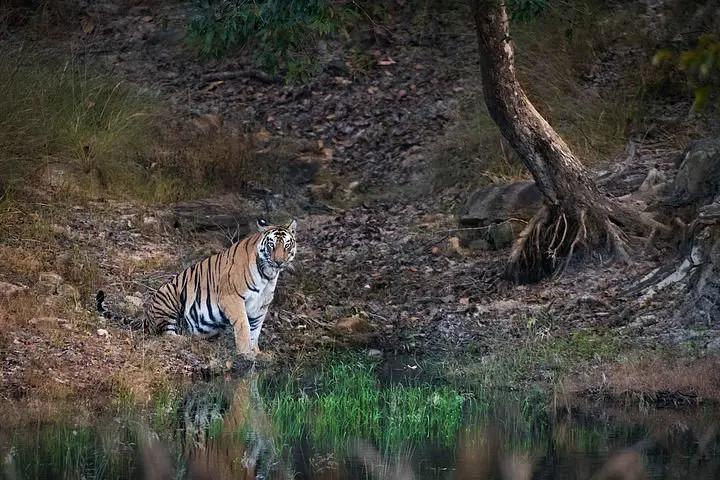
Periyar was made a tiger reserve in 1978. About 40 tigers were counted across its 925 square kilometres in 2017, in thick forest. Tigers are rarely seen from the boat. Elephants, gaur, sambar, wild boar, otters and about 266 species of birds are the real subjects here. March and April, the hottest months, bring the most animals to the water.
In the afternoon, walk a spice garden near Kumily with cardamom, pepper and vanilla on the vine. In the evening, watch Kalaripayattu, Kerala's old martial art, at a local kalari.
Note on tigers: Periyar is a forest reserve with a lake, not an open grassland park. A tiger sighting from the boat is rare, and we do not promise one. Elephants and gaur on the shore are common.
The Human Story
Many of the guides in Periyar's walking and rafting programmes are former poachers and sandalwood smugglers. After the arrest of a poaching leader in 1994, the reserve formed them into India's first eco-development committee made up entirely of ex-poachers. They now guide tourists, run bamboo rafts and patrol against poaching.
Experience of the Day
The 7:30 am boat among the drowned trees
Elephants, gaur and water birds on the shore
Spice garden walk
Kalaripayattu in the evening
Photographer's Notes
Light: Mist and soft light on the first boat; flat light by 10 am.
Vantage: Upper deck, side rail. Boats fill up, so board early.
Lens: 100-400 mm or a 150-600 mm; image stabilisation on, since tripods are not practical on the boat.
Settings: Kalaripayattu is fast; use 1/500 s and a high ISO.
Food
Recommended: Lunch at a Kumily restaurant.
Must-Try: Kappa (tapioca) with fish curry, a hill-country staple.
Shopping
Kumily's spice shops for cardamom and pepper straight from the plantations.
Activities to Do
Periyar Lake boat, 7:30 am
Spice garden walk
Kalaripayattu show
Optional Nearby Excursions
Bamboo rafting: a dawn-to-dusk trek and raft with a guard and four guides, maximum 10 guests, in place of the morning boat (quoted separately)
Day 7
THEKKADY TO ALLEPPEY | ONTO THE BACKWATERS
Route: Thekkady – Kottayam – Alleppey (Alappuzha), about 165 km
The road drops from the hills through rubber plantations to the flat country around Kottayam. You board your houseboat at Alleppey at about noon.
Houseboats are called kettuvallam in Malayalam. They began as rice and cargo barges, built without nails, with the planks tied together by coir rope. Now they carry bedrooms and an upper deck, and more than 400 of them work the Alleppey waters.
The boat cruises through the afternoon into Kuttanad. This is farmland on the edge of Vembanad, India's longest lake. Nearly 400 square kilometres of Kuttanad lie below sea level. From the deck you look down on green rice fields held back by earth dykes, with the canal running higher than the crop. Farmers here grow rice below the level of the sea beside them.
Boats must moor by dusk, around 6 to 6:30 pm. The sunset falls while you are still on the water.
Note on houseboat timings: Houseboats may not cruise after dark. Check-in is about noon and check-out 9 am. Cruising restarts about 7:30 to 8 am, so the dawn canoe on Day 8 is how you get onto the water at first light.
Experience of the Day
Boarding at noon
Afternoon cruise into Kuttanad
Rice fields below the waterline
Sunset from the upper deck
Photographer's Notes
Light: Low sun from about 4:30 pm; the water goes gold before the boat moors.
Vantage: The upper deck for height over the dykes; the bow for leading lines along the canal.
Lens: 24-70 mm for the scene; 70-200 mm for people on the banks and kingfishers on the wires.
Food
Recommended: All meals on board, cooked by the boat's crew.
Must-Try: Karimeen fry and Kerala fish curry made in the boat's own kitchen.
Activities to Do
Drive to Alleppey
Houseboat cruise
Sunset on the backwaters
Day 8
HOUSEBOAT TO KOVALAM | DAWN CANOE, LIGHTHOUSE SUNSET
Route: Kuttanad canals – Alleppey – Kollam bypass – Kovalam, about 158 km
A small canoe collects you from the houseboat at first light, around 6 am. It slips into side canals too narrow for the big boats, past washing steps, small churches and houses at the water's edge. The water is still at this hour, and the village is just waking.
Back on the houseboat for breakfast, then check out at 9 am and drive south along the coast to Kovalam.
In the evening, walk up to the Vizhinjam Lighthouse above Lighthouse Beach. The 36-metre tower started work in 1972. From the rocks below it, the curve of the beach runs north toward the other headlands.
Experience of the Day
Dawn canoe through the narrow canals
Village life at the water's edge
Drive down the coast
Sunset from the lighthouse headland
Photographer's Notes
Light: Blue hour and first light on the canals; warm side light at the lighthouse at sunset.
Vantage: Low in the canoe for reflections; the rocks south of Lighthouse Beach for the tower.
Lens: 35 mm prime in the canoe (keep it simple and dry); 16-35 mm at the lighthouse.
Gear: A dry bag for the canoe.
Food
Recommended: Dinner at a beach-front restaurant on Lighthouse Beach.
Must-Try: Fresh catch of the day, grilled with Kerala spices.
Activities to Do
Dawn canoe
Drive to Kovalam
Lighthouse sunset
Day 9
KOVALAM | THE HARBOUR AT DAWN
Route: Vizhinjam fishing harbour, Kovalam and Poovar, about 40 km of local drives
Vizhinjam fishing harbour, a few minutes from Kovalam, is busiest at first light, when the boats come in with the night's catch. Crews unload onto the quay, the auction starts and the colours of the boats and the fish give you a very different set of frames from the rest of the trip.
Rest through the middle of the day.
In the afternoon, drive to Poovar, where the Neyyar river meets the sea. A boat takes you through the mangrove channels to the sandbar that divides the river from the Arabian Sea. Stay for sunset over the water.
Note on the harbour: This is a working harbour. Keep clear of crews carrying catch, ask before close portraits, and follow your guide's lead on where to stand.
The Human Story
Vizhinjam has been a fishing and trading port for centuries. The men who land the catch at dawn have often been at sea all night. Your guide knows many of the crews, and a short conversation before the camera comes out makes all the difference.
Experience of the Day
Boats landing the catch at dawn
The fish auction on the quay
Mangrove boat ride at Poovar
Sunset where the river meets the sea
Photographer's Notes
Light: First light at the harbour; golden hour on the Poovar sandbar.
Vantage: The harbour quay; the boat in the mangroves; the sandbar looking west.
Lens: 24-70 mm at the harbour; 70-200 mm for details of hands, nets and fish.
Food
Recommended: Lunch at your hotel or a Kovalam café.
Must-Try: Kerala prawn curry with red rice.
Activities to Do
Vizhinjam harbour at dawn
Poovar estuary boat
Sunset on the sandbar
Optional Nearby Excursions
Varkala's red laterite cliffs, about 50 km north, for a late-afternoon cliff-top sunset (quoted separately)
Day 10
DEPARTURE | KOVALAM TO THIRUVANANTHAPURAM
Route: Kovalam to Thiruvananthapuram International Airport (TRV), about 15 km
A last morning on the beach, or a final walk to the lighthouse, depending on your flight time. Your driver takes you to Thiruvananthapuram airport.
Experience of the Day
Free morning
Airport drop
Photographer's Notes
Light: A last sunrise from the beach if your flight allows.
Gear: Back up your cards before you fly.
Food
Recommended: Breakfast at your hotel.
Must-Try: Puttu and kadala curry, a Kerala breakfast.
Activities to Do
Airport transfer
Tour Information
Your complete guide to a hassle-free and enjoyable trip.
Inclusion
Exclusion
Payment Terms
Important factors to consider before your trip!
Cancellation
Need To Know
Be Responsible Traveller
- Minimize Plastic Use : Bring a reusable water bottle, shopping bag, and utensils to reduce the need for single-use plastics. Many destinations have water refill stations and eco-friendly stores.
- Support Local and Sustainable Businesses : Eat at local restaurants, buy souvenirs from local artisans, and choose tour operators that prioritize sustainable practices and support the local community.
- Respect Wildlife and Natural Habitats : Avoid disturbing wildlife or their natural habitats. Stick to designated paths and observe animals from a distance without feeding or touching them.
- Dispose of Waste Properly : Follow local guidelines for recycling and waste disposal. If facilities aren't available, carry your waste with you until you can dispose of it responsibly.
- Educate Yourself and Others : Learn about the local environment, culture, and customs. Respect local practices and traditions, and share your knowledge about responsible travel with others.
- Choose Sustainable Activities : Engage in eco-friendly activities such as hiking, snorkeling, or visiting national parks. Avoid activities that exploit animals or damage the environment.
- Leave No Trace : Follow the principle of "Leave No Trace," which means leaving natural areas as you found them. Pack out all trash, avoid picking plants, and refrain from carving or writing on rocks or trees.
- Plant Trees Whenever Possible : Participate in local tree-planting initiatives or plant trees in your own community. Trees absorb carbon dioxide, provide oxygen, and help support biodiversity, making them vital for a healthy environment.
Connect
Share Itinerary
Email Itinerary
Frequently Asked Questions (FAQs) & People Also Ask — Kerala Photography: Tea, Backwaters & Wildlife
We help you prepare for your trip and ensure an effortless and enjoyable travel experience.
What is the best time for a Kerala photography tour?
December and January give the clearest mornings and the best valley mist in Munnar, but they are also the busiest. October to March as a whole works well. October and November add post-monsoon greens and full waterfalls. February and March are dry, but Eravikulam is closed for calving. The monsoon (June to September) gives dramatic skies and lower prices, with rain interruptions.
How many days do you need for Kerala?
Ten days is enough to cover the hills, a wildlife reserve, the backwaters and the coast properly with a camera. This plan gives two nights in each main stop and one night on a houseboat. An eleventh day, spent in Munnar, is the most useful addition for photographers, since it gives a second chance at sunrise.
Can I fly a drone in Kerala as a foreign tourist?
In practice, no. India requires every drone to be registered and flown by a DGCA-licensed pilot, and foreign licences are not recognised. Customs can also hold drones on arrival. Periyar Tiger Reserve is restricted in any case. For aerial shots, we can ask about hiring a licensed local pilot.
Can you see tigers in Periyar?
Rarely. Periyar had about 40 tigers across 925 square kilometres of thick forest in the 2017 count, and sightings from the lake are unusual. What you can expect from the boats is elephants, gaur, sambar, wild boar, otters and many water birds. March and April bring the most animals to the lake.
Is Eravikulam National Park open in February and March?
Usually not for most of that time. The park closes for about 45 to 60 days for the Nilgiri tahr calving season, normally from 1 February into March. On departures in that window, the Day 5 morning moves to Top Station or the Mattupetty valley. Outside it, the park opens at 7:30 am.
Can a houseboat go into the narrow canals?
No. Large houseboats stay on the lake and the wider channels, and they must moor by dusk. That is why the plan adds a small canoe at dawn on Day 8. It enters the narrow village canals at first light, before the houseboats start cruising again at about 7:30 to 8 am.
What camera lenses should I bring to Kerala?
Bring a wide zoom, a standard zoom and a telephoto of at least 400 mm. The wide lens is for Kolukkumalai and the lighthouse, the standard zoom for Fort Kochi and the houseboat, and the telephoto for Periyar and Eravikulam. A fast prime helps in the dim Kathakali theatre. Pack rain covers and silica gel for the humidity.
Is this a group photography workshop?
No. It is a private tour for you and your own party, with your own vehicle and a local photography guide who knows the locations and the light. The guide helps with positioning, timing and access. It is not a classroom course, though we can arrange a professional tutor on request at extra cost.
Can I photograph people in Kerala?
Yes, with permission. Fishermen at the nets and the harbour, tea pickers and canal-side villagers are often happy to be photographed if you ask first. Your guide will introduce you. Please avoid paying for photos; buying tea, fish or a craft works better. No photography inside the Paradesi Synagogue or Mattancherry Palace.
How is this different from BizareXpedition's other Kerala tour packages?
It follows the same core route as BizareXpedition's Munnar, Thekkady and Alleppey packages, but every day is timed for light. It adds the Kolukkumalai sunrise, Eravikulam, two Periyar boats, a dawn canoe, Kathakali make-up and the Vizhinjam harbour, plus a photography guide. Those packages suit a relaxed holiday; this one suits people travelling with a camera.
Do I need a visa for Kerala?
Yes, you need an Indian visa. Most nationalities can apply for an e-Visa online before travel, and Kochi and Thiruvananthapuram airports both accept e-Visa arrivals. Apply at least a week ahead and check the official Indian government e-Visa site for your nationality.
How much does a Kerala photography tour cost?
This 10-day trip costs about Rs.181,314 to Rs.195,819 per couple in the Premium tier. Luxury is about Rs.290,304 to Rs.313,528, and Ultra-Luxury about Rs.460,404 to Rs.497,236. Prices include hotels, the vehicle, the photography guide, entries and GST, and vary with dates and season.
BizareXpeditionTMReviews
Let's go, pack up, and hit the road!
Similar Tour Packages
Explore other exciting options for your next adventure!
Trusted Paths, Bold Journeys — Inside BizareXpedition
From humble beginnings to a trusted name in the industry, BizareXpedition's story is one of purpose-driven growth, community connection, and a relentless pursuit of excellence that speaks for itself.














Kerala Photography: Tea, Backwaters & Wildlife
best deal price
Without GST
₹90,657
per person on twin sharing
Book Now