
Ladakh Wildlife Monastery Package13N/14D
Ladakh Wildlife Monastery Package
Start & City : Delhi
best deal price
₹
Without GST ₹2,45,000
per person on twin sharing
Choose your departure city, dates, and add guests to secure your tour.
Hurry, as seats fill up, prices rise! Book now!
1. Choose your departure date
Highlights
Watch for Himalayan brown bears from Drenmo Lodge in the Mushkow Valley, with local spotters who scan the hillsides from first light.
Spend two nights in a family home at Rumbak, in Hemis National Park, and scan the slopes for blue sheep and ibex with a spotting scope.
Sit in on morning prayers at Thiksey, then walk the courtyard at Hemis, where 17th-century paintings of the Eighty-Four Mahasiddhas still hang.
Stand inside the Sumtsek at Alchi Choskor under three bodhisattvas, each about four metres tall.
Walk the pale, wind-cut ground below Lamayuru monastery, known as the Moonland.
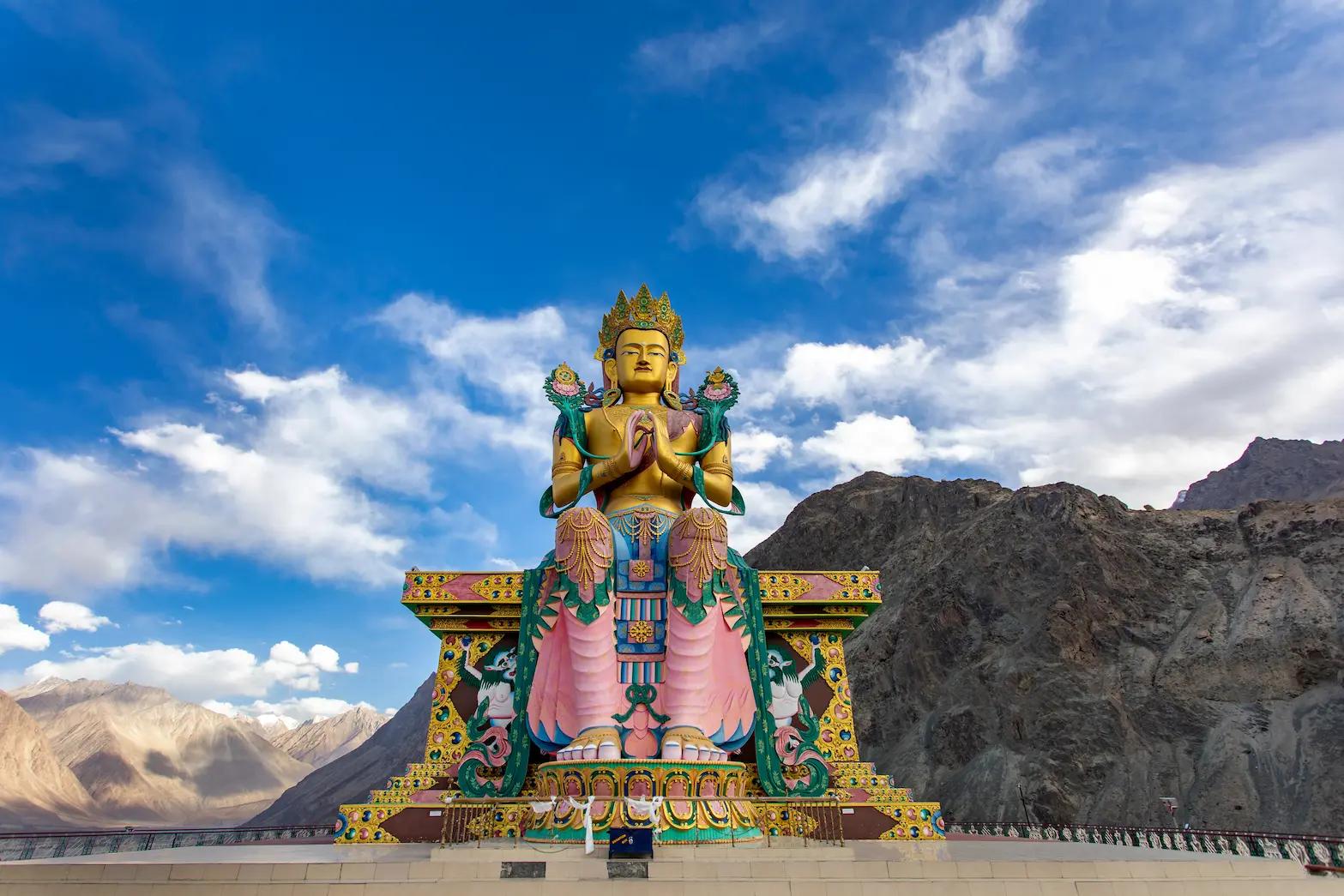
See the rock-cut Maitreya at Mulbekh, about nine metres tall and usually dated to the 8th century.
Walk Leh's Old Town with LAMO, then climb to the nine-storey Leh Palace.
Pay your respects at the Kargil War Memorial in Drass, with Tololing and Tiger Hill in view.
Essence of Journey
The experiences that capture the true spirit of the entire trip.
| Day | Route | Distance | Major Highlights |
|---|---|---|---|
| Day 1 | Delhi (arrival) | – | Airport pickup, rest |
| Day 2 | Delhi – Leh | Flight 1h 20m | Arrive at 3,500 m, rest |
| Day 3 | Leh (Old Town, Leh Palace, Stok) | About 30 km | LAMO walk, Leh Palace, Stok Palace Museum |
| Day 4 | Leh – Thiksey – Shey – Hemis – Leh | About 90 km round trip | Thiksey prayers, Shey Palace, Hemis monastery |
| Day 5 | Leh – Zingchen – Rumbak | About 30 km, then a 3 to 4 hr walk | Hemis National Park, family homestay |
| Day 6 | Rumbak (wildlife day) | On foot | Blue sheep, ibex, side valley walk |
| Day 7 | Rumbak – Zingchen – Alchi – Nurla | Walk out, then about 120 km | Alchi Choskor, Alchi Kitchen lunch |
| Day 8 | Nurla – Lamayuru – Mulbekh – Kargil – Drass | About 200 km (6 to 7 hrs with stops) | Lamayuru, Moonland, Mulbekh Maitreya, Drenmo Lodge |
| Day 9 | Drass (Mushkow Valley) | Short drives | Dawn and dusk bear watching, Holiyal village |
| Day 10 | Drass (Mushkow Valley) | Short drives | Bear watching, Kargil War Memorial, Stagsboo |
| Day 11 | Drass (Mushkow Valley) | Short drives | Bear watching, valley walk with spotters |
| Day 12 | Drass – Kargil – Lamayuru – Leh | About 290 km (8 to 9 hrs with stops) | Fotu La, Lamayuru, Basgo |
| Day 13 | Leh – Delhi | Flight 1h 20m | Early flight, afternoon in Delhi |
| Day 14 | Delhi (departure) | – | Transfer to airport |
About
Bears & Beyond is a private, 14-day Ladakh wildlife and monastery tour from Delhi. It pairs two genuine wildlife experiences — blue sheep and ibex on foot in Hemis National Park, and Himalayan brown bears watched from a dedicated lodge in the Mushkow Valley near Drass — with monastery visits at Thiksey, Hemis, Alchi, and Lamayuru along the way. You travel with one private vehicle and guide from Day 2 to Day 12, on a route built for safe acclimatisation, at your choice of three tiers.
The route climbs first and drops later. You land in Leh at about 3,250 m and spend three nights there, at 3,500 m. On Day 5 you walk to Rumbak, close to 4,000 m, for two nights in a family home. After that the trip runs west along the old Srinagar road, through Nurla, Lamayuru and Mulbekh, to Drass at about 3,300 m. Four nights at Drenmo Lodge give you three full days of bear watching. The Leh administration asks every visitor to rest for at least 48 hours before crossing a high pass, and this plan stays well inside that advice.
Monasteries sit on every stretch of the road: Thiksey, Shey and Hemis near Leh, Alchi and Lamayuru in the west, and the carved Maitreya at Mulbekh. For anyone looking for a Himalayan brown bear tour Ladakh can offer, or a Ladakh nature and monastery tour with real time on foot, this is a custom itinerary you can adjust before you book. As a Ladakh wildlife tour package it joins a Hemis National Park tour on foot, a Drass brown bear stay and a Ladakh monastery tour. It is a private Ladakh wildlife tour and a Ladakh wildlife holiday of 14 days. Hotels come in three tiers, Premium, Luxury and Ultra-Luxury, on the same days and the same route. Rumbak and Drass have one type of stay each, and the notes below explain how the tiers work there.
WHY BOOK THIS WITH BIZAREXPEDITION
A tailor-made wildlife and monastery holiday in Ladakh, 14 days, planned by BizareXpedition Services Pvt. Ltd. (CIN U63090UR2016PTC007433), with four nights in bear country.
Four nights in the Mushkow Valley, with spotters. Days 8 to 11 are at Drenmo Lodge in Holiyal village. Local spotters go out each morning, and there are dawn and dusk sessions on Days 9, 10 and 11.
A slow climb, then a drop. Leh at 3,500 m for three nights, Rumbak at close to 4,000 m on Day 5, then down to Nurla and Drass. The highest night is at Rumbak, about 500 m above Leh.
Two community stays. The Rumbak family home on Days 5 and 6 is part of the Himalayan Homestays programme, which puts 10% of proceeds into a village conservation fund. Drenmo Lodge began in 2016 as a few local homestays and gives 10% of annual profits to conservation.
The long road to Drass is cut in two. Leh to Drass is about 290 km. Day 7 ends at Nurla, about 200 km from Drass, and Day 8 stops at Lamayuru and Mulbekh on the way.
Monasteries along the route. Thiksey, Shey and Hemis on Day 4, Alchi on Day 7, Lamayuru and Mulbekh on Day 8, with a guide who explains each before you go in.
A Ladakh driver, a guide and oxygen on the trail. Ladakh allows only Ladakh-registered taxis for sightseeing, so the vehicle is a local Innova Crysta in all three tiers. One naturalist-cultural guide stays with you from Day 2 to Day 12, and a portable oxygen cylinder and pulse oximeter come to Rumbak.
ACCOMMODATION CATEGORIES
| Tier | Per couple | Per person |
|---|---|---|
|
Premium |
Rs.456,322 – 492,828 |
Rs.228,161 – 246,414 |
|
Luxury |
Rs.554,602 – 598,970 |
Rs.277,301 – 299,485 |
|
Ultra-Luxury |
Rs.755,572 – 816,018 |
Rs.377,786 – 408,009 |
Ladakh Wildlife Monastery Tour 3-Tier Pricing Summary
Hotels are named as examples for each tier and are confirmed at booking. Rumbak has family homestays only, and Drass has one specialist lodge with six rooms, so the tier changes the room and the tracking set-up there, not the property. Ask us if you want exclusive use of the lodge, and we will quote it. Meals are included at Rumbak and Drenmo Lodge, and Ladakh hotel nights include breakfast and dinner. Ladakh's taxi rules allow only Ladakh-registered vehicles for sightseeing, so all tiers travel in an Innova Crysta in Ladakh. Tier vehicles apply in Delhi: Innova Crysta, Fortuner, Mercedes.
Why This Ladakh Wildlife & Monastery Tour Is Different
Most Ladakh trips are either a monastery circuit or a wildlife trip — rarely both, and rarely with real wilderness time built in rather than a single drive-by viewpoint. Bears & Beyond does both properly: two nights walked into a national park, four nights based in a dedicated bear-watching lodge, and a string of genuinely significant monasteries along the connecting road.
Two distinct wildlife bases, not one quick stop. Rumbak, inside Hemis National Park, for blue sheep (bharal) and Asiatic ibex on foot; and the Mushkow Valley at Drass, for Himalayan brown bears — known locally as drenmo — watched with local spotters.
Conservation tourism that's actually structured that way. The Rumbak homestay puts 10% of proceeds into a village conservation fund through the Himalayan Homestays programme; Drenmo Lodge gives 10% of its annual profits to conservation. Both exist because wildlife tourism gives villagers a reason to live alongside the animals rather than see them as a threat.
Monasteries with real depth, not a checklist. Thiksey's dawn prayers, Hemis's 17th-century murals, the painted bodhisattvas of Alchi's Sumtsek, and the rock-cut Maitreya at Mulbekh are all worked into the route, each introduced by your guide before you go in.
A private guide and vehicle throughout. One naturalist-cultural guide stays with you from Day 2 to Day 12 — briefed on wildlife, monasteries, and altitude alike — with a portable oxygen cylinder and pulse oximeter carried on the Rumbak leg.
A stop that asks for quiet respect. The Kargil War Memorial at Drass, with Tololing and Tiger Hill visible from the site, is included as a place of real historical weight, not a photo stop.
3-TIER PRICING SUMMARY
| Tier | Per couple | Per person |
|---|---|---|
|
Premium |
Rs.456,322 – 492,828 |
Rs.228,161 – 246,414 |
|
Luxury |
Rs.554,602 – 598,970 |
Rs.277,301 – 299,485 |
|
Ultra-Luxury |
Rs.755,572 – 816,018 |
Rs.377,786 – 408,009 |
Ladakh Wildlife Monastery Tour 3-Tier Pricing Summary
Ranges run from the base total to about 8% above it, to allow for dates and season. Prices are indicative and are confirmed in a written quote. International flights, Indian visa fees and travel insurance are not included
Where You'll Go
Leh and its monasteries. Your base for the first three nights, at 3,500 metres, and again for one night on the way back. Leh's Old Town, the nine-storey Leh Palace, and Stok Palace Museum sit within easy reach, and Thiksey, Shey, and Hemis — all inside a half-day loop — round out the cultural side of the trip before you head into the wilderness.
Rumbak, inside Hemis National Park. A walk-in village of about three dozen households at close to 4,000 metres, reached on foot once the road ends at Zingchen. You stay in a family home for two nights, scanning the slopes for blue sheep and ibex with a spotting scope at dawn and dusk.
Alchi and Lamayuru, on the way west. Alchi Choskor's 11th-to-13th-century Sumtsek temple and Lamayuru's eroded, moon-like landscape both sit on the road between Rumbak and Drass, along with lunch at Alchi Kitchen, run by Nilza Wangmo since 2016.
Drass and the Mushkow Valley. Four nights at Drenmo Lodge in Holiyal village, the base for dawn and dusk sessions tracking Himalayan brown bears with local spotters, plus a visit to the Kargil War Memorial nearby.
SEASON ADJUSTMENTS
| Season | Months | Conditions | Price effect |
|---|---|---|---|
|
Spring |
Late April to mid-June |
Drenmo Lodge suggests April and May for the best bear photography. Wild tulips bloom in the Mushkow Valley in May and June. Nights are cold, and snow can sit on the passes. Some smaller properties keep limited dates, so we confirm at booking. |
Base price |
|
Peak |
Mid-June to August |
Warm days, cool nights, and flights and roads are busy. Hemis festival in June or July. Book early. |
Top of the price range (about +8%) |
|
Autumn |
September to October |
Clear light and fewer visitors. Bears feed heavily before winter sleep. Nights turn cold, and snow becomes common in Hemis from November. |
Base price |
|
Weather watch |
Any month, most often April and late summer |
In April 2025, 46 flights to Leh were cancelled over two days. In late August 2025, heavy rain disrupted road and air links for several days. Extra nights, if needed, are charged at stay rates. |
Base price, plus any extra nights |
|
Not offered |
November to early April |
Very cold, with snow on the passes and limited flights. The lodge season ends in December. Rumbak in winter is a snow-leopard stay, which is a separate trip. |
Not offered on this route |
Ladakh Wildlife Monastery Tour Season Adjustments
Is This a Wildlife Tour or a Monastery Tour?
It's genuinely both, in roughly equal measure. The first four days lean cultural — Leh, Thiksey, Shey, Hemis — the middle stretch is pure wilderness at Rumbak, and the back half of the trip is built entirely around brown bear tracking at Drass, with Alchi, Lamayuru, and Mulbekh worked into the transfer days between the two. If you want a Ladakh trip that isn't only temples or only wildlife, this route is built specifically to be both.
Wildlife You Might See
At Rumbak, inside Hemis National Park: blue sheep (bharal) are the most reliable sighting, grazing the slopes above the village, alongside Asiatic ibex, red fox, marmots, and golden eagles. Snow leopards do live in this valley, but they're watched here only between November and March, when they move to lower ground — outside this route's season. A sighting of tracks or scat is possible; a live sighting would be a genuine bonus, not something to expect.
At Drass, in the Mushkow Valley: the main draw is the Himalayan brown bear (drenmo), spotted at a respectful distance with a scope, most often at first light or in the last two hours of the day. Long-tailed marmots, Asiatic ibex, red fox, golden eagles, and bearded vultures are also seen, and a Tibetan wolf occasionally. Sightings are never promised — some mornings the spotters find nothing — but the programme gives you an arrival evening plus three full days of dedicated tracking to look.
PRACTICAL NOTES
Altitude and health. Leh is at 3,500 m and Rumbak is close to 4,000 m. Fotu La, crossed on Days 8 and 12, is about 4,100 m. The Leh administration requires at least 48 hours of acclimatisation before crossing a high pass, and this route spends three nights in Leh before Rumbak. The tourism advisory suggests light activity for the first two days and no alcohol or sleeping pills at height. Some visitors ask their doctor about acetazolamide, starting two days before arrival. Only your own doctor can advise on that. If symptoms grow worse with rest, descend and tell your guide at once. SNM Hospital in Leh is the main hospital.
Permits and access. Leh and Kargil towns need no permit for foreign guests. Hemis National Park needs an entry permit, which we arrange through the Wildlife Department in Leh. The Mushkow Valley sits close to the border, and rules for it rest with the Army and the district administration. They have changed before. We confirm access for foreign guests with our partners in Kargil before we quote dates. If a side valley is closed, the spotters move to the orchards and hillsides around Holiyal.
Wildlife. Sightings are never promised. Bears are watched at a distance with a scope, and some mornings show nothing. Blue sheep are the most likely sighting at Rumbak. Snow leopards are watched at Rumbak from November to March, and this trip does not run then.
Rumbak stay. Rumbak is a family home with simple rooms and homemade meals. There are no vehicle roads beyond Zingchen. Bags go by pony. Bring a warm sleeping layer and a torch.
Kargil War Memorial. The memorial honours soldiers who died in 1999, and families of those soldiers visit. It is not an attraction to treat lightly. Dress simply, keep voices low and do not climb on the displays. Ask before photographing soldiers or families. Tololing, Tiger Hill and Point 4875 are places of loss for many people, and your guide will speak of them with care.
Cash. There are no reliable ATMs after Leh, and ATMs are limited in Kargil. Carry rupees for tips, small purchases and site entries, roughly Rs 7,000 to 10,000.
Connectivity. Leh has reliable 4G on Airtel and Jio. Rumbak and the Mushkow Valley may have little or no signal. Only postpaid SIMs from elsewhere in India work in Ladakh. Foreign guests can buy a local SIM in Leh with a photo ID and a passport photo. Tell your family before Day 5 that you may be out of contact.
Water and heat. Drink three to four litres a day. Hot water at Drenmo Lodge runs fully from May to October. In April and November it comes by bucket. Nights in Drass can be cold even in summer.
Dress and photography. Bring layers, gloves, a warm hat and a windproof jacket. Bring binoculars if you have them, and a lens of 300 mm or longer for bears. Do not use flash near animals. Cover shoulders and knees in monasteries, and take off your shoes where asked. Photography is not allowed inside Alchi's temples. Ask before photographing monks or family homes.
Weather and flights. Every flight to Leh leaves in the morning. When weather stops one, the next is usually the next morning. Book your international flight for the evening of Day 14 or later.
Vehicles. Only Ladakh-registered taxis may run sightseeing in Ladakh. Your Delhi vehicle stays in Delhi, and a local vehicle takes over at Leh airport.
Tipping. Tips for the driver, guide, spotters and hotel staff are not included and are up to you. Your guide can advise on local practice.
Booking Summary
Dept. City :
--
Dept. Date :
--
Traveller :
Adults: 2, Child: 0, Infant: 0
Rooms :
--
Basic Price :
--
Total Cost
--
GST
--
Grand Total
--
Itinerary (Day Wise)
The first few days are the cultural warm-up — Leh, the old town walk with LAMO, morning prayers at Thiksey, an afternoon at Hemis — before the trip does something most Ladakh itineraries don't: it sends you on foot into Hemis National Park itself. The road stops at Zingchen, and you walk the last three or four hours up to Rumbak, a village of about thirty families at close to 4,000 metres, where you spend two nights scanning the slopes at dawn and dusk for blue sheep and ibex. From there it's back down and west, past Alchi's old temples and the bare, moon-like ground below Lamayuru, all the way to Drass — a long push, split over two days — for four nights at Drenmo Lodge in the Mushkow Valley. This is the part built around Himalayan brown bears, tracked with local spotters who head out before sunrise; sightings aren't guaranteed, but you get three full days plus an arrival evening to try. There's also a stop at the Kargil War Memorial along the way, which the itinerary treats with the seriousness it deserves rather than as another photo op. Fourteen days total, one guide and driver with you from Day 2 through Day 12, and the choice between Rumbak's homestay and Drenmo's rooms stays fixed — it's really the Leh, Nurla and Delhi hotels where the three tiers show up.
Day 1
DELHI | ARRIVAL
Route: Delhi airport to hotel
Your driver meets you at arrivals and takes you to the hotel. Nothing is planned for the evening.
The flight to Leh leaves early tomorrow. Every flight to Leh leaves in the morning, because winds pick up later in the day at an airport about 3,250 m high. Tonight is for sleep.
Day 2
DELHI TO LEH | ARRIVAL IN LADAKH
Route: Delhi – Leh (flight)
The flight crosses the Himalaya into the Indus valley. Your guide and driver meet you at Leh airport, and you go straight to the hotel.
Leh is at 3,500 m. The Ladakh tourism advisory asks new arrivals to rest on the first day and to add no more than about 500 m of sleeping height a day after that. Today is for rest. Drink plenty of water and skip alcohol tonight.
Day 3
LEH | OLD TOWN, LEH PALACE AND STOK
Route: Leh – Old Town – Leh Palace – Stok (15 km) – Leh
The morning starts with a walk through Leh's Old Town with LAMO, the Ladakh Arts and Media Organisation. It takes two to three hours through narrow lanes, past craft workshops and wood-fired bakeries. In 2008 the Old Town was placed on the World Monuments Watch list as an endangered site.
Leh Palace was built around 1600 by Sengge Namgyal. It has nine storeys and follows the style of the Potala Palace. When Dogra forces took Ladakh in the mid-19th century, the royal family moved out and the palace was left to decay. The Archaeological Survey of India is restoring it. From the roof you can see all of Leh.
Lunch is a home-cooked Ladakhi meal. In the afternoon, drive to Stok Palace Museum.
The Human Story: The Royal Family at Stok
After the Dogra takeover, the Namgyal family moved from Leh Palace to Stok Palace, built in 1820. The museum holds old coins, royal seals, textiles, jewellery and thangkas around 400 years old. Stok also sits at the foot of the Stok range, with a view of Stok Kangri (6,150 m).
Day 4
LEH | THIKSEY, SHEY AND HEMIS
Route: Leh – Thiksey (19 km) – Shey (15 km) – Hemis (45 km) – Leh
Thiksey monastery stands at about 3,600 m and has twelve storeys. It looks like a smaller Potala. It was founded in the mid-15th century by Palden Zangpo and belongs to the Gelug order. Its 15 m Maitreya statue is the largest in Ladakh and rises through two floors. Morning prayers begin around 7 am. Sit at the back and listen to the monks chant in unison.
Shey was the summer capital of Ladakh. The present palace and monastery were built in 1655 by Deldan Namgyal in memory of his father, Sengge Namgyal. Inside is a 12 m copper Buddha, gilded with about 5 kg of gold.
Hemis was re-established in 1672 by King Sengge Namgyal and follows the Drukpa lineage. It lies inside Hemis National Park, and the same park holds Rumbak, where you walk on Day 5. Its courtyard shows paintings of the Eighty-Four Mahasiddhas from the 17th century, made with ground mineral pigments. In 1894 a Russian journalist claimed that Hemis held a manuscript about Jesus in India. Scholars reject the claim, and the story is worth hearing as a story only.
Day 5
LEH TO RUMBAK | INTO HEMIS NATIONAL PARK
Route: Leh – Zingchen (about 30 km) – Rumbak (walk of 3 to 4 hours)
The road ends at Zingchen, where the park begins. Vehicles cannot go further, so the last stretch is on foot, up a gorge along a stream. Your guide sets a slow pace. Rumbak sits close to 4,000 m, about 500 m above Leh.
Hemis National Park covers about 4,400 km² and rises from about 3,000 m to 6,000 m. It was founded in 1981. Blue sheep, or bharal, graze the slopes above the village, and Asiatic ibex, red fox, marmots and golden eagles live here too. You reach the village by lunchtime. The afternoon is for rest, tea and a short walk to a spotting point with your guide.
Rumbak is a village of about three dozen households, and only some of them take guests. Rooms are simple. Meals are homemade Ladakhi food such as thukpa and momos.
The Human Story: The Rumbak Homestays
The homestay programme at Hemis began in the early 2000s, run by the Snow Leopard Conservancy India Trust. Snow leopards kill livestock, and villagers once saw them as a loss. Guest income changed that. Ten per cent of the proceeds go into a village conservation fund, and villagers now guide visitors on the leopard trails instead of seeing the cats only as a threat. A snow leopard that brings guests is worth more to the village alive.
Day 6
RUMBAK | BLUE SHEEP AND THE SIDE VALLEYS
Route: Rumbak – side valley walk – Rumbak
The day starts at first light on the slope above the village. Your guide and the local spotter scan the cliffs with a spotting scope. Bharal graze in small groups on steep ground and are easy to miss until one moves. Ibex are often higher up.
After breakfast, walk into a side valley above the village. Look for golden eagles on the cliffs and for pugmarks and droppings along the path. Your spotter can tell you what left them.
The afternoon is free. Sit on the roof with tea, or rest. The evening scan starts about an hour before sunset.
Day 7
RUMBAK TO NURLA | ALCHI
Route: Rumbak – Zingchen (walk of 2.5 to 3 hours) – Leh – Alchi (about 65 km from Leh) – Nurla (25 km)
You leave early, walk down the gorge to Zingchen, and drive west along the Indus. Nurla is close to 3,000 m, about 1,000 m below Rumbak, so the night is easier.
Alchi Choskor stands at about 3,100 m on the south bank of the Indus, roughly 65 km west of Leh. It has six temples from the 11th to 13th centuries. Local tradition names the translator Rinchen Zangpo as its founder. Wall inscriptions point to a noble called Kaldan Sherab. Scholars still debate which is right.
The main temple is the Sumtsek, and it is small. Inside stand three bodhisattvas about four metres tall, and their painted robes carry tiny scenes of court life, cloth patterns and Buddhist stories. Photography is not allowed inside. Flash damages the old mineral pigments, and the rule is enforced.
The Human Story: Alchi Kitchen
Lunch is at Alchi Kitchen. Nilza Wangmo, who grew up in Alchi, opened it in 2016. She trained young women from nearby villages to cook and serve. The menu is Ladakhi: skyu, a wheat-pasta stew; chutagi, bow-tie pasta in a local sauce; khambir, a fermented bread; and Tashi Tagye tea, an eight-ingredient blend.
Day 8
NURLA TO DRASS | LAMAYURU AND MULBEKH
Route: Nurla – Lamayuru (33 km) – Mulbekh (about 66 km) – Kargil (about 40 km) – Drass (about 60 km) – Holiyal village
Lamayuru sits at 3,510 m, about the same height as Leh. It is one of the oldest monasteries in Ladakh. Its oldest surviving temple, Seng-ge-sgang, is credited to Rinchen Zangpo. The monastery once housed up to 400 monks and has around 150 today. Lamayuru belongs to the Drikung Kagyu order today and was once the leading Bon monastery in Ladakh.
The land around it looks like the surface of the moon. The story goes that the yogi Naropa drained a lake that filled the valley, and that the monastery was founded on the dry bed. The pale, eroded ground does look like an old lake bed. Walk a short stretch of it with your guide, then return to the monastery.
The road then crosses Fotu La and Namika La and drops to Mulbekh, at about 3,500 m. Here a Maitreya Buddha is carved into the rock beside the road. It stands about nine metres tall. Scholars usually date it to about the 8th century, while older accounts place it in the Kushan period. Two old gompas, one Drukpa and one Gelug, stand above the village.
After lunch in Kargil, the road runs north-west to Drass. About 2 km before the town, at Stagsboo, stone carvings of Maitreya and Avalokiteshvara sit beside the road. Drenmo Lodge is in Holiyal village, a short drive from Drass town. Arrive, settle in, and watch the hillsides from the lodge deck as the light goes.
The Human Story: Drenmo Lodge
Drenmo Lodge began in 2016 as a small operation out of a few homestays owned by local residents. Today it is a refurbished village home with six rooms. Roots Ladakh, a Kargil operator, set it up together with Flame of the Forest, a lodge at Kanha. It gives 10% of its annual profits to wildlife conservation. Its aim is plain: if bears bring the village income, the village has a reason to live with them.
Day 9
DRASS | DAWN WITH THE SPOTTERS
Route: Drenmo Lodge – Mushkow Valley hillsides – Holiyal village
The spotters leave in the dark, before you. Each morning they go to different points in the valley and scan the slopes. When they find a bear, you are called and taken there by vehicle or on foot. Wake-up is around 5 am. Wear a warm layer and bring gloves.
Bears are most active at first light. They walk the hillsides and dig, possibly for tubers, and you watch through a spotting scope from a distance that keeps you and the bear at ease. Sightings are never promised. Some mornings the spotters find nothing.
Breakfast is back at the lodge. The middle of the day is for a walk through Holiyal's orchards and fields, or for rest. The evening session starts about two hours before sunset, from a different point.
Why the bears come down
A brown bear spends the warm months building fat for winter sleep. In the weeks before it dens, it eats up to about 45 kg of food a day, according to WWF-India. That is why bears come to orchards, crops, livestock pens and food stores in late summer and autumn. Since 2022, WWF-India has trained local volunteers in Kargil, called the Bear Brothers, to monitor bears, respond to conflict and put up predator-proof corrals.
Day 10
DRASS | BEARS, THE WAR MEMORIAL AND STAGSBOO
Route: Drenmo Lodge – Mushkow Valley – Kargil War Memorial (about 5 km from Drass town) – Drenmo Lodge
Start with the dawn session, as on Day 9. Your spotters may move you to a different valley if activity has shifted. Other animals may show themselves too: long-tailed marmots, Asiatic ibex, red fox and, less often, Tibetan wolf. Golden eagles and bearded vultures are seen along the ridgelines.
In the late morning, visit the Kargil War Memorial. The Indian Army built it in its present form in 2014. A pink sandstone wall carries the names of soldiers who died in Operation Vijay in 1999, and a gallery honours Captain Manoj Pandey, who received the Param Vir Chakra. From the site you can see Tololing, Tiger Hill and Point 4875, where the fighting took place.
The afternoon is free. The evening session starts about two hours before sunset.
Day 11
DRASS | THE LAST FULL DAY
Route: Drenmo Lodge – Mushkow Valley – Holiyal village
Today the spotters choose the valley. They read the valley each morning and decide where to send you. If you have seen a bear already, this is a good day to stay longer and watch its behaviour. If you have not, it is a day to try a different valley.
Between sessions, walk through Holiyal village with your host, who speaks Ladakhi, Hindi and English. The village grows apricots and apples and keeps livestock. Ask your host about the corrals and deterrents that villagers use against bears.
Pack tonight. Tomorrow is the longest drive of the trip.
Day 12
DRASS TO LEH | THE ROAD BACK
Route: Drass – Kargil – Mulbekh – Fotu La – Lamayuru – Basgo – Leh
The road retraces Day 8, in the opposite direction. Stop at Kargil for lunch, cross Fotu La and pass Lamayuru in the afternoon light. If you missed the memorial or Mulbekh, the guide can stop for a short visit.
Basgo, at 3,292 m, was once an important cultural and political centre and appears often in the Ladakhi Chronicles. If time allows, walk among its ruins and gompas before the last stretch to Leh.
You reach Leh in the evening. Check in and rest.
Day 13
LEH TO DELHI
Route: Leh – Delhi (flight)
You fly out of Leh early in the morning and reach Delhi before midday. The rest of the day is free. A half-day with a Delhi guide can be added if you wish.
Day 14
DELHI | DEPARTURE
Route: Delhi hotel to airport
Your driver takes you to the airport in time for your international flight.
Tour Information
Your complete guide to a hassle-free and enjoyable trip.
Inclusion
Exclusion
Payment Terms
Important factors to consider before your trip!
Cancellation
Need To Know
Be Responsible Traveller
- Minimize Plastic Use : Bring a reusable water bottle, shopping bag, and utensils to reduce the need for single-use plastics. Many destinations have water refill stations and eco-friendly stores.
- Support Local and Sustainable Businesses : Eat at local restaurants, buy souvenirs from local artisans, and choose tour operators that prioritize sustainable practices and support the local community.
- Respect Wildlife and Natural Habitats : Avoid disturbing wildlife or their natural habitats. Stick to designated paths and observe animals from a distance without feeding or touching them.
- Dispose of Waste Properly : Follow local guidelines for recycling and waste disposal. If facilities aren't available, carry your waste with you until you can dispose of it responsibly.
- Educate Yourself and Others : Learn about the local environment, culture, and customs. Respect local practices and traditions, and share your knowledge about responsible travel with others.
- Choose Sustainable Activities : Engage in eco-friendly activities such as hiking, snorkeling, or visiting national parks. Avoid activities that exploit animals or damage the environment.
- Leave No Trace : Follow the principle of "Leave No Trace," which means leaving natural areas as you found them. Pack out all trash, avoid picking plants, and refrain from carving or writing on rocks or trees.
- Plant Trees Whenever Possible : Participate in local tree-planting initiatives or plant trees in your own community. Trees absorb carbon dioxide, provide oxygen, and help support biodiversity, making them vital for a healthy environment.
Connect
Share Itinerary
Email Itinerary
Frequently Asked Questions (FAQs) & People Also Ask — Ladakh Wildlife Monastery Package
We help you prepare for your trip and ensure an effortless and enjoyable travel experience.
Can you see Himalayan brown bears in Ladakh?
Yes, but they are rare. Bears live in the Drass and Suru valley area of Kargil district. The Mushkow Valley at Drass is where guests watch them from a lodge, with local spotters who search the hillsides each morning. Estimates for the whole Indian and Pakistani Himalaya run from about 130 to 220 bears. Sightings are never promised. A Ladakh brown bear tour like this one gives three full days and an arrival evening to look.
What is the best time to see brown bears in Drass?
Drenmo Lodge runs from April to December and suggests April and May, or October onward, for the best photography. Bears feed heavily before winter sleep, so autumn is active. This route runs from late April to October. Early morning and the last two hours of light are the best times of day.
Can you see snow leopards on this tour?
Not likely. Snow leopards live in Hemis National Park and are watched at Rumbak between November and March, when they come to lower ground. On this route you may see pugmarks or droppings, and a sighting would be a bonus. A winter stay at Rumbak is a separate trip that we can plan.
Do foreigners need a permit for Drass, Kargil or Hemis?
Leh and Kargil towns need no permit for foreign guests. Hemis National Park needs an entry permit, which we arrange in Leh. Drass and the Mushkow Valley are near the border, so we confirm access with our partners in Kargil before we quote dates. Nubra, Pangong and Tso Moriri need a Protected Area Permit, but this route does not visit them.
How far is Drass from Leh, and how long is the drive?
About 290 km, and 8 to 9 hours with stops. The route cuts the outbound drive in two: Day 7 ends at Nurla, and Day 8 covers about 200 km to Drass, with stops at Lamayuru and Mulbekh. The return, on Day 12, is done in one day.
How do I avoid altitude sickness on a Ladakh wildlife tour?
Climb slowly and rest early. Leh is at 3,500 m and Rumbak is close to 4,000 m. The plan spends three nights in Leh before Rumbak and never adds more than about 500 m of sleeping height in a day. Drink water, skip alcohol on arrival night and ask your own doctor about medication before you travel. A portable oxygen cylinder and a pulse oximeter come to Rumbak
What is a Rumbak homestay like?
It is a family home with simple rooms and homemade Ladakhi meals such as thukpa and momos. The village has no vehicle road beyond Zingchen, so you walk in for 3 to 4 hours while ponies carry your bags. The Himalayan Homestays programme has run here since the early 2000s, and 10% of the proceeds go into a village conservation fund.
Are Himalayan brown bears dangerous to visitors?
Bears raid livestock and orchards, but attacks on people are rare. Guests watch from a distance set by the spotters, and nobody walks toward a bear. Wildlife groups in the Kargil area are training villagers to reduce conflict, which is why the lodge model exists. You follow the guide's rules, and the spotters choose where you stand.
What wildlife can I see in Ladakh other than bears?
At Rumbak, blue sheep (bharal) and ibex are the main sightings, with red fox, marmots and golden eagles. In the Mushkow Valley, look for long-tailed marmots, Asiatic ibex, red fox and bearded vultures, and less often a Tibetan wolf. Snow leopards and Pallas's cat are possible only on other routes and in other seasons.
Which monasteries does this Ladakh nature and monastery tour visit?
Thiksey, Shey and Hemis near Leh, Alchi Choskor in the Indus valley, Lamayuru, and the rock-cut Maitreya at Mulbekh. Leh Palace and Stok Palace Museum are also on the plan. Each visit is short and led by a guide who explains what to look for before you go in.
How much does a private Ladakh wildlife tour cost per person?
For this 14-day route, the modeled price is about Rs 228,161 to 246,414 per person at Premium, Rs 277,301 to 299,485 at Luxury, and Rs 377,786 to 408,009 at Ultra-Luxury, for two guests sharing. That covers domestic flights, stays, vehicle, guide, permits and the bear-tracking programme. International flights, visa and insurance are extra.
What happens if my Delhi to Leh flight is cancelled?
A weather cancellation at Leh usually moves the flight to the next morning, so plan for one lost day. All Leh flights leave early. If you are delayed on the way in, the first day in Leh is shortened and stays are re-arranged. If you are delayed on the way out, the Delhi night absorbs it. Book your international flight for the evening of Day 14 or later.
BizareXpeditionTMReviews
Let's go, pack up, and hit the road!
Similar Tour Packages
Explore other exciting options for your next adventure!
Trusted Paths, Bold Journeys — Inside BizareXpedition
From humble beginnings to a trusted name in the industry, BizareXpedition's story is one of purpose-driven growth, community connection, and a relentless pursuit of excellence that speaks for itself.














Ladakh Wildlife Monastery Package
best deal price
Without GST
₹2,45,000
per person on twin sharing
Book Now