
Adventure Ladakh: On Foot Over High Passes17N/18D
Adventure Ladakh: On Foot Over High Passes
Start & City : Delhi
best deal price
₹
Without GST ₹3,07,465
per person on twin sharing
Choose your departure city, dates, and add guests to secure your tour.
Hurry, as seats fill up, prices rise! Book now!
1. Choose your departure date
Highlights
Walk the Zanskar traverse from Padum to Lamayuru, about 110 to 120 km on foot, over Parfi La, Hanuma La, Singge La and Sirsir La.
Cross Singge La, at about 5,000 m, the highest pass of the walk, with an assistant guide, a turn-back time and oxygen at hand.
Spend a night in a Lingshed village home beside one of Zanskar's best-known Gelug monasteries, founded in the 1440s.
Walk down the Wanla gorge to Wanla's fort-monastery and finish at Lamayuru, among its Moonland rock.
Visit Alchi's Choskor temples, then walk the Sham valley from Likir to Yangthang and on to the juniper groves of Hemis Shukpachan.
See Thiksey, Shey and Hemis before the trail, and keep a spare day in Leh at the end for weather.
Essence of Journey
The experiences that capture the true spirit of the entire trip.
| Day | Route | Distance | Major Highlights |
|---|---|---|---|
| Day 1 | Delhi (arrival) | – | Airport pickup, rest |
| Day 2 | Delhi – Leh | Flight 1h 20m | Arrive at 3,500 m, rest |
| Day 3 | Leh (rest, briefing, gear check) | On foot | Trek briefing, oximeter baseline |
| Day 4 | Leh – Thiksey – Shey – Hemis – Leh | About 90 km round trip | Thiksey, Shey Palace, Hemis monastery |
| Day 5 | Leh – Lamayuru – Mulbekh – Kargil | About 230 km (7 to 8 hrs) | Lamayuru, Fotu La, Mulbekh Maitreya |
| Day 6 | Kargil – Rangdum – Pensi La – Padum | About 235 km (8 to 10 hrs) | Suru valley, Nun and Kun, Zanskar |
| Day 7 | Padum – Pishu – Hanumil | About 30 km drive, 14 km walk (4 to 5 hrs) | Zanskar river, first camp, about 3,700 m |
| Day 8 | Hanumil – Parfi La – Snertse | About 15 km (5 to 6 hrs) | Parfi La at about 3,900 m |
| Day 9 | Snertse – Hanuma La – Lingshed | About 14 km (6 to 9 hrs) | Hanuma La at about 4,700 m, village home |
| Day 10 | Lingshed – Murgum La – Singge La base | About 6 hrs | Lingshed monastery, camp at about 4,350 m |
| Day 11 | Singge La base – Singge La – Photoksar | About 7 hrs | Singge La at about 5,000 m, Bumiktse La |
| Day 12 | Photoksar – Sirsir La – Hanupatta | 5 to 7 hrs | Sirsir La at about 4,800 m |
| Day 13 | Hanupatta – Wanla | About 11 km (4 to 5 hrs) | Wanla gorge, river crossings |
| Day 14 | Wanla – Lamayuru – Nurla | About 11 km walk (3 to 4 hrs), then a short drive | Prinkiti La, Lamayuru Moonland |
| Day 15 | Nurla – Alchi – Likir – Yangthang | About 50 km drive, 10 km walk (4 to 6 hrs) | Alchi Choskor, Phobe La, village home |
| Day 16 | Yangthang – Hemis Shukpachan – Leh | About 10 km walk (4 to 6 hrs), then about 100 km drive | Tsermangchan La, juniper grove, Leh |
| Day 17 | Leh (spare day) | – | Rest, weather buffer |
| Day 18 | Leh – Delhi | Flight 1h 20m | Early flight, departure the same evening |
About
This is an 18-day private Ladakh Zanskar trek from Padum package. The heart of it is the classic Zanskar trek from Padum to Lamayuru: eight days on foot, about 110 to 120 km, over four passes including Singge La at about 5,000 m. It ends with an easier two-day walk through the Sham Valley and a spare day in Leh for weather. Domestic flights are included. Prices start at about INR 307,465 per person for two people sharing.
Some treks show you a valley. This one takes you across a whole mountain range. You start in Padum, the small capital of Zanskar, and walk north to the Indus, through villages that have no road for most of the year. You sleep beside a 600-year-old monastery, cross passes that look out over endless ridges, and walk down a narrow gorge to the eroded "Moonland" around Lamayuru.
It is a serious trek, and we plan it that way. The trip is built around two things: how your body adjusts to altitude, and what to do when the mountains don't follow the plan. That is why it has three nights in Leh before you start, an assistant guide on the hardest days, a satellite phone on the trail and a spare day before your flight home.
Why Choose the Padum to Lamayuru Trek?
There are easier treks in Ladakh. People choose this one because nothing else gives the same sense of journey.
A true traverse. You walk from one side of the Zanskar range to the other, from Padum to the Indus valley, rather than looping back to where you started.
Pass after pass. Parfi La, Hanuma La, Singge La and Sirsir La, plus smaller crossings such as Prinkiti La, each with wide views of the Zanskar peaks.
Lingshed Monastery. Founded in the 1440s and home to about 60 monks, it also runs a school for the remote villages around it. You sleep in a village home next to it.
Real village life. Photoksar's stone houses under a cliff, Wanla's 12th-century castle-monastery, butter tea in family kitchens.
The journey in. Two days by road through Kargil, the green Suru Valley, the 7,000 m peaks of Nun and Kun, and over Pensi La past the Drang-Drung Glacier.
A gentle finish. Alchi's 11th-century painted temples, Likir Monastery, and a lower, warmer walk through barley fields and juniper groves to Hemis Shukpachan.
How Our Zanskar Trek Is Different
A lot of Zanskar itineraries start walking the day after a long drive and push hard to Lamayuru. That works for some, but it leaves little room for error. Ours is built for travellers coming from overseas:
Three nights in Leh first. Rest, a trek briefing, a gear check and an easy day visiting Thiksey, Shey and Hemis monasteries.
Low first nights on the trail. You sleep around 3,700 m for the first two trail nights, so you walk into the high passes rather than jump into them.
Passes in rising order. Each pass is higher than the last (3,900 m, 4,700 m, then 5,000 m), and you sleep at 3,750 m or lower after each big one.
An assistant guide on the big days. On Hanuma La and Singge La, a second guide means the group can split safely if one person needs to turn back.
Safety kit on the trail. Oxygen, a pulse oximeter (daily blood-oxygen checks) and a satellite phone travel with you the whole way.
A spare day before your flight. If weather closes a pass for a day, we absorb it without risking your journey home.
Flights included. Your Delhi–Leh–Delhi economy flights are part of the price.
Key Passes and Altitudes
Published heights for Zanskar passes vary by up to a few hundred metres between sources. These are the figures we plan with; your guide confirms them on the ground.
| Pass or place | Height (m) | Height (ft) | Notes |
|---|---|---|---|
|
Leh |
3,500 |
11,480 |
Three nights to acclimatise |
|
Padum |
about 3,600 |
11,810 |
Zanskar's capital and trek start |
|
Parfi La |
about 3,900 |
12,800 |
First pass, a gentle warm-up |
|
Hanuma La |
about 4,700 |
15,420 |
First high pass, before Lingshed |
|
Singge La |
about 5,000 |
16,400 |
Highest point of the trek |
|
Sirsir La |
about 4,800 |
15,750 |
Last high pass |
|
Lamayuru |
3,510 |
11,520 |
End of the Zanskar traverse |
Ladakh Zanskar Trek Padum to Lamayuru Key Passes and Altitudes
How Hard Is the Zanskar Trek?
The Padum to Lamayuru trek is challenging. It is not technical, so you don't need ropes or climbing skills. What makes it hard is the combination of length, height and remoteness.
Eight walking days in a row, from 3 to 9 hours each.
Several passes above 4,000 m, and Singge La at about 5,000 m with a pre-dawn start and loose scree on the way down.
No road for about six days. Leaving the trail means a horse ride to the nearest road, which can take a day or more, or a helicopter if weather allows.
Stream crossings in the Wanla gorge, where water rises through the day.
The Sham Valley walk at the end is much easier, with short climbs and clear paths.
ACCOMMODATION CATEGORIES
| Destination | Nights | Premium | Luxury | Ultra-Luxury |
|---|---|---|---|---|
|
Delhi |
1 |
Radisson Blu Plaza Delhi Airport |
ITC Maurya |
The Oberoi, New Delhi |
|
Leh |
5 |
Hotel Chospa (boutique, Old Road) |
The Grand Dragon Ladakh |
Dolkhar (seven private villas in an orchard) |
|
Kargil |
1 |
Hotel Greenland, Kargil |
Hotel Greenland, Kargil (best room) |
Hotel Greenland, Kargil (best room) |
|
Padum |
1 |
Padum Guest House |
Lha-Ri Zanskar |
Lha-Ri Zanskar |
|
Hanumil, Snertse, Singge La base, Hanupatta |
4 |
Camps, standard twin tents |
Camps, larger tents with camp beds |
Camps, larger tents with camp beds and private toilet tent |
|
Lingshed, Photoksar, Wanla |
3 |
Village homes, shared rooms |
Village homes, best room |
Village homes, best room, with extra bedding and a private tent where a home is full |
|
Nurla, near Alchi |
1 |
Faryork Resort |
The Legacy Alchi |
The Apricot Tree Hotel |
|
Yangthang |
1 |
Village home |
Village home, best room |
Village home, best room |
Ladakh Zanskar Trek Padum to Lamayuru Accommodation Categories
Hotels and camps are named as examples for each tier and are confirmed at booking. Lingshed has only village homes, and Photoksar and Wanla have only village homes and camps, so the three tiers differ in set-up and bedding and not in the kind of stay. Padum and Kargil have a narrow choice, so Luxury and Ultra-Luxury share the same property. Hotel nights include breakfast and dinner, and all meals are included on the trail. The trail stays on Days 7 to 13 and Day 15 are priced as camps and homes.
Who should book it
This trek suits people who have walked at altitude before (ideally above 4,000 m) and can walk 6 to 8 hours on consecutive days. Plan for several weeks of training: hill walks with a loaded day pack, steady cardio and leg strength work. If you have a heart, lung or joint condition, talk to your doctor before booking.
Altitude and Safety on the Trail
Our plan follows the Ladakh tourism advice: rest on arrival and add no more than about 500 m of sleeping height a day. The largest jump on this route is about 550 m, to the Singge La base camp. Here is how we manage the rest:
A baseline oxygen reading in Leh, then checks every evening on the trail.
A turn-back time set the evening before Singge La. If weather or health calls for it, the group descends.
An assistant guide, oxygen cylinder and satellite phone on the high-pass days.
Fresh meals cooked by your crew, with boiled or filtered water. Aim for 3 to 4 litres a day.
A light headache or poor sleep on the first night in Leh is common. Some travellers ask their doctor about acetazolamide (Diamox) before the trip; only your own doctor can advise on that. If symptoms get worse with rest, you go down, and your guide arranges it.
3-TIER PRICING SUMMARY
| Tier | Per couple | Per person |
|---|---|---|
|
Premium |
Rs.614,930 – 664,124 |
Rs.307,465 – 332,062 |
|
Luxury |
Rs.717,620 – 775,030 |
Rs.358,810 – 387,515 |
|
Ultra-Luxury |
Rs.912,920 – 985,954 |
Rs.456,460 – 492,977 |
Ladakh Zanskar Trek Padum to Lamayuru 3-Tier Pricing Summary
Ranges run from the base total to about 8% above it, to allow for dates and season. Prices are indicative and are confirmed in a written quote. International flights, Indian visa fees and travel insurance are not included.
WHY BOOK THIS WITH BIZAREXPEDITION
A tailor-made, eighteen-day high-pass trek for two, planned by BizareXpedition Services Pvt. Ltd. (CIN U63090UR2016PTC007433), with the pass sequence, the sleeping heights and the spare day all written out.
Three nights in Leh, then lower sleeping heights for the first trail days. Leh at 3,500 m for three nights, then Kargil at about 2,700 m and Padum at about 3,600 m. The first trail nights are Hanumil at about 3,700 m and Snertse at about 3,750 m, so the body walks into the passes from low sleeping heights.
A rising sequence of passes. Parfi La at about 3,900 m comes first, then Hanuma La at about 4,700 m, then Singge La at about 5,000 m and Sirsir La at about 4,800 m. Each is higher than the last, and the walk drops to a village at 3,750 m or lower after each big one.
An assistant guide on the pass days. A lead guide stays with the group from Leh to Lamayuru. An assistant guide joins for the Hanuma La and Singge La stages, so the group can split safely if one guest is slower or needs to turn back.
Village nights where villages exist. Lingshed, Photoksar and Wanla have homes that take guests. Hanumil, Snertse, the Singge La base and Hanupatta are camps. Guests carry a day pack only. The cook, helper and horsemen carry the rest.
A walking finish in the Sham valley. After Zanskar, the Likir to Yangthang to Hemis Shukpachan walk is lower and easier, through barley terraces and juniper groves, and it ends in village homes.
A spare day in Leh. Day 17 is held empty. A weather day lost on the passes can be absorbed there, by shortening the Sham walk, without costing the flight home.
SEASON ADJUSTMENTS
| Season | Months | Conditions | Price effect |
|---|---|---|---|
|
Early season |
Mid-June to early July |
Singge La and Sirsir La can still hold snow, and streams on the Wanla gorge run high. Nights are cold in camps above 4,000 m. |
Base price |
|
Peak |
Mid-July to August |
The warmest weather and the most open passes. Afternoon cloud and short storms are possible, and the Wanla river can rise sharply after rain. |
Top of the price range (about +8%) |
|
Best light |
September to early October |
Clear days and the best views. Nights are very cold at the Singge La camp, and early snow on the passes is possible late in the month. |
Base price |
|
Weather watch |
Any month, most often July and August |
A pass can close for a day in snow or storm, and a river crossing can wait for the water to drop. The spare day in Leh is held for this. In April 2025, 46 flights to Leh were cancelled over two days. Extra nights, if needed, are charged at stay rates. |
Base price, plus any extra nights |
|
Not offered |
Mid-October to early June |
Snow closes Singge La, Sirsir La and the Pensi La road in turn, and the Zanskar villages are cut off. |
Not offered on this route |
Ladakh Zanskar Trek Padum to Lamayuru Season Adjustments
Permits and Paperwork for Foreign Trekkers
You need a valid Indian visa. Leh, Alchi, Likir and Lamayuru need no extra permit. Rules for Zanskar and the Photoksar and Wanla valleys have changed in recent years, so we check with a registered agent in Leh which permits, if any, apply to your nationality and route, and we arrange them for you.
Send us your passport and Indian visa copies at least three weeks before travel.
Send your insurance details. Your policy must cover high-altitude trekking to about 5,000 m and helicopter evacuation.
Getting There and Flight Tips
You arrive in Delhi, and we handle everything from there, including the flights to and from Leh. All flights in and out of Leh run in the morning, and weather can delay them by a day.
Book your international flight home for the evening of Day 18 or later.
If you cannot move your connection, ask us about an extra night in Delhi.
Phone Signal, Cash and Practical Tips
No signal on the trail for about six days, from Hanumil to Wanla. Tell family to expect no contact. The guide's satellite phone is for emergencies.
No ATMs after Kargil. Carry about INR 8,000 to 10,000 in cash for tips, small purchases and entries.
Gear: broken-in boots, trekking poles, a warm sleeping layer, rain jacket, sun protection and a day pack. Horses carry everything else. You can buy or rent kit in Leh.
Respect local customs: cover shoulders and knees in monasteries, ask before photographing people or shrine rooms, and never photograph military posts.
PRACTICAL NOTES
Fitness and difficulty. This is a long walk of eight consecutive trail days, with stages of 3 to 9 hours, several passes above 4,000 m and one above 4,900 m. Sources grade the Padum to Lamayuru traverse as challenging, and one source calls it moderate to strenuous. It needs good fitness, and experience of walking at altitude is strongly advised. Several weeks of training with a loaded day pack on hills help. The Sham valley walk at the end is easier.
Altitude and health. Leh is at 3,500 m, Kargil at about 2,700 m, Padum at about 3,600 m, Hanumil at about 3,700 m, Snertse at about 3,750 m and Lingshed at about 3,800 m. The Singge La base camp is at about 4,100 to 4,350 m, Photoksar at about 3,750 m and Hanupatta at about 3,770 m, with Wanla near 3,100 to 3,250 m. The highest sleeping point is about 550 m above the night before, which sits near the 500 m a day that the tourism advisory suggests. The advisory suggests light activity for the first two days in Leh and no alcohol or sleeping pills at height. Some visitors ask their doctor about acetazolamide, starting two days before the trek. Only your own doctor can advise on that. If symptoms grow worse with rest, descend and tell your guide at once.
Pass heights. Sources differ on pass heights by up to a few hundred metres. Singge La is given as 4,950 to 5,230 m, Sirsir La as 4,760 to 4,850 m, Hanuma La as 4,700 to 4,800 m and Parfi La as about 3,900 m. The document gives about 5,000 m, 4,800 m, 4,700 m and 3,900 m. Camp heights and walking times differ by up to an hour between sources, and your guide confirms them on the ground.
Remoteness and evacuation. From Hanumil to Wanla there is no road for about six days. A walker who has to leave the trail goes by horse to the nearest road, which can take a day or more, or by helicopter where the weather allows. Your insurance must cover helicopter evacuation from 5,000 m. The guide carries a satellite phone, oxygen and an oximeter, and tells you plainly if a stage should be shortened.
River crossings and weather. The Wanla gorge crosses the stream several times, and water rises through the day. The guide scouts each crossing and sets an early start. Afternoon cloud can bring short storms on the passes. The spare day in Leh is held for weather.
Permits. Leh, Alchi, Likir and Lamayuru need no permit. Rules for Zanskar and the Wanla and Photoksar valleys have changed in recent years and sources differ, so we confirm with a registered agent in Leh which permits, if any, apply to foreign guests and to the full route. We need passport and Indian visa copies at least three weeks before travel.
Roads. The Kargil to Padum road is mostly good to Panikhar and unmetalled dirt after it, and it is open from about mid-June to October or November. The Leh to Kargil road is open from about mid-April to November. Zanskar is served by Zanskar-registered vehicles, and Leh-registered vehicles drive no further than Kargil.
Cash and connectivity. There are no ATMs after Kargil, and Padum has a small bank. Carry rupees for tips, small purchases and entries, roughly Rs 8,000 to 10,000. There is no mobile signal on the trail between Hanumil and Wanla, and the guide's satellite phone is for emergencies. Leh and Kargil have signal on postpaid Airtel and Jio SIMs.
Food and water. The cook prepares fresh meals from supplies carried in. Water is boiled or filtered. Drink three to four litres a day, more on the pass days. Tell us about any dietary needs when you book.
What to carry. Guests carry a day pack with water, a warm layer, a rain jacket, sun protection and a camera. The horses carry the rest of the baggage. Sturdy, broken-in boots, trekking poles and a warm sleeping layer are essential, and your guide runs through the full kit list in the briefing.
Dress and photography. Bring layers, sun protection and a warm jacket for the passes and the camps. Cover shoulders and knees in monasteries, and take off your shoes where asked. Ask before photographing inside shrine rooms or people in the villages, and do not photograph military posts or convoys.
Weather and flights. Every flight in and out of Leh runs in the morning. When weather stops one, the next is usually the next morning. Book your international flight for the evening of Day 18 or later.
Tipping. Tips for guides, crew, drivers and hotel staff are not included and are up to you. Your guide can advise on local practice.
Booking Summary
Dept. City :
--
Dept. Date :
--
Traveller :
Adults: 2, Child: 0, Infant: 0
Rooms :
--
Basic Price :
--
Total Cost
--
GST
--
Grand Total
--
Itinerary (Day Wise)
This trek takes you across the whole Zanskar range instead of looping back to where you started. After a night in Delhi you fly to Leh, where you spend three easy days adjusting to the altitude. Those days include a trek briefing, a gear check and visits to the Thiksey, Shey and Hemis monasteries. Next comes a two-day drive through Kargil, the green Suru Valley and over Pensi La to Padum, the small capital of Zanskar. From Padum you walk for eight days, about 110 to 120 km in all, over Parfi La, Hanuma La, Singge La (about 5,000 m) and Sirsir La. Each pass is a little higher than the one before. On the way you sleep in a village home beside Lingshed Monastery, pass the stone houses of Photoksar and walk down the Wanla gorge to the eroded Moonland around Lamayuru. The trek then winds down with Alchi’s painted temples and a gentle walk through the Sham Valley, among barley fields and juniper groves, to Hemis Shukpachan. A spare day in Leh at the end covers any weather delays before your flight home. Throughout the trek, an assistant guide joins you on the hardest days, and oxygen and a satellite phone stay with the group.
Day 1
DELHI | ARRIVAL
Route: Delhi airport to hotel
Your driver meets you at arrivals and takes you to the hotel. Nothing is planned for the evening.
The flight to Leh leaves early tomorrow. Every flight to Leh leaves in the morning, because winds pick up later in the day at an airport about 3,250 m high. Tonight is for sleep.
Experience of the Day
– Private airport pickup and transfer to the hotel.
– A free evening to rest before tomorrow's early flight to Leh.
Food
Dinner at the hotel; nothing else is planned today.
Activities to Do
None scheduled. An easy evening to recover from the international flight.
Day 2
DELHI TO LEH | ARRIVAL IN LADAKH
Route: Delhi – Leh (flight)
The flight crosses the Himalaya into the Indus valley. Your guide and driver meet you at Leh airport, and you go straight to the hotel.
Leh is at 3,500 m. The Ladakh tourism advisory asks new arrivals to rest on the first day and add no more than about 500 m of sleeping height a day after that. Today is for rest. Drink plenty of water and skip alcohol tonight.
Experience of the Day
– The flight over the Himalaya to Leh.
– Met at the airport by your guide and driver.
– A first night at 3,500 m.
Food
Dinner at the hotel; keep it light and drink plenty of water.
Activities to Do
None scheduled. Rest and acclimatisation.
Day 3
LEH | REST, BRIEFING AND GEAR CHECK
Route: Leh hotel – main bazaar – Leh hotel
The morning is free. A slow walk to the main bazaar is fine, and any walking should stay easy. Your guide then holds the trek briefing at the hotel: the eight stages, the passes in order, the river crossings, what the horses carry and what you carry.
After the briefing the guide checks every guest's boots, poles, layers and day pack, and records a first pulse-oximeter reading for each guest. These readings are repeated each evening on the trail, and they give the guide a baseline for the whole walk.
Experience of the Day
– A trek briefing covering all eight stages and the passes.
– A gear check of boots, poles and layers.
– A first oximeter reading for each guest.
Food
Breakfast, lunch and dinner at the hotel.
Activities to Do
A slow walk to the main bazaar and the gear check.
Shopping
Leh's main bazaar has trekking gear, warm layers, hats and sun protection if anything is missing.
Day 4
LEH | THIKSEY, SHEY AND HEMIS
Route: Leh – Thiksey (19 km) – Shey (15 km) – Hemis (45 km) – Leh
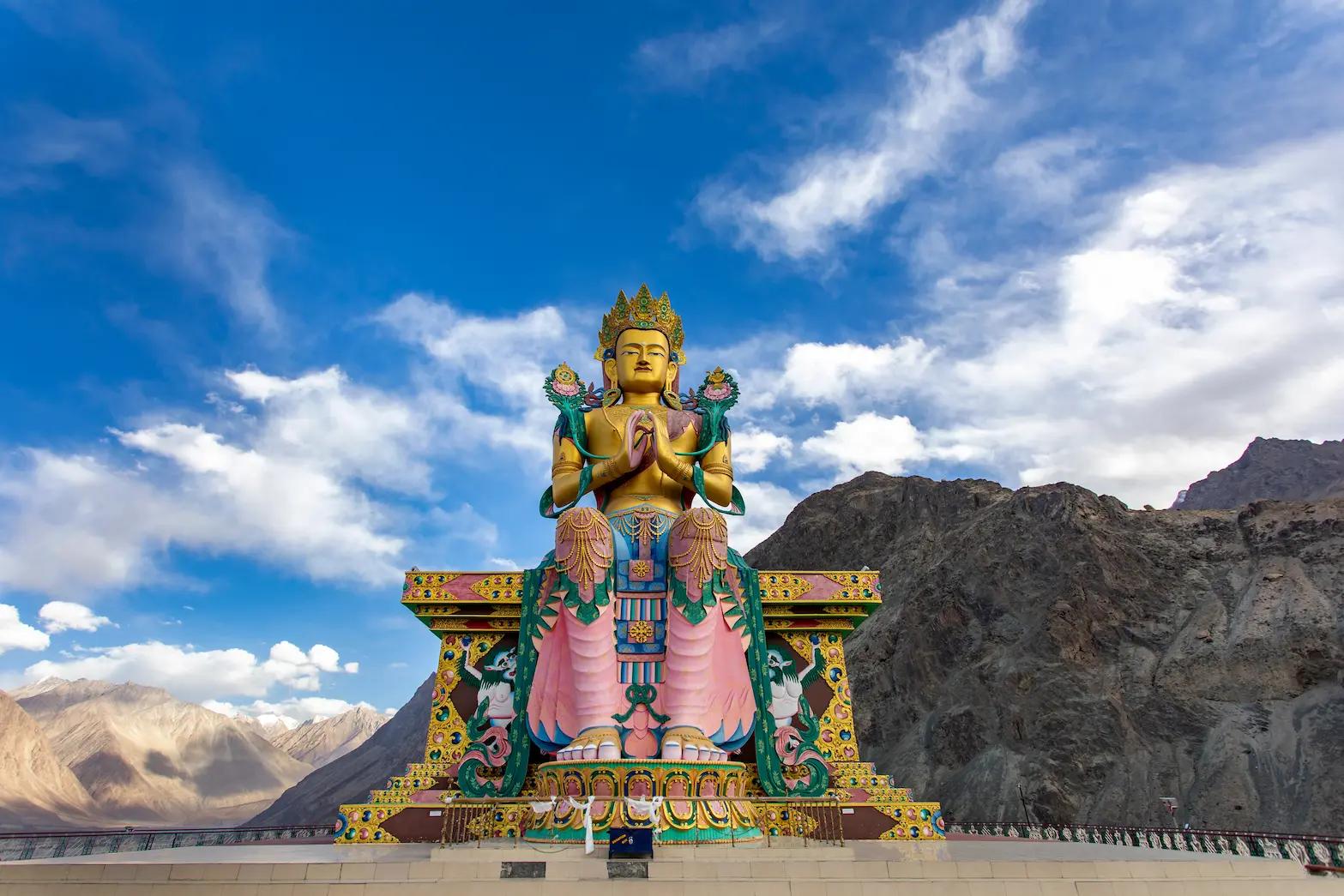
Thiksey monastery stands at about 3,600 m and has twelve storeys. It was founded in the mid-15th century by Palden Zangpo and belongs to the Gelug order. Its 15 m Maitreya statue, installed for the Dalai Lama's 1970 visit, is the largest in Ladakh. Morning prayers begin around 7 am, and you sit at the back and listen to the monks chant in unison.
Shey was the summer capital of Ladakh. The present palace and monastery were built in 1655 by Deldan Namgyal in memory of his father, Sengge Namgyal. Inside is a 12 m copper Buddha, gilded with about 5 kg of gold, made by a Nepalese sculptor with copper from the Lingshet mines in Zanskar.
Hemis was re-established in 1672 by King Sengge Namgyal and follows the Drukpa lineage. Its courtyard shows paintings of the Eighty-Four Mahasiddhas from the 17th century, made with ground mineral pigments.
Experience of the Day
– Morning prayers at Thiksey monastery, around 7 am.
– Shey Palace and its 12 m gilded copper Buddha.
– Hemis monastery's courtyard and its 17th-century Mahasiddha paintings.
Food
An early breakfast before departure; lunch and dinner at the hotel.
Activities to Do
Sitting in on the Thiksey prayer session; a walk through Hemis's painted courtyard.
Day 5
LEH TO KARGIL | LAMAYURU, FOTU LA AND MULBEKH
Route: Leh – Nimmu – Lamayuru – Fotu La – Namika La – Mulbekh – Kargil
The Indus valley narrows west of Leh, and the road runs down through Nimmu, where the Zanskar river joins the Indus. Lamayuru sits at 3,510 m, about the height of Leh. It is one of the oldest monasteries in Ladakh, and in nine days you will walk down into it from the Zanskar side. Today it is a short halt, to see the monastery and the pale, wind-cut ground called the Moonland.
The road then crosses Fotu La and Namika La. At Mulbekh, a Maitreya Buddha is carved into the rock beside the road. It stands about nine metres tall, and scholars usually date it to about the 8th century.
Kargil is a market town on the Suru River at about 2,700 m, and the night here is a step down in height before Zanskar. A Zanskar-registered vehicle and driver meet you at the hotel.
Experience of the Day
– Lamayuru's Moonland and its monastery.
– Fotu La and Namika La, both at about 4,100 m.
– The rock-cut Maitreya at Mulbekh.
Food
Breakfast at the Leh hotel; lunch near Lamayuru; dinner at the Kargil hotel.
Activities to Do
Short visits at Lamayuru and Mulbekh; a handover to your Zanskar vehicle in Kargil.
Day 6
KARGIL TO PADUM | THE SURU VALLEY, RANGDUM AND PENSI LA
Route: Kargil – Sankoo (40 km) – Panikhar (24 km) – Parkachik (16 km) – Rangdum (46 km) – Pensi La – Padum
The Suru River valley is green where Ladakh is usually dry, fed by glacier melt from Nun and Kun, two peaks over 7,000 m that stand on the skyline from Panikhar onward. Nun, at 7,135 m, is the higher, and Kun, at 7,077 m, sits just north of it. The villages along this stretch, Sankoo, Panikhar and Parkachik, are Muslim, part of Kargil district's Dard and Balti population, a different community from Buddhist Leh and Zanskar.
Rangdum monastery stands on a steep hill at about 4,031 m, at the head of the Suru valley. It was built in the 18th century under King Tsewang Namgyal II and belongs to the Gelug order. A halt here for tea is the first sign that the people ahead follow Tibetan customs.
Pensi La, at about 4,400 m, is the pass between Suru and Zanskar, and the Drang-Drung Glacier lies close to the road on the far side, a long tongue of ice. The road follows the Stod River down into Zanskar. Padum, the valley's small capital, is at about 3,600 m, a little higher than Leh.
Experience of the Day
– The Suru Valley, with Nun and Kun on the skyline.
– Rangdum monastery on its hill.
– Pensi La and the Drang-Drung Glacier, then arrival in Zanskar.
Food
Breakfast at the Kargil hotel; lunch at Rangdum or a roadside dhaba; dinner at the Padum hotel.
Activities to Do
Tea and a short visit at Rangdum; photo stops at Pensi La and the glacier.
Day 7
PADUM TO HANUMIL | THE FIRST DAY ON FOOT
Route: Padum – Pishu (about 30 km by road) – Hanumil (14 km on foot)
After breakfast the vehicle drives down the valley to Pishu, at about 3,600 m, where the horses and crew are waiting. From here the road ends for the trek, and you walk.
The first day is short and flat. The trail follows the river through barley fields and low villages to Hanumil, with long views up the valley. The horses go ahead and the cook has tea ready by the time you arrive.
Tonight is the first night in a tent. The guide records the evening oximeter readings and explains tomorrow's pass.
Experience of the Day
– The drive to Pishu, where the road ends for the trek.
– A first walk along the Zanskar river.
– A first night in camp, at about 3,700 m.
Food
Breakfast at the Padum hotel; trail lunch; dinner in the dining tent.
Activities to Do
A short, flat walk of 4 to 5 hours with the horses carrying the loads.
Day 8
HANUMIL TO SNERTSE | OVER PARFI LA
Route: Hanumil – Parfi La (about 3,900 m) – Snertse
The trail climbs gently to Parfi La, at about 3,900 m, the first pass of the walk. It is a low crossing and a good test of pace for the harder ones to come. The descent drops to the Snertse valley, where the camp sits beside a stream.
From here the trail turns away from the Zanskar river and begins to climb in earnest. Tomorrow is the first long day.
Experience of the Day
– Parfi La, the first pass, at about 3,900 m.
– A camp beside a stream at Snertse.
– Clear night skies at about 3,750 m.
Food
Breakfast and dinner in the dining tent; trail lunch.
Activities to Do
A walk of 5 to 6 hours with a gentle pass crossing.
Day 9
SNERTSE TO LINGSHED | OVER HANUMA LA
Route: Snertse – Hanuma La (about 4,700 m) – Lingshed
Hanuma La, at about 4,700 m, is the first high pass. The climb is long and steady, and the view from the top runs across the Zanskar range. The descent to Lingshed is steep in places and takes a while.
Lingshed monastery was founded in the 1440s by Changsems Sherab Zangpo, a student of Je Tsongkhapa, and belongs to the Gelug order. It has about 60 monks, and it also runs a school for the surrounding villages. It is set among fields on a hillside, and the village around it has only homestays for guests.
Experience of the Day
– Hanuma La, at about 4,700 m.
– The descent to Lingshed.
– Lingshed monastery and a night in a village home.
Food
Breakfast in the dining tent; trail lunch; dinner in the village home.
Activities to Do
A long pass crossing of 6 to 9 hours, then an evening visit to the monastery.
The Human Story: A School Above the Passes
Lingshed's monastery doubles as a community school, and its monks and teachers serve the villages of the Trans-Sengge-La region, which are cut off from the main roads for much of the year. Solar microgrids installed in 2016 bring electric light to the monastery. Tonight's family is part of that community, and the welcome here is simple: butter tea, fresh barley bread, a warm kitchen.
Day 10
LINGSHED TO SINGGE LA BASE | MURGUM LA AND KIUPA LA
Route: Lingshed – Murgum La (about 4,100 m) – Kiupa La (about 3,850 m) – Singge La base
An early visit to the monastery, if the morning prayers are in session, comes first. Then the trail climbs and drops across two smaller passes, Murgum La at about 4,100 m and Kiupa La at about 3,850 m, before it turns up the valley to the foot of Singge La.
The camp sits in open ground below the pass. Tonight the group sleeps at the highest point of the walk, about 4,350 m at most, which is about 550 m above Lingshed. The guide records readings twice, at sunset and before bed.
Experience of the Day
– Early prayers at Lingshed monastery, if in session.
– Murgum La and Kiupa La.
– The highest night of the walk, below Singge La.
Food
Breakfast in the village home; trail lunch; dinner in the dining tent.
Activities to Do
A walk of about 6 hours over two small passes, with an early evening.
Day 11
SINGGE LA BASE TO PHOTOKSAR | OVER SINGGE LA
Route: Singge La base – Singge La (about 5,000 m) – Bumiktse La (about 4,200 m) – Photoksar
Singge La is the highest pass of the walk. Sources give its height anywhere from 4,950 to 5,230 m, and a figure of about 5,000 m is used here. The start is before sunrise, and the climb is steady on loose ground, with a final steeper section near the top. The top has long views over the Zanskar range, and the descent is on loose scree and then a rocky valley.
Beyond the pass, Bumiktse La, at about 4,200 m, is the second crossing of the day. Photoksar, at about 3,750 m, has stone houses clustered under a cliff. The road to this village crosses Sirsir La, and snow closes it in winter.
Experience of the Day
– Singge La, at about 5,000 m, the highest pass.
– Bumiktse La, at about 4,200 m.
– Photoksar's stone houses under their cliff.
Food
An early breakfast before the pre-dawn start; trail lunch; dinner in the village home.
Activities to Do
A pass crossing of about 7 hours with an assistant guide, oxygen and a set turn-back time.
Day 12
PHOTOKSAR TO HANUPATTA | OVER SIRSIR LA
Route: Photoksar – Sirsir La (about 4,800 m) – Hanupatta
Sirsir La, at about 4,800 m, is a shorter climb than Singge La but still a high one. The trail climbs out of Photoksar and crosses the pass, then drops through a valley to the village of Hanupatta, with a camp beside the stream.
Tonight the walk starts to feel complete. The highest crossings are behind you, and the route runs downhill to the Indus.
Experience of the Day
– Sirsir La, at about 4,800 m.
– Long views across the Zanskar range.
– A night in camp at Hanupatta.
Food
Breakfast in the village home; trail lunch; dinner in the dining tent.
Activities to Do
A walk of 5 to 7 hours with one pass crossing.
Day 13
HANUPATTA TO WANLA | THE WANLA GORGE
Route: Hanupatta – Franji La – Wanla
The trail follows the Wanla river down a narrow gorge, crossing the stream several times. The water is lowest in the morning and rises as the day warms, so the guide sets an early start and scouts each crossing. The path crosses a low rise, Franji La, at about 3,400 m, and drops to Wanla, at about 3,100 to 3,250 m.
Wanla's monastery sits inside an old castle built by the Ladakhi king Lhachen Ngaglug in the 12th century, with the temple added in the 14th. It belongs to the Drigung Kagyu order and is a sub-monastery of Lamayuru. Its three-storeyed Avalokiteshvara temple is one of the earliest Drigung Kagyu prayer chambers to survive in Ladakh.
Experience of the Day
– The Wanla gorge and its stream crossings.
– Wanla's old castle-monastery of the Drigung Kagyu order.
– A night in a village home.
Food
Breakfast in the dining tent; trail lunch; dinner in the village home.
Activities to Do
A walk of 4 to 5 hours with several stream crossings, then time to visit the fort-monastery.
Day 14
WANLA TO LAMAYURU | THE LAST PASS, THEN NURLA
Route: Wanla – Prinkiti La (about 3,750 m) – Lamayuru – Nurla
The last day is short. The trail climbs to Prinkiti La, at about 3,725 to 3,750 m, and looks down on Lamayuru and its monastery, with the pale, wind-cut ground of the Moonland around it. Lamayuru is one of the oldest monasteries in Ladakh, and its oldest surviving temple, Seng-ge-sgang, is credited to Rinchen Zangpo.
A Leh vehicle meets the group at Lamayuru, and the crew and horses part from you here. After a late lunch the road runs east to Nurla, near Alchi, where tonight is in a hotel with a hot shower.
Experience of the Day
– Prinkiti La and the first view of Lamayuru.
– Lamayuru's Moonland and monastery.
– A hot shower and a hotel bed at Nurla.
Food
Breakfast in the village home; lunch in Lamayuru; dinner at the Nurla hotel.
Activities to Do
A short walk of 3 to 4 hours, then a visit to the monastery before the drive.
Day 15
NURLA TO YANGTHANG | ALCHI, LIKIR AND THE SHAM VALLEY
Route: Nurla – Alchi – Likir (about 50 km by road) – Phobe La – Yangthang (about 10 km on foot)
Alchi Choskor stands at about 3,100 m on the south bank of the Indus, roughly 65 km west of Leh. It has six temples from the 11th to 13th centuries. Local tradition names the translator Rinchen Zangpo as its founder, and wall inscriptions point to a noble called Kaldan Sherab; scholars still debate which is right. In the Sumtsek stand three bodhisattvas, each about four metres tall.
Likir monastery sits on a hilltop about 52 km west of Leh. It was founded in 1065 at the order of King Lhachen Gyalpo, and belongs to the Gelug order today. A gilded Maitreya statue, 23 m tall, is visible from the roof.
From Likir the Sham valley walk begins. The path crosses Phobe La, at about 3,600 to 3,700 m, and Chagatse La, and drops to Yangthang, at about 3,700 m. The climbs are short, the trail is clear and the nights are in village homes.
Experience of the Day
– Alchi Choskor's 11th-to-13th-century temples.
– Likir monastery and its 23 m Maitreya.
– A walk over Phobe La to Yangthang.
Food
Breakfast at the hotel; lunch at Alchi or Likir; dinner in the Yangthang home.
Activities to Do
A guided visit to the Alchi temples after their midday break, then a 4-to-6-hour walk.
Day 16
YANGTHANG TO HEMIS SHUKPACHAN, THEN LEH
Route: Yangthang – Tsermangchan La (about 3,880 m) – Hemis Shukpachan – Leh
The last walking day crosses Tsermangchan La, at about 3,880 m, and drops into Hemis Shukpachan, at about 3,600 m. Shukpa is the Ladakhi word for juniper, and the groves around the village are held sacred; monks burn the wood as incense in prayers. The village has a large Buddha statue at its centre and red rock formations on the hill called Dakmar.
The walk ends with tea in a village home. Your vehicle then drives you back to Leh, by the Indus road, for a hot shower, a hotel dinner and a bed at 3,500 m.
Experience of the Day
– Tsermangchan La, at about 3,880 m.
– The sacred juniper grove at Hemis Shukpachan.
– Tea in a village home, then the road to Leh.
Food
Breakfast in the Yangthang home; trail lunch; dinner at the Leh hotel.
Activities to Do
A last walk of 4 to 6 hours, then the drive back to Leh.
Day 17
LEH | SPARE DAY
Route: Leh
This day is held empty. If a pass was closed by weather, or a river crossing needed a day of waiting, the plan absorbs it here, usually by shortening the Sham valley walk. If nothing went wrong, it is a free day to rest, walk the bazaar and shop.
Leh's main bazaar sells pashmina, Ladakhi jewellery and prayer flags. The Old Town and Leh Palace can be visited on foot if you have the energy.
Experience of the Day
– A spare day in Leh, used for weather if it is needed.
– Time to rest after the trek.
Food
Breakfast and dinner at the hotel; lunch as you choose.
Activities to Do
None scheduled. Walking in Leh's bazaar or Old Town if you wish.
Shopping
Leh's main bazaar, for pashmina, Ladakhi jewellery and prayer flags, is a short walk from the hotel.
Day 18
LEH TO DELHI | DEPARTURE
Route: Leh hotel to airport, then flight to Delhi
Your driver and guide take you to the airport for the morning flight to Delhi. On arrival, a driver takes you to your onward flight or hotel.
Experience of the Day
– Transfer to Leh airport.
– Departure on your morning flight to Delhi.
Food
Breakfast at the hotel; other meals as you choose.
Activities to Do
None scheduled. The day is kept free to flex around your flight time.
Tour Information
Your complete guide to a hassle-free and enjoyable trip.
Inclusion
Exclusion
Payment Terms
Important factors to consider before your trip!
Cancellation
Need To Know
Be Responsible Traveller
- Minimize Plastic Use : Bring a reusable water bottle, shopping bag, and utensils to reduce the need for single-use plastics. Many destinations have water refill stations and eco-friendly stores.
- Support Local and Sustainable Businesses : Eat at local restaurants, buy souvenirs from local artisans, and choose tour operators that prioritize sustainable practices and support the local community.
- Respect Wildlife and Natural Habitats : Avoid disturbing wildlife or their natural habitats. Stick to designated paths and observe animals from a distance without feeding or touching them.
- Dispose of Waste Properly : Follow local guidelines for recycling and waste disposal. If facilities aren't available, carry your waste with you until you can dispose of it responsibly.
- Educate Yourself and Others : Learn about the local environment, culture, and customs. Respect local practices and traditions, and share your knowledge about responsible travel with others.
- Choose Sustainable Activities : Engage in eco-friendly activities such as hiking, snorkeling, or visiting national parks. Avoid activities that exploit animals or damage the environment.
- Leave No Trace : Follow the principle of "Leave No Trace," which means leaving natural areas as you found them. Pack out all trash, avoid picking plants, and refrain from carving or writing on rocks or trees.
- Plant Trees Whenever Possible : Participate in local tree-planting initiatives or plant trees in your own community. Trees absorb carbon dioxide, provide oxygen, and help support biodiversity, making them vital for a healthy environment.
Connect
Share Itinerary
Email Itinerary
Frequently Asked Questions (FAQs) & People Also Ask — Adventure Ladakh: On Foot Over High Passes
We help you prepare for your trip and ensure an effortless and enjoyable travel experience.
What does the 18 day Ladakh trek include, and what is left out?
It covers 17 nights, Delhi to Leh flights both ways, vehicles, a lead guide, an assistant guide on the pass days, a cook, a helper and pack horses, camp equipment, permits and the listed entries. International flights, visa, insurance and tips are extra.
How hard is the trek?
It is a challenging trek. There are eight consecutive walking days of 3 to 9 hours, passes above 4,000 m on several of them and one above 4,900 m, and no road for about six days. You do not need technical climbing skills, but you do need good fitness and experience of walking at altitude.
Why eighteen days?
Three nights in Leh come first for acclimatisation, then two driving days to reach Padum. The Zanskar traverse itself takes eight walking days, the Sham valley walk takes two more, and a spare day is held at the end for weather. Fewer days would cut either the acclimatisation or the weather buffer.
Will I get altitude sickness?
Some mild effect, a light headache or poor sleep, is common above 3,000 m and is not itself a reason to worry. The plan keeps the early trail nights near 3,700 m, and the highest sleeping point is about 4,350 m. Ask your own doctor about acetazolamide before you travel. If symptoms worsen with rest, your guide arranges a descent.
Where do we sleep on the trail?
In camps at Hanumil, Snertse, the Singge La base and Hanupatta, and in village homes at Lingshed, Photoksar, Wanla and Yangthang. Camps have a dining tent and a toilet tent. Village homes are simple, with shared bedding and fixed menus.
What happens if a pass is closed by weather?
The guide sets a turn-back time on the high-pass days and a safe alternative where one exists. A day lost on the passes is absorbed by the spare day in Leh, usually by shortening the Sham valley walk. If a longer delay happens, extra nights are charged at stay rates.
What if one of us cannot cross a pass?
The assistant guide makes that possible. On the Hanuma La and Singge La days the group can split, with the assistant guide taking a guest back to the previous camp or village. The plan for such a day is agreed at the briefing.
What permits do I need, and who arranges them?
We confirm with a registered agent in Leh which permits apply, since rules for Zanskar and the Wanla and Photoksar valleys have changed and sources differ. We need passport and Indian visa copies at least three weeks before travel.
Will I have phone signal?
In Leh and Kargil, yes, on postpaid Airtel and Jio SIMs. On the trail between Hanumil and Wanla there is none. The guide carries a satellite phone for emergencies, and family at home should expect no contact on Days 7 to 13.
Do I need a private guide, or can I join a group tour?
The plan is private throughout: your own guides, cook, helper and horses. No day is shared with another group's schedule, which matters most on the pass days, where timing and pace depend on the weather and on how you are feeling.
How much does this high pass trek cost per person?
For this 18-day route, the modeled price is about Rs 307,465 to 332,062 per person at Premium, Rs 358,810 to 387,515 at Luxury, and Rs 456,460 to 492,977 at Ultra-Luxury, for two guests sharing. That covers stays, domestic flights, vehicles, guides, crew, permits and the listed entries. International flights, visa and insurance are extra.
Who is this trek best suited for?
A guest with trekking experience and several weeks of leave, who wants to cross a mountain range on foot and finish among villages and monasteries. Guests who want a shorter walk can look at our Markha Valley package, and guests who want a summit can look at our Stok Kangri expedition.
BizareXpeditionTMReviews
Let's go, pack up, and hit the road!
Similar Tour Packages
Explore other exciting options for your next adventure!
Trusted Paths, Bold Journeys — Inside BizareXpedition
From humble beginnings to a trusted name in the industry, BizareXpedition's story is one of purpose-driven growth, community connection, and a relentless pursuit of excellence that speaks for itself.














Adventure Ladakh: On Foot Over High Passes
best deal price
Without GST
₹3,07,465
per person on twin sharing
Book Now