
Amit
Writer
Updated On - Oct 15, 2026
25 min
Published On - Oct 15, 2026
Khajuraho Complete Guide — Temples, Sculpture and History
Inside India's most technically accomplished stone sculpture — a UNESCO World Heritage town built by a dynasty determined to carve the whole of human life onto sandstone, for Indian and international travellers alike.
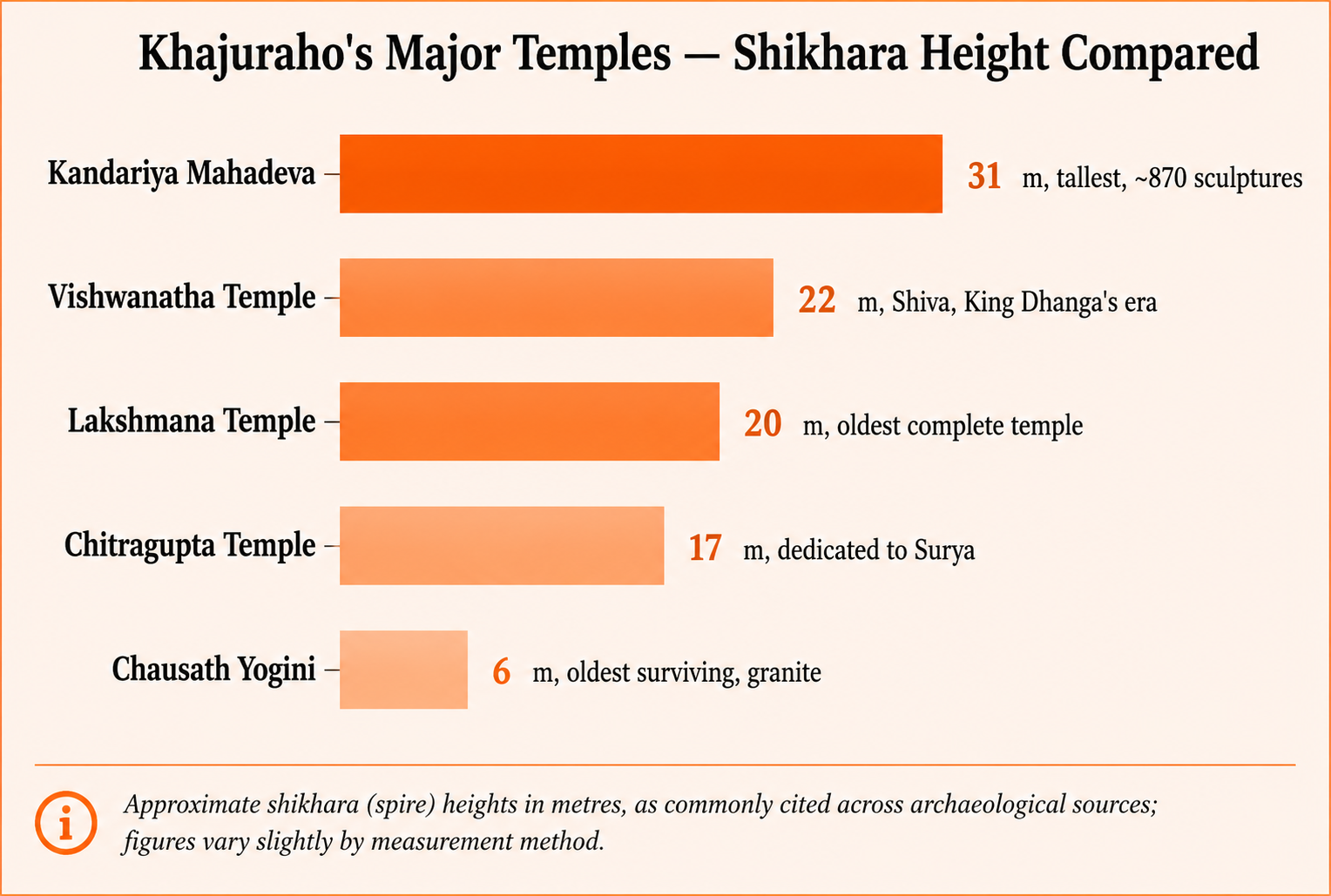
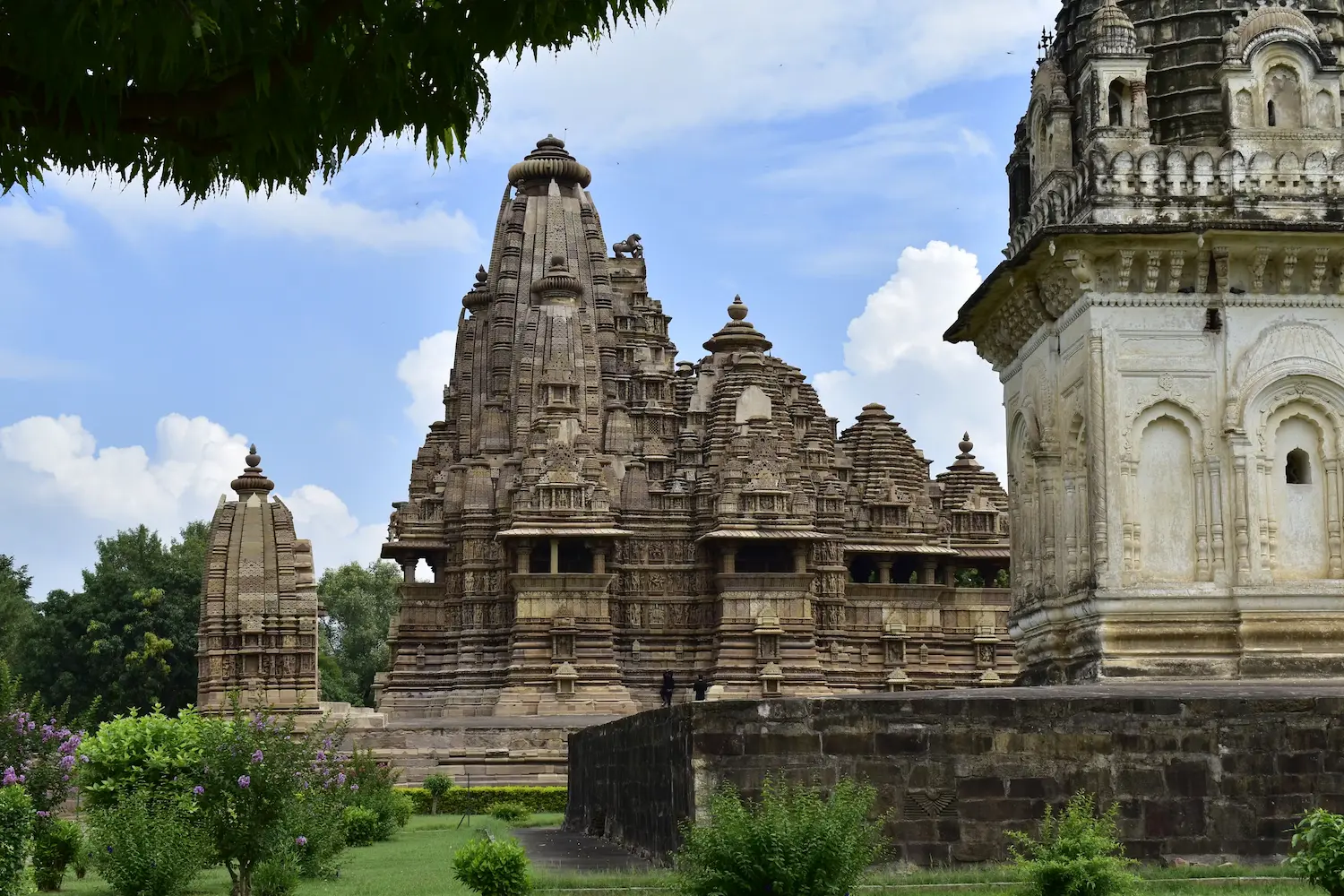
The first thing that struck me at Kandariya Mahadeva was not the scale — though at over thirty metres, its shikhara genuinely dwarfs everything around it — but the silence in which nearly nine hundred individual sculptures manage to exist on a single building without once feeling crowded. A guide beside us traced one panel with a flat palm, not quite touching the stone, and said simply, this one took a mason's whole working life. Somewhere above us a langur watched from the spire's topmost finial, entirely unbothered by a thousand years of human awe passing beneath it.
Khajuraho does not announce itself the way Agra or Varanasi does. It sits quietly in rural Chhatarpur district, a small town that exists almost entirely because of twenty-five surviving temples built a thousand years ago by a dynasty most of the world has never heard of. And yet nothing else in India, and very little else on earth, matches the sheer density and technical audacity of what the Chandela masons left behind here.
The Chandelas and Their Sandstone Ambition
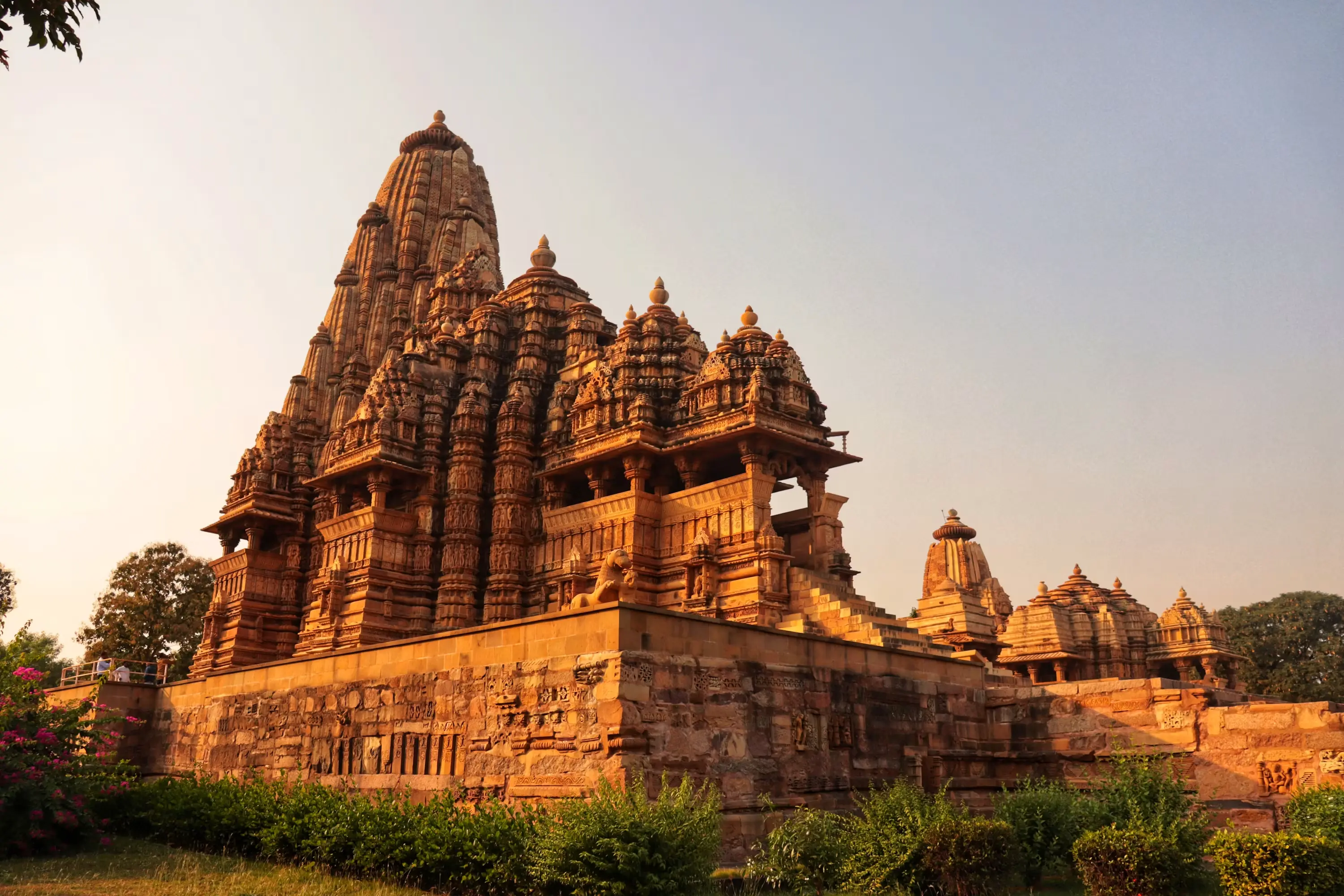
Khajuraho likely takes its name from the Sanskrit kharjura, meaning date palm, and vahaka, meaning bearer — local legend recalls two golden date-palm trees once flanking the town's gates, long since vanished. Between roughly 950 and 1050 CE, the Chandela dynasty, ruling a kingdom then known as Jejakabhukti from their capital at nearby Mahoba, undertook a building programme so ambitious that by the twelfth century the site held some eighty-five temples spread across twenty square kilometres. Deliberately, the Chandelas built their religious capital away from their fortified seat at Kalinjar — Khajuraho was conceived purely as a spiritual and artistic showcase, not a defended city, which may explain why its sculptors were given such extraordinary creative latitude.
The kingdom's two most consequential rulers bookend the site's golden age. Yashovarman commissioned the Lakshmana Temple around 954 CE, establishing the canonical panchayatana layout — a main shrine flanked by four subsidiary shrines — that later temples would refine. His successor Dhanga oversaw the Vishvanatha temple, and by the reign of King Vidyadhara, roughly 1017 to 1029, Chandela masons completed the Kandariya Mahadeva, the largest and most intricately carved temple at the site, built, according to some accounts, to commemorate a victory over the raiding armies of Mahmud of Ghazni. Remarkably, the Chandelas patronised Hindu and Jain temple-building side by side, using the same sandstone, the same Nagara architectural vocabulary, and often the same guild of masons — a working religious pluralism carved directly into stone eleven centuries before anyone thought to call it that.
The dynasty's fortunes ended in 1202, when the army of the Delhi Sultanate under Qutb-ud-din Aibak overran the Chandela kingdom, and temple construction at Khajuraho ceased for good. The Moroccan traveller Ibn Battuta, passing through around 1335, still found ascetic yogis living among the ruins, but in the centuries that followed the site's remote, rural location — the very quality that once made it a peaceful religious retreat — became its accidental protection. Jungle reclaimed the abandoned temples, hiding them from further destruction, until a British army engineer, Captain T.S. Burt, rediscovered the complex in 1838 while following local reports of ruins in the forest. UNESCO inscribed the Khajuraho Group of Monuments as a World Heritage Site in 1986, and today the temples stand as the single most complete surviving record of mature Nagara-style temple architecture anywhere in India
| Detail | Information |
|---|---|
|
Location |
Chhatarpur district, Madhya Pradesh, Central India |
|
Built by |
Chandela dynasty, c. 950–1050 CE |
|
UNESCO status |
World Heritage Site since 1986 |
|
Surviving temples |
~25 of an original ~85, in Western, Eastern & Southern groups |
|
Architecture style |
Nagara (North Indian), sandstone with granite foundations |
|
Western Group entry fee |
Indian nationals ₹40; foreign nationals ₹600 (approx., confirm current rate) |
|
Ideal visit length |
1.5 to 2 days, including the sound and light show |
|
Best season |
October to March; avoid April–June heat |
|
Nearest gateway airport |
Khajuraho Airport (HJR), direct flights from Delhi and Varanasi |
Khajuraho — Essential Facts
KHAJURAHO IS A FULL TASTING MENU CARVED IN STONE — DHARMA, ARTHA, KAMA, AND MOKSHA, SERVED ONE TEMPLE AT A TIME, OVER THE COURSE OF A THOUSAND YEARS.
Getting There — For Indian and International Travellers
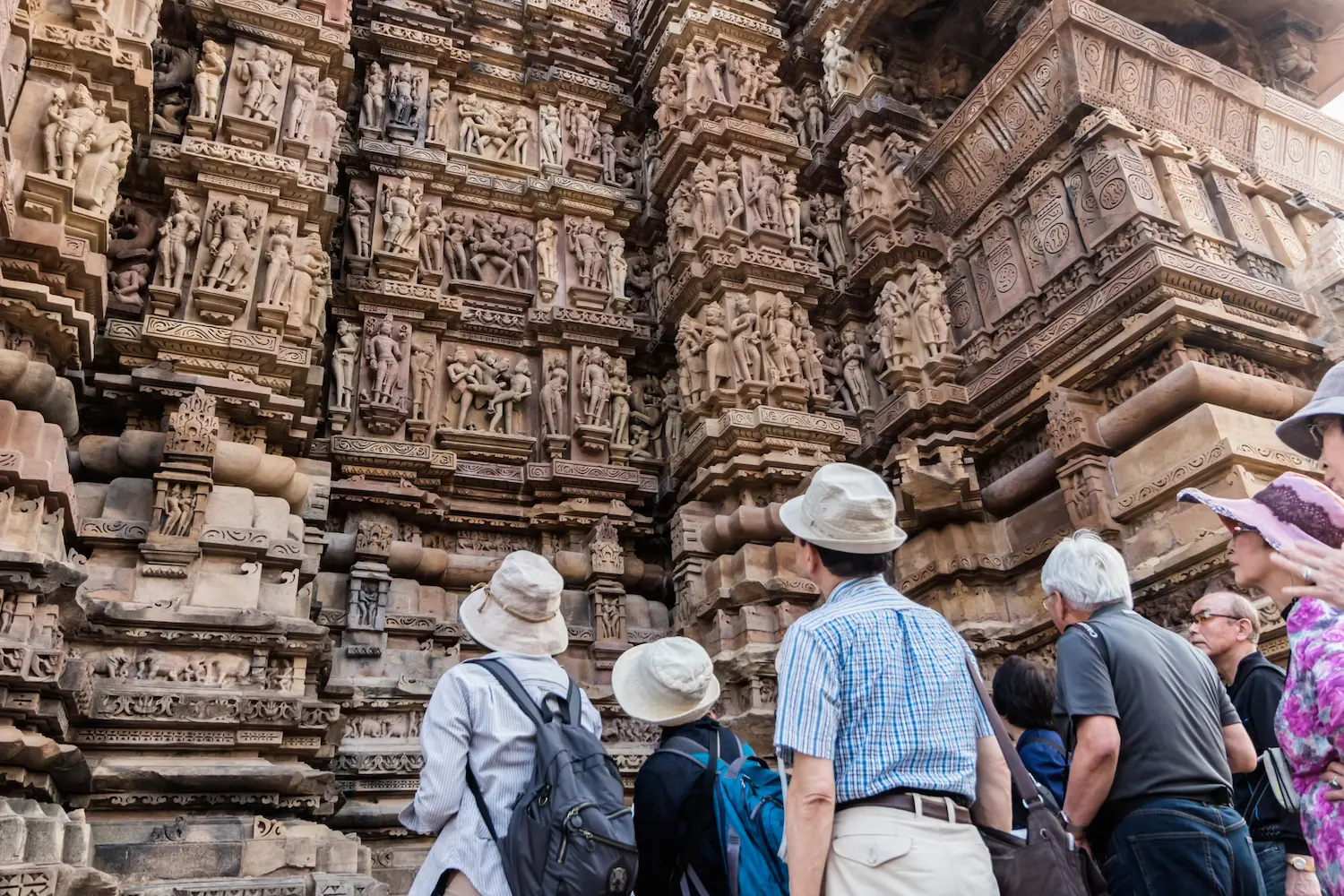
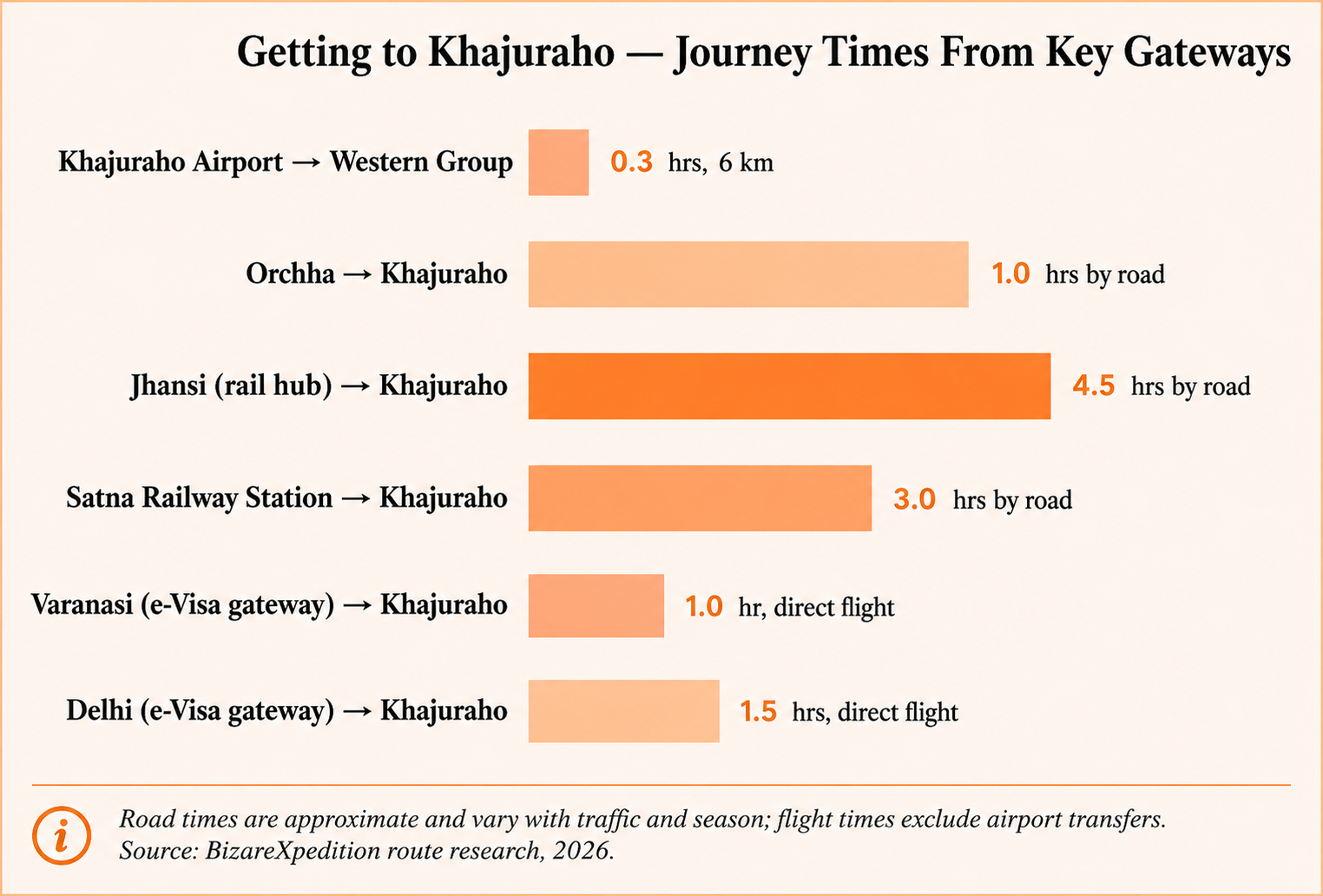
Khajuraho's own small airport is by far the easiest way in, with direct flights on IndiGo and Alliance Air from Delhi and Varanasi, both of which sit on India's e-Visa network of designated arrival airports — meaning most international visitors can fly straight into Delhi on an e-Tourist Visa and connect onward to Khajuraho in a single onward hop, landing barely fifteen minutes from the temple complex. Varanasi in particular makes an excellent combined itinerary: a spiritual, riverside North India leg followed by a short flight straight into Central India's temple town.
| Route | Distance | Approx. Time |
|---|---|---|
|
Khajuraho Airport → Western Group of Temples |
~8 km |
15–20 min |
|
Orchha → Khajuraho |
~175 km |
4 hrs by road |
|
Jhansi (rail hub) → Khajuraho |
~175 km |
4.5 hrs by road |
|
Satna Railway Station → Khajuraho |
~117 km |
3 hrs by road |
|
Varanasi (e-Visa gateway) → Khajuraho |
— |
~1 hr, direct flight |
|
Delhi (e-Visa gateway) → Khajuraho |
— |
~1.5 hrs, direct flight |
Khajuraho — Route
Travellers coming overland have two realistic approaches. From Delhi or Agra, the classic route runs via Jhansi, roughly four and a half hours further by road, with Orchha an easy and highly recommended overnight stop en route — the drive between Orchha and Khajuraho itself takes about four hours through gently rolling Bundelkhand countryside. From the east or south, Satna railway station, on the main line connecting Mumbai, Kolkata, and Varanasi, sits about three hours from Khajuraho by road and is often the more practical rail option than Jhansi for travellers not already routing through North India. Khajuraho does have its own railway station too, though service is limited compared to Jhansi or Satna, so most visitors treat flying or the Orchha road route as the primary options.
The Three Temple Groups
Khajuraho's surviving temples are organised into three distinct clusters, and understanding the difference before you arrive makes for a far more satisfying visit than treating the whole site as one undifferentiated stop.
The Western Group — the main event. This is the ticketed, ASI-managed cluster and the one most visitors mean when they say Khajuraho: Kandariya Mahadeva, Lakshmana, Vishvanatha, Chitragupta, Devi Jagadambi, and the granite Chausath Yogini among them, all set within a landscaped, walkable park. Budget a minimum of three unhurried hours here, ideally split across two visits — one at opening time for soft morning light and thinner crowds, and one closer to the sound and light show in the evening.
The Eastern Group — Jain temples and quiet devotion. A short auto-rickshaw ride from the Western Group, the Eastern cluster mixes several Hindu temples with the site's finest Jain monuments, chief among them the Parshvanatha Temple, the largest Jain shrine at Khajuraho, carved with the same technical mastery as the Western Group but with markedly fewer visitors. Several of these temples remain active places of worship today, which shifts the atmosphere noticeably from monument to living shrine.
The Southern Group — the quiet outlier. Smallest and least visited of the three, the Southern Group's standout is the Duladeo Temple, dedicated to Shiva and built slightly later than the Western Group's masterpieces, showing a more ornate, almost baroque final phase of Chandela carving. Few tour groups make it out here, which is exactly its appeal for travellers who prefer temples without a crowd.
| Group | Key Temples | Ticketed? | Time Needed |
|---|---|---|---|
|
Western Group |
Kandariya Mahadeva, Lakshmana, Vishvanatha |
Yes (ASI ticket) |
3+ hours |
|
Eastern Group |
Parshvanatha, Adinatha, Javari |
Mostly free |
1–1.5 hours |
|
Southern Group |
Duladeo, Chaturbhuja |
Free |
1 hour |
|
Archaeological Museum |
Adjacent to Western Group |
Small fee |
45 min |
Khajuraho — Group
READING KANDARIYA MAHADEVA'S SCULPTURE BANDS IS LIKE WORKING THROUGH A FULL-COURSE MEAL COURSE BY COURSE — GODS AND GUARDIANS FOR THE APPETISER, CELESTIAL NYMPHS FOR THE MAIN EVENT, AND THE HUMAN LIFE CYCLE CARVED IN AS DESSERT.
Understanding the Sculptures — Beyond the Headlines
Khajuraho's international reputation rests disproportionately on its erotic sculpture, which in reality makes up a small fraction — most scholars estimate under ten percent — of the total carving across the complex. The far larger body of work depicts deities, celestial nymphs known as surasundaris, musicians, dancers, mythical beasts, battle scenes, and unremarkable daily life: women applying makeup, a farmer at work, a wedding procession. Scholars remain divided on what the intimate carvings specifically represent — theories range from Tantric ritual symbolism and Shakti-tradition fertility worship to a visual grammar of the four traditional aims of Hindu life, dharma, artha, kama, and moksha, with kama, desire, taking its rightful place alongside duty, prosperity, and liberation rather than being hidden from view. Whatever the precise original intent, the sculptures were carved by masters of anatomical observation working at the absolute peak of medieval Indian stonecraft, and visitors who come expecting only novelty tend to leave far more struck by the sheer technical range on display across the entire temple.
| Temple | Dedicated To | Built (approx.) | Notable For |
|---|---|---|---|
|
Kandariya Mahadeva |
Shiva |
1025–1050 CE |
Tallest shikhara; ~870 sculptures |
|
Lakshmana Temple |
Vishnu |
930–954 CE |
Oldest complete temple, panchayatana layout |
|
Vishvanatha Temple |
Shiva |
c. 1002 CE |
King Dhanga's crowning temple |
|
Chitragupta Temple |
Surya (Sun God) |
c. 1000–1025 CE |
Rare Sun God sanctum, chariot imagery |
|
Parshvanatha Temple |
Jain Tirthankara |
954 CE |
Largest Jain temple at the site |
|
Chausath Yogini |
64 Yoginis |
c. 850–900 CE |
Oldest surviving structure, sole granite temple |
Khajuraho — Temple
Look closely and the construction technique is its own quiet marvel: builders had no mortar, so sandstone blocks were fitted using mortise and tenon joints, precision-cut interlocking joins that have held for a millennium without binding agent, reinforced here and there with iron clamps. Each temple sits on an elevated jagati platform, its plan set out on a vastu-purusha-mandala grid believed to encode cosmic order, rising through a garbhagriha sanctum, antarala vestibule, and one or more mandapa halls toward the shikhara — a soaring spire whose form, unique to the Nagara style, is echoed by miniature spires, or urushringa, clustered around its base to accentuate the building's vertical thrust toward the heavens.
When to Go — Weather, Festival, and Light
October through March brings Khajuraho's most comfortable weather, with daytime temperatures generally between 15°C and 28°C and cool, clear evenings well suited to the sound and light show. April through June turns punishing, with the Bundelkhand plain routinely crossing 40°C by midday, while the July–September monsoon brings humidity and occasional heavy rain that can disrupt an outdoor sightseeing schedule, though it also greens the surrounding countryside beautifully for anyone willing to trade comfort for near-empty temple grounds.
| Season | Months | Typical Temp | Best For |
|---|---|---|---|
|
Winter |
Oct – Mar |
8°C to 28°C |
Sightseeing comfort, sound and light show, dance festival |
|
Summer |
Apr – Jun |
25°C to 45°C |
Avoid extended outdoor exploration |
|
Monsoon |
Jul – Sep |
26°C to 33°C |
Greenery, thinner crowds, occasional rain disruption |
When to Go
If dates allow, plan around the Khajuraho Dance Festival, held annually in the last week of February against the illuminated backdrop of the Western Group. Running since 1975, the week-long programme brings India's leading classical dancers to open-air stages near the Chitragupta and Vishvanatha temples, performing Bharatanatyam, Kathak, Odissi, Kuchipudi, Manipuri, Kathakali, and Mohiniyattam on consecutive evenings, with core performances free to attend and open equally to domestic and international visitors. It remains one of the more understated great cultural events in India — dignified, well organised, and entirely unlike the crowd intensity of festivals elsewhere in the country.
Things to do in Khajuraho...
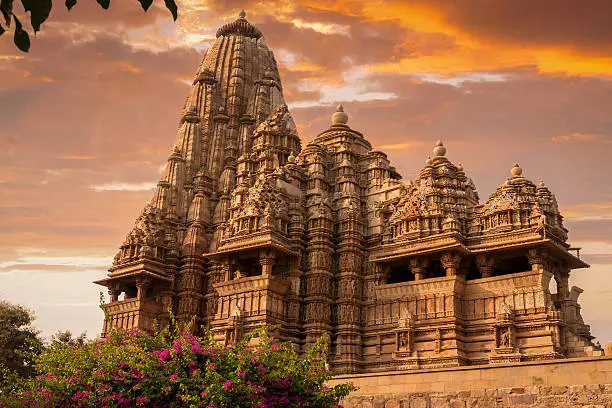
Visit the Western Group twice — dawn and dusk. The soft light of early morning brings out the depth of the carving far better than the flat glare of midday, and returning near closing time ahead of the sound and light show lets you watch the sandstone shift colour as the sun drops.
Attend the sound and light show. Staged nightly within the Western Group, the roughly fifty-minute programme narrates Khajuraho's history and the Chandela dynasty's rise, with separate English and Hindi sittings each evening — a genuinely useful orientation for anyone visiting the temples the following morning, not simply a tourist add-on.
Hire a licensed guide for at least one temple visit. Much of what makes Kandariya Mahadeva remarkable is invisible without context — specific mythological panels, construction technique, and the layout's cosmological logic are easy to walk past unknowingly. A good guide, hired at the entrance or through your hotel, transforms an hour of looking into an hour of actually seeing.
Walk the quieter Eastern and Southern Groups. Most visitors exhaust their time and energy on the Western Group alone. The Eastern Group's Jain temples and the Southern Group's Duladeo Temple reward the extra half-day with genuinely fine carving and a fraction of the footfall.
Take a half-day trip to Raneh Falls. About twenty kilometres from town, the Ken River carves through a canyon of crystalline granite in striking shades of pink, grey, and red — a dramatic natural counterpoint to a day spent among carved sandstone, especially striking just after the monsoon.
Consider a short safari extension to Panna National Park. Roughly an hour's drive away, Panna Tiger Reserve makes a natural add-on for travellers who want to pair Khajuraho's heritage circuit with a wildlife morning, without the longer detour that Bandhavgarh or Kanha would require. Note that, like every other Madhya Pradesh reserve, Panna's core zone closes for the monsoon, so a summer or winter add-on works far better than a July–September one.
Hire an auto-rickshaw by the day rather than piecemeal. A full day covering all three temple groups typically runs ₹500 to ₹800 depending on season and how far you negotiate; a two-day hire that also covers Raneh Falls usually settles around ₹1,200 to ₹1,400. Agree the full day's plan and total price with the driver before setting off, in rupees, out loud, in front of your hotel reception if that helps — it avoids the far more common problem of a price renegotiated stop by stop.
Try Ken Gharial Sanctuary as a budget alternative to a full Panna safari. Roughly fifteen kilometres out, this smaller sanctuary bordering Raneh Falls offers gharial and crocodile sightings, birdlife, and the same dramatic granite canyon for a fraction of a full tiger safari's cost — entry, guide, and a small vehicle fee typically add up to a few hundred rupees per person rather than the thousands a Panna jeep safari runs.
| Activity | Location | Duration | Notes |
|---|---|---|---|
|
Sound and light show |
Western Group grounds |
~50 min |
Separate English and Hindi sittings nightly |
|
Archaeological Museum visit |
Near Western Group |
45 min |
Closed Fridays; useful context before/after |
|
Raneh Falls excursion |
~20 km from town |
Half day |
Best during/just after monsoon; runs dry by summer |
|
Ken Gharial Sanctuary |
~15 km from town |
2–3 hrs |
Budget alternative to Panna; gharial and birdlife |
|
Panna National Park safari |
~1 hr from town |
Half day |
Book safari slots in advance; closed monsoon |
Khajuraho — Activity
A KHAJURAHO DAY IS A PROPER TASTING MENU — THE WESTERN GROUP AS THE RICH MAIN COURSE, RANEH FALLS AS THE PALATE-CLEANSING SORBET, AND THE SOUND AND LIGHT SHOW AS THE AFTER-DINNER DIGESTIF NOBODY SKIPS.
Things not to do in Khajuraho...
Don't rush it into a half-day stop. The temptation on a Delhi–Agra–Khajuraho circuit is to treat Khajuraho as a quick photo stop before rushing onward. The carving detail alone rewards a slow, guided morning at the Western Group, and a proper visit needs a minimum of one full day, ideally with an overnight to catch the evening show as well.
Don't touch or climb on the sculptures. These are protected archaeological monuments under the Archaeological Survey of India, not backdrop props. Guards actively enforce this, and it is worth respecting even where they aren't watching.
Don't accept the first unofficial guide who approaches at the gate, and be wary of anyone offering to show you a 'local school'. Self-appointed guides commonly work the entrance areas and the old village lanes; agree a price clearly before starting, or arrange a guide in advance through your hotel or a licensed operator. A specific, recurring pattern worth knowing: a friendly local strikes up conversation, offers to 'practise English', and eventually leads visitors to a rundown building presented as an underfunded local school, where a well-rehearsed pitch asks for a cash donation. Genuine as some community schools are, this specific walk-in-and-donate routine has been reported often enough by travellers that it's worth simply declining any unplanned detour to a school, orphanage, or workshop suggested mid-walk by someone you just met.
Don't scan a shop's QR code without checking the payee name that appears before you pay. In January 2025, fraudsters in Khajuraho were caught on CCTV pasting fake QR-code stickers directly over the real ones outside a dozen shops and a petrol pump overnight, silently rerouting UPI payments to their own accounts until customers noticed an unfamiliar name on the payment confirmation screen. The specific incident was resolved, but the method is simple enough to recur anywhere. Get in the habit, in Khajuraho and everywhere else in India, of glancing at the payee name your UPI app shows after scanning and before confirming payment; if it doesn't match the shop, don't pay, and tell the shopkeeper immediately.
Don't wear beachwear or overly casual clothing at active temples. The Western Group itself has no strict enforced dress code, but several temples in the Eastern Group remain active places of worship. Modest, comfortable clothing is simply respectful, and shoes come off before entering shrine interiors wherever access is permitted.
Don't skip sun protection in shoulder-season heat. Even in the cooler October and March edges of the recommended season, midday sun across the open temple grounds is intense. Carry water, a hat, and sunscreen regardless of month.
| Requirement | Detail |
|---|---|
|
Western Group entry |
Indian ₹40 / foreign ₹600 approx.; children under 15 free |
|
Licensed guide fee |
From ~₹1,800 for a group of two at the Western Group gate |
|
Photography |
Permitted outdoors; flash and tripods restricted near carvings |
|
Drone/commercial filming |
Requires prior ASI authorisation |
|
Dress code |
No strict enforcement at Western Group; modest dress advised at active shrines |
|
e-Visa (international visitors) |
Apply online in advance; arrive via Delhi, Varanasi or other designated airport |
|
Persistent harassment |
Dial 100 for police; a phone photo of the person often ends it on its own |
Khajuraho — Requirement
Where to Eat
Khajuraho's tiny size means its best eating is well known by name rather than by cuisine type. The Madras Coffee House, opposite the Western Group at the Jain Mandir Road intersection, is the reliable choice for South Indian breakfast — filter coffee and idli-sambar for well under ₹200 — and a genuinely good spot to fuel up before opening time at the temples. Mediterraneo, tucked into a first-floor space in Gol Market, is the town's unlikely but well-regarded Italian option, a favourite recommendation among rickshaw drivers for visitors wanting a change from thali. Street food stalls around the market are plentiful and cheap, but travellers without an already well-adjusted stomach for Indian street food should treat them cautiously on a short visit; a stomach upset is a poor way to spend a limited Khajuraho itinerary. If a hotel or driver steers you firmly toward one specific restaurant with unusual insistence, treat it as a commission arrangement rather than a genuine recommendation and feel free to choose your own.
Where to Stay
Khajuraho's accommodation has grown considerably since UNESCO listing brought international attention in 1986, and the town now runs the full range from simple family-run guesthouses to internationally branded hotels, most clustered within a short auto-rickshaw ride of the Western Group. Budget and mid-range properties dominate, reflecting Khajuraho's role as a one-to-two-night stop on a longer circuit rather than an extended-stay destination, though several boutique and heritage-style properties have opened in recent years for travellers wanting to linger.
| Category | Examples | Per Night (Couple) | Honest Note |
|---|---|---|---|
|
Budget guesthouse |
Family-run lodges near town centre |
₹1,800 – ₹3,000 |
Simple, good value, close to temples |
|
Mid-range hotel |
3-star properties |
₹4,500 – ₹8,000 |
Reliable comfort, often with pool |
|
Boutique/heritage |
Smaller design-led properties |
₹9,000 – ₹15,000 |
Character-rich, book ahead in peak season |
|
International chain |
The Lalit, Radisson Jass tier |
₹16,000+ |
Full-service comfort near the Western Group |
Where to Stay
Travelling Khajuraho Responsibly
Carry a LifeStraw or similarly filtered bottle to cut down on single-use plastic across a full day of walking between temple groups; most hotels now provide refill points. Engage licensed guides and drivers rather than informal touts wherever possible, since it channels tourism income toward accountable local operators. Buy handicrafts and textiles — Chanderi and Maheshwari weaves in particular — from the state-run Mrigynaynee Emporium or clearly established shops rather than unlicensed street sellers pressing hard-sell souvenirs near the temple gates. And treat the Eastern Group's active shrines with the same quiet respect you would show any working place of worship, regardless of how empty the courtyard looks compared to the Western Group's crowds.
Before you go...
Book your flights or train connections early if travelling during the Khajuraho Dance Festival in late February, when the town's limited accommodation fills quickly. Carry cash in small denominations as backup for ticket counters that have moved to QR-only digital payment, and download offline maps before arrival, since mobile data can be patchy away from the main temple areas. If Khajuraho is one stop on a longer North India itinerary, we strongly recommend building in the Orchha overnight en route from Jhansi rather than treating it as a pass-through — it adds only a few hours and rewards it many times over.
| Checklist Item | Note |
|---|---|
|
Government photo ID / passport |
Carried for ticket purchase and hotel check-in |
|
Cash in small denominations |
Backup for QR-only ticket counters |
|
Sun protection |
Hat, sunscreen, water even in cooler months |
|
Modest, comfortable clothing |
Especially for active shrines in the Eastern Group |
|
Guide booked in advance (optional) |
Through hotel or licensed operator, to avoid gate touts |
|
Indian e-Visa (international visitors) |
Apply online ahead; arrive via a designated e-Visa airport |
Checklist Item
At BizareXpedition, our Himalayan roots in Haridwar don't stop us from loving Central India's slower, denser rhythm — we build Khajuraho itineraries around unhurried mornings with a genuinely knowledgeable guide, an evening at the sound and light show, and enough breathing room to walk the quieter Eastern and Southern groups that most rushed circuits skip entirely.
Budget Guide
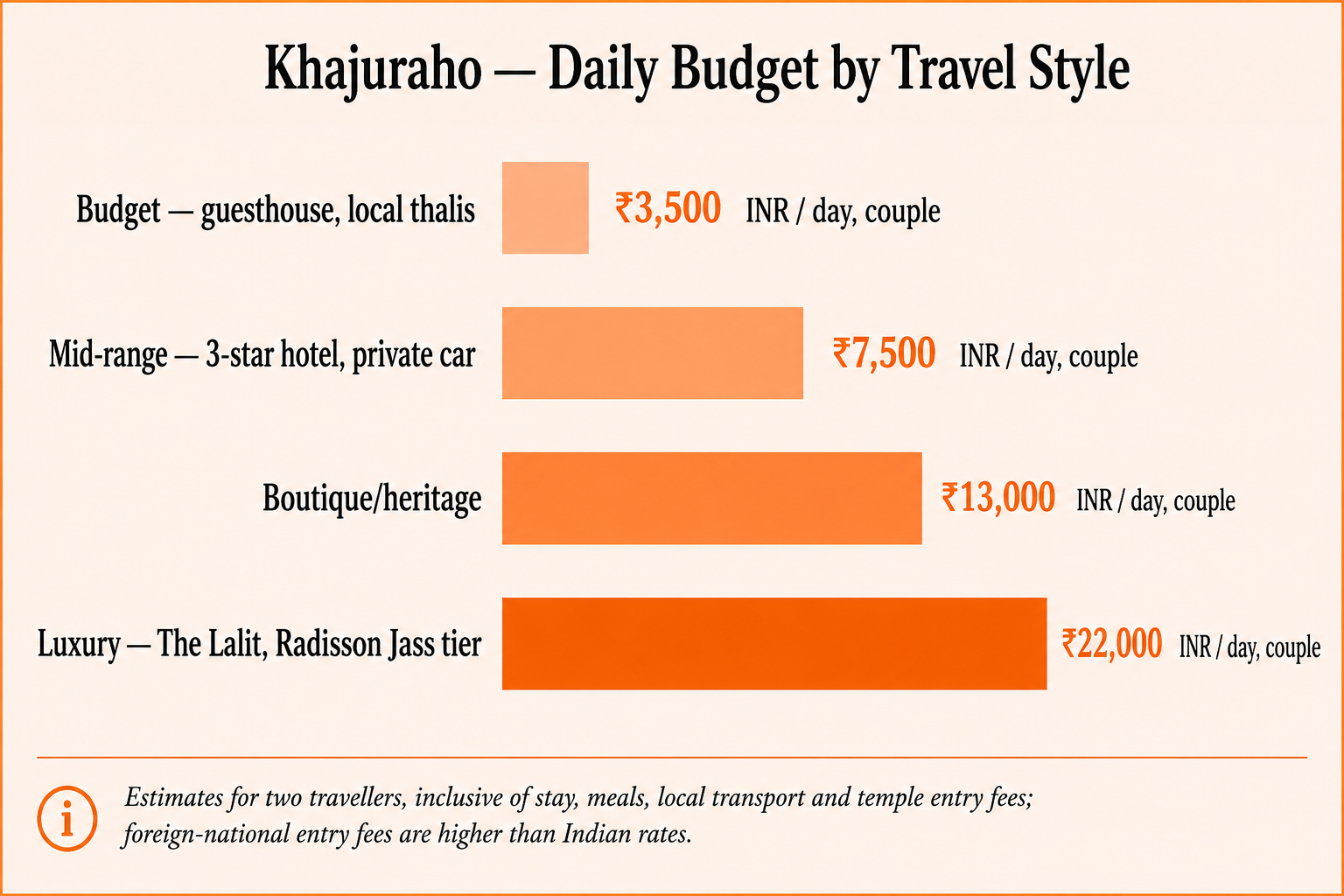
A comfortable two-day, one-night Khajuraho stop — mid-range hotel, guided Western Group visit, sound and light show, and a half-day excursion to Raneh Falls — typically runs between ₹12,000 and ₹20,000 per couple, inclusive of stay, meals, guide, and entry fees. Extend to three nights with the full three-group temple circuit and a Panna safari morning, and the number climbs to roughly ₹25,000 to ₹40,000 in mid-range comfort, considerably more at the international-chain tier.
| Style | Per Day (Couple) | -Day Total (approx.) |
|---|---|---|
|
Budget |
₹3,500 |
₹10,500 |
|
Mid-range |
₹7,500 |
₹22,500 |
|
Boutique/heritage |
₹13,000 |
₹39,000 |
|
Luxury |
₹22,000+ |
₹66,000+ |
Budget Guide
Somewhere between the third and fourth carved band on Kandariya Mahadeva's outer wall, the sheer volume of human labour stops being a statistic and starts being a presence — a thousand years of unnamed hands still visible in the stone, patient enough to wait exactly this long for someone to finally look up and notice.