
Himachal Pradesh: Hills, Valleys & the Cold Desert14N/15D
Himachal Pradesh: Hills, Valleys & the Cold Desert
Start & City : Delhi, Chandigarh
best deal price
₹
Without GST ₹1,40,049
per person on twin sharing
Choose your departure city, dates, and add guests to secure your tour.
Hurry, as seats fill up, prices rise! Book now!
1. Choose your departure date
Highlights
Walk through Shimla's Christ Church and the 1888 Viceregal Lodge, the British Raj's summer capital and the rooms where some of the last talks before 1947 were held.
Visit the Bhimakali Temple at Sarahan, the 13th-century royal chapel of the Bushahr kingdom, on the way into Kinnaur.
Cross into Spiti's high-altitude cold desert through Nako, a 3,660-metre lake village, with an Inner Line Permit arranged for you.
Stand inside Tabo Monastery, founded in 996 CE and continuously in use since — one of the oldest working Buddhist sites in the Himalaya, and the 'Ajanta of the Himalaya' for its 1,000-year-old murals.
See Key Monastery's fortress-like stack of buildings at 4,166 metres, and the plateau villages of Kibber, Langza and Hikkim, home to the world's highest post office.
Cross Kunzum La at 4,551 metres and spend a night near Chandratal, the crescent-shaped 'moon lake' at over 4,300 metres.
Descend through the Atal Tunnel into Manali, and visit the 1553 Hadimba Temple in its ancient deodar forest.
Spend a full day in McLeodganj at the Dalai Lama's own residence-temple complex, and the Tibet Museum documenting the 1959 exile.
Watch the Beating Retreat ceremony at the Wagah Border, and visit the Golden Temple's dawn light and its free kitchen feeding over 100,000 people a day.
Essence of Journey
The experiences that capture the true spirit of the entire trip.
| Day | Route | Distance | Major Highlights |
|---|---|---|---|
| Day 1 | Delhi (airport, hotel) | 20 km local | Arrival, route briefing |
| Day 2 | Delhi - Chandigarh - Shimla (road) | ~350 km, 7-8 hours | Kalka foothills, first hill-station air |
| Day 3 | Shimla (Ridge, Christ Church, Viceregal Lodge) | 20 km local | Christ Church, Viceregal Lodge, the Ridge |
| Day 4 | Shimla - Narkanda - Rampur - Sarahan - Kalpa | ~230 km, 8 hours | Sarahan's Bhimakali Temple, first sight of Kinner Kailash |
| Day 5 | Kalpa - Reckong Peo - Nako - Tabo | ~195 km, 7-8 hours | Nako village and lake, first Inner Line Permit checkpoint |
| Day 6 | Tabo - Dhankar - Kaza | ~60 km, 3 hours | Tabo Monastery's 1,000-year-old murals, Dhankar Monastery |
| Day 7 | Kaza - Key - Kibber - Langza/Hikkim/Komic | ~90 km local loop | Key Monastery, Chicham bridge, Hikkim's post office |
| Day 8 | Kaza - Losar - Kunzum La - Chandratal | ~100 km, 6-7 hours | Kunzum La (4,551 m), Chandratal's eco-camp |
| Day 9 | Chandratal - Batal - Gramphu - Atal Tunnel - Manali | ~135 km, 7-8 hours | Atal Tunnel, descent into the Kullu valley |
| Day 10 | Manali (Hadimba Temple, Old Manali, Naggar) | ~30 km local | Hadimba Temple, Old Manali, Naggar Castle |
| Day 11 | Manali - Mandi - Palampur - Dharamshala | ~245 km, 7-8 hours | Kangra valley tea gardens, first view of the Dhauladhar range |
| Day 12 | McLeodganj (Tsuglagkhang Complex, Tibet Museum, Bhagsu) | ~25 km local | Tsuglagkhang Complex, Namgyal Monastery, the Tibet Museum |
| Day 13 | Dharamshala - Pathankot - Amritsar - Wagah | ~230 km, 6 hours incl. Wagah | Wagah Border retreat ceremony |
| Day 14 | Amritsar (Golden Temple, Partition Museum, Jallianwala Bagh) | ~25 km local incl. airport transfer | Harmandir Sahib at dawn, Jallianwala Bagh, evening flight to Delhi |
| Day 15 | Delhi (hotel - airport) | 20 km local | Departure |
About
This is a Himachal Pradesh tour package International first-time visitors rarely find assembled in one route: a British-era hill station, a princely Kinnauri temple, the Tibetan Buddhist cold desert of Spiti, an adventure-sports valley, the seat of the Dalai Lama, and the Golden Temple, all on one private, tailor-made journey across a single 15-day arc, entering through the hills and leaving through the plains.
The direction of travel follows a physiological logic, not just a scenic one. Shimla sits at about 2,200 metres, Kalpa at roughly 2,960, Nako near 3,660, and Kaza close to 3,800 — a gradual, day-by-day climb that gives the body time to adjust before the highest point of the trip, Kunzum La at 4,551 metres, on Day 8. Arriving in Spiti from the Manali side instead would mean crossing that same altitude gap in a single day, so the route enters through Kinnaur and exits through Manali, not the reverse.
This is a himachal holiday for foreigners built around a private vehicle, a driver and an English-speaking guide for the whole journey, with a Tibetan-culture specialist added for the Dharamshala day and an Inner Line Permit arranged in advance for the Kinnaur and Spiti sections. It doubles as a himachal complete tour for tourists who want the state's full range in one trip rather than a single region, and it is priced in three tiers, Premium, Luxury and Ultra-Luxury, with every departure built to your dates within the short window the high mountain roads allow.
Note on season and permits. The Manali-Kaza road over Kunzum La is open only from late May to late September; outside that window this route is not possible in the direction described here. Foreign nationals also need an Inner Line Permit for Nako onward through Spiti (not for Kalpa, Sangla or Sarahan, which are unrestricted) — BizareXpedition arranges this, and it is built into the price. Both of these are explained in full where they apply, on Day 5 and in the Practical Notes.
WHY BOOK THIS WITH BIZAREXPEDITION
Six very different Himachals, on one route, with one guide who knows all of them.
A rare combination, not a marketing line. Colonial hill stations, a Tibetan Buddhist cold desert and a still-functioning exile government headquarters exist in very few places on earth inside a single state. This route visits all three, in the order the altitude actually asks for.
The permits handled before you fly. The Inner Line Permit for Nako, Tabo and Kaza is arranged in advance, checked at Reckong Peo on Day 5, and included in the price — nothing to arrange at the border yourself.
A guide who carries the whole route, not a relay of local drivers. The same English-speaking guide travels with you from Shimla to Amritsar, so the context connecting a Bushahr temple to a Buddhist monastery to a Sikh gurdwara doesn't get lost at a handover.
An honest altitude plan. Kunzum La and Chandratal sit above 4,300 metres. The route climbs to that height gradually over six days rather than all at once, and the Practical Notes below say plainly what altitude actually feels like and what to tell your guide.
Three tiers, one route. The Premium, Luxury and Ultra-Luxury versions share the same 15-day route and the same guide standard. The tiers change the rooms, the vehicle on the mountain sections, and the specialist support.
ACCOMMODATION CATEGORIES
| Destination | Nights | Premium | Luxury | Ultra-Luxury |
|---|---|---|---|---|
|
Delhi |
2 |
Radisson Blu Plaza Delhi Airport |
ITC Maurya |
The Oberoi, New Delhi |
|
Shimla |
2 |
Clarkes Hotel, Shimla |
Clarkes Hotel, Shimla |
Wildflower Hall, An Oberoi Resort |
|
Kalpa |
1 |
Best available heritage stay (named at booking) |
Best available heritage stay (named at booking) |
Best available heritage suite (named at booking) |
|
Kaza |
2 |
Comfortable guest house (named at booking) |
Best available property (named at booking) |
Best available property, top room (named at booking) |
|
Chandratal |
1 |
Eco-camp, shared washroom tent |
Eco-camp, attached washroom tent |
Eco-camp, premium heated tent |
|
Manali |
2 |
Well-appointed riverside resort (named at booking) |
Span Resort & Spa, Manali |
The Himalayan, Naggar |
|
Dharamshala |
2 |
Comfortable hotel (named at booking) |
Best available hotel (named at booking) |
Best available hotel, top room (named at booking) |
|
Amritsar |
1 |
Ramada Amritsar |
Hyatt Regency Amritsar |
Taj Swarna, Amritsar |
|
Tabo |
1 |
Simple guest house (named at booking) |
Best available guest house (named at booking) |
Best available guest house, top room (named at booking) |
Himachal Pradesh International Accommodation Categories
Note on hotels and vehicles. Kalpa, Tabo and Kaza have no branded hotels at any tier — the mountains simply don't have them yet — so all three tiers there differ by room grade and service rather than by a named property; Chandratal's eco-camp differs by tent type only, since camps are re-licensed each season and named operators change year to year. On the Shimla-Kalpa-Tabo-Kaza-Chandratal-Manali mountain sections, even the Ultra-Luxury tier travels in a rugged 4x4 (a Toyota Fortuner or equivalent) rather than a sedan-style luxury car, since the roads don't suit one — the tier's comfort there is expressed through the hotel and guide, not the vehicle. Property names are proposals and are confirmed at booking. Rates in this document are modelled, not contract rates.
3-TIER PRICING SUMMARY (indicative)
| Tier | Per couple | Per person (twin sharing) |
|---|---|---|
|
Premium |
Rs.280,098 – Rs.302,506 |
Rs.140,049 – Rs.151,253 |
|
Luxury |
Rs.435,960 – Rs.470,837 |
Rs.217,980 – Rs.235,418 |
|
Ultra-Luxury |
Rs.683,865 – Rs.738,574 |
Rs.341,932 – Rs.369,287 |
Himachal Pradesh International 3-Tier Pricing Summary
Prices are indicative and modelled. The upper figure covers date and season variation. The final quote depends on dates, hotels confirmed and any upgrade you choose.
Shimla: The Raj's Summer Capital
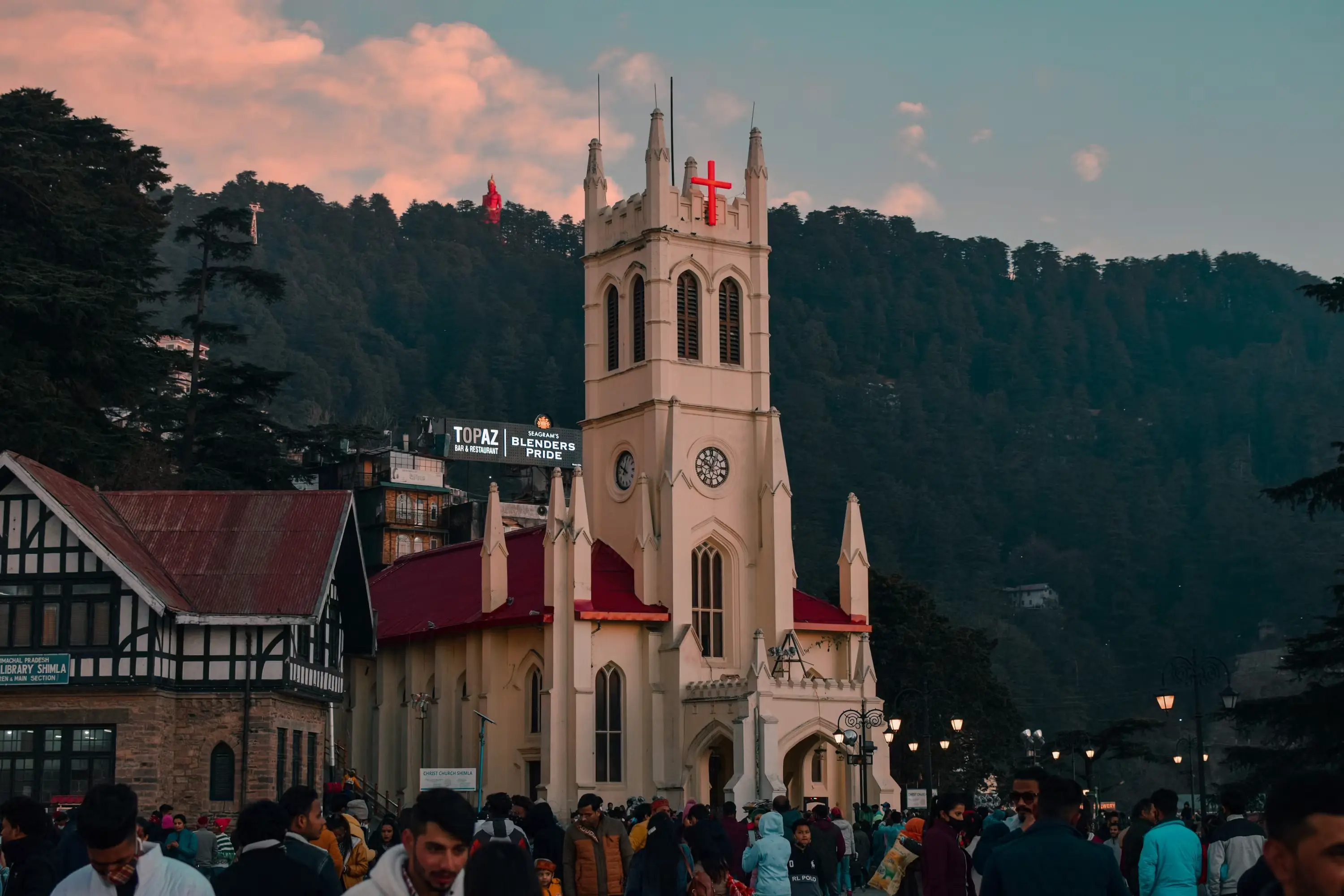
Shimla was the summer capital of British India for over a century, and its two landmark buildings both date from that period. Christ Church on the Ridge, consecrated in 1857, is one of the oldest churches in North India. The Viceregal Lodge, built in 1888 in Scottish baronial style, now houses the Indian Institute of Advanced Study, and its rooms carried some of the last formal talks between British and Indian leaders before 1947. The rest of the day moves at Mall Road pace — the pedestrian promenade, Scandal Point, and the shawl and woollen-craft shops that still supply much of Himachal's winter clothing trade — deliberately unhurried, since the body is still adjusting to altitude here.
Kinnaur: A Kingdom's Temple and the Kinner Kailash
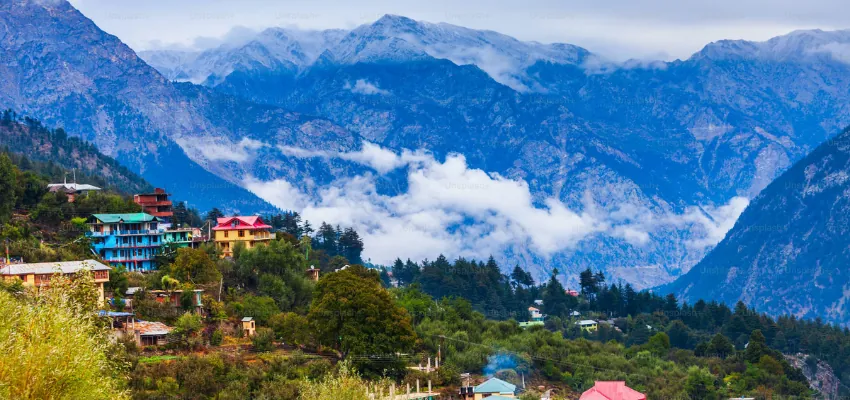
The road to Kalpa passes through Sarahan for a stop at the Bhimakali Temple, the former royal chapel of the Bushahr kingdom. Built in kath-kuni style — alternating timber and stone, without mortar — around the 13th century, its twin towers survived the severe 1905 Kangra earthquake with only a slight, later-corrected tilt. Beyond Sarahan the light changes: drier air, apple and chilgoza-pine slopes, and on a clear afternoon into Kalpa, the first full view of the Kinner Kailash range, a jagged wall of peaks considered by many Kinnauris to be Shiva's Himalayan home.
Spiti: The Cold Desert's Living Monasteries
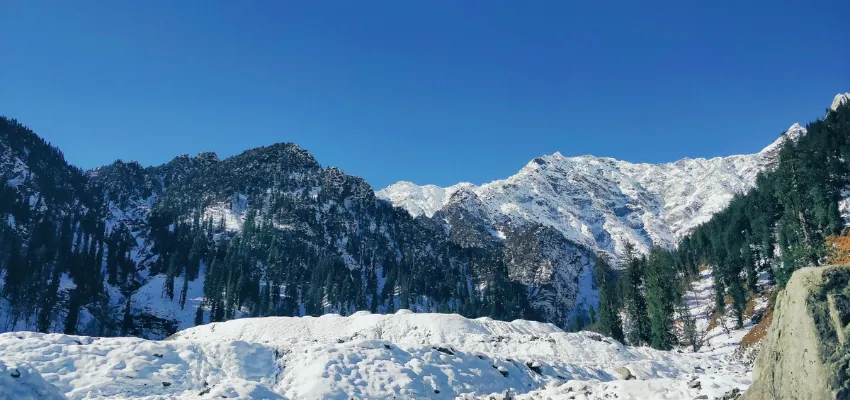
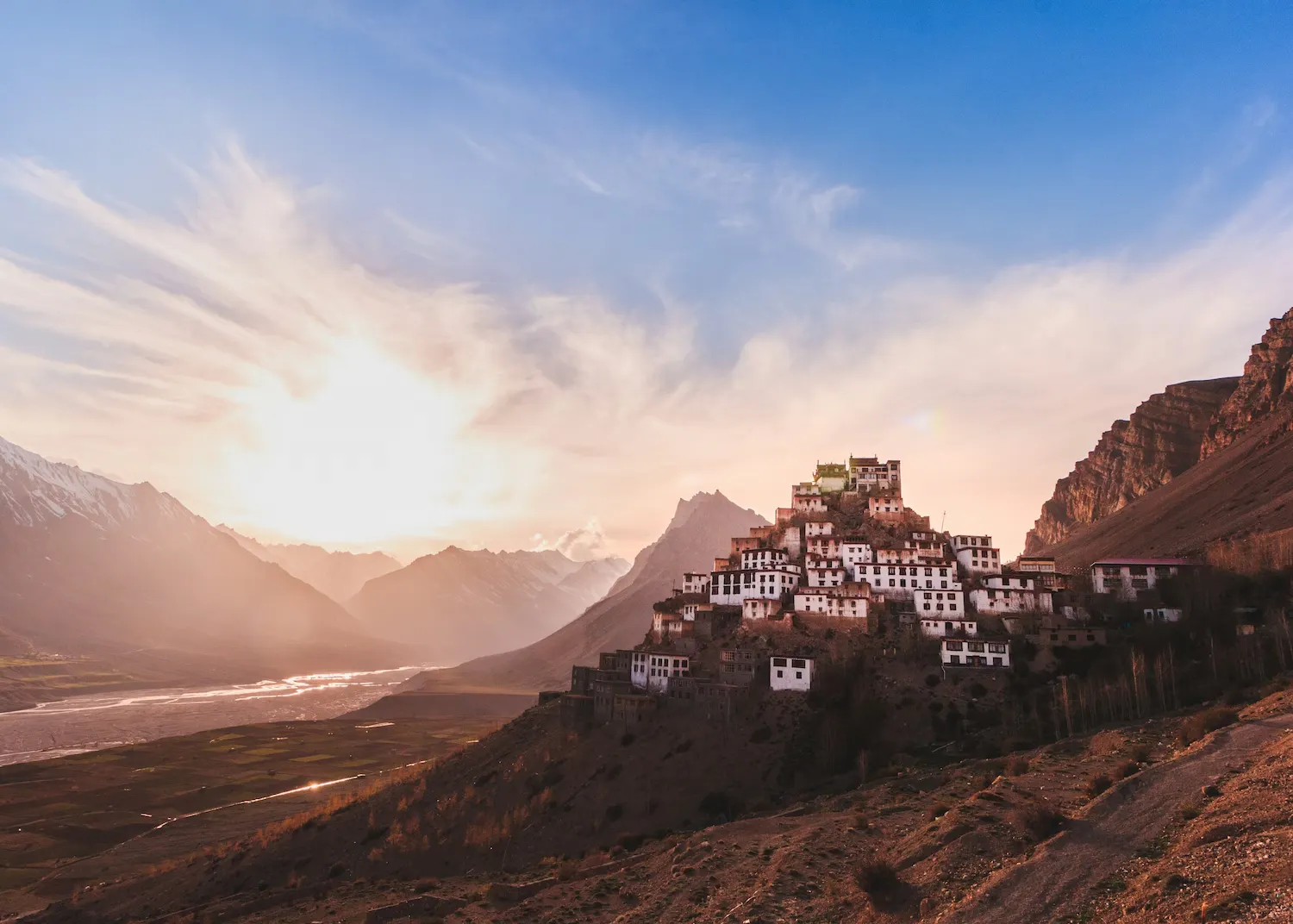
Past Reckong Peo the trees thin out and the hillsides turn to bare scree and ochre rock — the high-altitude cold desert Ladakh and Spiti are both known for. Tabo Monastery, founded in 996 CE and continuously in use since, is one of the oldest working Buddhist institutions in the Himalaya; its murals, spanning the 10th to 20th century, have earned it the name 'the Ajanta of the Himalaya,' and the 14th Dalai Lama has held Kalachakra ceremonies here twice. Dhankar Monastery, once the political capital of the Spiti kingdom, clings to a cliff edge above the confluence of the Spiti and Pin rivers. Key Monastery, Spiti's largest and most photographed gompa, stacks whitewashed buildings up a hillside at 4,166 m and has been rebuilt after Mongol raids, war damage and a 1975 earthquake, with around 250 monks living and studying there today. The high plateau adds Kibber, one of the world's highest motorable villages; Langza, with its giant Buddha statue and marine fossils from an old seabed; and Hikkim, home to the world's highest post office, functioning since 1983.
Kunzum La and Chandratal: The Trip's High Point
The road to Kunzum La is Spiti's most dramatic single stretch, opening each year only from late May to late September once the Border Roads Organisation clears the winter snow. At 4,551 m it frames a first sight of the Chandrabhaga range and the Bara Shigri glacier system. A short side road drops to Chandratal — 'the lake of the moon,' named for its crescent shape — at just over 4,300 m, one of the most photographed and least-touched high-altitude lakes in the Indian Himalaya.
Manali: Hadimba Temple and the Return to Green
The Atal Tunnel, at 9.02 km one of the world's longest highway tunnels above 3,000 m, cuts through the Pir Panjal range and drops you from bare cold-desert rock into the Kullu valley's pine forest within the hour. Hadimba Temple, built in 1553 in a distinctive cave-and-pagoda style inside a grove of ancient deodar cedars, is dedicated to Hidimba from the Mahabharata and holds no idol in the usual sense — a natural rock formation inside is worshipped as her footprint. Old Manali's lanes and, for those who want it, Naggar's Nicholas Roerich Art Gallery round out the stay.
McLeodganj: The Dalai Lama's Seat in Exile
McLeodganj has been the residence of the 14th Dalai Lama and the seat of the Tibetan government-in-exile since 1960, the year after he crossed the Himalaya on foot following the 1959 uprising in Lhasa. The Tsuglagkhang Complex — his residence-temple, adjoining Namgyal Monastery — is a working religious and political centre, not a museum piece, and visiting it is one of Himachal's strongest specific draws for international travellers. The adjoining Tibet Museum documents the 1959 exile through photographs, testimony and objects carried out of Tibet by refugees.
Amritsar: The Golden Temple and the Border at Sunset
The Wagah Border ceremony — a daily, tightly choreographed display of marching, high kicks and flag lowering performed by both countries' border guards — closes out the mountain leg of the trip with something entirely different; foreign passport holders are seated in a dedicated stand, second only to VIP seating. The Golden Temple, Harmandir Sahib, is best seen at or before dawn, and its Guru Ka Langar feeds upward of 100,000 people a day, of any faith, entirely free — widely considered the largest free community kitchen in the world. Jallianwala Bagh, where British troops opened fire on an unarmed crowd on 13 April 1919, and the adjoining Partition Museum are treated as places of memory rather than attractions, and your guide sets the pace accordingly.
SEASON ADJUSTMENTS
| Season | Dates | Conditions |
|---|---|---|
|
Summer to early autumn (this build) |
Mid-June to late September |
The only window Kunzum La is open, so the only window this full route runs in the direction described. July-August carries the highest landslide risk on the Kinnaur road (NH-05); June and September are the more stable choices within the season. |
|
Late spring |
April to early June |
Shimla and Kinnaur are open and pleasant, but Kunzum La is still snowbound, so Spiti can only be reached and left via the Kinnaur road, not looped through to Manali. Offered as a shorter, out-and-back version on request. |
|
Winter |
October to March |
Not offered in this form. Kunzum La is closed by snow, Chandratal is inaccessible, and Spiti's own guest houses reduce to minimal winter service. A winter Kinnaur-only or Shimla-Dharamshala-Amritsar version can be built separately. |
Himachal Pradesh International Season Adjustments
Road status on the Kinnaur and Spiti sections can change with short notice after heavy rain; your guide reconfirms both roads before departure and again on the day.
Who This Trip Suits
First-time visitors to India who want an unhurried pace, a single guide for the whole route, and a deliberate mix of an easy first week, a demanding middle and an easy finish.
Travellers who want Himachal's full range in one trip rather than a single region — colonial hill station, Buddhist cold desert, Tibetan exile capital and Sikh holy city, all on one route.
Photographers and culture travellers drawn to Tabo's thousand-year-old murals, Chandratal's moon-lake setting, and the Tsuglagkhang Complex's living Tibetan Buddhist tradition.
Travellers comfortable with long driving days and high altitude, with no technical trekking involved, but real distances and a genuine gain in elevation to respect.
Anyone who'd rather know the real constraints upfront — permit requirements, the Kunzum La season window, and where camping is and isn't allowed — than discover them mid-trip.
PRACTICAL NOTES
Altitude. The route climbs gradually from Shimla's 2,200 m to Kunzum La's 4,551 m over six days, which is the medically sound way to make this gain. Mild headache or breathlessness on the first day at a new altitude is normal; tell your guide about anything stronger, especially at Kaza, Chandratal and Kunzum La.
Inner Line Permit. Foreign nationals need an Inner Line Permit for Nako, Tabo, Kaza and the plateau villages beyond, arranged in advance and checked at Reckong Peo. Officially, Kinnaur asks for parties of two or more foreign nationals and Spiti for four or more, though both district offices routinely relax this for couples and smaller groups in practice. Carry your passport and visa copies for the checkpoint.
Road conditions. The Kinnaur road (NH-05) can close for hours at a time after monsoon landslides, and the Batal-Gramphu stretch near Chandratal is rough going. Both are built into the schedule with buffer time, and a rugged 4x4 is used throughout the mountain sections at every tier.
Fitness. No trekking or technical climbing is involved. The walks at Nako, Chandratal and around the monasteries are all on foot over uneven but non-technical ground; comfortable walking shoes are enough.
Cold at altitude. Nights at Chandratal and Kaza can fall well below freezing even in July and August. Warm layers, a good jacket and a warm hat matter more here than at any other point on the route.
Dress and conduct at religious sites. Cover shoulders and knees at temples and monasteries, remove shoes where asked, and cover your head at the Golden Temple (scarves are provided free). At Tsuglagkhang, follow your guide's lead on where photography is appropriate — it is a working monastery and residence, not a museum.
Connectivity. Mobile network is patchy to absent through much of Kinnaur and Spiti, and jammed altogether near the Wagah Border for security reasons. Tell family or colleagues to expect gaps in contact for several days at a stretch.
Tipping. Tips for the guide, driver and specialists are given at the end of the trip. Your guide advises on a suitable amount.
Booking Summary
Dept. City :
--
Dept. Date :
--
Traveller :
Adults: 2, Child: 0, Infant: 0
Rooms :
--
Basic Price :
--
Total Cost
--
GST
--
Grand Total
--
Itinerary (Day Wise)
This 15-day trip takes you through six very different sides of Himachal on one road. You start slowly in Shimla, the old summer capital of British India. Then the road climbs a little each day through Kinnaur's apple villages and the Bhimakali Temple at Sarahan, into the cold desert of Spiti. There you'll see Tabo's thousand-year-old murals and Key Monastery, and spend a night by the Chandratal lake. You cross Kunzum La and come down through the Atal Tunnel into Manali's deodar forests. After that come the tea gardens of Kangra and the Tibetan quarter of McLeodganj, home of the Dalai Lama. The trip ends in Amritsar with the Wagah Border ceremony and the Golden Temple at dawn. The same English-speaking guide stays with you the whole way, and we arrange your Inner Line Permits before you land. The route is set to your dates and your pace.
Day 1
ARRIVE DELHI | Briefing Before the Climb
Route: Delhi (airport, hotel)
Your guide meets you at the hotel this evening with maps of the road ahead: fourteen nights, nine districts, and a climb from Delhi's 216 metres to Kunzum La's pass at over 4,500. Nothing about tomorrow's drive is rushed into; tonight is for resetting the clock and going through what altitude actually feels like, day by day, so there are no surprises once the road starts climbing.
Experience of the Day
– Airport pickup and transfer.
– Evening route and altitude briefing with your guide.
Food
Dinner at the hotel, from a menu that suits jet lag. Written allergy notes are handled in advance.
Activities to Do
Airport pickup
Hotel check-in
Trip briefing
Day 2
DELHI TO SHIMLA | Into the Hills
Route: Delhi - Chandigarh - Shimla (road)
The drive is flat and fast to Chandigarh, then turns uphill at Kalka, where the narrow-gauge Kalka-Shimla railway - a UNESCO World Heritage line since 2008 - climbs the same ridge on 103 tunnels and 800-plus bridges. Your own road follows a gentler version of that same climb, gaining about 2,000 metres over the last two hours, and Shimla's pine-and-deodar air replaces the plains heat well before you reach the Ridge.
Himachal Pradesh built its international reputation on exactly this kind of arrival: a colonial hill station reached by a slow, scenic climb rather than a sudden change of altitude. Starting here, rather than flying straight into the mountains, lets the body adjust gradually before Kinnaur and Spiti ask more of it later in the trip.
Experience of the Day
– Drive Delhi to Shimla via Chandigarh and Kalka.
– Check in and an easy evening walk on the Mall.
Food
Lunch en route at Chandigarh. Dinner at the hotel or a Mall Road restaurant, guide's choice on the night.
Activities to Do
Drive to Shimla
Evening walk on the Mall
Day 3
SHIMLA | The Summer Capital of British India
Route: Shimla (Ridge, Christ Church, Viceregal Lodge)
Shimla was the summer capital of the British Raj for over a century, and its two landmark buildings both date from that period. Christ Church on the Ridge, consecrated in 1857, is one of the oldest churches in North India, its neo-Gothic tower long a fixed point on the Shimla skyline. A short drive away, the Viceregal Lodge - built in 1888 in Scottish baronial style as the Viceroy's official residence - now houses the Indian Institute of Advanced Study, and its rooms still carry the weight of the political conversations held there in the run-up to 1947.
The rest of the day moves at Mall Road pace: the pedestrian promenade, Scandal Point, and the shawl and woollen-craft shops that still supply much of Himachal's winter clothing trade. A local guide walks you through both buildings' history rather than leaving you to read a signboard, and the day is deliberately unhurried - the body is still adjusting to altitude, and this is the easiest day of the whole circuit to simply slow down.
The Human Story
Lord Dufferin commissioned the Viceregal Lodge as a working seat of imperial government, not a holiday retreat, and it functioned as one for nearly sixty years. Its library and council chamber hosted some of the last formal talks between British and Indian leaders before independence, and walking its corridors today is one of the more direct ways to stand inside that history rather than just read about it.
Experience of the Day
– Christ Church and the Ridge.
– Viceregal Lodge (Indian Institute of Advanced Study) guided walk.
– Mall Road and Scandal Point.
Food
Try Himachali dham thali for lunch - a festive, ghee-forward set meal with rajma-madra and kaddu ka khatta. Dinner at the hotel.
Shopping
Kinnauri and Kullu shawls, Tibetan-influenced woollens on Lower Bazaar.
Activities to Do
Christ Church visit
Viceregal Lodge tour
Mall Road walk
Optional Nearby Excursions
Jakhu Temple and its hilltop Hanuman statue, a steep half-day walk or short taxi ride.
The Himalayan Bird Park, below the Ridge.
Day 4
SHIMLA TO KALPA | Into Kinnaur, by Way of a Kingdom's Temple
Route: Shimla - Narkanda - Rampur - Sarahan - Kalpa
This is the longest driving day of the trip, and also one of the most rewarding. The road descends through Narkanda's apple country, follows the Sutlej river through Rampur - once the seat of the Bushahr kingdom - and climbs to Sarahan for a stop at the Bhimakali Temple, the former royal chapel of the Bushahr rulers. Built in kath-kuni style (alternating timber and stone, without mortar) around the 13th century, its twin towers survived the severe 1905 Kangra earthquake with only a slight, later-corrected tilt.
Beyond Sarahan the road climbs again into Kinnaur proper, and the light changes with it: drier air, apple and chilgoza-pine slopes, and - on a clear afternoon into Kalpa - the first full view of the Kinner Kailash range, a jagged wall of peaks considered by many Kinnauris to be Shiva's Himalayan home.
The Human Story
Bhimakali was the kuldevi, the family goddess, of the Bushahr royal line, and the temple doubled as both shrine and treasury for the kingdom. The temple's own account holds that its foundation survived the 1905 earthquake when the main tower tilted and then straightened again in a later tremor - whether read as engineering or providence, the building has stood through more than a century of Himalayan seismic activity since.
Note on distance. Sources vary on the Shimla-Kalpa road, from about 220 to 245 km depending on the exact route through Rampur and Sarahan. We use 230 km and 8 hours as the working figure; the guide confirms the day's pace with you as it goes.
Experience of the Day
– Drive through Narkanda's apple orchards.
– Bhimakali Temple, Sarahan.
– Arrive Kalpa for the Kinner Kailash view.
Food
Lunch at Rampur or Sarahan. Dinner at the hotel in Kalpa, Kinnauri rajma and buckwheat rotis on the menu.
Activities to Do
Sarahan temple visit
Drive to Kalpa
Day 5
KALPA TO TABO | Crossing Into the Cold Desert
Route: Kalpa - Reckong Peo - Nako - Tabo
The road out of Kalpa drops to Reckong Peo, Kinnaur's district headquarters and the checkpoint where your Inner Line Permit for the stretch ahead is verified, then follows the Sutlej and Spiti rivers east into markedly different country: the trees thin out, the hillsides turn to bare scree and ochre rock, and by Nako the landscape has become the high-altitude cold desert Ladakh and Spiti are both known for.
Nako itself, at about 3,660 metres, is built around a small sacred lake ringed by four old Buddhist temples, with willow and poplar trees planted along its banks giving the only real shade for kilometres. Local legend holds the surrounding hills to be the haunt of fairies, and a nearby cave is said to bear the footprint of Padmasambhava, the 8th-century master credited with bringing Buddhism to the Himalaya. From Nako the road drops again into the Spiti valley proper, reaching Tabo by late afternoon.
Foreign guests: Inner Line Permit. Nako and everything beyond it into Spiti sits inside a Protected Area that foreign nationals may only enter with an Inner Line Permit, arranged in advance and checked at Reckong Peo. Lower Kinnaur - Kalpa, Sangla, Chitkul, Sarahan - needs no such permit; this is the point on the route where it starts to matter. BizareXpedition arranges the paperwork before you travel; carry your passport and visa copies for the checkpoint itself.
Experience of the Day
– Permit check at Reckong Peo.
– Nako village, lake and monastery.
– Arrive Tabo by late afternoon.
Food
Lunch at Nako or Chango. Dinner at the guest house in Tabo, simple Spitian fare - thukpa, momos, local vegetables.
Activities to Do
Nako lake walk
Drive to Tabo
Day 6
TABO TO KAZA | The Ajanta of the Himalaya, and a Monastery on a Cliff
Route: Tabo - Dhankar - Kaza
Tabo Monastery was founded in 996 CE by the translator Rinchen Zangpo, acting for the king of the Guge kingdom, and has functioned continuously ever since - making it one of the oldest working Buddhist institutions in the Himalaya. Its nine temples and 23 chortens are built of mud brick with three-foot walls, and the murals inside, spanning the 10th to the 20th century, have earned it the name 'the Ajanta of the Himalaya.' The 14th Dalai Lama has held Kalachakra ceremonies here twice, in 1983 and 1996, and the Archaeological Survey of India has proposed the site for UNESCO status.
The short drive on to Kaza detours to Dhankar, once the political capital of the Spiti kingdom, whose monastery clings to a cliff edge above the confluence of the Spiti and Pin rivers in a way photographs rarely do justice to. By the time you reach Kaza - Spiti's largest town and its administrative centre, at about 3,800 metres - you are inside the sub-division that requires its own separate Inner Line Permit layer, already arranged.
The Human Story
Tabo's walls are thick enough to have absorbed a 1975 earthquake that damaged the complex badly, and the murals underneath the plaster and soot of a thousand years of butter lamps have survived largely because the monastery kept using the same rooms rather than abandoning or rebuilding them. It is a rare case of continuous use being the thing that preserved, rather than endangered, a fragile heritage site.
Experience of the Day
– Tabo Monastery, guided.
– Dhankar Monastery.
– Arrive Kaza.
Food
Lunch at Dhankar or en route. Dinner in Kaza.
Activities to Do
Tabo Monastery visit
Dhankar Monastery stop
Drive to Kaza
Day 7
KAZA | Key Monastery, Kibber, and the World's Highest Post Office
Route: Kaza - Key - Kibber - Langza/Hikkim/Komic
Key Monastery, about 12 km from Kaza at 4,166 metres, is Spiti's largest and most photographed gompa, its whitewashed buildings stacked up a hillside like a fortress. Founded in the 11th century by a student of the Buddhist teacher Atisha, it has been plundered by Mongol raiders, sacked in the Ladakh-Kulu wars, damaged by both the Dogra army and Sikh forces in 1841, gutted by fire, and shaken by the 1975 earthquake - and rebuilt each time. Around 250 monks live and study there today.
From Key the road continues to Kibber, one of the world's highest motorable villages, crossing the Chicham bridge - among Asia's highest bridges - over a spectacular gorge. If time and the group's pace allow, the plateau villages of Langza (a giant Buddha statue watching over a village that sits on an old seabed, still yielding marine fossils), Hikkim (home to the world's highest post office, functioning since 1983) and Komic round out the day - a rare cluster of settlements this high and this far from anywhere else.
Practical note. Kaza sits at 3,800 m and the plateau villages go higher still - Komic, at around 4,587 m, is one of the highest permanently inhabited villages on Earth. This is the altitude day where taking it slowly matters most; the itinerary keeps the pace unhurried and the driving distances short for exactly that reason.
Experience of the Day
– Key Monastery, guided.
– Kibber village and Chicham bridge.
– Langza, Hikkim and Komic, as the day's pace allows.
Food
Packed lunch on the plateau. Dinner in Kaza.
Activities to Do
Key Monastery visit
Kibber and Chicham bridge
Highest post office at Hikkim
Day 8
KAZA TO CHANDRATAL | Over Kunzum La to the Moon Lake
Route: Kaza - Losar - Kunzum La - Chandratal
The road to Kunzum La is Spiti's most dramatic single stretch: bare, wind-carved mountains giving way at 4,551 metres to a pass that opens each year only from late May to late September, once the Border Roads Organisation clears the winter snow. On a clear day the pass frames a first sight of the Chandrabhaga range and the Bara Shigri glacier system in the distance.
A short side road drops from near the pass to Chandratal - Chandra Taal, 'the lake of the moon,' named for its crescent shape - at just over 4,300 metres. It is one of the most photographed lakes in the Indian Himalaya, and one of the few untouched high-altitude lakes left in the region.
Note on camping at Chandratal. Overnight camping and cooking are no longer allowed on the lakeshore itself, to protect its fragile ecosystem from erosion and waste. Your eco-camp sits in a designated zone about 1.5-2 km from the water, a 20-40 minute walk away; camp names and exact sites here change from season to season as licences are reissued each year, so BizareXpedition confirms the specific camp closer to your travel dates. Nights are cold even in summer - well below freezing is normal - so the camp's tents, bedding and heating are the one place on this trip where 'luxury' is measured in warmth, not square footage.
Experience of the Day
– Cross Kunzum La (4,551 m).
– Walk to Chandratal at sunset.
– Evening at the eco-camp.
Food
Packed lunch en route. Dinner at the eco-camp, a simple hot meal built for altitude.
Activities to Do
Kunzum La photo stop
Chandratal lakeside walk
Day 9
CHANDRATAL TO MANALI | Down Through the Atal Tunnel
Route: Chandratal - Batal - Gramphu - Atal Tunnel - Manali
The descent from Chandratal is slow and rough for its first stretch - the Batal-Gramphu stretch is one of the least developed roads in the state - before joining the Manali-Leh highway at Gramphu. From there the Atal Tunnel, at 9.02 km one of the world's longest highway tunnels above 3,000 metres, cuts straight through the Pir Panjal range and bypasses the old, traffic-choked Rohtang Pass road entirely, dropping you into the Kullu valley's pine forest and river air within the hour.
The change is abrupt in the best way: from bare cold-desert rock to green valley walls, apple orchards and the sound of the Beas river, all inside a single afternoon. Manali, reached by evening, is the first proper rest after five demanding mountain days.
Experience of the Day
– Drive down via Batal and Gramphu.
– Atal Tunnel crossing.
– Arrive Manali by evening.
Food
Packed breakfast, lunch en route at Gramphu or Koksar. Dinner at the hotel in Manali.
Activities to Do
Descent drive
Atal Tunnel crossing
Day 10
MANALI | Old Manali and the Temple in the Cedar Forest
Route: Manali (Hadimba Temple, Old Manali, Naggar)
Hadimba Temple, built in 1553 in a distinctive cave-and-pagoda style inside a grove of ancient deodar cedars, is dedicated to Hidimba, a figure from the Mahabharata said to have married the Pandava prince Bhima. The temple holds no idol in the usual sense - a natural rock formation inside is worshipped as her footprint - and the surrounding Dhungri forest is old enough that some of its trees are said to predate the temple itself.
The afternoon moves at a slower pace through Old Manali's lanes and, for those who want it, a short drive to Naggar - former capital of the old Kullu kingdom and home to the Nicholas Roerich Art Gallery, the Russian painter's house and studio for the last years of his life.
The Human Story
In the Mahabharata, Hidimba falls in love with Bhima during the Pandavas' exile and their son, Ghatotkacha, later fights on their side at Kurukshetra. Manali's own temple keeps that story alive not through an idol but through the forest itself - the deodars around Hadimba Temple are treated as part of the sacred site, not just its setting.
Experience of the Day
– Hadimba Temple and the Dhungri deodar forest.
– Old Manali lanes.
– Naggar Castle and the Roerich gallery, optional.
Food
Try Himachali trout for lunch by the Beas. Dinner at the hotel.
Shopping
Old Manali's shawl and handicraft stores; Kullu caps and woven shawls.
Activities to Do
Hadimba Temple visit
Old Manali walk
Optional Nearby Excursions
Naggar Castle and Roerich Art Gallery, half day.
Solang Valley for a short cable-car ride, weather permitting.
Day 11
MANALI TO DHARAMSHALA | Through the Kangra Tea Country
Route: Manali - Mandi - Palampur - Dharamshala
The road out of the Kullu valley drops through Mandi - a temple town on the Beas sometimes called the 'Varanasi of the hills' for its density of small shrines - before climbing again into Kangra district. Palampur, about two hours short of Dharamshala, sits inside Himachal's tea-growing belt: the Kangra valley has grown tea commercially since the 1850s, and its gardens run in bright green terraces right up against the Dhauladhar range's snow line.
By late afternoon the road climbs the last stretch into Dharamshala and McLeodganj above it, and the Dhauladhar's sheer granite wall - close at hand, not a distant backdrop - comes into full view for the first time.
Experience of the Day
– Drive via Mandi and Palampur.
– Stop in the Kangra tea gardens.
– Arrive Dharamshala/McLeodganj.
Food
Lunch at Mandi or Palampur, with a tea-garden stop for a fresh cup of Kangra tea. Dinner at the hotel.
Activities to Do
Drive to Dharamshala
Tea garden stop
Day 12
DHARAMSHALA & MCLEODGANJ | Home of the Dalai Lama
Route: McLeodganj (Tsuglagkhang Complex, Tibet Museum, Bhagsu)
McLeodganj has been the residence of the 14th Dalai Lama and the seat of the Tibetan government-in-exile since 1960, the year after he crossed the Himalaya on foot following the 1959 uprising in Lhasa. The Tsuglagkhang Complex - his residence-temple, adjoining Namgyal Monastery - is not a museum piece but a working religious and political centre, and visiting it plainly is one of Himachal's strongest specific draws for international travellers, distinct from any other stop in the state.
The adjoining Tibet Museum documents the 1959 exile and the decades since through photographs, testimony and objects carried out of Tibet by refugees, and is worth the hour it asks for. The afternoon has room for Bhagsu Falls, a short walk above McLeodganj's main square, or simply more time in the town's Tibetan bakeries and bookshops.
Visiting an active community, respectfully. Tsuglagkhang is a functioning monastery and the Dalai Lama's own residence, not a sightseeing set. Modest dress, quiet voices inside the temple halls, and following your guide's lead on where photography is and isn't appropriate are all that's asked. On the days His Holiness is in residence and holding public teachings, access to parts of the complex may be limited or require separate registration; your guide checks this before the visit.
Experience of the Day
– Tsuglagkhang Complex and Namgyal Monastery.
– Tibet Museum.
– Bhagsu Falls, optional.
Food
Tibetan thukpa and momos for lunch in McLeodganj. Dinner at the hotel.
Shopping
Tibetan handicrafts, prayer flags and thangka paintings around the main square, sold in support of the exile community's own cooperatives.
Activities to Do
Tsuglagkhang Complex visit
Tibet Museum
Bhagsu Falls walk
Day 13
DHARAMSHALA TO AMRITSAR | Down to the Punjab Plains, and the Border at Sunset
Route: Dharamshala - Pathankot - Amritsar - Wagah
The road drops out of the hills for the last time at Pathankot and runs flat across Punjab's wheat and rice country to Amritsar - a genuine change of register after twelve days of mountains. By late afternoon you transfer 28 km out to Wagah, the only road border crossing between India and Pakistan, for the Beating Retreat ceremony: a daily, tightly choreographed display of marching, high kicks and flag lowering performed by both countries' border guards to a crowd of thousands, timed to sunset (around 4:15 pm in winter, closer to 5:15 pm in summer).
Foreign passport holders are seated in a dedicated stand at Wagah, second only to VIP seating and ahead of the general public stands - carry your passport for it. It is unlike anywhere else in the state: part military ceremony, part sporting event, and an unusual way to end a journey that began in the high Himalaya five days earlier.
Experience of the Day
– Drive to Amritsar via Pathankot.
– Wagah Border Beating Retreat ceremony.
Food
Lunch en route. Dinner in Amritsar - your first taste of Punjabi tandoori and dal makhani on this trip.
Activities to Do
Drive to Amritsar
Wagah Border ceremony
Day 14
AMRITSAR | The Golden Temple and a City's Harder History
Route: Amritsar (Golden Temple, Partition Museum, Jallianwala Bagh)
The Golden Temple - Harmandir Sahib, the holiest gurdwara in Sikhism - is best seen at or before dawn, when the crowds are thinnest and the gold dome catches the first light over the sacred pool, the Amrit Sarovar. The Guru Ka Langar here feeds upwards of 100,000 people a day, of any faith or background, entirely free and run by volunteers - widely considered the largest free community kitchen in the world, and worth sitting down inside for, not just observing.
The day's other stop, Jallianwala Bagh, is a harder one: the walled garden where, on 13 April 1919, British troops under General Dyer opened fire on an unarmed crowd gathered for a Baisakhi festival, killing several hundred people in a few minutes. The site preserves the bullet-marked walls and the well many fled into, and the adjoining Partition Museum documents 1947's displacement through recorded testimony and personal objects. Both are treated as places of memory, not attractions, and your guide sets the pace accordingly. In the evening, a short transfer to Amritsar airport for the flight to Delhi.
Visiting the Golden Temple. Cover your head (scarves are provided free at the entrance), remove shoes and wash your feet before entering, and expect a fully egalitarian, unhurried queue alongside pilgrims of every background. Photography is generally allowed outdoors around the sarovar; follow your guide's lead inside the sanctum itself.
Experience of the Day
– Golden Temple at dawn, including the Guru Ka Langar.
– Jallianwala Bagh and the Partition Museum.
– Evening flight to Delhi.
Food
Breakfast at the Golden Temple's langar hall, if you choose to sit for it. Lunch in Amritsar - kulcha and lassi. Dinner at the Delhi hotel after arrival.
Activities to Do
Golden Temple visit
Jallianwala Bagh and Partition Museum
Flight to Delhi
Day 15
DELHI DEPARTURE | Journey's End
Route: Delhi (hotel - airport)
Breakfast at the hotel, then a private transfer to the airport. Fourteen nights ago this trip started at Delhi's 216 metres; it has since touched Kunzum La at over 4,500, crossed two Inner Line Permit zones, and moved from a British viceroy's council chamber to a Tibetan temple to a Sikh gurdwara's free kitchen. Your guide sees you off at the terminal.
Experience of the Day
– Breakfast at the hotel.
– Airport transfer and departure.
Food
Breakfast at the hotel.
Activities to Do
Airport transfer
Tour Information
Your complete guide to a hassle-free and enjoyable trip.
Inclusion
Exclusion
Payment Terms
Important factors to consider before your trip!
Cancellation
Need To Know
Be Responsible Traveller
- Minimize Plastic Use : Bring a reusable water bottle, shopping bag, and utensils to reduce the need for single-use plastics. Many destinations have water refill stations and eco-friendly stores.
- Support Local and Sustainable Businesses : Eat at local restaurants, buy souvenirs from local artisans, and choose tour operators that prioritize sustainable practices and support the local community.
- Respect Wildlife and Natural Habitats : Avoid disturbing wildlife or their natural habitats. Stick to designated paths and observe animals from a distance without feeding or touching them.
- Dispose of Waste Properly : Follow local guidelines for recycling and waste disposal. If facilities aren't available, carry your waste with you until you can dispose of it responsibly.
- Educate Yourself and Others : Learn about the local environment, culture, and customs. Respect local practices and traditions, and share your knowledge about responsible travel with others.
- Choose Sustainable Activities : Engage in eco-friendly activities such as hiking, snorkeling, or visiting national parks. Avoid activities that exploit animals or damage the environment.
- Leave No Trace : Follow the principle of "Leave No Trace," which means leaving natural areas as you found them. Pack out all trash, avoid picking plants, and refrain from carving or writing on rocks or trees.
- Plant Trees Whenever Possible : Participate in local tree-planting initiatives or plant trees in your own community. Trees absorb carbon dioxide, provide oxygen, and help support biodiversity, making them vital for a healthy environment.
Connect
Share Itinerary
Email Itinerary
Frequently Asked Questions (FAQs) & People Also Ask — Himachal Pradesh: Hills, Valleys & the Cold Desert
We help you prepare for your trip and ensure an effortless and enjoyable travel experience.
Do foreign nationals need a permit for Spiti and Kinnaur?
Yes, for part of the route. Nako, Tabo, Kaza and the plateau villages beyond sit inside a Protected Area that requires an Inner Line Permit for foreign nationals, checked at Reckong Peo. Kalpa, Sangla, Chitkul and Sarahan need no such permit. BizareXpedition arranges the paperwork in advance and it is included in the price.
When is the full Shimla-Kinnaur-Spiti-Manali loop actually possible?
Only from about mid-June to late September, since Kunzum La — the pass connecting Spiti to the Manali side — is closed by snow the rest of the year. Outside that window, Spiti can still be visited from the Kinnaur side as an out-and-back trip, but not looped through to Manali.
Is altitude sickness a real risk on this route?
Yes, and we plan around it rather than around a promise that it won't happen. Kunzum La and Chandratal sit above 4,300 metres. The route gains height gradually over six days specifically to reduce that risk, and your guide is briefed to watch for symptoms and adjust the day if needed.
How many stone temples or monasteries will we actually see?
The core religious sites are the Bhimakali Temple at Sarahan, Tabo Monastery, Dhankar Monastery, Key Monastery, Hadimba Temple at Manali, and the Tsuglagkhang Complex at McLeodganj — six distinct sites across six centuries and three religious traditions, each with its own guided visit rather than a drive-by stop.
Why does this Himachal circuit take 15 days?
The road distances are long in their own right — Shimla to Kalpa alone is a full 8-hour drive — and the altitude gain through Kinnaur and Spiti needs a gradual pace rather than a rushed one. A shorter version can be built by dropping the plateau villages around Kaza or the Chandratal overnight, and we'll tell you plainly what that trades away if you ask for it.
Can we skip Chandratal and go straight from Kaza to Manali?
Yes, and it saves a day. Chandratal is offered as a genuine highlight — an overnight near one of the Himalaya's most photographed lakes — rather than a fixed requirement, and the itinerary and price adjust if you'd rather move straight through.
Is it true you can't camp right at Chandratal lake anymore?
Correct. Overnight camping on the lakeshore is no longer permitted, to protect the lake's fragile ecosystem. Eco-camps operate in a designated zone about 1.5-2 km away, a 20-40 minute walk from the water, and we tell every guest this before they book so the picture in their head matches what they'll actually get.
What is McLeodganj, and why is it on this route?
McLeodganj, above Dharamshala, has been the residence of the 14th Dalai Lama and the seat of the Tibetan government-in-exile since 1960. Visiting the Tsuglagkhang Complex and the Tibet Museum there is one of the strongest, most specific reasons an international traveller comes to Himachal at all, and this route gives it a full day rather than a passing stop.
Is this trip suitable for someone visiting India for the first time?
Yes — it's built for exactly that. The pace is unhurried, the guide stays with you the whole way rather than handing off between cities, and the route deliberately mixes an easy first week (Shimla, Kinnaur) with a more demanding middle (Spiti, Kunzum La) and an easy finish (Manali, Dharamshala, Amritsar).
What vehicle do we actually travel in through the mountains?
A rugged 4x4 — a Toyota Fortuner or equivalent — at every tier, including Ultra-Luxury, on the Shimla-through-Manali mountain sections. The roads don't suit a sedan-style luxury car, and the tier's comfort is expressed through the hotel and guide instead. Sedans return for the flatter Dharamshala-Amritsar-Delhi stretch if requested.
How much does this Himachal circuit cost?
A private 15-day, 14-night circuit costs about Rs.280,098 to Rs.302,506 per couple in Premium, Rs.435,960 to Rs.470,837 in Luxury, and Rs.683,865 to Rs.738,574 in Ultra-Luxury. These are modelled figures and depend on dates and hotels confirmed.
Can this trip be extended or shortened?
Yes, the whole route is tailor-made. Common additions are Sangla and Chitkul in Kinnaur, an extra night in Kaza for the plateau villages, or Dalhousie and Khajjiar after Dharamshala. Tell us your dates and interests and we rebuild the route.
BizareXpeditionTMReviews
Let's go, pack up, and hit the road!
Similar Tour Packages
Explore other exciting options for your next adventure!
Trusted Paths, Bold Journeys — Inside BizareXpedition
From humble beginnings to a trusted name in the industry, BizareXpedition's story is one of purpose-driven growth, community connection, and a relentless pursuit of excellence that speaks for itself.














Himachal Pradesh: Hills, Valleys & the Cold Desert
best deal price
Without GST
₹1,40,049
per person on twin sharing
Book Now