
Himachal Homestay: Responsible Travel Immersion11N/12D
Himachal Homestay: Responsible Travel Immersion
Start & City : Kullu
best deal price
₹
Without GST ₹82,404
per person on twin sharing
Choose your departure city, dates, and add guests to secure your tour.
Hurry, as seats fill up, prices rise! Book now!
1. Choose your departure date
Highlights
Sleep inside a family's own home for five nights across Sangla/Rakcham, Tabo, Kibber and Demul, each one assigned by that village's own hosting roster.
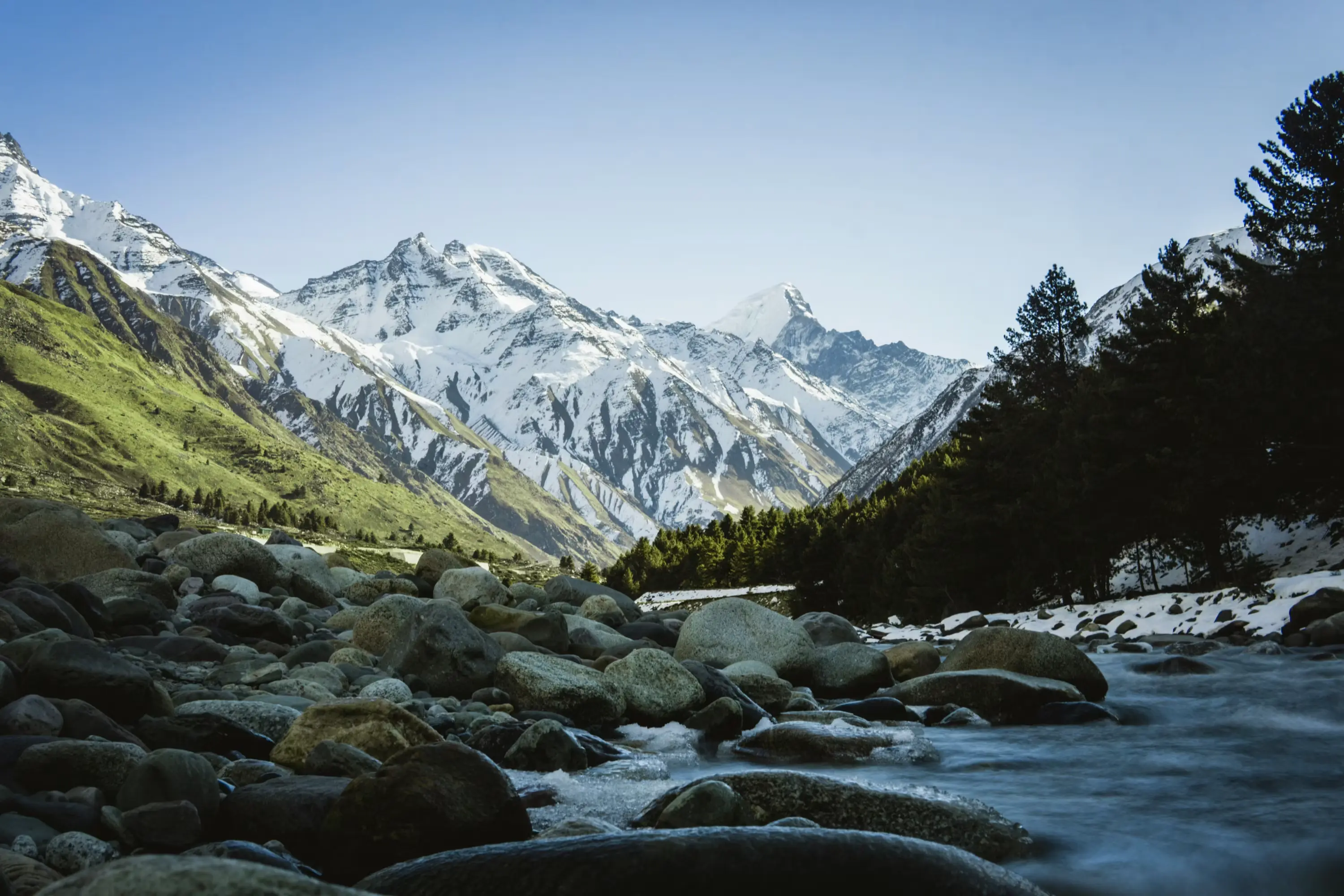
Walk into Chitkul, the last inhabited village on the Baspa before the old Hindustan-Tibet trade road disappears into restricted border country.
Climb into Kamru Fort's thousand-year-old wooden tower, still the site of every Bushahr king's coronation, built entirely without nails or mortar.
Be assigned your Demul homestay by the village's own coordinator — the same rotation that has shared tourism income across roughly half the village's households every year for two decades.
Cross the Kunzum Pass at 4,551 metres into Spiti's cold desert, then camp within sight of Chandratal, the crescent “Moon Lake,” in a zone set back from the shore to protect it.
Visit Komic's 500-year-old Lundup Tsemo Gompa, in one of the highest villages anywhere with a motorable road to it.
Post a card from Hikkim, the world's highest post office, and walk the fossil-strewn ground at Langza, once the floor of the Tethys Sea.
Essence of Journey
The experiences that capture the true spirit of the entire trip.
| Day | Route | Distance | Major Highlights |
|---|---|---|---|
| Day 1 | Arrival Kullu (Bhuntar Airport) | ~10 km | Beas riverside, local bazaar, homestay-etiquette briefing |
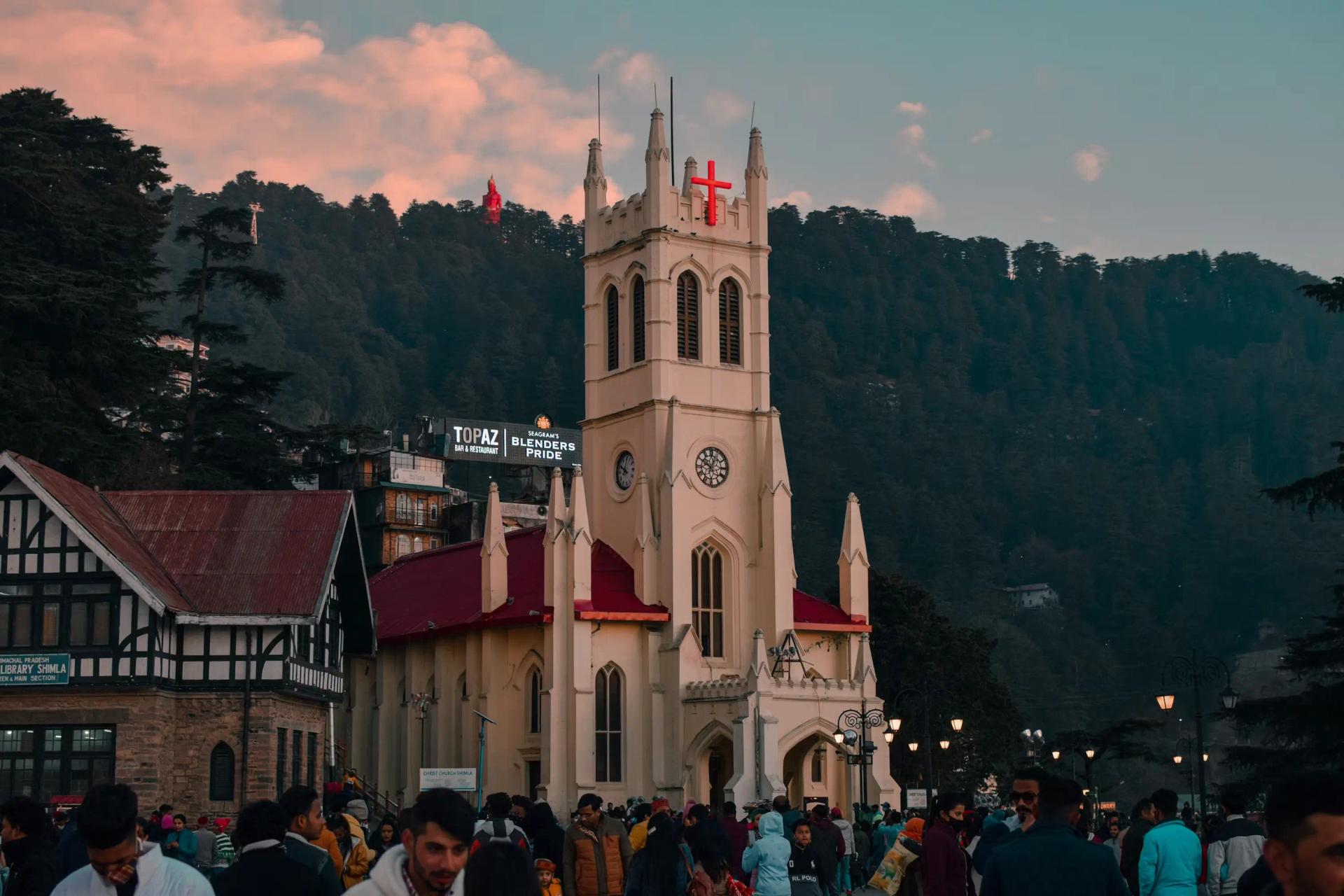
| Day 2 | Kullu → Shimla | ~210 km / 7-8 hrs | Kalka-Shimla railway views, Christ Church, Mall Road |
| Day 3 | Shimla → Sarahan (via Narkanda-Rampur, NH-05) | ~165 km / 6-7 hrs | Narkanda apple belt, Bhimakali Temple, Sarahan bazaar |
| Day 4 | Sarahan → Sangla/Rakcham (via Karcham) | ~100 km / 4-5 hrs | Baspa valley entry, Kamru Fort, Rakcham homestay |
| Day 5 | Sangla/Rakcham → Chitkul → back | ~50 km round trip | Chitkul, last village before the border road, Mathi Devi temple |
| Day 6 | Sangla/Rakcham → Tabo (via Karcham-Powari-Nako-Sumdo) | ~195 km / 7-8 hrs | Nako village and lake, Sumdo ILP check, Tabo Monastery (996 CE) |
| Day 7 | Tabo → Kaza → Kibber | ~75 km / 2-3 hrs | Dhankar viewpoint (drive-by), Kaza market, Kibber Wildlife Sanctuary edge |
| Day 8 | Kibber → Komic → Hikkim → Langza → Demul | ~60-65 km loop | Lundup Tsemo Gompa (Komic), Hikkim post office, Langza fossils, Demul homestay |
| Day 9 | Demul → Kaza | ~32 km | Free time and handicraft shopping in Kaza, Key Monastery viewpoint (optional) |
| Day 10 | Kaza → Chandratal (via Kunzum Pass) | ~100 km / 6-7 hrs | Kunzum Pass (4,551 m), Chandratal eco-camp |
| Day 11 | Chandratal → Kullu (via Manali, Atal Tunnel) | ~170 km / 6-7 hrs | Rohtang bypass, Beas valley descent |
| Day 12 | Departure — Kullu → Bhuntar Airport | ~10 km | Departure |
About
Sangla, Chitkul, Tabo and Kibber already appear in BizareXpedition's own hotel-based Kinnaur-Spiti circuits — usually as a lunch stop or a night's hotel stay on the way to somewhere else. This himachal village homestay tour international product flips that around: eleven of its twelve nights are spent sleeping inside the villages themselves, and five of those nights are spent inside a family's own home, arranged the same way the village arranges it for its own guests.
This is a private, 12-day Himachal village homestay tour built around Kinnaur and Spiti's own rotation systems: eleven of its twelve nights are spent sleeping inside the villages themselves, and five of those nights are spent inside a family's own home at Sangla/Rakcham, Tabo, Kibber and Demul. Every homestay is assigned by that village's own coordinator, the same way it's assigned for any traveller, not picked by BizareXpedition or the guest — and every host family is paid directly inside the room rate, not left to a tip. A guest booking Ultra-Luxury sleeps in the same home, at the same family's table, as a guest booking Premium; tier differences sit in the hotel and camp nights either side, the vehicle, and the guide. A private vehicle, driver and Inner Line Permit for Kinnaur and Spiti travel with you throughout.
The route runs Kullu to Shimla to Sarahan, into Kinnaur's Baspa valley at Sangla and Rakcham, over to Tabo, Kibber and Demul on Spiti's high plateau, out through Kaza and Chandratal, and back to Kullu — a real kinnaur spiti village stay for foreigners route, not a shortened highlights reel of both regions. Every homestay night is assigned by the village's own rotation roster, not picked by BizareXpedition or by the guest, and every family is paid inside the room rate rather than left to a tip.
This is a responsible travel himachal product in practice, not just in name: a guest booking the Ultra-Luxury tier sleeps in the same home, at the same family's table, as a guest booking Premium. The difference between tiers sits in the hotel and camp nights either side of the homestays, the vehicle, and the guide — not in a fictional upgrade to someone's living room.
WHY BOOK THIS WITH BIZAREXPEDITION
Six reasons this circuit is built the way it is.
Five homestay nights, assigned not chosen. At Sangla/Rakcham (Days 4–5), Tabo (Day 6), Kibber (Day 7) and Demul (Day 8), the host family is set by that village's own rotation coordinator — the same system used for every guest, BizareXpedition's or otherwise.
The host family is paid inside the room rate. Every homestay night's cost in this document already includes what BizareXpedition pays the family directly. Inclusions states this plainly, so no guest is left wondering whether to also leave cash.
The established road into Kinnaur, chosen on purpose. The route enters via Shimla–Narkanda–Rampur (NH-05) rather than the shorter Jalori Pass track, which narrows sharply near the top and is shut for weeks most winters — not a road BizareXpedition risks with a laden vehicle and a full day's driving still ahead.
A full day built around each homestay base, not a pass-through. Chitkul (Day 5) and the Komic–Hikkim–Langza–Demul loop (Day 8) are both run as day trips from a base the guest already knows, rather than a single tick-box stop on the way somewhere else.
Two climate zones treated as two climate zones. The Kullu–Shimla–Sarahan leg sits in the monsoon-exposed outer Himalaya; Kinnaur beyond Karcham and all of Spiti sit in the rain-shadow cold desert. The Season Adjustments table further on keeps these as two separate weather risks, not one blended “mountain season” line.
One vehicle, one driver, three real tiers. BizareXpedition runs this circuit itself for all twelve days. Premium, Luxury and Ultra-Luxury differ in the Shimla, Sarahan, Kaza and Chandratal nights, the vehicle, and guide support — never in the homestay itself, which is the same family's home at every tier.
ACCOMMODATION CATEGORIES
| Destination | Nights | Premium | Luxury | Ultra-Luxury |
|---|---|---|---|---|
|
Kullu |
2 |
Comfortable riverside hotel |
Boutique riverside property |
Best available premium property, flagged honestly rather than guessed |
|
Shimla |
1 |
Heritage-style hotel, Mall Road area |
Colonial-era heritage hotel |
Wildflower Hall (Oberoi) or equivalent |
|
Sarahan |
1 |
Simple valley-view guesthouse |
Comfortable guesthouse, better rooms |
Best available in Sarahan, flagged honestly rather than guessed |
|
Sangla/Rakcham (homestay) |
2 |
Assigned family home, shared bathroom |
Assigned family home, private bathroom where the roster allows |
Same as Luxury — the home does not change |
|
Tabo (homestay/guesthouse) |
1 |
Assigned family home or village guesthouse |
Same, best available room |
Same as Luxury — the home does not change |
|
Kibber (homestay) |
1 |
Assigned family home, shared bathroom |
Assigned family home, private bathroom where available |
Same as Luxury — the home does not change |
|
Demul (homestay) |
1 |
Rotation-assigned family home |
Same, best available room |
Same as Luxury — the home does not change |
|
Kaza |
1 |
Simple in-town guesthouse |
Boutique guesthouse |
Best available in Kaza, flagged honestly rather than guessed |
|
Chandratal |
1 |
Standard eco-camp, shared bathroom |
Deluxe eco-camp tent, attached bathroom |
Premium eco-camp tent, dedicated staff |
Himachal Village Homestay Accommodation Categories
A note on the homestay nights: the same family, the same house, and the same rotation-assigned room is what every tier books at Sangla/Rakcham, Tabo, Kibber and Demul — there is no “luxury” version of a family's home. Where a village's registered homestay roster has a room with its own bathroom, that room is offered to Luxury and Ultra-Luxury guests first; where it doesn't, every guest uses the same shared facilities the family itself uses. Real tier differences sit in the hotel and camp nights, the vehicle, and the guide.
3-TIER PRICING SUMMARY
| Tier | Per Couple | Per Person |
|---|---|---|
|
Premium |
Rs.164,808 – Rs.177,993 |
Rs.82,404 – Rs.88,996 |
|
Luxury |
Rs.220,374 – Rs.238,004 |
Rs.110,187 – Rs.119,002 |
|
Ultra-Luxury |
Rs.291,312 – Rs.314,617 |
Rs.145,656 – Rs.157,308 |
Himachal Village Homestay 3-Tier Pricing Summary
Ranges reflect ordinary date/season variance. Final pricing is confirmed at the time of booking against actual travel dates and current rates.
The Five Homestay Nights
HOW THE HOMESTAYS WORK
The same family, the same house, and the same rotation-assigned room is what every tier books at Sangla/Rakcham, Tabo, Kibber and Demul — there is no 'luxury' version of a family's home. Where a village's registered homestay roster has a room with its own bathroom, that room is offered to Luxury and Ultra-Luxury guests first; where it doesn't, every guest uses the same shared facilities the family itself uses. Real tier differences sit in the hotel and camp nights, the vehicle, and the guide.
Sangla and Rakcham (2 Nights)
The first homestay night of the trip, in the Baspa valley. On arrival, the village's own homestay coordinator — not BizareXpedition, and not the guest — assigns the family, the same way it would for any traveller passing through. A day trip to Chitkul, the last inhabited village on the old Hindustan-Tibet trade route before it runs into restricted border territory, sits between the two nights, with the group returning to the same family in Rakcham where the roster allows it.
Tabo (1 Night)
A homestay or village guesthouse night beside one of the oldest working Buddhist monasteries in the Himalaya, founded in 996 CE.
Kibber (1 Night)
A homestay at the edge of the Kibber Wildlife Sanctuary, assigned the same way as the first two, by the village's own coordinator.
Demul (1 Night)
Demul's homestay programme runs on a strict rotation across the village's roughly fifty households: in any given year, only about half the village hosts guests, and the other half sits out until the following year. The system exists because, left unmanaged, tourism income in a small village tends to concentrate in whichever house sits closest to the road — Ishita Khanna, founder of the Spiti-based social enterprise Ecosphere, helped establish this rotation here specifically to spread that income across the whole community rather than a lucky few.
SEASON ADJUSTMENTS
| Season | Conditions | Zone Affected | Note |
|---|---|---|---|
|
Peak (mid-June to mid-Sept) |
Full loop open, Kunzum Pass and Chandratal accessible |
Both zones |
Best overall window; book homestays well ahead |
|
High (late Sept to early Oct) |
Full loop still open; cooler nights, clearer skies |
Both zones |
A quieter alternative to peak season |
|
Shoulder (April to mid-June) |
Kinnaur reachable; Kunzum Pass and Chandratal still closed |
Outer Himalaya + Kinnaur only |
Spiti-Chandratal loop not possible; Kinnaur-only variant available |
|
Monsoon (July–Aug) |
Outer Himalaya sees regular rain and landslide risk on NH-05 |
Outer Himalaya only |
Spiti itself, in the rain shadow, stays largely dry |
|
Caution / Closure (Nov–March) |
Kunzum Pass and Manali-side road closed; homestays cold; Shimla-Kinnaur highway can see snow-related closures |
Both zones |
This itinerary is not offered in this form during winter |
Himachal Village Homestay Season Adjustments
This route crosses two genuinely different weather zones: the monsoon-exposed outer Himalaya (Kullu, Shimla, Sarahan) and the rain-shadow trans-Himalayan zone (Kinnaur beyond Karcham, and all of Spiti). They don't share one season, and this table keeps them separate rather than folding both into a single “mountain season” line.
What You'll Experience Beyond the Homestays
The Bhimakali Temple, Sarahan. The pagoda-roofed royal chapel of the former Bushahr kingdom, built in kath-kuni style — alternating stone and deodar timber, no mortar — a flexible frame that let it survive the 1905 Kangra earthquake largely intact.
Kamru Fort and the Kamakhya Devi shrine. The Bushahr kingdom's capital for centuries, a five-storey wooden tower built the same mortar-free way, and still the site of every new titular head of the Bushahr line's coronation.
Chitkul and the Mathi Devi temple. The last inhabited village on the old Hindustan-Tibet trade route, where a 2024 IIT Delhi air-quality study found some of the cleanest air recorded anywhere in India.
Tabo Monastery's assembly halls, founded in 996 CE and still in daily use. Several sources describe it as a UNESCO World Heritage Site — that isn't accurate. The Archaeological Survey of India protects it and has proposed it for UNESCO recognition, but it has never actually been inscribed. What is documented: the 14th Dalai Lama chose Tabo for Kalachakra ceremonies in both 1983 and 1996.
Komic, Hikkim and Langza. Komic's 500-year-old Lundup Tsemo Gompa sits in one of the highest villages anywhere with a motorable road; Hikkim holds the world's highest post office, functioning since 1983; Langza's slopes are scattered with marine fossils from the old Tethys Sea floor.
Kunzum Pass and Chandratal. The 4,551-metre pass between Spiti and Lahaul, open only roughly mid-June to early October, followed by a walk from the eco-camp to the crescent-shaped 'Moon Lake' at around 4,300 m.
Key Monastery, optional. Spiti's largest monastery, viewable from Kaza and worth a closer look at its repeatedly rebuilt, fortress-like architecture.
Who This Trip Suits
Travellers who want a genuine cultural exchange, not a curated version of one — sleeping where the village decides, eating what the family cooks, on their schedule.
Responsible-travel and slow-travel guests who specifically want to know their money reaches the host family directly, not just the operator.
Repeat Himalaya travellers who've already done a hotel-based Kinnaur-Spiti circuit and want to go a layer deeper into the same region.
Travellers comfortable with shared bathrooms, early dinners and basic facilities in exchange for a homestay experience that isn't staged for tourists.
Anyone who wants the honest version before booking — including the fact that no tier buys a nicer homestay, only a nicer hotel on the nights either side of one.
PRACTICAL NOTES
Homestay Etiquette Meals follow the family's own schedule, not a fixed hotel dinner time. Ask before photographing family members. Shared bathrooms are the norm in most villages; use water sparingly, since it's often carried or heated by hand.
Altitude & Health Kibber, Demul, Komic and Kaza all sit above 4,000 metres. The route's gradual climb through Kinnaur is deliberate acclimatisation, not incidental. Drink water, avoid alcohol above 3,000 metres, and report any headache or nausea to the guide immediately.
Permits Foreign nationals need an Inner Line Permit for both Kinnaur and Spiti, arranged by BizareXpedition and checked at Sumdo. Carry the original passport and visa at all times through this stretch.
Road Reliability This route enters Kinnaur via the established Shimla–Narkanda–Rampur highway (NH-05) rather than the shorter Jalori Pass track, which is narrower and closes most winters. NH-05 itself can still see occasional snow or landslide closures; a day of schedule flexibility is worth building in.
Connectivity Mobile signal is patchy beyond Kalpa and largely absent in Kinnaur and Spiti's smaller villages; postpaid connections work intermittently where prepaid often doesn't. Don't rely on connectivity for anything time-sensitive after Sarahan.
Drinking Water Boiled or filtered water is provided at homestays and hotels; single-use plastic bottles are discouraged in the Spiti valley's more ecologically sensitive stretches, including around Chandratal.
Dress Code Modest dress is appropriate at all monasteries and temples on this route; shoulders and knees covered, shoes removed before entering.
Tipping Homestay families are already paid through the accommodation cost. A further tip is entirely optional and not expected.
Photography Ask before photographing any person, whether a host family member or a villager — this applies throughout the trip, not only at homestays.
Booking Summary
Dept. City :
--
Dept. Date :
--
Traveller :
Adults: 2, Child: 0, Infant: 0
Rooms :
--
Basic Price :
--
Total Cost
--
GST
--
Grand Total
--
Itinerary (Day Wise)
This is a 12-day trip for people who want to live inside Himachal's mountain villages rather than just pass through them. From Kullu you drive to Shimla and Sarahan, then into Kinnaur's Baspa valley. There you'll spend two nights with a family in Sangla or Rakcham and walk up to Chitkul, the last village before the Tibetan border. Next, the road crosses into Spiti, where you stay with families in Tabo, Kibber and Demul. Along the way you'll see a monastery from 996 CE, the world's highest post office at Hikkim, and fossils at Langza. You cross Kunzum Pass and camp near Chandratal lake before heading back to Kullu. Each village chooses your host family through its own rotation, and the family is paid directly as part of your room rate. So every guest, whatever the package tier, sits at the same kitchen table and gets the same welcome.
Day 1
ARRIVAL IN KULLU | Beas Riverside & Homestay Briefing
Route: Bhuntar Airport → Kullu town
Kullu sits on the Beas river at a little over 1,200 metres — a comfortable altitude, and a long way below the villages ahead. The river runs wide and fast here, fed by snowmelt from the ranges the road climbs into over the next two days.
The afternoon is for settling in: currency, SIM cards if needed, and a short walk along the riverside bazaar. Before dinner, the guide runs through what a homestay night actually involves — mealtimes set by the family rather than the guest, shared bathrooms in some villages, and the plain fact that no one chooses which house they're assigned to.
Note: Homestay nights start on Day 4. This first-evening briefing covers what to expect, so no one is caught off guard by a bucket bath or an early dinner four days from now.
Experience of the Day
– Arrive at Bhuntar and transfer to Kullu by private vehicle.
– Walk the riverside bazaar and get a first look at the Beas valley.
– Sit through a short, honest briefing on homestay etiquette before the villages begin.
Food
Himachali dham thali at a local restaurant — rice, rajma-madra and a khatta at the centre of the plate.
Shopping
Kullu's own shawls and Kinnauri caps, sold at the same riverside bazaar, are worth a look before the trip heads uphill.
Activities to Do
Riverside walk along the Beas.
Rest and acclimatise after the flight before the mountain driving begins.
Day 2
KULLU TO SHIMLA | Transit Day
Route: Kullu → Mandi → Shimla
Kullu and Shimla aren't on the same river system, so the road climbs and drops repeatedly through Mandi before settling into the ridgeline approach to Shimla.
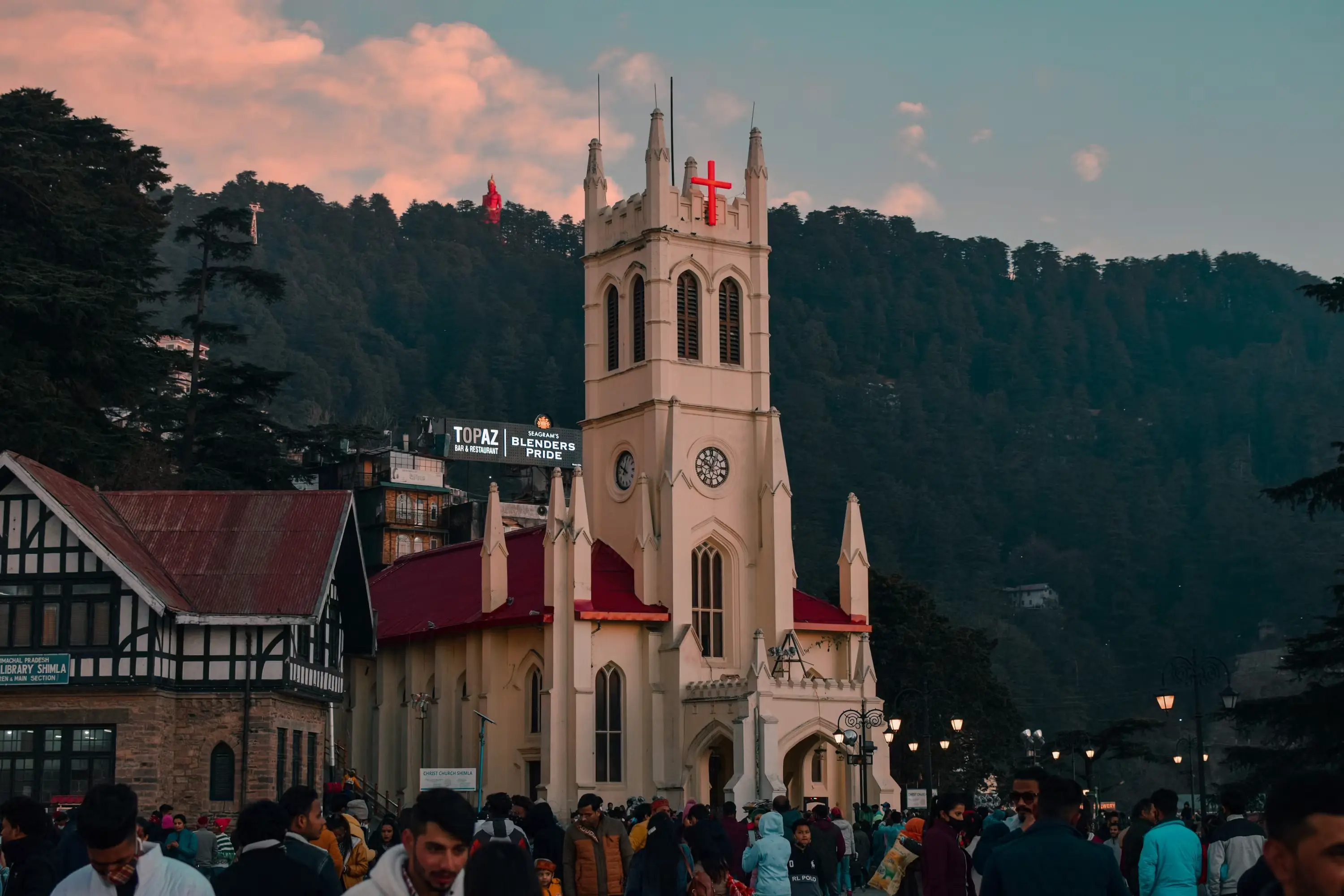
The town itself was built as the Raj's summer capital — the Kalka-Shimla railway, a UNESCO World Heritage line completed in 1903, still runs the same route it always has, and the toy trains are visible from the road on the final approach.
Late afternoon is free on the Mall Road and around Christ Church, Shimla's oldest church, consecrated in 1857.
Experience of the Day
– Drive from Kullu to Shimla via Mandi, with a lunch stop en route.
– Walk the Mall Road and Christ Church in the late afternoon.
Food
Try Himachali siddu — a steamed wheat bun, usually with a walnut or poppy-seed filling — at a Mall Road eatery.
Activities to Do
Mall Road walk.
Optional visit to the Viceregal Lodge (Indian Institute of Advanced Study), built in 1888.
Day 3
SHIMLA TO SARAHAN | Into Kinnaur's Gateway
Route: Shimla → Narkanda → Rampur → Sarahan (via NH-05)
There are two ways out of Shimla toward Kinnaur: the shorter Jalori Pass track through the Banjar valley, and the longer NH-05 highway through Narkanda and Rampur, taken today. Jalori tops out above 3,100 metres on a narrow, exposed road that closes for weeks most winters and is not the kind of road to trust with a loaded vehicle carrying international guests — NH-05 is wider, better maintained, and used daily by the trucks that supply Kinnaur itself.
Narkanda, roughly halfway, sits in Himachal's apple belt — the orchards along this stretch of road are part of what keeps the highway busy year-round. Sarahan itself, the old summer capital of the Bushahr kingdom, sits below Shrikhand Mahadev at a comfortable altitude, and the pagoda-roofed Bhimakali Temple at its centre is the day's real destination.
The Human Story
The Bhimakali Temple's kath-kuni construction — alternating layers of stone and deodar timber, with no mortar between them — lets the whole structure flex slightly rather than crack when the ground moves. That's not a decorative choice: the temple survived the 1905 Kangra earthquake, which flattened masonry buildings across the region, while its layered wooden frame simply absorbed the shock and kept standing.
Experience of the Day
– Drive from Shimla to Sarahan via Narkanda and Rampur on the established NH-05 highway.
– Visit the Bhimakali Temple complex, seat of the former Bushahr kingdom.
– Walk Sarahan's small bazaar in the evening.
Food
Kinnauri-style rajma and buckwheat rotis start appearing on menus from Sarahan onward.
Activities to Do
Bhimakali Temple visit.
Evening bazaar walk.
Day 4
SARAHAN TO SANGLA/RAKCHAM | First Homestay Night, Baspa Valley
Route: Sarahan → Jeori → Karcham → Sangla → Rakcham
The road follows the Sutlej down to Karcham before turning off up the Baspa river into the valley Sangla and Rakcham sit in. The Baspa runs clear and fast here, and the valley floor is flat enough for the terraced fields and orchards that support Sangla's own economy.
This is the first homestay night of the trip. On arrival, the village's own homestay coordinator — not BizareXpedition, and not the guest — assigns the family for the night, the same way it would for any traveller passing through.
Before settling in, there's time to see Kamru village and its fort, on a spur above Sangla.
The Human Story
Kamru Fort was the Bushahr kingdom's capital for centuries before the seat moved to Sarahan and then Rampur, and its five-storey wooden tower is built with the same kath-kuni method as the Bhimakali Temple — stone courses locked together by deodar beams, no nails, no mortar. The Kamakhya Devi shrine on the fort's upper floor, its idol said to have been brought from Guwahati generations ago, is still where every new titular head of the Bushahr line is required to be crowned. A thousand-year-old building doesn't survive by accident in an earthquake zone; the flexible wooden frame is why it's still standing, and why the coronation still happens here.
Note: Homestay dinner is whatever the family is cooking, usually eaten at their own table on their own schedule — earlier than most hotel dinners. Ask before photographing family members, and expect a shared bathroom unless the roster has assigned a private one.
Experience of the Day
– Drive from Sarahan to Rakcham via Karcham, entering the Baspa valley.
– Visit Kamru village and its fort above Sangla.
– Settle into the homestay assigned by the village coordinator on arrival.
Food
Dinner is whatever the host family has cooked — typically a Kinnauri thali of rajma, buckwheat rotis and a seasonal vegetable.
Activities to Do
Kamru Fort and Kamakhya Devi temple visit.
Evening walk along the Baspa in Rakcham.
Day 5
SANGLA/RAKCHAM — CHITKUL DAY TRIP | Homestay Night 2
Route: Rakcham ↔ Chitkul (round trip)
Chitkul sits further up the Baspa than Rakcham, at roughly 3,450 metres, and is commonly described as the last inhabited village on the old Hindustan-Tibet trade route before it runs into restricted border territory. Beyond it, the valley is closed to general travel.
The village's own Mathi Devi temple, built in the same kath-kuni style seen at Sarahan and Kamru, is said locally to mark where the goddess settled after crossing the Himalaya from Vrindavan. A 2024 IIT Delhi air-quality study found Chitkul's air among the cleanest recorded anywhere in India — not a surprise, given how little sits upwind of it.
The group returns to Rakcham for a second homestay night, back with the same family where the village's roster allows it.
Experience of the Day
– Drive up to Chitkul and walk the village and riverside.
– Visit the Mathi Devi temple.
– Return to Rakcham for the second homestay night.
Food
Apricots and dried fruit, a Kinnaur specialty, are sold fresh in Chitkul's small shops in season.
Activities to Do
Chitkul village walk.
Mathi Devi temple visit.
Riverside time at Rakcham in the evening.
Optional Nearby Excursions
A short walk further along the Baspa from Chitkul toward the last visible army checkpoint, weather and time permitting.
Day 6
SANGLA/RAKCHAM TO TABO | Crossing into Spiti
Route: Rakcham → Karcham → Powari → Nako → Sumdo → Tabo
This is the longest driving day of the trip, and it's also where the landscape changes for good: the road runs from Kinnaur's terraced, monsoon-fed valleys into the treeless, rain-shadow desert of Spiti. Nako, a lake village at around 3,660 metres, is the last real stop before the terrain turns properly arid.
At Sumdo, foreign nationals' permits are checked again before the road continues into Spiti proper — the same Inner Line Permit arranged for Kinnaur covers this crossing, and the checkpoint itself is routine rather than eventful.
Tabo, reached by evening, is built around one of the oldest working Buddhist monasteries in the Himalaya — founded in 996 CE, and still in daily use.
The Human Story
Tabo Monastery was founded in 996 CE by the translator Rinchen Zangpo on behalf of the Guge kingdom, and its mud-brick assembly halls have never been rebuilt from scratch — only repaired, including after the 1975 Kinnaur earthquake. Several sources describe it as a UNESCO World Heritage Site; that isn't accurate. The Archaeological Survey of India protects it and has proposed it for UNESCO recognition, but it has never actually been inscribed. What is documented is that the 14th Dalai Lama chose Tabo for Kalachakra ceremonies in both 1983 and 1996, the latter marking the monastery's thousandth year — a mud building in a cold desert, still significant enough a thousand years on to draw its tradition's own spiritual head back to it.
Experience of the Day
– Drive from Rakcham to Tabo via Nako and the Sumdo permit checkpoint.
– Visit Nako village and its lake en route.
– Evening visit to Tabo Monastery's assembly halls.
Food
Spitian thukpa and momos start appearing on menus from Tabo onward — Tibetan-influenced, suited to the cold.
Activities to Do
Nako lake stop.
Tabo Monastery evening visit.
Day 7
TABO TO KIBBER | Third Homestay Night
Route: Tabo → Kaza → Kibber
The road to Kaza passes below Dhankar, Spiti's former capital, perched on a cliff edge above the confluence of the Spiti and Pin rivers — seen from the road today, since the climb up to its monastery rewards a visit of its own rather than a brief stop between drives.
Kaza itself, Spiti's small administrative town, is a brief stop for lunch and any last errands before the final climb to Kibber, at around 4,270 metres one of the higher permanently inhabited villages on this route.
Kibber sits at the edge of the Kibber Wildlife Sanctuary, known chiefly for its snow leopard population, though sightings depend entirely on luck and season. The third homestay night here is assigned the same way as the first two, by the village's own coordinator.
Note: Kibber and Spiti generally sit well above 4,000 metres. Altitude sickness is a real risk this high, and the gradual climb through Kinnaur over the previous five days is the acclimatisation schedule, not an afterthought — drink water, avoid alcohol, and tell the guide about any headache or nausea immediately rather than waiting it out.
Experience of the Day
– Drive from Tabo to Kibber via Kaza, with a lunch stop in Kaza.
– View Dhankar's cliff-edge site from the road.
– Settle into the assigned Kibber homestay.
Food
Butter tea and dried apricots, a Spitian household staple, are commonly offered on arrival at a homestay.
Activities to Do
Kaza market stop.
Evening walk around Kibber village.
Day 8
KIBBER TO DEMUL | High-Village Loop — Komic, Hikkim, Langza
Route: Kibber → Komic → Hikkim → Langza → Komic → Demul
This day strings together four of Spiti's highest villages before ending at Demul for the fourth homestay night. Komic, at 4,587 metres, is one of the highest villages anywhere with a motorable road reaching it, and its Lundup Tsemo Gompa — roughly 500 years old — sits right at the village edge.
Hikkim, a short drive on, holds the world's highest post office, still functioning since 1983; postcards sent from here genuinely do arrive, if slowly. Langza, back down toward the main valley, is known for the marine fossils scattered across its slopes — the physical remains of the Tethys Sea that once covered this ground long before the Himalaya existed.
From Langza the road loops back through Komic and onto the narrow, mostly unpaved stretch to Demul, where the fourth and final homestay of the trip is waiting.
The Human Story
Demul's homestay programme runs on a strict rotation across the village's roughly fifty households: in any given year, only about half the village hosts guests, and the other half sits out until the following year. The system exists because, left unmanaged, tourism income in a small village tends to concentrate in whichever house sits closest to the road — Ishita Khanna, founder of the Spiti-based social enterprise Ecosphere, helped establish this rotation here specifically to spread that income across the whole community rather than a lucky few. It's why a guest doesn't choose their Demul homestay: a village coordinator assigns it on arrival, the same way it's assigned for every traveller who stays here.
Note: The final Komic–Demul stretch is a narrow dirt road; it's driven slowly and in daylight. This is also the day's longest stretch without proper toilets — plan accordingly at Komic or Hikkim.
Experience of the Day
– Visit Komic's Lundup Tsemo Gompa, one of the highest-altitude monasteries on the route.
– Post a card from Hikkim, the world's highest post office.
– Walk the fossil beds at Langza.
– Arrive at Demul and settle into the rotation-assigned homestay.
Food
Dinner at the Demul homestay is typically a simple thukpa or tsampa-based meal, cooked over a wood or dung-fuelled stove.
Shopping
Fossil-hunters sometimes find loose ammonite fragments near Langza — taking them isn't encouraged, since they're part of what makes the site worth visiting for the next guest.
Activities to Do
Lundup Tsemo Gompa visit.
Hikkim post office visit.
Langza fossil walk.
Day 9
DEMUL TO KAZA | Return to the Valley Floor
Route: Demul → Kaza
A short, easy drive back down to Kaza, Spiti's largest town, after four consecutive homestay nights. The afternoon is deliberately unstructured — time to do laundry, use better phone signal than anywhere in the previous four days offers, and walk Kaza's own small market.
Key Monastery, Spiti's largest, is visible from several points around Kaza and can be visited as an optional stop for anyone who wants a closer look at its fortress-like, repeatedly rebuilt architecture before the trip moves on toward Chandratal.
Experience of the Day
– Drive from Demul to Kaza.
– Free afternoon for laundry, shopping, and connectivity.
– Optional Key Monastery visit.
Food
Kaza has the widest choice of restaurants on the whole route, including a few serving Israeli and continental dishes alongside Spitian and Tibetan food.
Shopping
Kaza's market sells Spitian pashmina, dried seabuckthorn products, and local handicrafts — the last real shopping stop before Chandratal and the return leg.
Activities to Do
Kaza market walk.
Rest and re-supply before the high-altitude legs ahead.
Optional Nearby Excursions
Key Monastery, roughly 12 km from Kaza, viewable from a short detour.
Day 10
KAZA TO CHANDRATAL | Over the Kunzum Pass
Route: Kaza → Kunzum Pass → Batal → Chandratal
The Kunzum Pass, at 4,551 metres, is the physical boundary between Spiti and Lahaul, and it's only open roughly mid-June to early October — the same short window that makes Chandratal reachable by this road at all.
Camping directly on Chandratal's shore is no longer allowed. Years of visitor waste and physical wear had visibly degraded the lake's water clarity, and the local Koksar panchayat pushed the permitted camping zone back to beyond Batal, a few kilometres from the water. It's a short walk from camp to the shore rather than a tent pitched at the water's edge — a genuine, if minor, inconvenience in exchange for a lake that's still worth walking to.
Chandratal itself, the crescent-shaped “Moon Lake,” sits at around 4,300 metres and turns shades of turquoise and deep blue through the day as the light changes.
Note: Chandratal's eco-camps run only in season (mid-June to early October) and have no heating beyond blankets and hot water bottles; nighttime temperatures drop well below freezing even in August. Bring warm layers regardless of the season.
Experience of the Day
– Drive from Kaza to Chandratal via the Kunzum Pass.
– Walk from the eco-camp to Chandratal's shore for sunset.
Food
Camp dinners are simple, hot, vegetarian meals — the altitude and the camp's limited kitchen keep the menu basic but filling.
Activities to Do
Kunzum Pass photo stop.
Chandratal lakeside walk at sunset.
Day 11
CHANDRATAL TO KULLU | Return via Manali
Route: Chandratal → Batal → Gramphoo → Atal Tunnel → Manali → Kullu
The return leg drops out of Spiti's cold desert and back into the greener, wetter Kullu valley in a single day — the same climate shift the outbound leg took five days to cross gradually, now run in reverse and all at once, since the descent doesn't carry the same altitude-sickness risk the climb did.
The Atal Tunnel, opened in 2020, cuts under the Rohtang Pass rather than over it, saving several hours and avoiding one of the route's more weather-exposed sections. Manali is a brief stop for lunch before the final short run down to Kullu.
Experience of the Day
– Drive from Chandratal back to Kullu via Batal, Gramphoo, the Atal Tunnel and Manali.
– Lunch stop in Manali.
Food
A last chance for Himachali dham or simple Punjabi fare in Manali before Kullu.
Activities to Do
Optional short stop at Manali's Mall Road if time allows.
Day 12
DEPARTURE | Kullu → Bhuntar Airport
Route: Kullu → Bhuntar Airport
A short transfer to Bhuntar Airport for the onward or homeward flight.
Experience of the Day
– Transfer to Bhuntar Airport for departure.
Food
A packed breakfast or an early meal at the hotel before the transfer, depending on flight timing.
Activities to Do
Final packing and check-out before the airport transfer.
Tour Information
Your complete guide to a hassle-free and enjoyable trip.
Inclusion
Exclusion
Payment Terms
Important factors to consider before your trip!
Cancellation
Need To Know
Be Responsible Traveller
- Minimize Plastic Use : Bring a reusable water bottle, shopping bag, and utensils to reduce the need for single-use plastics. Many destinations have water refill stations and eco-friendly stores.
- Support Local and Sustainable Businesses : Eat at local restaurants, buy souvenirs from local artisans, and choose tour operators that prioritize sustainable practices and support the local community.
- Respect Wildlife and Natural Habitats : Avoid disturbing wildlife or their natural habitats. Stick to designated paths and observe animals from a distance without feeding or touching them.
- Dispose of Waste Properly : Follow local guidelines for recycling and waste disposal. If facilities aren't available, carry your waste with you until you can dispose of it responsibly.
- Educate Yourself and Others : Learn about the local environment, culture, and customs. Respect local practices and traditions, and share your knowledge about responsible travel with others.
- Choose Sustainable Activities : Engage in eco-friendly activities such as hiking, snorkeling, or visiting national parks. Avoid activities that exploit animals or damage the environment.
- Leave No Trace : Follow the principle of "Leave No Trace," which means leaving natural areas as you found them. Pack out all trash, avoid picking plants, and refrain from carving or writing on rocks or trees.
- Plant Trees Whenever Possible : Participate in local tree-planting initiatives or plant trees in your own community. Trees absorb carbon dioxide, provide oxygen, and help support biodiversity, making them vital for a healthy environment.
Connect
Share Itinerary
Email Itinerary
Frequently Asked Questions (FAQs) & People Also Ask — Himachal Homestay: Responsible Travel Immersion
We help you prepare for your trip and ensure an effortless and enjoyable travel experience.
How many days do you need for a Kinnaur-Spiti village homestay tour?
This itinerary runs 11 nights and 12 days, covering Kullu, Shimla, Sarahan, Sangla/Rakcham, Tabo, Kibber, Demul, Kaza and Chandratal. That length comes from the real driving distances between these villages and the gradual altitude gain Kinnaur and Spiti require — it can be shortened, but doing so means dropping a homestay village or a day trip rather than compressing the driving.
Do I get to choose which family I stay with?
No — each village's own homestay coordinator assigns the family, the same way it would for any traveller. This is intentional: it's how Sangla/Rakcham, Tabo, Kibber and Demul share tourism income across their own households rather than concentrating it with whichever family is easiest to book.
Is a Spiti and Kinnaur homestay tour safe for foreign travellers?
Yes, with the usual precautions any high-altitude trip needs. The main real risks are altitude sickness above 4,000 metres and seasonal road closures, both handled directly in this itinerary through its gradual acclimatisation route and its choice of the more reliable Shimla-Narkanda-Rampur highway into Kinnaur.
Do foreign nationals need a permit for Kinnaur and Spiti?
Yes — an Inner Line Permit, arranged by BizareXpedition and checked at Sumdo on the way into Spiti. Guests need only carry their original passport and Indian visa; the paperwork itself is handled by the ground team before the trip reaches Kinnaur.
What is altitude sickness risk like on this route, and how is it managed?
Kibber, Demul, Komic and Kaza all sit above 4,000 metres, where mild altitude sickness is a real possibility for anyone. This itinerary's five-day climb through Kinnaur before reaching Spiti's highest villages is built as gradual acclimatisation, and guides are briefed to treat any headache or nausea seriously rather than waiting it out.
What is a homestay in Spiti actually like?
It means sleeping in a real family's home, eating what they're cooking on their own schedule, and often sharing a bathroom rather than having an en-suite one. It's a simpler, more direct experience than a hotel room, and this document's Practical Notes cover the etiquette — mealtimes, photography, water use — in detail before any guest arrives at one.
Is the homestay experience different at the Ultra-Luxury tier?
No — the family and the home are exactly the same at every tier, since the product is staying with that specific family, not a fabricated upgrade to their house. Tier differences on this itinerary sit in the Shimla, Sarahan, Kaza and Chandratal nights, the vehicle, and the guide, not in the homestay itself.
When is the best time to do this Kinnaur-Spiti homestay circuit?
Mid-June to mid-September is the most reliable window, since it's the only period the Kunzum Pass and Chandratal are both open and accessible. Late September into early October is a quieter alternative with cooler nights; outside that roughly four-month window, the Chandratal leg isn't possible at all.
Is the host family paid directly, or should guests tip separately?
The family is paid directly, folded into the accommodation cost already quoted in this document — it isn't a separate fee or an informal arrangement left to the guest. A further tip is entirely optional and not expected at any of the four homestay villages.
What should I know about homestay etiquette before I go?
Meals run on the family's own schedule rather than a hotel's fixed dinner hour, bathrooms are often shared, and photographing a family member should always be asked first. These points are covered in a pre-trip briefing on Day 1 and repeated in this document's Practical Notes, so nothing about a homestay night comes as a surprise.
Why does this route go via Shimla instead of the shorter Jalori Pass road?
Jalori Pass is a shorter link into Kinnaur, but it narrows sharply above 3,100 metres and closes for weeks most winters, which makes it a poor fit for a loaded vehicle carrying international guests. The Shimla-Narkanda-Rampur highway (NH-05) is longer but wider, better maintained, and used daily by the trucks that supply Kinnaur itself — this itinerary takes that road on purpose.
Is transport private throughout this trip?
Yes — BizareXpedition runs this circuit with its own vehicle and driver for all 12 days, including the two 4x4-only mountain stretches into Kinnaur and Spiti. The only nights the vehicle isn't in use are the four homestay nights themselves, when guests are on foot within the village.
BizareXpeditionTMReviews
Let's go, pack up, and hit the road!
Similar Tour Packages
Explore other exciting options for your next adventure!
Trusted Paths, Bold Journeys — Inside BizareXpedition
From humble beginnings to a trusted name in the industry, BizareXpedition's story is one of purpose-driven growth, community connection, and a relentless pursuit of excellence that speaks for itself.














Himachal Homestay: Responsible Travel Immersion
best deal price
Without GST
₹82,404
per person on twin sharing
Book Now