
Hiking the High Tibetan Monasteries of Ladakh8N/9D
Hiking the High Tibetan Monasteries of Ladakh
Start & City : Leh
best deal price
₹
Without GST ₹1,03,874
per person on twin sharing
Choose your departure city, dates, and add guests to secure your tour.
Hurry, as seats fill up, prices rise! Book now!
1. Choose your departure date
Highlights
Walk from Rizong to Yangthang, Hemis Shukpachan and Ang, three village stages between about 3,200 m and 3,900 m.
Visit Shey, Thiksey, Stok, Likir, Rizong, Hemis and Matho, and see the Sumtsek temple at Alchi, with its 11th to 13th century murals.
Sleep in village homes at Yangthang, Hemis Shukpachan and Ang, with homemade Ladakhi meals and a cooking lesson.
Walk the juniper grove at Hemis Shukpachan, a village where the juniper is held sacred.
Climb the ruins above Tingmosgang, the 15th-century capital where the 1684 treaty was signed.
Keep to moderate walking: three to five hours a day, with passes below 3,900 m and nights close to the height of Leh.
Essence of Journey
The experiences that capture the true spirit of the entire trip.
| Day | Route | Distance | Major Highlights |
|---|---|---|---|
| Day 1 | Leh (arrival) | Airport transfer | Arrive at 3,500 m, rest |
| Day 2 | Leh – Shey – Thiksey – Stok – Leh | About 65 km round trip | Palace and two great monasteries |
| Day 3 | Leh – Likir – Alchi – Nurla | About 95 km (4 to 5 hrs) | Likir, Alchi Sumtsek, lower ground |
| Day 4 | Nurla – Rizong – Yanshagthang | Short drive, then about 4 hrs on foot | Gelug monastery, first village night |
| Day 5 | Yangthang – Hemis Shukpachan | 8 to 10 km (4 to 5 hrs on foot) | Tsermangchan La, juniper grove |
| Day 6 | Hemis Shukpachan – Ang | About 10 km (3 to 4 hrs on foot) | Mebtak La, apricot village |
| Day 7 | Ang – Tingmosgang – Leh | Walk, then about 92 km by road | Fortress ruins above Temisgam |
| Day 8 | Leh – Hemis – Matho – Leh | Full-day local drive | Two more great monasteries |
| Day 9 | Leh (departure) | Transfer to airport | Morning flight out |
About
This is a 9-day private cultural trek in Ladakh, India. You visit the great Tibetan Buddhist monasteries around Leh by road, then walk for three days through the Sham Valley from Rizong to Yangthang, Hemis Shukpachan and Ang, sleeping in village homestays. Walks last 3 to 5 hours, passes stay under 3,900 m, and no mountain experience is needed. Prices start at about INR 103,874 per person for two people sharing.
You don't need glaciers or 5,000 m passes to walk in Ladakh. West of Leh, in the Sham Valley, monasteries and villages sit a few hours apart on old footpaths that monks and farmers still use every day. You walk past barley fields, prayer walls and apricot orchards, cross small passes with wide views, and arrive each afternoon at a family home where dinner is already on the stove.
This trip is for people who want to understand Ladakh, not just photograph it. You sit in on morning prayers, walk between temples painted 900 years ago, cook momos with a local family and climb the ruins where a 17th-century peace treaty was signed. The walking is gentle enough for most reasonably fit travellers, and a vehicle is always close by.
Why Hike the Sham Valley?
Monastery to monastery on foot. Walk the old village paths that link Rizong to the villages beyond, rather than just driving between temples.
Ladakh's finest Buddhist art. The Sumtsek temple at Alchi holds murals and four-metre bodhisattva statues from the 11th to 13th centuries, painted in a Kashmiri style found almost nowhere else.
Living monasteries. Morning prayers at 12-storey Thiksey, the strict meditation monastery of Rizong, the Drukpa courtyard of Hemis and Matho, the only Sakya monastery in Ladakh.
Real village homestays. Three nights with Ladakhi families at Yangthang, Hemis Shukpachan and Ang. The family is paid directly, so your money stays in the village.
A cooking lesson. Make thukpa or momo dough with the women of the house at Hemis Shukpachan, then eat what you made.
Sacred juniper and apricot orchards. Hemis Shukpachan is named after its holy juniper grove; Ang sits among apricot trees.
History underfoot. Climb the ruins of Tingmosgang, a 15th-century royal capital where the 1684 treaty between Ladakh and Tibet was signed.
How Hard Is the Sham Valley Trek?
The Sham Valley trek is easy to moderate, which is why it is often called Ladakh's "baby trek". If you can walk five hours on a hill path with a light day pack, you can do this.
Walking time: 3 to 5 hours a day, on paths villagers use daily.
Climbs: a few hundred metres at most. The steepest bit is about half an hour of loose ground up the Mebtak La.
Height: passes under 3,900 m, about 400 m above Leh.
Luggage: a vehicle carries your bags wherever there is a road. Ponies carry them on the one stretch with no road.
Backup: if you are tired, you can ride to the next village on any stage with a road.
A month of regular hill walks before the trip is enough preparation. There is little shade on the trail, so a hat, sunscreen and two litres of water are essential.
Altitude: Why This Trek Is Gentle on the Body
Leh sits at 3,500 m, so altitude matters even on an easy trek. This plan keeps it simple:
Two nights in Leh before any walking, with only easy sightseeing.
A night at Nurla, near 3,000 m, lower than Leh.
No night more than about 200 m above Leh, which makes altitude sickness unlikely for most rested travellers.
A portable oxygen cylinder and pulse oximeter travel with you for the whole trip.
Drink plenty of water and skip alcohol for the first couple of days. Ask your own doctor whether you need any altitude medication. SNM Hospital in Leh is the main hospital.
ACCOMMODATION CATEGORIES
| Destination | Nights | Premium | Luxury | Ultra-Luxury |
|---|---|---|---|---|
|
Leh |
4 |
Hotel Chospa (boutique, Old Road) |
The Grand Dragon Ladakh |
Dolkhar (seven private villas in an orchard) |
|
Nurla (near Alchi) |
1 |
Faryork Resort (bamboo cottages on the Indus) |
The Legacy Alchi (boutique resort) |
The Apricot Tree Hotel (boutique hotel above the Indus) |
|
Yangthang |
1 |
Village homestay |
Village homestay (same) |
Village homestay (same) |
|
Hemis Shukpachan |
1 |
Village homestay |
Village homestay (same) |
Village homestay (same) |
|
Ang |
1 |
Village homestay |
Village homestay (same) |
Village homestay (same) |
Ladakh Monastery And Sham Valley Accommodation Categories
Hotels in Leh and Nurla are named as examples for each tier and are confirmed at booking. The three village nights are in family homes in every tier, because the homes are the point of the walk and there are no hotels in these villages; the best available room is requested for the upper tiers and cannot be guaranteed. Rooms are simple, with shared bathrooms, and the meals are homemade Ladakhi food. Homestay families are matched at booking, and at Ang a simple guesthouse may be used if the families are full. Ladakh hotel nights include breakfast and dinner, and all meals are included in the villages.
Permits and Paperwork
Good news: Leh and the Sham Valley need no Protected Area Permit. You only need a valid Indian visa and your passport.
Send us your passport and Indian visa copies at least two weeks before travel.
Carry your passport on the road; there are checkposts.
Choose insurance that covers high altitude and medical evacuation.
3-TIER PRICING SUMMARY
| Tier | Per couple | Per person |
|---|---|---|
|
Premium |
Rs.207,749 – 224,369 |
Rs.103,874 – 112,184 |
|
Luxury |
Rs.260,669 – 281,523 |
Rs.130,334 – 140,761 |
|
Ultra-Luxury |
Rs.368,399 – 397,871 |
Rs.184,199 – 198,935 |
Ladakh Monastery And Sham Valley 3-Tier Pricing Summary
Ranges run from the base total to about 8% above it, to allow for dates and season. Prices are indicative and are confirmed in a written quote. International flights, Indian visa fees and travel insurance are not included.
WHY BOOK THIS WITH BIZAREXPEDITION
A tailor-made, nine-day cultural trek for two, planned by BizareXpedition Services Pvt. Ltd. (CIN U63090UR2016PTC007433), where the walking joins the monasteries and the stay is in the villages between them.
Monastery to monastery, on foot. The walking days start at Rizong monastery and end in village homes, so each day joins a place of worship to the next village. The paths are old ones used by villagers and monks, with a vehicle always within reach.
Fitness that most guests already have. Walking days run three to five hours, the passes are between about 3,580 m and 3,890 m, and the climbs are a few hundred metres at most. No guest needs mountain experience.
Nights close to the height of Leh. Alchi is lower than Leh, and Yangthang, Hemis Shukpachan and Ang are within about 200 m of it. The walking is built on a body that has already rested for two nights in Leh.
Village homes for the nights. Yangthang, Hemis Shukpachan and Ang are slept in family homes, with cooking and dinner shared with the household. The family is paid directly, which keeps the money in the village.
The great monasteries on either side. Shey, Thiksey and Stok before the walk, Likir and Alchi on the way west, Tingmosgang at the end, and Hemis and Matho on the last day.
Longer walks on request. Guests who want a longer walk can add the Likir to Yangthang stage over the Phobe La, or the Lamayuru to Alchi walk, both described in the Tailor-made note.
SEASON ADJUSTMENTS
| Season | Months | Conditions | Price effect |
|---|---|---|---|
|
Early season |
May to mid-June |
Passes are clear but nights are cold in the villages, and some homestays are only just open. |
Base price |
|
Peak |
Mid-June to August |
Warm days, green fields and full homestays. The best weather for walking. |
Top of the price range (about +8%) |
|
Best light |
September to early October |
Clear light, harvested barley and cooler walking days. |
Base price |
|
Weather watch |
July and August |
Rain in the Sham valley is rare, but cloudburst-type storms can wash out a stretch of path or road. Extra nights, if needed, are charged at stay rates. |
Base price, plus any extra nights |
|
Not offered |
Late October to April |
Nights are below freezing, homestays close, and the passes can hold snow. |
Not offered on this route |
Ladakh Monastery And Sham Valley Season Adjustments
PRACTICAL NOTES
Flights: all Leh flights run in the morning. There is no spare day in this plan, so book your onward flight for the evening of Day 9 or later.
Cash: no reliable ATMs after Leh. Carry about INR 7,000 to 9,000 for tips, entries and small purchases.
Phone signal: good 4G in Leh, patchy in the villages. Only postpaid Indian SIMs work in Ladakh.
Dress: cover shoulders and knees in monasteries. Photography is not allowed inside Alchi's Sumtsek, and flash is banned in most shrine rooms.
Pack: comfortable walking shoes or light boots, a sun hat, sunscreen, layers and a warm jacket for evenings.
Booking Summary
Dept. City :
--
Dept. Date :
--
Traveller :
Adults: 2, Child: 0, Infant: 0
Rooms :
--
Basic Price :
--
Total Cost
--
GST
--
Grand Total
--
Itinerary (Day Wise)
This gentle trip shows you Ladakh through its monasteries and villages, on foot and at an easy pace. You land in Leh and take a quiet first day to adjust to the altitude. On the second day you visit Shey, Thiksey (with its morning prayers) and Stok. Next you drive west to Likir and Alchi, where the Sumtsek temple holds murals painted 900 years ago. From Rizong you start walking. For three days you follow old village paths through the Sham Valley to Yangthang, Hemis Shukpachan and Ang, crossing small passes below 3,900 m. You spend each night with a Ladakhi family, and at Hemis Shukpachan, beside its sacred juniper grove, you can join a cooking lesson. On the last walking day you climb the ruins of Tingmosgang, where a treaty between Ladakh and Tibet was signed in 1684, then drive back to Leh. The next day you visit Hemis and Matho monasteries before flying home. Walks last three to five hours, a vehicle carries your bags, and you can always ride to the next village if you’re tired, so no mountain experience is needed.
Day 1
LEH | ARRIVAL IN LADAKH
Route: Leh airport to hotel
Your guide and driver meet you at Leh airport and take you straight to the hotel. The flight into Leh crosses the Himalaya, and every flight lands in the morning, because winds pick up later in the day at an airport about 3,250 m high.
Leh is at 3,500 m. The Ladakh tourism advisory asks new arrivals to rest on the first day and add no more than about 500 m of sleeping height a day after that. Today is for rest. Drink plenty of water and skip alcohol tonight.
Experience of the Day
– Met at Leh airport by your guide and driver.
– A flight over the Himalaya into the Indus valley.
– A full rest day at 3,500 m, as the Ladakh tourism advisory asks of new arrivals.
Food
Lunch and dinner at the Leh hotel.
Activities to Do
Light rest only today. No sightseeing is planned on arrival day.
Day 2
LEH | SHEY, THIKSEY AND STOK
Route: Leh – Shey (about 15 km) – Thiksey (about 19 km) – Stok (about 15 km, across the Indus) – Leh
Shey was the summer capital of Ladakh. The present palace and monastery were built in 1655 by Deldan Namgyal in memory of his father, Sengge Namgyal. Inside is a 12 m copper Buddha, gilded with about 5 kg of gold, made by a Nepalese sculptor with copper from the Lingshet mines in Zanskar. Below the palace a long line of whitewashed chortens runs along the edge of the fields.
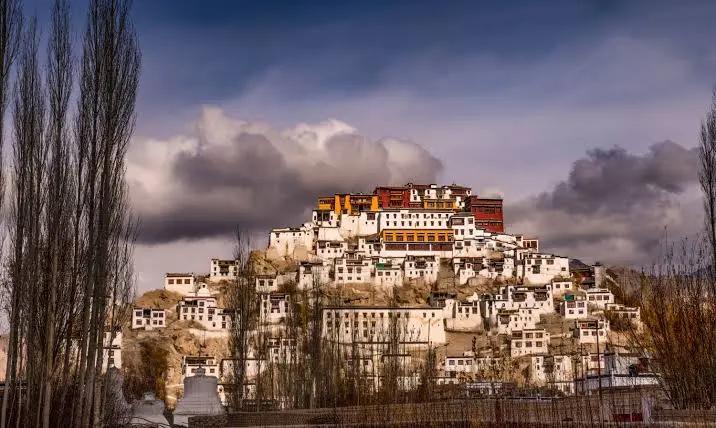
Thiksey monastery stands at about 3,600 m and has twelve storeys. It was founded in the mid-15th century by Palden Zangpo and belongs to the Gelug order. Its 15 m Maitreya statue, installed for the Dalai Lama's 1970 visit, is the largest in Ladakh. Morning prayers begin around 7 am, and a visit at that hour shows a working monastery before the day's groups arrive.
Stok lies across the Indus from Leh. Its palace, built in the early 19th century, is still the home of the former royal family, and part of it is a museum. Return to the hotel by late afternoon. Tonight the guide briefs the walking days: the stages, the passes, what the ponies carry and what you carry.
Experience of the Day
– Shey Palace and its 12 m gilded copper Buddha.
– Thiksey monastery's twelve storeys and 15 m Maitreya statue.
– Stok Palace, home of the former royal family.
Food
Breakfast at the hotel; lunch en route or at the hotel; dinner at the hotel.
Activities to Do
A guided walk through Shey and Thiksey; a visit to the Stok Palace museum; an evening briefing on the walking days.
Day 3
LEH TO NURLA | LIKIR AND ALCHI
Route: Leh – Likir (about 52 km) – Alchi (about 65 km from Leh) – Nurla (about 25 km further)
Likir monastery sits on a hilltop about 52 km west of Leh, reached by a short diversion road off the Srinagar–Leh highway. It was founded in 1065 at the order of King Lhachen Gyalpo, the fifth king of Ladakh, and belongs to the Gelug order today. A gilded Maitreya statue, 23 m tall and completed in 1999, is visible from the roof. The path from Likir to Yangthang, over the Phobe La, is the classic start of the Sham valley walk, and the guide points out where it leaves the village.
Alchi Choskor stands at about 3,100 m on the south bank of the Indus, roughly 65 km west of Leh. It has six temples from the 11th to 13th centuries. Local tradition names the translator Rinchen Zangpo as its founder, and wall inscriptions point to a noble called Kaldan Sherab; scholars still debate which is right. In the Sumtsek stand three bodhisattvas, each about four metres tall, and their painted robes carry tiny scenes of court life, cloth patterns and Buddhist stories. The murals show a Kashmiri hand.
Lunch is at Alchi Kitchen. The night is at Nurla, about 25 km further on, close to 3,000 m and the lowest sleeping height of the stay.
Experience of the Day
– Likir monastery and its 23 m gilded Maitreya statue.
– Alchi Choskor, the temple complex of the 11th to 13th centuries.
– Lunch at Alchi Kitchen.
Food
Breakfast at the Leh hotel; lunch at Alchi Kitchen; dinner at the Nurla hotel.
Activities to Do
A short visit to Likir; a guided visit to the Alchi temples after their midday break.
The Human Story: Alchi Kitchen
Nilza Wangmo, who grew up in Alchi, opened Alchi Kitchen in 2016 and trained young women from nearby villages to cook and serve. The menu is Ladakhi: skyu, a wheat-pasta stew; chutagi, bow-tie pasta in a local sauce; khambir, a fermented bread; and Tashi Tagye tea, an eight-ingredient blend.
Day 4
NURLA TO YANGTHANG | RIZONG ON FOOT
Route: Nurla – Rizong (short drive) – walk to Yangthang (about 4 hours)
Rizong monastery was founded in 1831 by Lama Tsultim Nima and belongs to the Gelug order. It holds about 40 monks and is known for the strictness of its rule, with no mask dances and few ceremonies, and it stands in a rocky side valley chosen for meditation. The Julichen nunnery lies about 2 km away, and the nuns work the fields that supply both houses. The setting is quiet and the visit is short and respectful.
From Rizong the path leads to Yangthang, a small village in the next valley, walked in about four hours. The ground is dry and open, and there is little shade, so the guide sets an early start and a steady pace. Yangthang has a handful of houses among barley fields, and the family that hosts the group serves a late lunch and a simple dinner.
Experience of the Day
– Rizong monastery and the Julichen nunnery.
– The first walk, from Rizong to Yangthang.
– A night in a family home.
Food
Breakfast at the Nurla hotel; lunch and dinner at the Yangthang homestay.
Activities to Do
A guided walk of about four hours; a monastery visit before it.
The Human Story: The Monks and Nuns of Rizong
Rizong follows the rule of discipline closely. Monks do not leave the monastery except for illness, and the nuns of Julichen grow the food. The monastery is called a paradise for meditation because it asks little of the outside world, and your guide explains what visitors should and should not do.
Day 5
YANGTHANG TO HEMIS SHUKPACHAN | THE TSERMANGCHAN LA
Route: Yangthang – Tsermangchan La – Hemis Shukpachan (8 to 10 km)
The path climbs gently from Yangthang to the Tsermangchan La, crosses it, and drops to Hemis Shukpachan. The climb is a few hundred metres, and the descent is on a dirt track that locals use daily. This is the stage where the walking feels like a walk: barley fields, willows, mani walls, and ahead the red rock hill of Dakmar.
Hemis Shukpachan is a Sham valley village about 70 km from Leh. Shukpa is the Ladakhi word for juniper, and the groves around the village are held sacred; monks burn the wood as incense in prayers. The village has a large Buddha statue at its centre and homestays, which are the only way to stay here. The afternoon is for a short walk through the juniper grove and a cooking lesson with the family, followed by dinner at their table.
Experience of the Day
– The Tsermangchan La and the descent to Hemis Shukpachan.
– The sacred juniper grove and the village Buddha.
– A cooking lesson with the host family.
Food
Breakfast at the Yangthang homestay; trail lunch; dinner at the Hemis Shukpachan homestay.
Activities to Do
A guided walk of 8 to 10 km; a walk through the juniper grove; a cooking lesson.
The Human Story: Dinner at the Family Table
Homestays here are arranged through a village programme, and the family keeps what the guests pay. The cooking lesson is the point: you make the dough for thukpa or momos with the women of the house, and eat what you made. Keep the evening slow.
Day 6
HEMIS SHUKPACHAN TO ANG | THE MEBTAK LA
Route: Hemis Shukpachan – Mebtak La – Ang (about 10 km)
The Mebtak La is the pass where the climb is steepest, a wall of loose ground that takes about half an hour to ascend, and then the path drops through the dry hills toward the Indus valley. On the far side the landscape changes: lower, warmer, with apricot orchards around the village of Ang.
The walk ends by early afternoon, and the rest of the day is free for the village: the orchards, the stream, and the family's kitchen. Ang is the lowest sleeping height of the three village nights, and the nights are warm by Ladakh standards.
Experience of the Day
– The Mebtak La and the pony stage.
– Apricot orchards around Ang.
– An afternoon at the family home.
Food
Breakfast at the Hemis Shukpachan homestay; trail lunch; dinner at the Ang homestay.
Activities to Do
A guided walk of about 10 km; a walk through the orchards.
Day 7
ANG TO TINGMOSGANG AND LEH
Route: Ang – Temisgam (about 8 km on foot) – Tingmosgang – Leh (about 92 km)
The last walk descends to the main road at Temisgam. Tingmosgang, in the village of Temisgam, lies about 92 km west of Leh, near Khalatse and north of the main road. King Drag-pa-Bum made it his capital in the 15th century, and a palace and monastery stand on the hillock above the village, much of the old fortification now in ruin. The Treaty of Tingmosgang was signed here in 1684. It ended the Tibet–Ladakh–Mughal War and fixed the border between Ladakh and Tibet, and it gave Ladakh exclusive rights to the pashmina wool trade in exchange for brick tea. Your guide walks you up through the ruins and explains what the sites on the hillock were.
The vehicle then takes the group back to Leh, along the Indus, to the hotel by late afternoon. Tonight is a hot shower and a restaurant dinner of your choice.
Experience of the Day
– The last walk down to the Indus at Temisgam.
– The ruins and treaty site above Tingmosgang.
– A hot shower and a bed in Leh.
Food
Breakfast at the Ang homestay; lunch en route; dinner in Leh at a restaurant of your choice.
Activities to Do
A guided walk of about 3 hours; a climb through the Tingmosgang ruins.
Day 8
LEH | HEMIS AND MATHO
Route: Leh – Hemis (about 45 km) – Matho – Leh
Hemis was re-established in 1672 by King Sengge Namgyal and follows the Drukpa lineage. Its courtyard shows paintings of the Eighty-Four Mahasiddhas from the 17th century, made with ground mineral pigments. In 1894 a Russian journalist claimed that Hemis held a manuscript about Jesus in India. Scholars reject the claim, and the story is worth hearing as a story only.
Matho is the only monastery of the Sakya order in Ladakh, and sources date its founding to the 15th or 16th century. It sits above the Indus across from Stakna. The afternoon is free in Leh. A last walk through the old town or the main bazaar is a good way to close.
Experience of the Day
– Hemis monastery and its mural courtyard.
– Matho, the only Sakya monastery in Ladakh.
– A free afternoon in Leh.
Food
Breakfast at the hotel; lunch en route or at the hotel; dinner at the hotel.
Activities to Do
Guided visits at Hemis and Matho; the main bazaar in the evening if you wish.
Shopping
Leh's main bazaar sells pashmina, Ladakhi jewellery, prayer flags and thangka paintings, a short walk from the hotel.
Day 9
LEH | DEPARTURE
Route: Leh hotel to airport
Your driver and guide take you to the airport. Every flight out of Leh leaves in the morning. If your onward flight is later in the day, the morning is free for the main bazaar, where pashmina, Ladakhi jewellery and prayer flags are sold.
Experience of the Day
– Transfer to Leh airport.
– Departure on your morning flight.
Food
Breakfast at the hotel; other meals as you choose.
Activities to Do
None scheduled. If your flight is later, the morning is free for the bazaar.
Shopping
Leh's main bazaar, for pashmina, Ladakhi jewellery and prayer flags, is a short walk from the hotel.
Tour Information
Your complete guide to a hassle-free and enjoyable trip.
Inclusion
Exclusion
Payment Terms
Important factors to consider before your trip!
Cancellation
Need To Know
Be Responsible Traveller
- Minimize Plastic Use : Bring a reusable water bottle, shopping bag, and utensils to reduce the need for single-use plastics. Many destinations have water refill stations and eco-friendly stores.
- Support Local and Sustainable Businesses : Eat at local restaurants, buy souvenirs from local artisans, and choose tour operators that prioritize sustainable practices and support the local community.
- Respect Wildlife and Natural Habitats : Avoid disturbing wildlife or their natural habitats. Stick to designated paths and observe animals from a distance without feeding or touching them.
- Dispose of Waste Properly : Follow local guidelines for recycling and waste disposal. If facilities aren't available, carry your waste with you until you can dispose of it responsibly.
- Educate Yourself and Others : Learn about the local environment, culture, and customs. Respect local practices and traditions, and share your knowledge about responsible travel with others.
- Choose Sustainable Activities : Engage in eco-friendly activities such as hiking, snorkeling, or visiting national parks. Avoid activities that exploit animals or damage the environment.
- Leave No Trace : Follow the principle of "Leave No Trace," which means leaving natural areas as you found them. Pack out all trash, avoid picking plants, and refrain from carving or writing on rocks or trees.
- Plant Trees Whenever Possible : Participate in local tree-planting initiatives or plant trees in your own community. Trees absorb carbon dioxide, provide oxygen, and help support biodiversity, making them vital for a healthy environment.
Connect
Share Itinerary
Email Itinerary
Frequently Asked Questions (FAQs) & People Also Ask — Hiking the High Tibetan Monasteries of Ladakh
We help you prepare for your trip and ensure an effortless and enjoyable travel experience.
How hard is the walking?
Moderate. Walking days run three to five hours, the climbs are a few hundred metres at most, the passes are under 3,900 m and the paths are used by villagers daily. No technical skill is needed. A guest who can walk five hours on a hill path with a day pack is comfortable.
Which monasteries do we visit?
Shey, Thiksey and Stok on Day 2, Likir and Alchi on Day 3, Rizong on Day 4, the ruins at Tingmosgang on Day 7, and Hemis and Matho on Day 8. Hemis Shukpachan and Yangthang are villages with village shrines and no great monasteries.
Is it a trek or a sightseeing tour?
Both. The three middle days are walking days, with vehicles on call, and the days around them are monastery visits by road. It suits a guest who wants to walk between the monasteries and not only see them from a car.
How high do we sleep?
Leh at 3,500 m for two nights, then Nurla near 3,000 m, Yangthang near 3,650 m, Hemis Shukpachan near 3,700 m and Ang lower. No night is more than about 200 m above Leh, which makes altitude sickness improbable for most guests who have rested in Leh.
What are the homestays like?
Family homes with simple rooms, shared bathrooms and homemade Ladakhi food. The family hosts you and cooks, and the money stays in the village. Rooms can be cold in the early and late season, and water can be limited.
What if I cannot walk a stage?
The vehicle follows each stage on the road wherever one exists, so a guest who is tired can ride to the next village. Day 6 has no road, and the guide arranges a pony if needed.
When is the best time to go?
From May to early October, with mid-June to August the warmest and the busiest. September gives clear light. The villages are cold at night in May, and homestays close from late October.
Do I need a permit?
Leh and the Sham valley need no Protected Area Permit. We need passport and Indian visa copies at least two weeks before travel. Carry your passport on the road.
Can I start from Delhi?
Yes. A Delhi night and the Delhi–Leh flights can be added, and the flights are quoted separately at about Rs 34,000 for two. Leh flights land in the morning, so a Delhi night before is usual.
How much does this cost per person?
The modeled price is about Rs 103,874 to 112,184 per person at Premium, Rs 130,334 to 140,761 at Luxury, and Rs 184,199 to 198,935 at Ultra-Luxury, for two guests sharing. That covers stays, vehicle, guide, ponies, entries and the listed experiences. Flights, visa and insurance are extra.
Why are the village homestays the same in every tier?
There are no hotels in these villages, and the family home is the point of the stay. The upper tiers differ in the Leh and Nurla hotels, and we ask for the best available room in the homes, though we cannot guarantee it.
What if I want a harder walk?
Our fourteen-day Trekking in Ladakh crosses passes above 5,000 m on the Markha Valley route, and the Tailor-made note describes a Likir to Yangthang start and the Lamayuru to Alchi crossing as longer walks in the same valley.
BizareXpeditionTMReviews
Let's go, pack up, and hit the road!
Similar Tour Packages
Explore other exciting options for your next adventure!
Trusted Paths, Bold Journeys — Inside BizareXpedition
From humble beginnings to a trusted name in the industry, BizareXpedition's story is one of purpose-driven growth, community connection, and a relentless pursuit of excellence that speaks for itself.














Hiking the High Tibetan Monasteries of Ladakh
best deal price
Without GST
₹1,03,874
per person on twin sharing
Book Now