
Losar: Tibetan Buddhist New Year in Spiti11N/12D
Losar: Tibetan Buddhist New Year in Spiti
Start & City : Delhi
best deal price
₹
Without GST ₹91,161
per person on twin sharing
Choose your departure city, dates, and add guests to secure your tour.
Hurry, as seats fill up, prices rise! Book now!
1. Choose your departure date
Highlights
Spend Losar itself inside a working Buddhist community's own winter calendar — monastery-rotating new-year prayers and Cham dances, not a staged summer performance.
Stand inside Tabo Monastery's mud-brick assembly hall, painted in 996 CE; Spiti's near-total absence of rainfall is exactly what has kept its original clay sculptures and wall paintings intact for over a thousand years.
Wake in Kaza to nights near –25°C and watch the town's own New Year customs unfold — a crier's announcement, home-to-home visits by musicians, chang and decorated cakes.
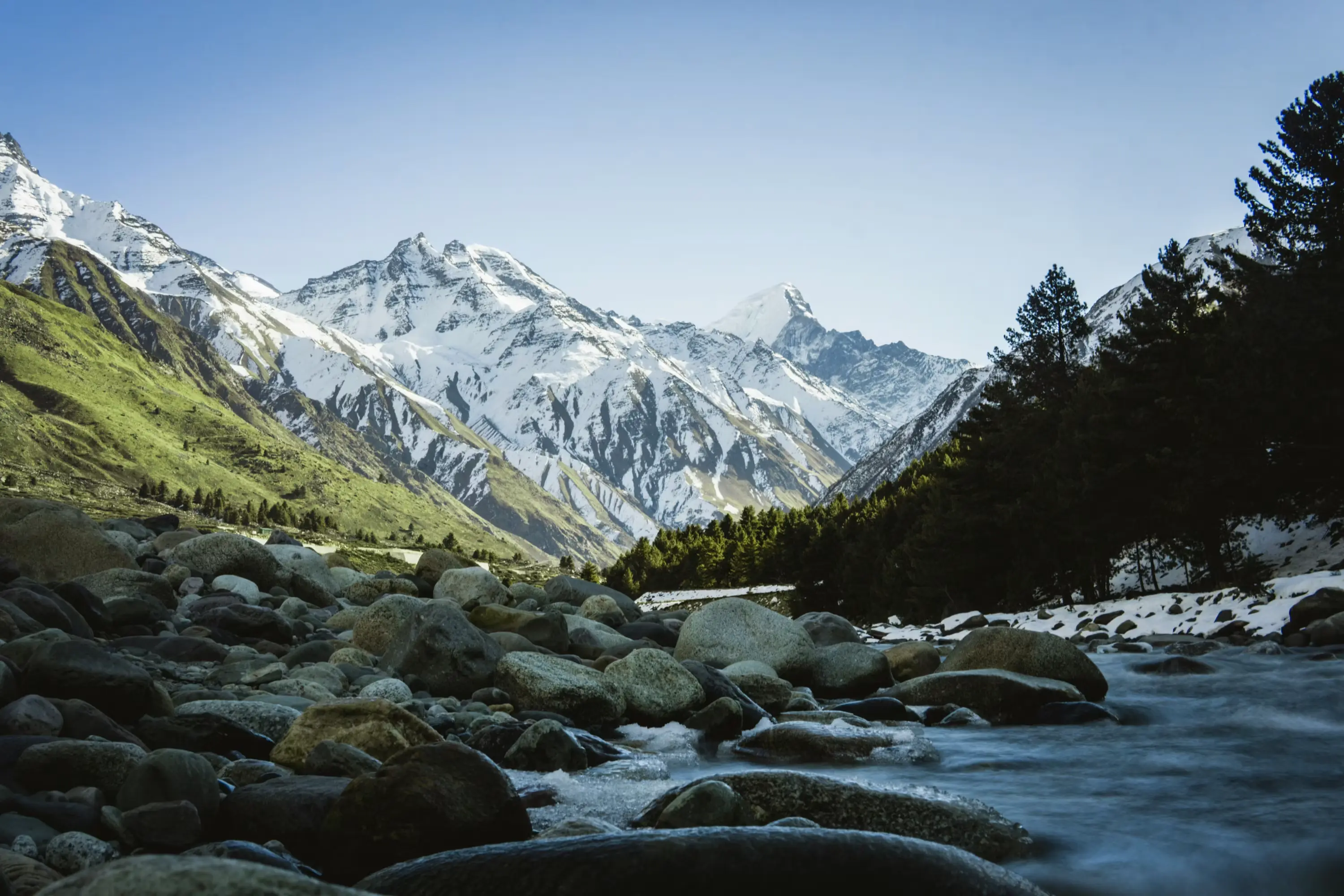
Drive in by the only road open in winter — the Shimla-Kinnaur highway along the Sutlej gorge — with Kalpa's Kinnaur Kailash range turning gold at first light.
Visit Tangyud Monastery at Komic (4,520m), one of only two Sakya-lineage monasteries left in Spiti, built into a canyon edge beside the Kibber Wildlife Sanctuary.
Hear Kalpa's own Shyam Saran Negi story — the schoolteacher who cast India's first-ever vote in 1951 and kept voting in every election until his death at 105.
Reach Kibber, one of the world's highest permanently inhabited villages, on the edge of a sanctuary that holds roughly 30 snow leopards.
One full buffer day is built into the four nights at Kaza at no extra cost, so a snowbound stretch of road does not cost you the festival itself.
Essence of Journey
The experiences that capture the true spirit of the entire trip.
| Day | Route | Distance | Major Highlights |
|---|---|---|---|
| Day 1 | Arrive Delhi | – | International arrival, private transfer, welcome briefing |
| Day 2 | Delhi – at leisure | – | Winter-gear and Inner Line Permit briefing; optional Old/New Delhi sightseeing |
| Day 3 | Delhi → Shimla | ~342 km / 8–9 hrs | Kalka foothills, Mall Road, Christ Church, The Ridge |
| Day 4 | Shimla → Kalpa | ~222 km / 7–8 hrs | Narkanda, Rampur, Sarahan pass-by, first Kinnaur Kailash views |
| Day 5 | Kalpa → Tabo | ~155 km / 6–7 hrs | Reckong Peo (ILP check), Nako village and lake, Sumdo checkpoint |
| Day 6 | Tabo → Kaza | ~48 km / 1.5–2 hrs | Tabo Monastery (996 CE), arrival in Kaza, acclimatisation evening |
| Day 7 | Kaza – Losar customs | local | Town crier's announcement, home visits, chang and New Year cakes |
| Day 8 | Kaza → Komic/Kibber → Kaza | ~50 km round trip | Tangyud Monastery (Komic), Kibber village and Wildlife Sanctuary edge |
| Day 9 | Kaza – buffer / Dhankar–Key excursion | ~50 km round trip | Buffer day (weather-dependent); Dhankar Monastery and Key Monastery if road is clear |
| Day 10 | Kaza → Kalpa | ~200 km / 7–8 hrs | Direct return via Tabo and Nako, no overnight break |
| Day 11 | Kalpa → Shimla | ~222 km / 7 hrs | Return via Rampur and Narkanda |
| Day 12 | Shimla → Delhi | ~342 km / 8 hrs | Return drive, day-use rest, international departure |
About
This losar festival spiti tour international is built around one fixed point on the Tibetan lunar calendar: Losar, the Buddhist New Year, celebrated across Spiti's monasteries and villages every winter. It runs into Spiti by the only road open in that season — the Shimla-Kinnaur highway — and gives the festival itself, not a generic winter sightseeing loop, the centre of the trip.
The road choice is not scenic preference; it is geography. The Manali side of Spiti crosses Kunzum La at 4,551 metres, a pass buried under snow for roughly eight months a year. The Shimla-Kinnaur route instead threads along the Sutlej and Spiti river gorges at a lower, gentler gradient, through Kalpa, Nako and Tabo, and stays driveable — with real, disclosed exceptions — through the winter. That is why every domestic and international Spiti circuit that runs in February enters from this side, and why this tibetan buddhist new year himachal tour follows the same road.
Losar itself is quieter than its reputation suggests. The large, elaborately staged masked Cham dance that most photographs of “Spiti's Losar” actually show — the one at Key Monastery — belongs to a separate summer festival, Gustor, moved to July decades ago specifically so visitors could attend it. What Losar itself brings is smaller and more local: a rotating set of monasteries hold their own new-year prayers and Cham dances on their own calendar within the festival window, and every village runs its own version of the same customs — a town crier's New Year announcement, musicians visiting house to house in order of seniority, chang and pink-iced cakes shared at each stop. This spiti winter festival tour for foreigners is built around that real, smaller event, not the summer spectacle wearing its name.
What is the Losar festival Spiti tour?
The Losar festival Spiti tour is a private winter trip that takes you into Spiti Valley, in India's Himachal Pradesh, for the Tibetan Buddhist New Year. You drive in on the only road that stays open in winter, stay four nights in Kaza, and spend Losar with a working Buddhist community: monastery prayers, masked Cham dances, and the house-to-house visits that mark the new year in Spiti's villages.
Most Spiti tours are summer trips. This one isn't. We built it around a single date on the Tibetan lunar calendar, and everything else, from the route to the number of nights in Kaza, follows from that.
What Losar in Spiti actually looks like
We'd rather set the right expectations than sell you a photo.
The huge masked dance you'll find in most pictures of "Losar in Spiti" is actually Gustor, a summer festival at Key Monastery. Losar itself is smaller, quieter and far more personal. Here's what you're likely to see:
A town crier calling out the New Year in the morning
Musicians visiting homes in a set order of seniority, with a stop at each house
Chang (barley beer), butter tea and pink-iced cakes shared with guests
Homes marked with flour-painted auspicious signs, and juniper burned as incense
New-year prayers and Cham dances at whichever monastery is hosting that year (it rotates, and we confirm it before you travel)
Nobody puts this on for visitors. You're a guest at a community celebration, and for most of our travellers that's the whole point.
WHY BOOK THIS WITH BIZAREXPEDITION
A handful of things about this specific trip are worth knowing before you book.
Built for one festival window, not adapted from a summer route. The day plan, the buffer day, and the Kaza stay length are all set by Losar's own dates each year, not stretched from an existing warm-season Spiti circuit.
A buffer day that costs nothing extra. One full day inside the four nights at Kaza is held free specifically to absorb a closure on the Shichilling stretch between Tabo and Kaza — the road's real winter bottleneck — without needing to add a paid extra night.
Permits handled before you land. The Inner Line Permit required for foreign nationals travelling beyond Kalpa (Nako, Tabo, Kaza and the plateau villages) is processed through Reckong Peo ahead of your arrival, not queued for on the day.
One winter-equipped vehicle and driver, start to finish. A single 4x4 fitted for winter driving — snow chains carried, not just promised — and one driver who knows this specific stretch of road run the whole 12 days.
Direct ground operations in Kinnaur-Spiti. BizareXpedition runs this route itself rather than reselling a third party's winter departure, which is what lets the buffer day and permit handling above actually happen on schedule.
Three tiers, one honest standard for a thin winter market. Spiti's winter guesthouse market is small; every tier here is named for what it actually is — heated, open, and confirmed for the season — rather than dressed up with a star count that means little at 3,800 metres in February.
ACCOMMODATION CATEGORIES
| Destination | Nights | Premium | Luxury | Ultra-Luxury |
|---|---|---|---|---|
|
Delhi |
2 |
Radisson Blu Plaza, Delhi Airport |
ITC Maurya |
The Oberoi, New Delhi |
|
Shimla |
2 |
The Cecil-standard heritage hotel |
Clarkes Hotel Shimla |
Wildflower Hall, An Oberoi Resort |
|
Kalpa |
2 |
Heated 3-tier guesthouse, valley view |
Heated boutique lodge, Kinnaur Kailash view |
Best available heated property, full valley view |
|
Tabo |
1 |
Heated winter guesthouse |
Best available heated guesthouse |
Best available heated guesthouse |
|
Kaza |
4 |
Heated winter guesthouse, bukhari stove |
Best available heated property, bukhari stove |
Best available heated property, bukhari stove |
Losar Festival Spiti Tour Accommodation Categories
Delhi and Shimla have a real, competitive hotel market and are named below. Beyond Kalpa, winter Spiti's guesthouse market is thin — only a small subset of properties stay open and heated through February — so Tabo and Kaza are shown by tier standard rather than a guessed brand name, flagged honestly rather than guessed, and reconfirmed with ground operations each season before booking.
How we handle winter in Spiti
Winter here is serious. This is how we plan for it:
The buffer day. Heavy snow can close the Shichilling stretch between Tabo and Kaza for hours, or occasionally for more than a week. We keep one full day free in Kaza at no extra cost, so a closure doesn't cost you Losar.
Flight slack. We ask you to leave 2–3 spare days before your international flight home, as a second safety margin.
Gradual altitude gain. You reach Kaza on Day 6, not Day 2, so your body has time to adjust.
One vehicle, one driver. The same winter-ready 4x4 and the same driver, who knows this road, for the whole trip.
Permits sorted early. Your Inner Line Permit is ready before you reach the checkpoint at Reckong Peo.
3-TIER PRICING SUMMARY
| Tier | Per Couple (INR) | Per Person (INR) |
|---|---|---|
|
Premium |
Rs.182,322 – 196,908 |
Rs.91,161 – 98,454 |
|
Luxury |
Rs.255,402 – 275,834 |
Rs.127,701 – 137,917 |
|
Ultra-Luxury |
Rs.355,194 – 383,610 |
Rs.177,597 – 191,805 |
Losar Festival Spiti Tour 3-Tier Pricing Summary
Pricing is indicative and modeled, not a live quote — it varies with exact travel dates, current hotel rates, and group size. A confirmed quote is issued at the time of booking.
SEASON ADJUSTMENTS
This is a fixed seasonal departure timed to Losar. Because Losar follows the Tibetan lunar calendar, its Gregorian date shifts by two to three weeks most years — the table below is a planning reference; BizareXpedition reconfirms the exact date and host monastery for your travel year before booking.
| Year | Losar (Gregorian date) | Note |
|---|---|---|
|
2026 |
18 February |
Already past for this travel year |
|
2027 |
7 February |
Next confirmed departure window; book by Nov 2026 for permit lead time |
|
2028 |
26 February |
Planning reference — reconfirmed closer to the date |
|
2029 |
14 February |
Planning reference — reconfirmed closer to the date |
Losar Festival Spiti Tour Season Adjustments
Winter road risk (Shichilling stretch, Tabo–Kaza): heavy snowfall between November and March can close this stretch from a few hours up to, in a bad year, more than a week. One buffer day is built into the Kaza stay at no extra cost to absorb this — see Day 9 and Practical Notes. This is handled as an advisory, not priced into the package cost, since the risk cannot be predicted in advance.
Who this Spiti winter festival tour for foreigners suits
A good fit if you:
Want to see Buddhist culture as it's lived, not staged
Are comfortable with basic but warm rooms, heated by wood stoves
Can handle long road days (7–9 hours on several days) and real cold
Travel with some flexibility on your return flight
Probably not the right fit if you:
Need hotel-standard central heating and hot showers on demand
Have heart or lung conditions that make high altitude risky (please check with your doctor)
Want a guaranteed snow leopard sighting. That calls for a dedicated tracking trip, and we can plan one
PRACTICAL NOTES
Safety One private winter-equipped 4x4 and the same driver for all 12 days; snow chains are carried, not just promised, for the Shichilling stretch and any other icy section.
Winter road risk Hold your return international flight with 2–3 days of slack. The buffer day at Kaza (Day 9) is the primary safeguard, but a longer closure in a bad year is possible — flight slack is the second layer of protection, not a substitute for the buffer day.
Permits Foreign nationals need an Inner Line Permit for Nako, Tabo, Kaza and the plateau villages beyond Kalpa, checked at Reckong Peo. BizareXpedition processes this in advance of your arrival.
Altitude Kaza sits at roughly 3,800 metres and Kibber/Komic higher still. The itinerary gains altitude gradually across five days before reaching Kaza; drink water through each driving day and flag any headache or breathlessness to your guide early.
Cold Kaza nights run roughly –12°C to –25°C in February. Every guesthouse on this route runs a wood-burning bukhari stove rather than central heating — the honest standard for this altitude and season.
Drinking water Bottled or filtered water only beyond Shimla; your guide carries a filtered supply as backup on the higher-altitude days.
Dress code Modest dress at all monasteries — shoulders and knees covered, shoes removed before entering prayer halls. Warm layers are essential regardless of dress code.
Photography Photography inside monastery prayer halls is often restricted or requires permission — your guide checks this at each site rather than assuming it's allowed.
Connectivity Mobile network beyond Kalpa is limited to BSNL/Jio in most stretches, and patchy at Kibber and Komic. Let family know in advance that daily contact may not be possible.
Tipping Not compulsory. If you'd like to tip your driver or guide, roughly Rs.500–800 per day per person is the usual local range.
Booking Summary
Dept. City :
--
Dept. Date :
--
Traveller :
Adults: 2, Child: 0, Infant: 0
Rooms :
--
Basic Price :
--
Total Cost
--
GST
--
Grand Total
--
Itinerary (Day Wise)
Most people only see Spiti in summer. This 12-day trip takes you there in the depth of winter to share Losar, the Tibetan Buddhist New Year, with the people who live there. After two easy days in Delhi, you drive up through Shimla and Kalpa. Winter closes the Manali side, so you take the Kinnaur highway, the one road that stays open. You stop at Tabo's thousand-year-old monastery on the way to Kaza, where you spend four nights. In the village you'll hear the town crier call in the New Year and see musicians go from house to house. You'll share chang and pink-iced cakes, and watch prayers and Cham dances at whichever monastery is hosting that year. There's also a day trip to Komic and Kibber, two of the highest villages on earth. One spare day is built in at no extra cost, so a snowy road won't cost you the festival. We arrange your permits ahead of time, and the same winter-ready 4x4 and driver stay with you from start to finish.
Day 1
ARRIVAL IN DELHI | WELCOME TO INDIA
Route: International airport → Delhi hotel
Your flight lands in Delhi and a private transfer takes you straight to the hotel. There is nothing scheduled for this evening beyond check-in and rest — the drive north starts properly tomorrow, and the days ahead are long enough that this first evening is better spent recovering from the flight than sightseeing.
A trip briefing covers what the next eleven days actually involve: the Inner Line Permit process at Reckong Peo, the winter kit you'll be issued for Kaza and Kibber, and the specific Losar dates confirmed for this year's departure.
Experience of the Day
– Airport meet-and-greet and private transfer
– Check-in and rest
– Evening trip briefing on permits, winter kit and this year's confirmed Losar dates
Food
Hotel dinner; the kitchen can flag any dietary requirement noted at booking.
Activities to Do
Settle in and adjust to the time zone
Review the winter-kit checklist issued at briefing
Day 2
DELHI AT LEISURE | PERMITS & WINTER-GEAR BRIEFING
Route: Delhi (day at leisure)
This day exists for one practical reason: the drive to Shimla tomorrow is the first of four long mountain-road days in a row, and starting it well-rested and properly kitted out matters more here than in most other Himalayan circuits, given how cold Kaza gets in February.
Guests who'd rather not spend the whole day resting can use the private car for Old Delhi (Jama Masjid, Chandni Chowk) or New Delhi (Humayun's Tomb, India Gate, Qutub Minar) — whichever suits, at your own pace.
Experience of the Day
– Free morning and afternoon
– Optional Old Delhi or New Delhi sightseeing by private car
– Winter-gear issue and fitting: down jackets, thermal layers, gloves
Food
Breakfast at the hotel; lunch and dinner options in Delhi's own restaurant scene, recommended by your BizareXpedition contact on request.
Shopping
Khan Market or Dilli Haat for last-minute essentials before the mountain leg begins.
Activities to Do
Old Delhi heritage walk (optional)
New Delhi monuments circuit (optional)
Final permit-document check with your BizareXpedition contact
Day 3
DELHI TO SHIMLA | INTO THE FOOTHILLS
Route: Delhi → Chandigarh → Shimla, approx. 342 km / 8–9 hours
The plains give way to the first hill roads a little past Chandigarh, and the temperature drops steadily for the rest of the drive. Shimla itself sits at 2,206 metres — a gentle first step up before the real altitude gain begins tomorrow.
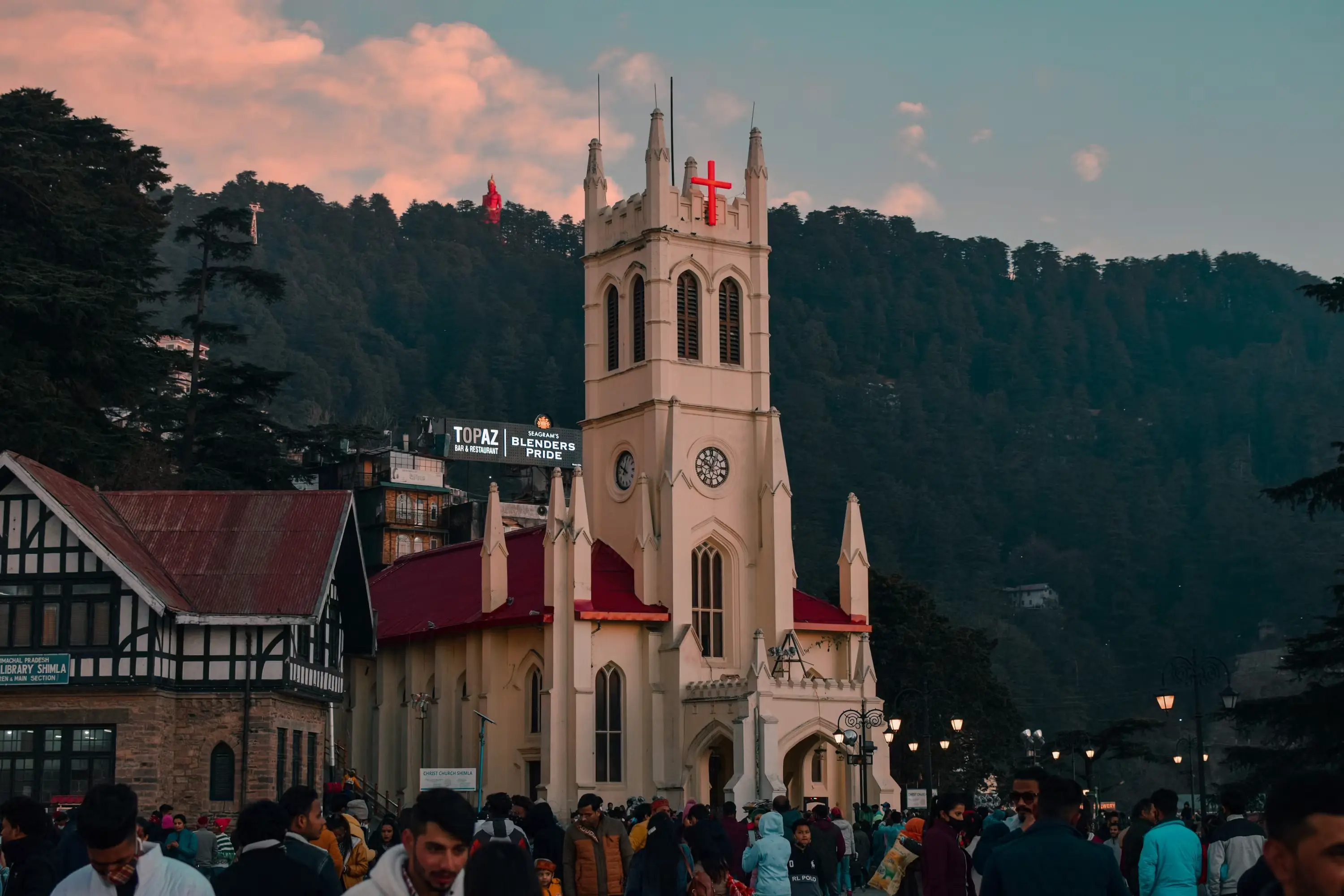
The town's colonial-era core — the Mall, the Ridge, Christ Church — was built as the Raj's summer capital specifically because the elevation kept it cool when Delhi baked; in February the same elevation just means an early evening chill and, most years, leftover snow on the Ridge.
Experience of the Day
– Full-day drive from Delhi
– Evening walk on the Mall Road and the Ridge
– Christ Church, Shimla's oldest church in North India
Food
Himachali dham thali or a Mall Road cafe dinner — Shimla's food scene runs both registers well.
Shopping
Mall Road for shawls, woollens and Kinnauri caps — useful here before the colder days ahead.
Activities to Do
Evening Ridge and Mall Road walk
Christ Church visit
Day 4
SHIMLA TO KALPA | ENTERING KINNAUR
Route: Shimla → Narkanda → Rampur → Kalpa, approx. 222 km / 7–8 hours
This is the day the road actually becomes the Kinnaur highway proper — narrower, cut into the gorge wall above the Sutlej, climbing in stages rather than one continuous grade. It is also the day that makes the whole route possible: this same NH-05 corridor stays open through winters that close the Manali side completely, because it never climbs over a high pass the way the Kunzum La crossing does.
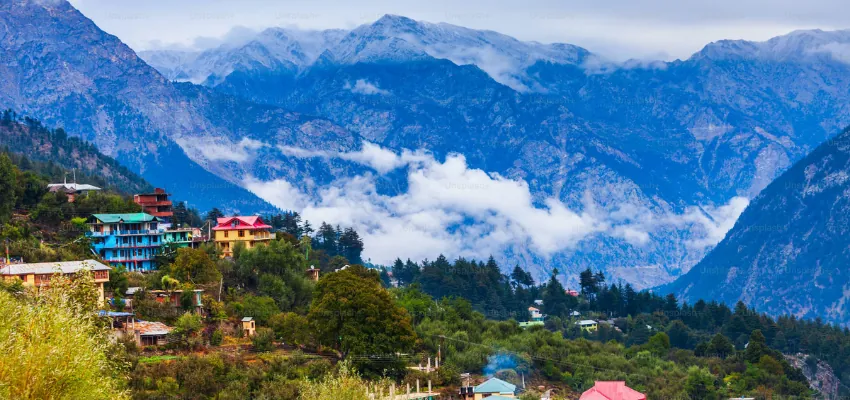
Kalpa sits at 2,960 metres directly across the valley from the Kinnaur Kailash range, and the peaks catch the last and first light of the day before the valley floor does — worth being awake for, on either end.
Note on altitude: Kalpa is roughly 750 metres higher than Shimla. It's a manageable single-day gain, but drink water through the drive and take the evening slowly if you feel any lightheadedness.
Experience of the Day
– Sutlej gorge drive through Narkanda and Rampur
– First full views of the Kinnaur Kailash range on arrival
– Evening at Kalpa, watching the range catch the last light
Food
Kinnauri rajma and buckwheat rotis — a local combination here, not found much further down the valley.
Activities to Do
Evening viewpoint walk for the Kinnaur Kailash range
Rest and acclimatise before tomorrow's permit checkpoint
Day 5
KALPA TO TABO | THE PERMIT LINE AND THE COLD DESERT
Route: Kalpa → Reckong Peo → Nako → Sumdo → Tabo, approx. 155 km / 6–7 hours
Reckong Peo is where the paperwork actually happens: your Inner Line Permit, arranged in advance, is checked here before the road continues toward Nako and the high plateau. The landscape changes fast past this point — Kinnaur's pine-forested slopes give way to the bare, wind-carved rock of the trans-Himalayan cold desert within a couple of hours.
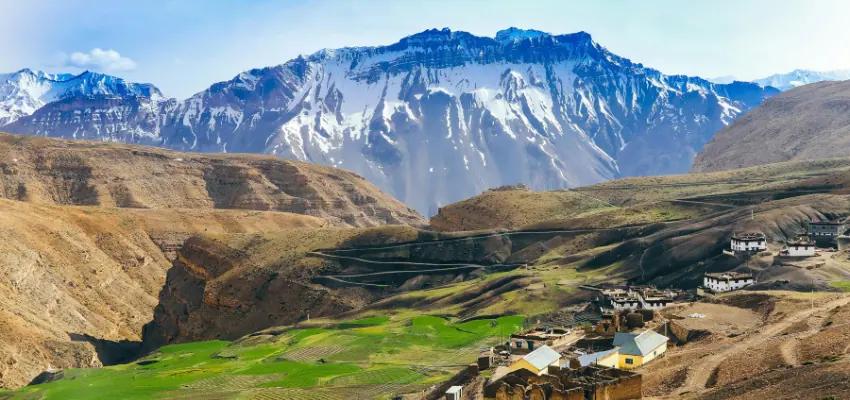
Nako's small lake and its cluster of centuries-old temples make a natural halfway stop. By the time the road drops into Tabo late in the afternoon, you're standing in one of the driest inhabited places in India — average annual rainfall here is measured in single-digit centimetres.
The Human Story
Tabo Monastery was founded in 996 CE by the translator-monk Rinchen Zangpo, and its mud-brick assembly hall still holds its original clay sculptures and wall paintings — not replicas, the actual 10th-century work. That survival isn't an accident of care alone: mud brick fails almost everywhere else in the world because moisture gets in and the walls slump or dissolve. Spiti's near-total absence of rain removed that threat entirely, which is the real reason a building this fragile in material has outlasted most stone monuments built centuries later elsewhere in the Himalayas. It is sometimes described as “UNESCO-listed,” which is not accurate — it is protected by the Archaeological Survey of India and has been proposed for UNESCO World Heritage status, but was never actually inscribed.
Experience of the Day
– Reckong Peo Inner Line Permit checkpoint
– Nako village, lake and its centuries-old temple cluster
– Arrival at Tabo Monastery, founded 996 CE
Food
Thukpa and butter tea on arrival at Tabo — standard, and welcome, after a cold day's drive.
Activities to Do
Tabo Monastery assembly hall and mural viewing (guided)
Evening walk through Tabo village
Day 6
TABO TO KAZA | ARRIVING FOR LOSAR
Route: Tabo → Kaza, approx. 48 km / 1.5–2 hours
The shortest driving day of the trip, deliberately — Kaza sits at roughly 3,800 metres, another real step up from Tabo, and the rest of today is for settling in rather than sightseeing. Kaza is Spiti's administrative headquarters and, at Losar, its most visible centre of celebration: flags go up along the main street, and the town's own households begin their New Year preparations in the days immediately before the festival proper.
Winter nights here run roughly –12°C to –25°C. Every heated guesthouse used on this route runs a wood-burning bukhari stove in the guest rooms — the honest, real standard for this altitude and season, not a comfort claim dressed up as luxury.
Note on winter heating: Central heating does not exist in Kaza's winter guesthouse market at any price point. A bukhari stove, refuelled through the evening, is what every property here actually runs — stated plainly rather than left for you to discover on arrival.
Experience of the Day
– Short scenic drive from Tabo
– Acclimatisation afternoon in Kaza
– First view of the town's Losar preparations
Food
Spitian thukpa, momos and salted butter tea — the everyday winter staples here.
Activities to Do
Rest and acclimatise
Evening walk through Kaza's main market street
Day 7
LOSAR IN KAZA | NEW YEAR CUSTOMS
Route: Kaza (local, on foot)
This is the day the whole trip is timed around, and it looks quieter than most people expect. Losar's own signature event in Spiti isn't a single staged performance; it's a town crier's New Year announcement, followed by musicians visiting homes in a fixed order of seniority, each stop marked with chang (barley beer) and cakes with pink icing. Whichever monastery is hosting that year's rotating new-year prayers and Cham dance — the schedule is confirmed closer to the date, since it moves between Spiti's monasteries year to year — you're taken to it as a guest of the occasion, not seated in a tourist enclosure built for it.
Homes are cleaned in advance and marked with flour-painted auspicious signs; cedar and juniper are burned as incense through the day. None of this is performed for visitors — it's simply what the town is doing on its own calendar, and you're there to see it happen.
Note on this year's dates: Losar follows the Tibetan lunar calendar and shifts by two to three weeks most years — see the Season Adjustments table for the confirmed Gregorian dates through 2029. BizareXpedition reconfirms the exact date and the host monastery for that year before departure.
The Human Story
The large, elaborately staged masked Cham dance most travel photography of “Spiti's Losar” actually shows is Key Monastery's own Gustor festival, held in July — moved there decades ago by the monastery's own leadership specifically so travellers who can't reach Spiti in a February snowstorm could still see it. It has nothing to do with Losar's actual date. What Losar keeps for itself is smaller: rotating monastery prayers and dances, on the community's own winter calendar, seen mostly by the people who live here.
Experience of the Day
– Town crier's New Year announcement
– Home-to-home visits by musicians, chang and cakes shared at each stop
– Visit to that year's host monastery for Losar-time prayers and Cham dance (schedule confirmed closer to departure)
Food
Kapse (fried New Year pastries) and chang, offered widely through the day as part of the customs themselves — alongside a regular restaurant lunch and dinner.
Activities to Do
Follow the town's New Year customs on foot
Attend the host monastery's Losar prayers/Cham dance
Day 8
KOMIC & KIBBER | HIGH VILLAGES AND A SAKYA MONASTERY
Route: Kaza → Komic → Kibber → Kaza, approx. 50 km round trip
Komic and Kibber sit within a few kilometres of each other on the plateau above Kaza, and both are worth the climb. Tangyud Monastery, at Komic, belongs to the Sakya-Ngor lineage — one of only two Sakya monasteries left in Spiti, the rest being Gelug foundations like Key and Tabo. Its current fortress-like structure, with slanted mud walls and red-and-white battlements, most likely dates to the early 14th century, though an earlier Kadampa monastery on the same site is credited to Rinchen Zangpo himself.
Kibber, a short drive further, is one of the highest permanently inhabited villages in the world and sits at the edge of the Kibber Wildlife Sanctuary — roughly 2,220 square kilometres of snow leopard habitat, home to an estimated 30 of the animals, though a sighting is never guaranteed on a short winter visit like this one.
The Human Story
Tangyud Monastery has survived more than earthquakes and altitude. Records describe roughly 60 resident monks in 1855, and the monastery was repeatedly robbed between 1920 and 1940 before being significantly damaged again in the 1972 earthquake. That it still stands, actively used, on a canyon edge at 4,520 metres says more about the durability of the building's engineering — thick mud-brick walls built to lean inward against the cliff face — than about a quiet history.
Experience of the Day
– Drive up to Komic and Tangyud Monastery
– Kibber village and the edge of the Kibber Wildlife Sanctuary
– Views over the plateau toward Chicham's suspension bridge
Food
Packed lunch carried up from Kaza — nothing is reliably open for a hot meal at this altitude in February.
Activities to Do
Tangyud Monastery visit (guided)
Kibber village walk
Optional viewpoint stop for the Chicham Bridge, Asia's highest suspension bridge
Optional Nearby Excursions
Chicham Bridge viewpoint (weather-dependent, same half-day loop)
Day 9
BUFFER DAY | DHANKAR & KEY MONASTERY
Route: Kaza → Dhankar → Key → Kaza, approx. 50 km round trip (weather-dependent)
This day exists on the schedule for one specific, disclosed reason: the Shichilling stretch of road between Tabo and Kaza is the route's real winter bottleneck, and it can close for anywhere from a few hours to, in a bad year, more than a week under heavy snowfall. Rather than pricing that uncertainty into the trip, one full day is held free here at no extra cost, so a closure earlier in the week doesn't cost you Losar itself.
If the road stays clear and the buffer isn't needed for its primary purpose, the day runs as a visit to Dhankar — Spiti's former capital, its monastery built directly into a cliff edge above the confluence of the Spiti and Pin rivers — and Key Monastery, Spiti's largest, with roughly 250 resident monks today after a history of being destroyed and rebuilt more than once.
Note on the buffer day: If the road has closed earlier in the trip and this day is needed to hold your place in Kaza until it reopens, Dhankar and Key are dropped without charge. BizareXpedition also recommends holding your return international flight with 2–3 days of slack for exactly this reason.
Experience of the Day
– Dhankar Monastery, built into the cliff above the Spiti-Pin confluence (if road conditions allow)
– Key Monastery, Spiti's largest, roughly 250 resident monks (if road conditions allow)
– Otherwise: a free day in Kaza to continue following Losar's home-visit customs
Food
Local Kaza restaurant lunch and dinner; Dhankar has a small tea stall if the excursion runs.
Activities to Do
Dhankar Monastery and viewpoint (weather-dependent)
Key Monastery visit (weather-dependent)
Free day in Kaza as fallback
Day 10
KAZA TO KALPA | THE LONG RETURN
Route: Kaza → Tabo → Nako → Reckong Peo → Kalpa, approx. 200 km / 7–8 hours
The return runs the whole Kaza-to-Kalpa stretch in one day rather than splitting it with a second Tabo night, since the monastery and the town have already been seen outbound. It's a long day in the vehicle, but it's the same road you already know, run in daylight, with an early start recommended while the surface is still firm.
Experience of the Day
– Full-day return drive through Tabo and Nako
– Second view of the Kinnaur Kailash range on arrival at Kalpa
Food
Packed lunch en route; dinner at Kalpa on arrival.
Activities to Do
Rest on arrival at Kalpa
Day 11
KALPA TO SHIMLA
Route: Kalpa → Rampur → Narkanda → Shimla, approx. 222 km / 7 hours
The road out of Kinnaur feels different in reverse — you're descending out of the cold desert and back into pine forest by the time Narkanda comes into view, with the temperature climbing steadily through the day.
Arrival in Shimla by evening leaves time for a last unhurried walk on the Mall before the final leg to Delhi tomorrow.
Experience of the Day
– Full-day return drive via Rampur and Narkanda
– Evening arrival in Shimla
Food
Dinner on Shimla's Mall Road.
Activities to Do
Evening Mall Road walk
Day 12
SHIMLA TO DELHI | DEPARTURE
Route: Shimla → Chandigarh → Delhi, approx. 342 km / 8 hours
The last day is simple: the drive back to Delhi, a day-use room to rest and change before a long flight, and a private transfer to the airport timed to your departure. Trip ends here.
Experience of the Day
– Full-day drive back to Delhi
– Day-use room for rest before your flight
– Private transfer to the airport
Food
Lunch en route; final meal at your own discretion in Delhi.
Activities to Do
Rest before departure
Tour Information
Your complete guide to a hassle-free and enjoyable trip.
Inclusion
Exclusion
Payment Terms
Important factors to consider before your trip!
Cancellation
Need To Know
Be Responsible Traveller
- Minimize Plastic Use : Bring a reusable water bottle, shopping bag, and utensils to reduce the need for single-use plastics. Many destinations have water refill stations and eco-friendly stores.
- Support Local and Sustainable Businesses : Eat at local restaurants, buy souvenirs from local artisans, and choose tour operators that prioritize sustainable practices and support the local community.
- Respect Wildlife and Natural Habitats : Avoid disturbing wildlife or their natural habitats. Stick to designated paths and observe animals from a distance without feeding or touching them.
- Dispose of Waste Properly : Follow local guidelines for recycling and waste disposal. If facilities aren't available, carry your waste with you until you can dispose of it responsibly.
- Educate Yourself and Others : Learn about the local environment, culture, and customs. Respect local practices and traditions, and share your knowledge about responsible travel with others.
- Choose Sustainable Activities : Engage in eco-friendly activities such as hiking, snorkeling, or visiting national parks. Avoid activities that exploit animals or damage the environment.
- Leave No Trace : Follow the principle of "Leave No Trace," which means leaving natural areas as you found them. Pack out all trash, avoid picking plants, and refrain from carving or writing on rocks or trees.
- Plant Trees Whenever Possible : Participate in local tree-planting initiatives or plant trees in your own community. Trees absorb carbon dioxide, provide oxygen, and help support biodiversity, making them vital for a healthy environment.
Connect
Share Itinerary
Email Itinerary
Frequently Asked Questions (FAQs) & People Also Ask — Losar: Tibetan Buddhist New Year in Spiti
We help you prepare for your trip and ensure an effortless and enjoyable travel experience.
What is Losar and when does it take place in Spiti?
Losar is the Tibetan Buddhist New Year, celebrated across Spiti's monasteries and villages on a date set by the Tibetan lunar calendar. It falls in February most years — 7 February in 2027, 26 February in 2028 — and BizareXpedition confirms the exact date for your travel year before booking, since it shifts by two to three weeks annually.
Will I see the famous masked Cham dance at Key Monastery during Losar?
No — that specific, widely-photographed performance is Key Monastery's own Gustor festival, held in July, not Losar. This tour is built around what Losar itself brings: smaller, monastery-rotating new-year prayers and Cham dances, plus village-level customs, seen on the community's own winter calendar.
Is the road to Spiti actually open in February?
Yes, on one specific route. The Shimla-Kinnaur highway through Kalpa, Nako and Tabo stays open through winter, unlike the Manali side, which is closed by snow at Kunzum Pass from around October to June. This itinerary uses the Kinnaur route exclusively.
How cold does it get in Spiti in February?
Kaza typically sees nights between about –12°C and –25°C in February, with daytime temperatures often still below freezing. Every guesthouse used on this route runs a wood-burning bukhari stove for heating, and winter clothing is issued as part of the trip.
What happens if snow blocks the road during the trip?
One full buffer day is built into the four nights at Kaza specifically for this — the Shichilling stretch between Tabo and Kaza is the route's real winter bottleneck and can close for hours to, occasionally, over a week. We also recommend holding your return international flight with 2–3 days of slack.
Do foreign nationals need a permit to visit Spiti in winter?
Yes. An Inner Line Permit is required for Nako, Tabo, Kaza and the villages beyond Kalpa, checked at Reckong Peo. BizareXpedition arranges this in advance so it's ready before you reach the checkpoint.
How many days do you need for a Losar festival tour of Spiti?
This tour runs 11 nights/12 days from Delhi, which allows a gradual altitude gain over the five days into Kaza, a four-night stay spanning the festival window with one buffer day, and a return by the same road. A shorter version is possible but leaves less margin for winter road delays.
Is Tabo Monastery a UNESCO World Heritage Site?
Not officially, though it's often described that way. Tabo Monastery is protected by the Archaeological Survey of India and has been proposed for UNESCO World Heritage status, but it has never actually been inscribed.
Will we see snow leopards on this trip?
Not guaranteed. Kibber Wildlife Sanctuary, near Komic, holds an estimated 30 snow leopards, but this is a short winter visit built around Losar, not a dedicated multi-day tracking expedition, and a sighting depends on conditions no itinerary can promise.
What is the best way to reach Spiti for Losar — Shimla or Manali side?
The Shimla-Kinnaur side, and it's the only realistic option in winter — the Manali-Kunzum route is snowbound. This also means entering via Kalpa and Kinnaur first, which doubles as a gradual, safer altitude gain before Kaza.
What should I pack for a winter Spiti trip?
Heavy down layers, thermal base layers, insulated waterproof boots, gloves and a warm hat are essential; BizareXpedition issues additional winter kit (jackets, extra thermals) at the Delhi briefing. Sunglasses and sunscreen matter even in winter, since UV exposure at this altitude stays high.
Is this trip suitable for a couple travelling alone, or does it need a group?
It runs as a private, tailor-made trip for however many guests are travelling — a couple does not need to join a larger group. The vehicle, driver and guide are dedicated to your party for all 12 days.
BizareXpeditionTMReviews
Let's go, pack up, and hit the road!
Similar Tour Packages
Explore other exciting options for your next adventure!
Trusted Paths, Bold Journeys — Inside BizareXpedition
From humble beginnings to a trusted name in the industry, BizareXpedition's story is one of purpose-driven growth, community connection, and a relentless pursuit of excellence that speaks for itself.














Losar: Tibetan Buddhist New Year in Spiti
best deal price
Without GST
₹91,161
per person on twin sharing
Book Now