

Karan
Writer
Updated On - Aug 29, 2026
25 min
Published On - Jul 29, 2026
Ranthambore National Park Complete Guide
Where a thousand-year-old fort watches over India's most photographed tigers — a practical, honest guide to Rajasthan's flagship reserve.
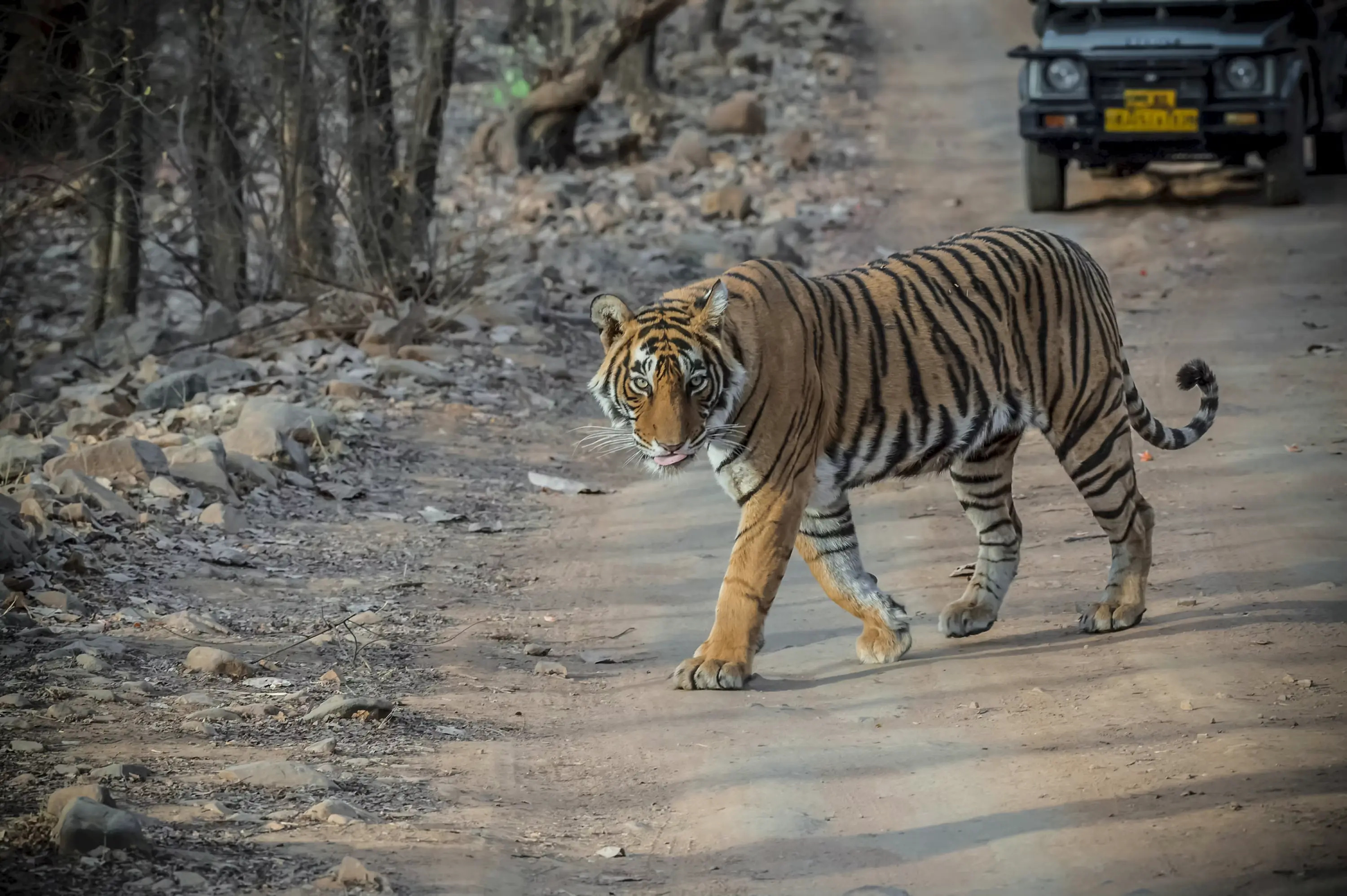
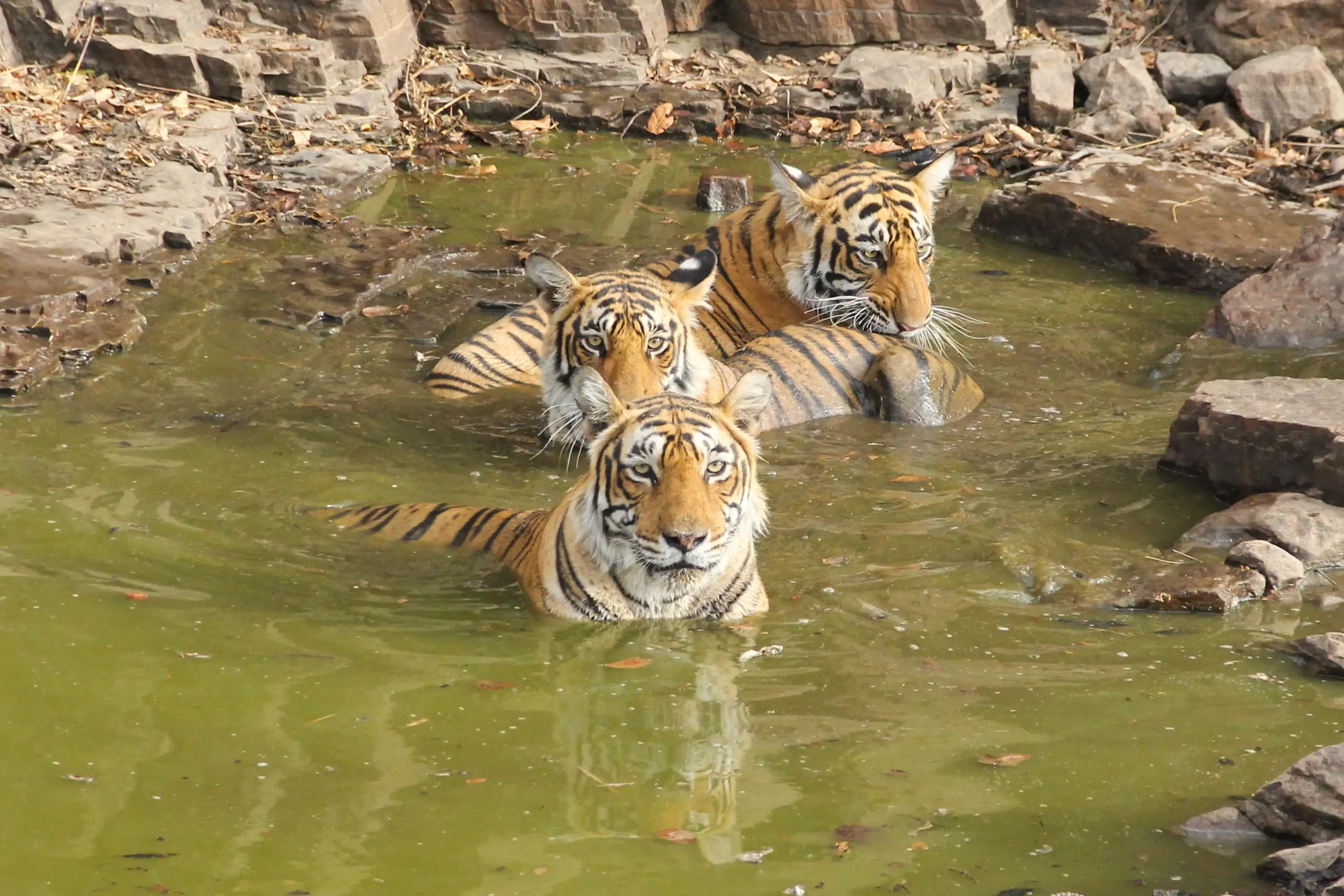
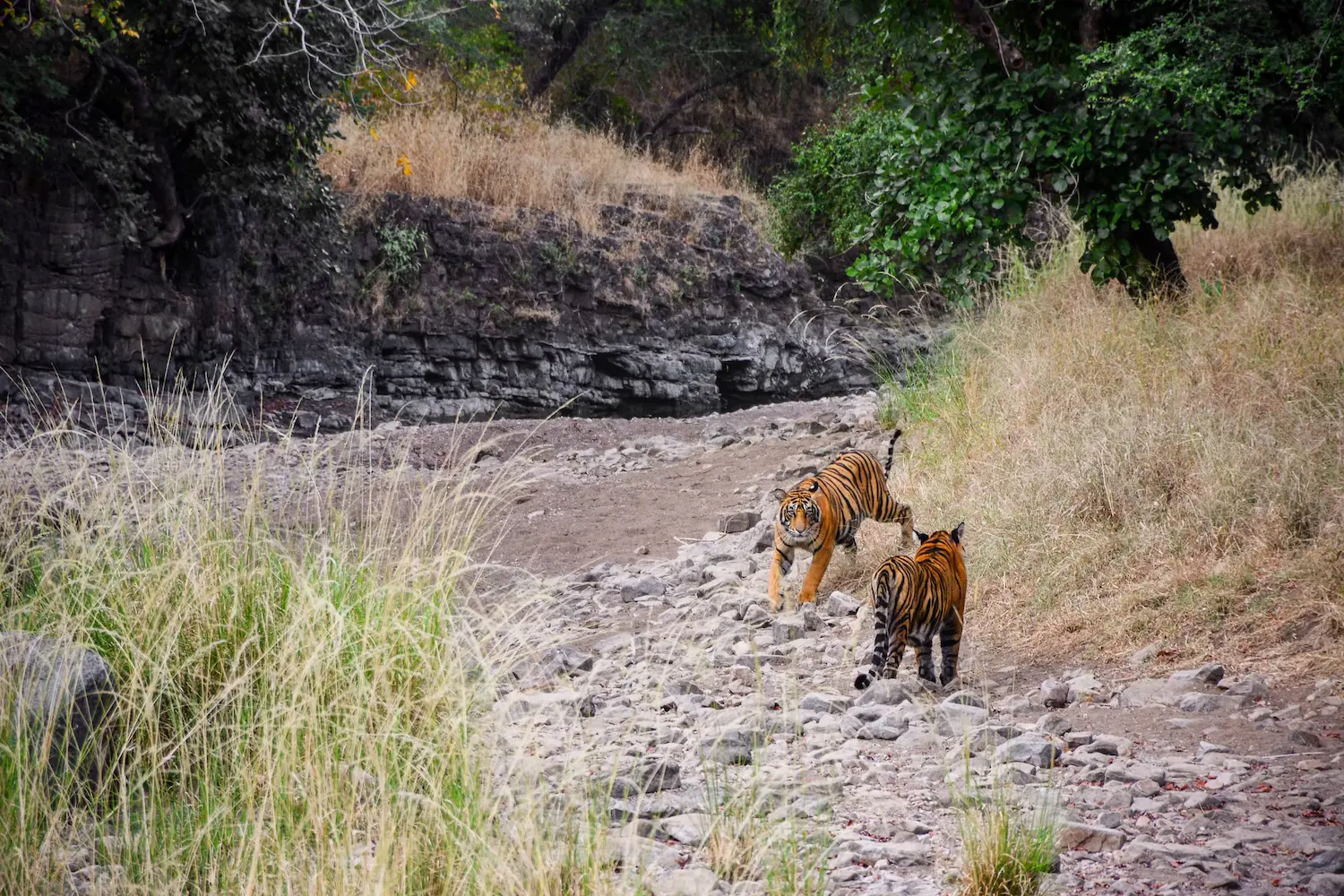
The tigress crossed the causeway of Padam Talao at a walk, unhurried, past the ruins of a red sandstone hunting pavilion that has stood on that same lakeshore for close to four centuries. Behind her, on the hill above, the ramparts of a fort a thousand years older still caught the first hard light of a Rajasthan morning. Nobody in our jeep reached for a camera immediately. For a few seconds it was simply too strange and too beautiful to interrupt — a wild tiger walking past a Mughal-era hunting lodge, beneath a fortress that had outlasted the empire that built it, in a landscape that felt less like a nature reserve than a set piece from a story too improbable to invent.
Ranthambore is unlike India's other major tiger reserves in one crucial way: nowhere else does the history loom quite this large over the wildlife. The 10th-century fort at its centre is a genuine UNESCO World Heritage Site in its own right, and the dry, open terrain around it makes for some of the most reliable tiger sightings anywhere in the country. It is also, we should say plainly upfront, the reserve most prone to booking confusion and tourist frustration — this guide covers both the magic and the practical minefield in equal measure.
A Fort Older Than the Forest's Modern Story
Ranthambore Fort's foundations were laid around 944 CE by the Chauhan king Sapaldaksha, and the fortress that grew from it — known in its time as Ranastambhapura, roughly "the city of the battle post" — became one of the most formidable strongholds in Rajasthan, second in scale only to Chittorgarh. Its most storied ruler, Hammir Dev Chauhan, held the fort against Alauddin Khilji's Delhi Sultanate army at the turn of the 14th century, a siege still recounted in Rajasthan as one of the defining tales of Rajput resistance. The fort changed hands repeatedly after that — Delhi Sultanate garrisons, the Sisodias of Mewar, the Hada Rajputs of Bundi, briefly Gujarat's Sultan Bahadur Shah — before Emperor Akbar's Mughal army took it after a month-long siege in 1568. It passed to the Kachwaha Maharajas of Jaipur in the 17th century and remained theirs until Indian independence, and Ranthambore Fort itself was formally recognised by UNESCO in 2013 as part of the serial World Heritage listing "Hill Forts of Rajasthan" — a genuine, fully inscribed heritage site, not merely a tentative nomination.
The forest around the fort tells a separate, more recent story. For most of the 20th century it served as the private hunting ground of the Jaipur royal family, a use that, paradoxically, kept the habitat largely intact until 1955, when it became the Sawai Madhopur Game Sanctuary. It joined Project Tiger in 1973, was declared a full national park in 1980, and later absorbed the neighbouring Sawai Mansingh and Keladevi sanctuaries to form today's 1,334-square-kilometre tiger reserve, though the national park core itself covers roughly 392 square kilometres. Ranthambore's most famous resident was Machli, the tigress who ruled the park for nearly two decades until her death in 2016 and became, by most accounts, the most photographed tiger in the world; her descendants still range across several of the park's zones today. In an unexpected 2025–26 development, cheetahs reintroduced at Kuno National Park in neighbouring Madhya Pradesh have begun wandering into and around Ranthambore, raising the unusual prospect of tigers, leopards, and cheetahs sharing the same landscape — something no other wild population on Earth currently does.
| Detail | Information |
|---|---|
|
Location |
Sawai Madhopur district, Rajasthan, at the Aravalli–Vindhya confluence |
|
Established |
Game sanctuary 1955; Project Tiger reserve 1973; national park 1980 |
|
Total reserve / core park area |
~1,334 sq km reserve / ~392 sq km national park |
|
Safari zones |
10 zones; 1–5 core, 6–10 buffer |
|
Ranthambore Fort |
10th-century Chauhan fort; UNESCO World Heritage Site (2013) |
|
Known for |
High tiger-sighting probability; Machli, the world's most photographed tigress |
|
Park open season |
1 October to 30 June; closed 1 July–30 Sept for monsoon |
|
Nearest railhead |
Sawai Madhopur, ~10 km from the park |
|
Nearest airport |
Jaipur, ~180 km / 3 hours by road |
Ranthambore — Essential Facts
RANTHAMBORE IS A TASTING MENU SERVED IN A THOUSAND-YEAR-OLD DINING ROOM — THE FORT AS THE SETTING, THE TIGER AS THE COURSE EVERYONE ACTUALLY CAME FOR.
Getting There
Sawai Madhopur is Ranthambore's gateway in every practical sense — a well-connected railway junction roughly ten kilometres from the park, on the Delhi–Mumbai main line, with direct trains from Delhi, Jaipur, Agra, and Mumbai making it the single easiest way in for most Indian travellers. Jaipur's airport, about 180 kilometres and three hours by road, is the nearest airport with meaningful flight connectivity, linking Ranthambore easily to a wider Rajasthan circuit through Jaipur, Udaipur, and Jodhpur. For travellers already routing through North India's Golden Triangle, Ranthambore sits a comfortable four-and-a-half-hour drive from Agra, making a Taj Mahal–to–tiger-safari combination entirely realistic within a single loop.
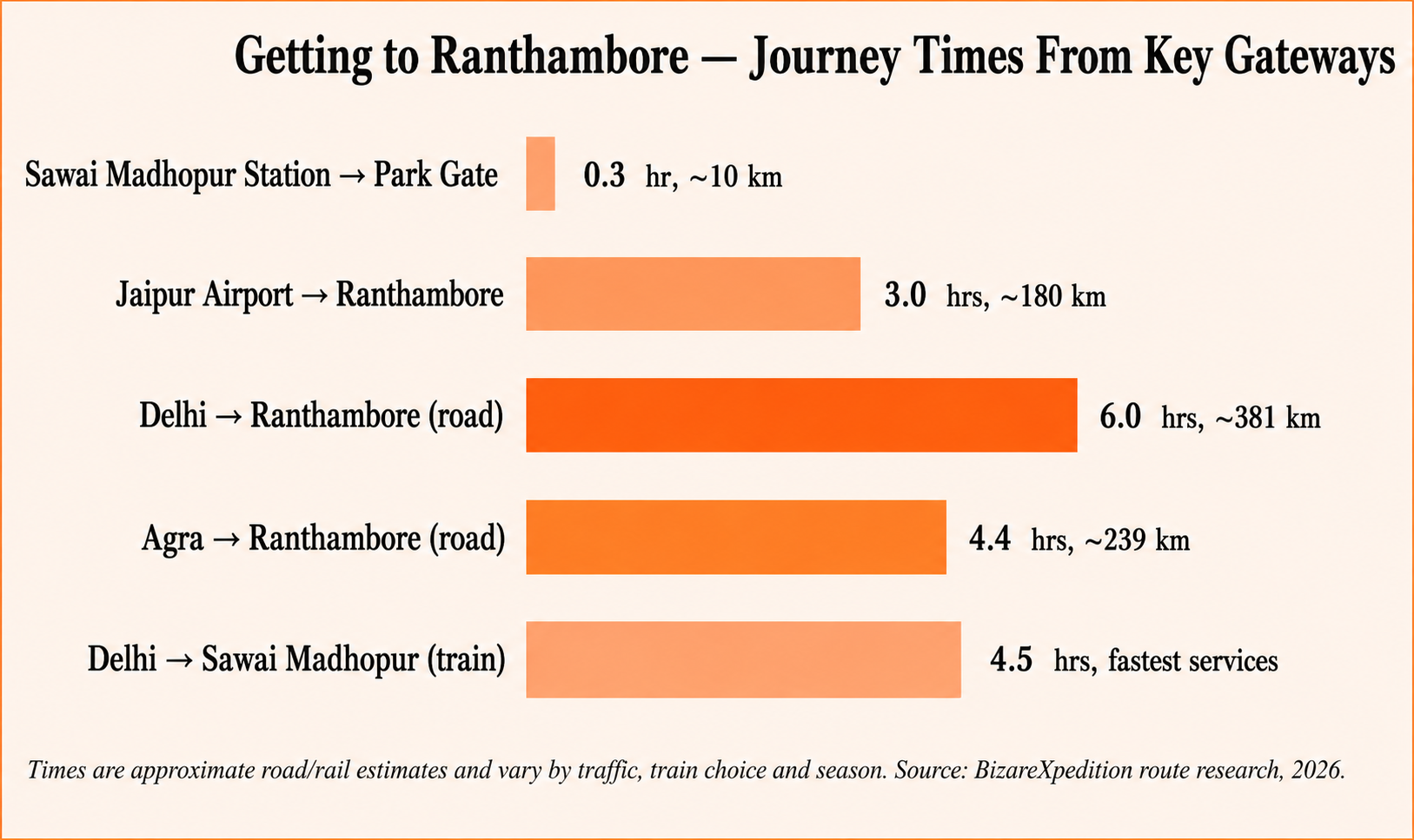
| Route | Distance | Approx. Time |
|---|---|---|
|
Sawai Madhopur Station → Park Gate |
~10 km |
20–30 min |
|
Jaipur Airport → Ranthambore |
~180 km |
3 hrs |
|
Delhi → Ranthambore (road) |
~381 km |
6 hrs |
|
Agra → Ranthambore (road) |
~239 km |
4.5 hrs |
|
Udaipur → Ranthambore (road) |
~388 km |
6+ hrs |
|
Delhi → Sawai Madhopur (train) |
~365 km |
4.5–5.5 hrs, fastest services |
Ranthambore — Route
Safari Zones — And the Booking System, Honestly
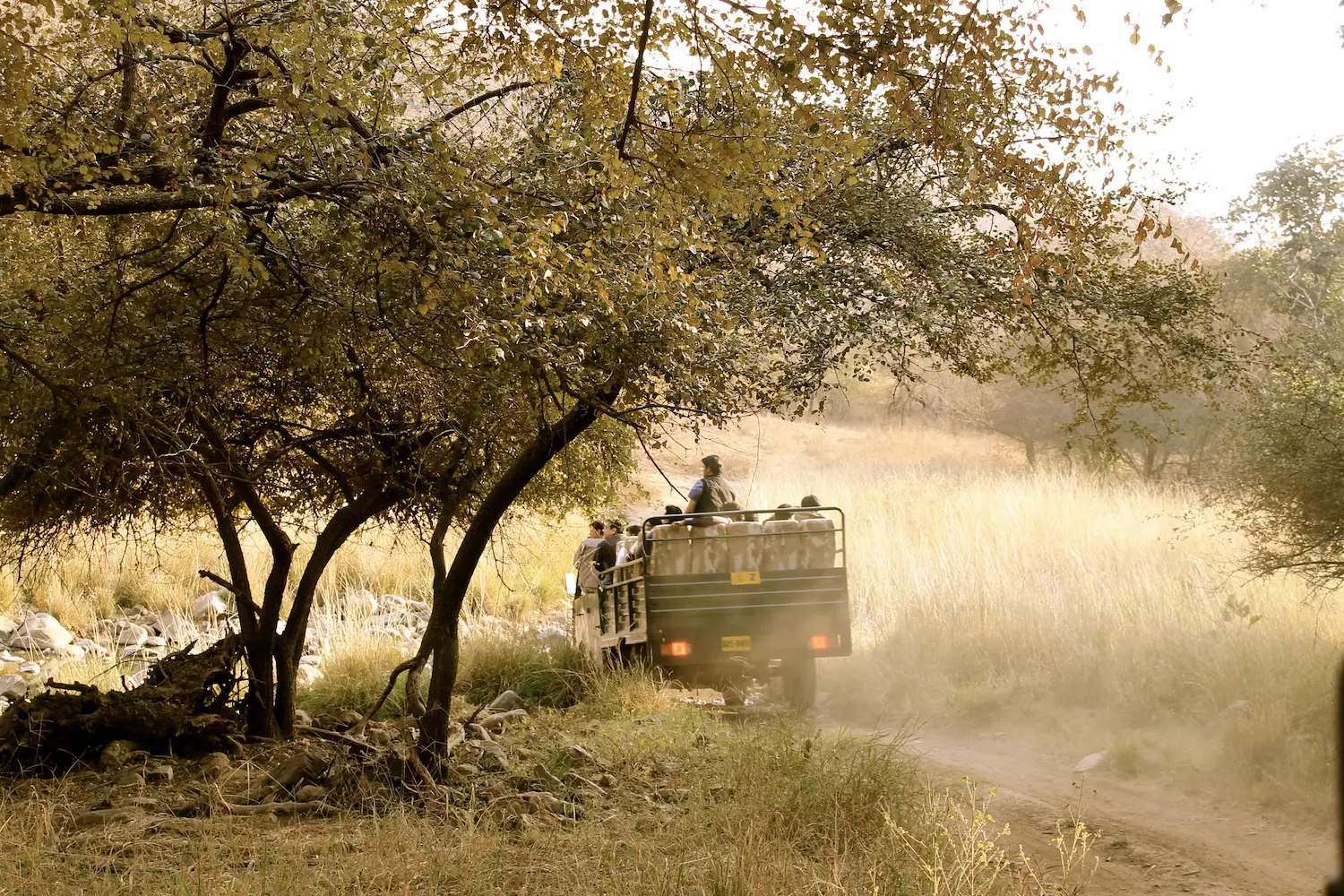
Ranthambore's tourism area is divided into ten numbered zones, five designated core (1–5) and five buffer (6–10), with zones 2, 3, and 4 generally regarded as the strongest for tiger sightings thanks to their lakes and denser resident tiger territories, though zones 1 and 6 through 10 all produce genuine sightings too. Two vehicle types operate: the six-seater open Gypsy jeep, preferred by photographers and couples for its manoeuvrability and closer access, and the twenty-seater open Canter, a considerably cheaper option better suited to larger groups, though permitted in every zone except 7 and 8. Both run two shifts daily, roughly sunrise to late morning and mid-afternoon to sunset, with exact timings shifting seasonally. Zones 1 through 5 close for safaris on Wednesdays, and zones 6 through 10 close on Tuesdays — worth checking against your travel dates before booking.
Here is the part most guides won't tell you plainly: booking a Ranthambore safari is genuinely more frustrating than at almost any other Indian tiger reserve. The official government portal, run by the Rajasthan Forest Department, has a long-standing reputation among travellers — Indian and international alike — for crashing, freezing, and rejecting valid international cards, and zone allocation can feel arbitrary even when the booking itself succeeds. A cottage industry of private booking websites has grown up around this frustration; most are legitimate resellers charging a service margin rather than outright scams, but a smaller number are unlicensed operators with no real accountability, and there have been genuine reports of payments taken with no ticket delivered. The single safest route is booking well ahead through a licensed, well-reviewed operator who can show a verifiable track record, or persevering with the official portal yourself and treating any successful booking as a small victory. Whichever route you take, never wire money to an unverified individual or a booking site with no clear company registration, and keep every payment confirmation and screenshot until your safari is actually completed.
| Zone Group | Zones | Character | Best For |
|---|---|---|---|
|
Core, strongest sightings |
2, 3, 4 |
Lakes, dense tiger territories |
First safari, best overall odds |
|
Core, solid sightings |
1, 5 |
Mixed terrain, fort views from some tracks |
Second safari, fort backdrop |
|
Buffer zones |
6, 7, 8, 9, 10 |
More variable, lighter crowds |
Additional safaris, better availability |
Ranthambore — Zone Group
BOOKING A RANTHAMBORE SAFARI IS LIKE ORDERING OFF A TASTING MENU WHERE THE KITCHEN OCCASIONALLY FORGETS YOUR ORDER EXISTS — WORTH THE TROUBLE, BUT BRING PATIENCE ALONG WITH YOUR APPETITE.
When to Go
Ranthambore operates from 1 October to 30 June, closing entirely through the monsoon. Winter, November through February, is the most comfortable season for visitors and the best for birdlife and photography light, though tigers can be harder to spot in the denser winter cover. Late March through June, as temperatures climb past 40°C and water sources shrink, is when most naturalists rate sighting probability at its genuine peak — animals concentrate visibly around the park's lakes, and Ranthambore's relatively open, dry deciduous terrain means visibility stays good even in the heat, unlike denser Central Indian forests. If a tiger sighting is your absolute priority and you can handle real heat, April and May are worth the discomfort.
| Season | Months | Typical Temp | Best For |
|---|---|---|---|
|
Winter |
Nov – Feb |
8°C to 27°C |
Comfortable safaris, birdlife, photography light |
|
Spring |
Mar |
15°C to 35°C |
Transitional; sightings improving |
|
Summer |
Apr – Jun |
25°C to 46°C |
Highest tiger-sighting probability, waterhole action |
|
Monsoon |
Jul – Sep |
— |
Park closed to tourism |
When to Go
Things to do at Ranthambore...
Book at least three to four safaris across two to three days. Given how much of the sighting outcome depends on zone allocation and simple luck, spreading your visit across multiple drives and, ideally, more than one zone meaningfully improves your odds over a single rushed safari.
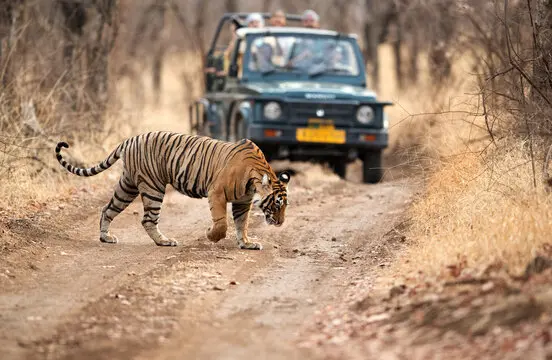
Choose the jeep over the canter if your budget allows. A six-seater Gypsy gets closer, moves faster to a sighting, and gives every passenger an actual view; a twenty-seater canter is considerably cheaper but crowded, and photographers in particular tend to regret the trade-off after the first drive.
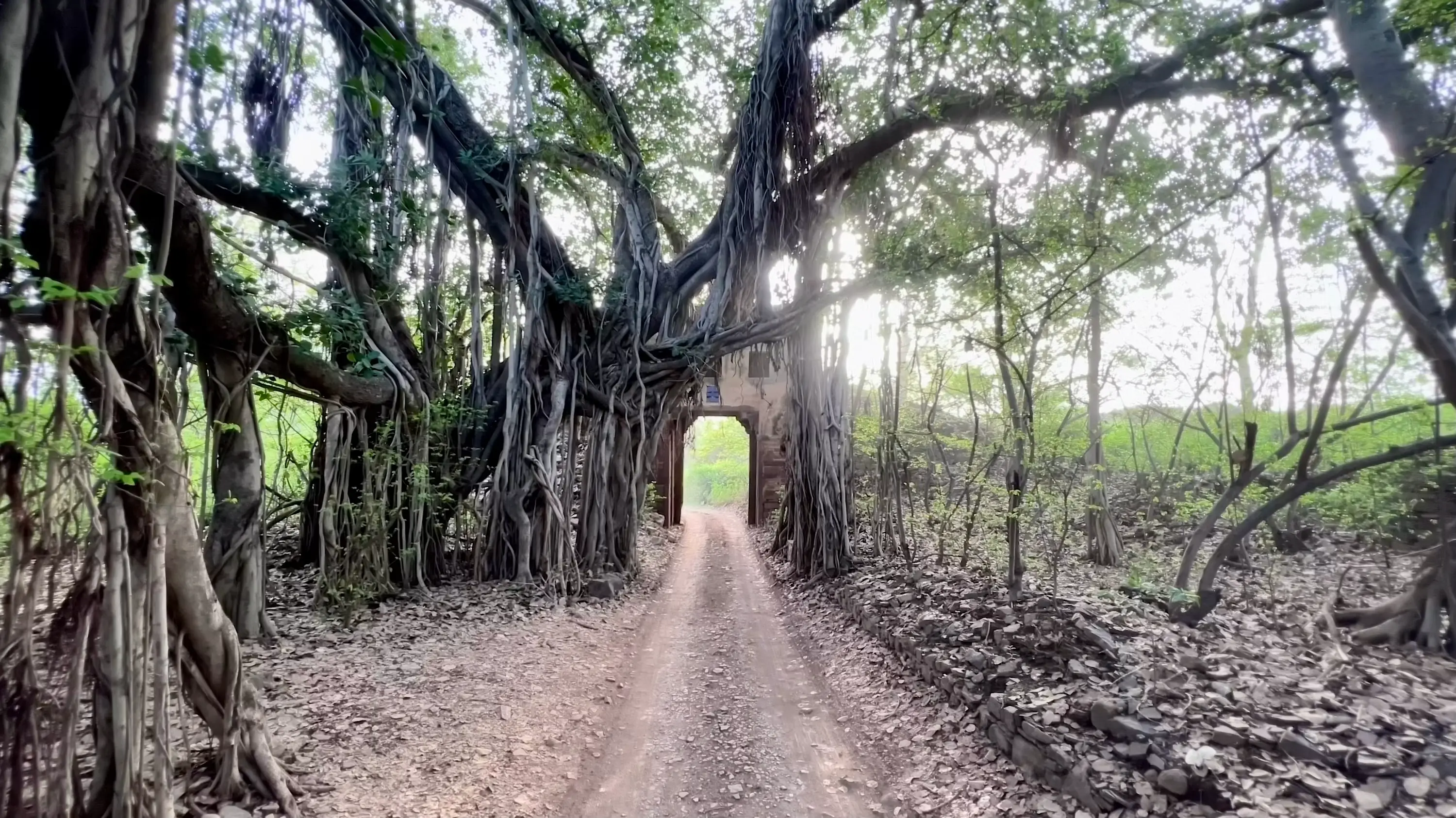
Visit Ranthambore Fort on a non-safari morning or afternoon. Entry to the fort itself is free and separate from the safari permit system, reached by a straightforward walk of about 1.5 kilometres from the Jogi Mahal entrance. The Trinetra Ganesh Temple inside, dedicated to a three-eyed depiction of Ganesha and built, by legend, under Hammir Dev Chauhan himself, remains an active pilgrimage site drawing devotees from across India, and the fort's ramparts give a sweeping view over the lakes and forest below.
Try the local Rajasthani kitchen beyond the hotel buffet. Dal baati churma — baked wheat rolls, spiced lentils, and a sweet crumbled-wheat dessert — is the dish to order at least once, alongside laal maas for those who eat meat and gatte ki sabzi, a gram-flour dumpling curry, for vegetarians. Small, well-reviewed local restaurants in Sawai Madhopur generally serve a more authentic version than hotel multi-cuisine menus.
Add a day trip to the Chambal Gharial Sanctuary if your schedule allows. A calmer boat excursion along the Chambal river, roughly a full day's outing, offers sightings of the critically endangered gharial crocodile alongside a wide range of waterbirds — a genuinely different pace from the safari circuit, worth building into a longer stay.
| Activity | Vehicle / Mode | Duration | Notes |
|---|---|---|---|
|
Core zone safari (1–5) |
Gypsy (6) or Canter (20) |
~3.5 hrs |
Strongest sighting odds, especially 2, 3, 4 |
|
Buffer zone safari (6–10) |
Gypsy or Canter (except 7, 8) |
~3.5 hrs |
More availability, variable sightings |
|
Ranthambore Fort visit |
On foot from Jogi Mahal gate |
2–3 hrs |
Free entry; separate from safari permit |
|
Chambal Gharial Sanctuary |
Boat excursion |
Full day |
Gharials, crocodiles, birdlife |
Ranthambore — Activity
Things not to do at Ranthambore...
Don't leave booking until the last minute, and don't panic if the official portal fights back. Book 60 to 90 days ahead for peak winter and summer dates, through the official Rajasthan Forest Department portal if you're comfortable navigating it, or through a licensed operator with genuine, verifiable reviews if you're not. Confirmed bookings are non-refundable and non-transferable, so double-check every visitor's ID details before submitting.
Don't wire money to an unverified reseller or an unusually pushy WhatsApp contact. Several private booking sites and individuals reach out proactively once you've searched or enquired online; some are legitimate resellers, but treat any request for payment outside a clear, traceable channel — and any operator who can't produce a real company name and registration — with real caution.
Don't assume a higher price guarantees a better zone. Zone allocation runs through the forest department's own system, and while a good, established operator can genuinely improve your odds through experience and timing, no legitimate booking can guarantee zones 2, 3, or 4 outright. Treat any operator promising a guaranteed prime zone or a guaranteed tiger sighting with real scepticism.
Don't tip a guide or driver for reckless, off-track, or overly aggressive driving toward a sighting. Tipping culture inside Ranthambore's vehicles can tip over into pressure for guides to chase alarm calls too fast or too close; reward calm, informative, rule-following guiding instead, and say so clearly if a driver is pushing the vehicle harder than feels safe or fair to the animal.
Don't skip travel insurance or underestimate the summer heat. April and May safaris in an open vehicle at 44°C-plus are genuinely gruelling; carry more water than feels necessary, protect your head and skin, and confirm your insurance covers rural Rajasthan if you're travelling internationally.
| Requirement | Detail |
|---|---|
|
Safari booking |
Official Rajasthan Forest Department portal, or a verified licensed operator, 60–90 days ahead |
|
ID required |
Government photo ID (passport for foreign nationals); details must match booking exactly |
|
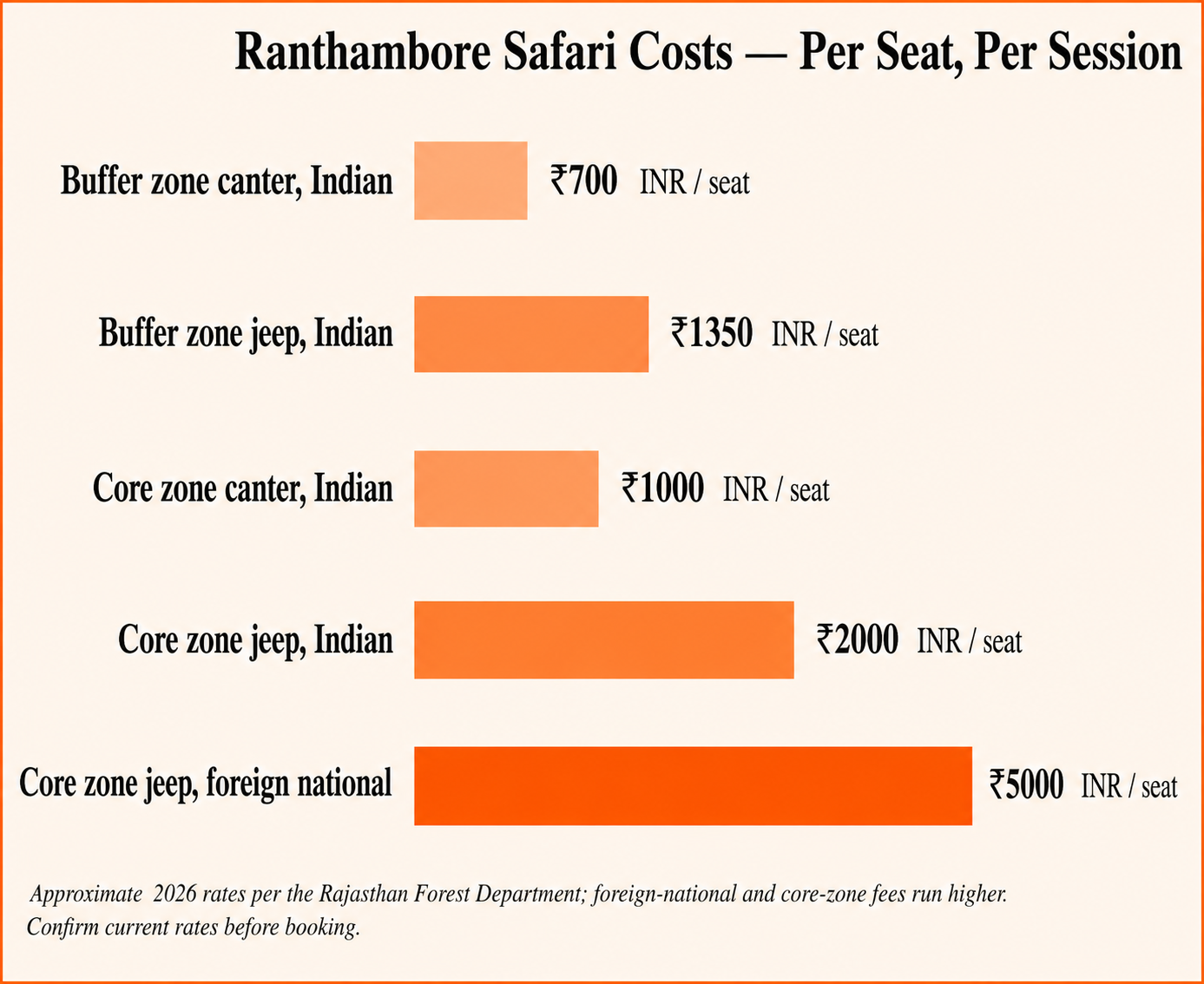
Safari fee (approx., per seat) |
Indian nationals ₹700–2,100 depending on zone/vehicle; foreign nationals roughly double to triple |
|
Park closure |
Closed 1 July–30 Sept; zones 1–5 closed Wednesdays, zones 6–10 closed Tuesdays |
|
Cancellations |
Confirmed safari bookings are non-refundable and non-transferable |
Ranthambore — Requirement
Where to Stay — From Simple Lodges to Royal Tents
Sawai Madhopur holds Ranthambore's full accommodation spectrum, from simple guesthouses to two of India's most celebrated luxury properties. The Oberoi Vanyavilas, with its royal-caravan-inspired luxury tents, and Aman-i-Khas, an ultra-exclusive seasonal camp, both sit at the very top of India's safari-lodge market and draw serious international travellers building Ranthambore into a dedicated leg of a longer India itinerary. The heritage-minded Sawai Madhopur Lodge, once an actual royal hunting lodge and now run under the Taj group, offers a genuine slice of that history at a more accessible (if still premium) price point, while a wide range of mid-range hotels and boutique jungle lodges fill in the space between budget guesthouses and the five-star tier.
| Category | Examples | Per Night (Couple) | Honest Note |
|---|---|---|---|
|
Budget guesthouse |
Family-run lodges, Sawai Madhopur |
₹2,500 – ₹4,500 |
Simple, functional, good value |
|
Mid-range hotel |
3-star properties near the park |
₹6,000 – ₹12,000 |
Reliable comfort, safari coordination |
|
Heritage/boutique |
Sawai Madhopur Lodge and similar |
₹15,000 – ₹28,000 |
Genuine royal history, strong service |
|
Ultra-luxury |
Oberoi Vanyavilas, Aman-i-Khas |
₹1,00,000+ |
Top-tier globally; seasonal, book far ahead |
Where to Stay
Travelling Ranthambore Responsibly
Carry a LifeStraw or similarly filtered bottle rather than accumulating single-use plastic across multiple safari days; most lodges now offer refill points. Inside the vehicle, insist on calm, rule-following driving regardless of how eager fellow passengers are for a closer sighting — Ranthambore's popularity puts real pressure on its tiger population, and every visitor who declines to reward reckless off-track driving helps keep that pressure in check. At the Trinetra Ganesh Temple and other active shrines inside the fort, dress and behave as you would at any working place of worship, not simply a photogenic ruin. Spend locally in Sawai Madhopur's markets and smaller restaurants rather than defaulting to hotel dining for every meal, and if you visit the Chambal Gharial Sanctuary, follow your boat guide's lead closely — the gharial population there remains critically endangered and easily disturbed.
Before you go...
Book your safari permits the moment your travel dates are fixed, and budget real patience for the booking process itself — this is the one Indian tiger reserve where we'd actively recommend paying a trusted operator's service fee rather than wrestling with the portal solo, unless you enjoy that sort of thing. Pack layers for winter dawn safaris and serious sun protection for a summer visit, carry cash for the rural stretches around Sawai Madhopur, and if you're travelling internationally, confirm your Indian e-Visa and rural-coverage travel insurance well ahead of departure.
| Checklist Item | Note |
|---|---|
|
Government photo ID / passport |
Carried on every safari; details must match booking exactly |
|
Safari permits booked |
60–90 days ahead via official portal or a verified licensed operator |
|
Layered clothing for winter |
Genuine warmth for pre-dawn winter safaris |
|
Sun protection for summer safaris |
Hat, sunscreen, extra water |
|
Binoculars and camera with zoom lens |
Standard cameras fine; drones strictly prohibited |
|
Payment confirmations saved |
Keep screenshots of every booking transaction until safari completion |
|
Travel insurance |
Confirm rural India coverage before departure |
Checklist Item
At BizareXpedition, our Himalayan roots in Haridwar don't stop us from loving a good desert tiger reserve — we build Ranthambore into North India itineraries with a genuine, verified safari booking handled on your behalf, enough drives across enough zones to make the odds work in your favour, and a proper visit to the fort itself, so the trip delivers both halves of what makes this reserve unlike any other in India.
Budget Guide
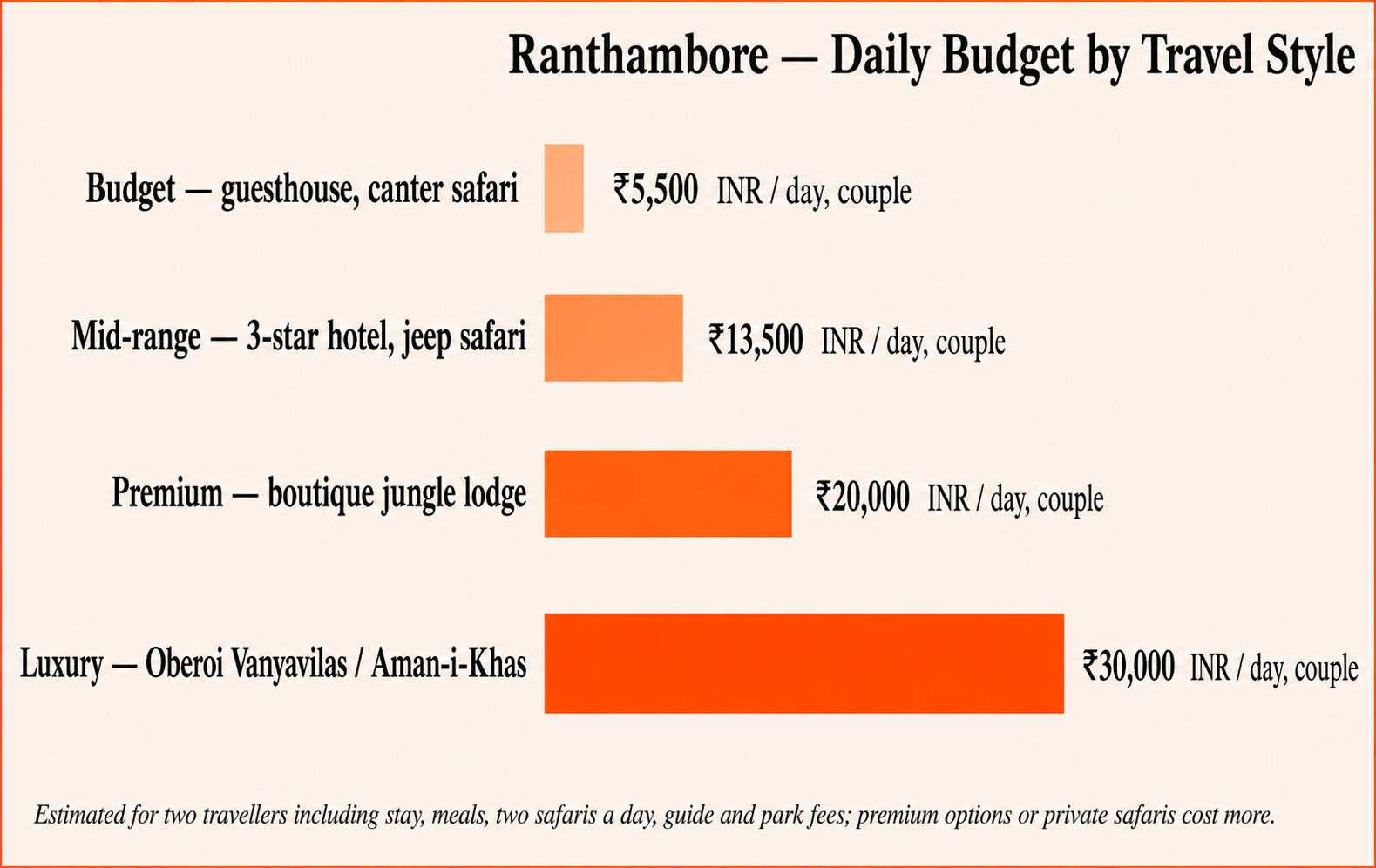
A comfortable three-night, four-safari Ranthambore trip in mid-range comfort typically runs between ₹35,000 and ₹55,000 per couple, inclusive of stay, meals, jeep safaris, and guide fees. Step into the heritage or boutique tier and the same trip climbs toward ₹80,000 to ₹1.2 lakh; the ultra-luxury tier at Oberoi Vanyavilas or Aman-i-Khas runs considerably higher again, reflecting genuinely world-class service and access.
| Style | Per Day (Couple) | 3-Night Total (approx.) |
|---|---|---|
|
Budget |
₹5,500 |
₹16,500 |
|
Mid-range |
₹13,000 |
₹39,000 |
|
Premium |
₹28,000 |
₹84,000 |
|
Luxury |
₹90,000+ |
₹2,70,000+ |
Budget Guide
Long after the safari jeep has rolled back through the gate, it isn't the booking frustration you remember, but a tigress walking past a four-hundred-year-old hunting pavilion beneath a thousand-year-old fort — proof, in one unhurried frame, of exactly how long this particular corner of Rajasthan has belonged to something wilder than any empire that tried to hold it.
Best Selling Tour Packages
Explore other exciting options for your next adventure!