
Gangtok Tour Packages
Gangtok Tour Packages
Gangtok tour packages from BizareXpedition are private, fully customised itineraries covering Sikkim's capital, the high-altitude Tsomgo Lake, and the Indo-China border crossing at Nathula Pass, with extensions into the remote Yumthang Valley — planned entirely around your dates, pace, and comfort with altitude, and with no group coaches or fixed departures involved. Whether you're chasing snow at 14,000 feet, a peaceful monastery visit, or a honeymoon somewhere genuinely different from the usual hill-station circuit, your Gangtok trip is built only for you, with one vehicle, one driver, and one itinerary.
Gangtok sits in the Eastern Himalayas as the capital of Sikkim, a state that quietly does things differently from the rest of India — it was India's first fully organic state, its Buddhist monasteries sit alongside Hindu temples without friction, and its mountain views rival anything in Nepal or Bhutan without requiring an international border crossing. Most travellers treat Gangtok as a brief stop before rushing to Nathula Pass and back. That's a missed opportunity — the city itself, its ropeway views, its market street, and its monasteries reward a proper day of unhurried exploring before you head into the high mountains. BizareXpedition's local guides and drivers know the permit process, the altitude pacing, and the exact viewpoints that make a Sikkim trip memorable rather than just a checklist of passes.
This page covers what a Gangtok tour actually costs, how to get here, what to see, when to visit, what the weather will do to your plans, and what to eat while you're at it — explained plainly, the way we'd brief a friend before their trip.
Gangtok Tour Package Pricing — What It Actually Costs
Direct answer: A private Gangtok tour package with BizareXpedition typically ranges from roughly ₹7,500 to ₹11,000 per person per day in the Premium tier, ₹16,000–₹19,000 in the Luxury tier, and ₹25,000 and above per person per day in the Ultra-Luxury tier, depending on hotel category, vehicle type, group size, and whether Nathula Pass or a North Sikkim (Lachung-Yumthang) extension is included.
Here's what actually moves that number. A 3-night Gangtok-only trip for a couple, staying in a comfortable 3–4 star property with a private SUV and driver (SUVs are mandatory for the hill terrain and permit checkpoints, not optional here), sits at the lower end of the Premium band — the core cost is the vehicle, driver, and a Tsomgo Lake and Nathula Pass day trip, which requires special permits that we arrange in advance on your behalf. Extending into North Sikkim for Yumthang Valley and Lachung (roughly 2–3 additional nights) increases the per-day average because North Sikkim requires a separate protected-area permit, dedicated local vehicles beyond a certain point, and higher-altitude accommodation, all of which cost more to arrange properly. Families and small groups sharing a larger SUV or Urbania-style vehicle tend to land in the mid-Premium to Luxury range as vehicle costs spread across more travellers. Anyone requesting a Pelling or Darjeeling extension for a fuller Eastern Himalayan circuit, or 5-star mountain-view resort stays, naturally moves into Luxury or Ultra-Luxury — that's where the trip shifts from a Sikkim visit to a genuinely comprehensive Eastern Himalayan experience.
| Package Tier | Best Suited For | Typical Per-Person/Day Range* | What Sets It Apart |
|---|---|---|---|
|
Premium |
Couples, solo travellers, focused Gangtok-Nathula visits |
₹7,500 – ₹11,000 |
Comfortable 3–4 star stays, private SUV, Tsomgo Lake and Nathula Pass day trip with permits handled |
|
Luxury |
Families, honeymooners, North Sikkim explorers |
₹16,000 – ₹19,000 |
4–5 star properties, extended Lachung-Yumthang Valley circuit, dedicated local expert guide |
|
Ultra-Luxur |
Travellers wanting a full Eastern Himalayan circuit |
₹25,000+ |
5-star mountain-view resorts, Pelling/Darjeeling extensions, priority permit processing |
Gangtok Tour Package Pricing
What's always included, across every tier: private airport/railway station pickup and drop, a dedicated SUV and driver for the full duration (essential given Sikkim's hill roads), daily breakfast, all required Inner Line and Protected Area Permits for Nathula Pass and North Sikkim arranged on your behalf, and a day-wise itinerary paced around altitude and comfort. What's quoted separately and transparently: monastery or monument entry where applicable, meals beyond breakfast, and optional extensions to Pelling, Darjeeling, or deeper North Sikkim circuits.
How to Reach Gangtok
Gangtok is reachable by air via Pakyong Airport (PYG), Sikkim's own airport roughly 35 km away, or the larger Bagdogra Airport (IXB) roughly 124 km away, by train via New Jalpaiguri (NJP) railway station roughly 125 km away, and by road via NH10, which connects Gangtok to Siliguri and the wider North East India network.
A few practical notes that actually matter when you're planning:
By Air: Pakyong Airport, opened in 2018, is Sikkim's own airport and the closer option when flights are operating, though weather-related cancellations are more common here than at larger airports — Bagdogra remains the more reliable fallback. BizareXpedition arranges private pickup from either airport so your Gangtok trip begins the moment you land.
By Train: New Jalpaiguri is the nearest major railway station, well connected to Delhi, Kolkata, and other major cities, followed by a scenic 4–5 hour drive up into the hills to Gangtok.
By Road: NH10 connects Gangtok to Siliguri and Darjeeling, making it easy to combine Sikkim with a wider North East India or Darjeeling-hills itinerary. We arrange a private one-way drop or pickup so your Gangtok leg links seamlessly with the rest of your trip.
Permits matter here: Both Nathula Pass and North Sikkim (Lachung, Lachen, Yumthang Valley) require special Protected Area and Inner Line Permits, arranged through registered tour operators rather than independently by travellers. BizareXpedition handles this process as a standard part of every Gangtok package, so you don't need to navigate it yourself.
Best Places to Visit in and Around Gangtok
The essential Gangtok experience covers MG Marg, the Gangtok Ropeway, and Rumtek Monastery within the city, plus the high-altitude Tsomgo (Changu) Lake and Nathula Pass (roughly 55 km and 2–3 hours away), with an optional extension to Yumthang Valley in North Sikkim (roughly 150 km, requiring an overnight stay in Lachung).
Within Gangtok city:
MG Marg — Gangtok's pedestrian-only main street, lined with cafés, shops, and colourful buildings, and one of the cleanest, most relaxed city streets in India. A genuinely pleasant evening stroll.
Rumtek Monastery — one of the largest and most significant Buddhist monasteries in Sikkim, seat of the Kagyu lineage, with striking architecture and, on the right day, the sound of monks in prayer.
Gangtok Ropeway — a cable car offering sweeping views over the city and, on clear days, the surrounding Himalayan ridgelines; a quick, worthwhile addition to any city itinerary.
Tashi View Point — a popular spot for views of Mount Kanchenjunga on clear mornings, best visited early before clouds roll in.
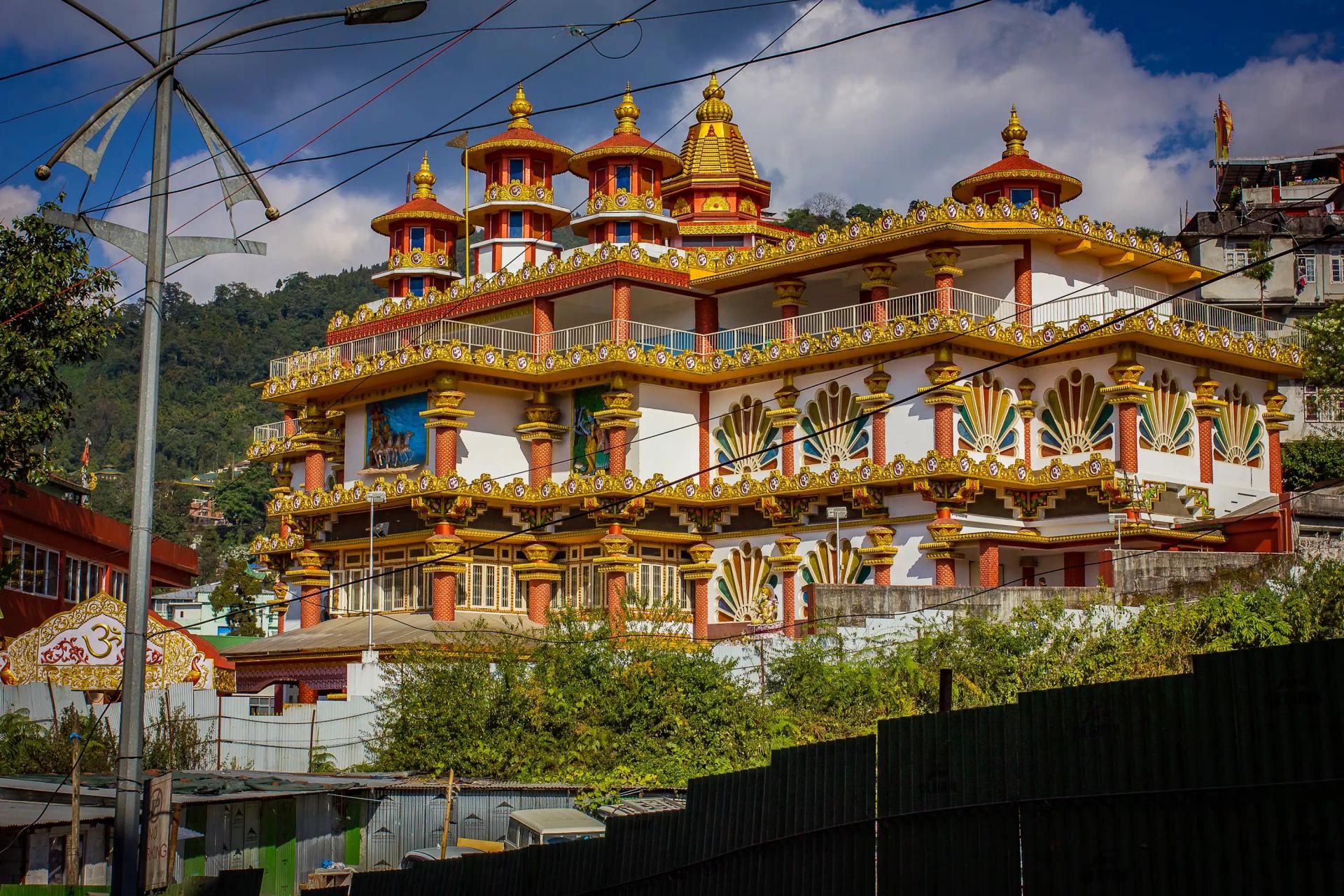
Enchey Monastery & Ganesh Tok / Hanuman Tok — a cluster of smaller monasteries and viewpoints around the city, easy to combine into a half-day heritage circuit.
Namgyal Institute of Tibetology — a research institute and museum housing a genuinely significant collection of Tibetan Buddhist manuscripts, art, and artefacts, worth an hour for anyone interested in the region's culture.
Day trips and extensions we build into most itineraries:
Tsomgo (Changu) Lake & Nathula Pass — a glacial lake at roughly 12,400 feet, often frozen in winter, followed by the Indo-China border crossing at Nathula Pass at over 14,000 feet — genuinely one of the most dramatic single-day excursions available anywhere in India. Both require permits, which we arrange in advance.
Yumthang Valley ("Valley of Flowers") — in North Sikkim near Lachung, this high-altitude valley is spectacular with rhododendrons in bloom (roughly April–May) and equally striking under snow in winter. Best as a 2–3 night extension given the drive and permit requirements.
Pelling & Darjeeling — for travellers with more time, Pelling offers Kanchenjunga views and Pemayangtse Monastery, while Darjeeling adds its famous tea estates and toy train — both worthwhile additions to a fuller Eastern Himalayan circuit.
Best Time to Visit Gangtok
The best time to visit Gangtok is between March and June, and again from September to mid-December, when clear skies offer the best mountain views and Nathula Pass remains accessible — winter (December to February) brings snow and dramatic scenery but higher closure risk at high-altitude passes.
Spring (March to May) brings blooming rhododendrons, especially valuable if you're extending to Yumthang Valley, while autumn (September to November) offers the clearest, haze-free mountain visibility of the year — many photographers consider this the single best window. Winter is genuinely beautiful, with snow at Tsomgo Lake and Nathula Pass drawing visitors specifically for that experience, but road closures due to snowfall are common and itineraries need extra flexibility built in. Monsoon (June to August) brings heavy rainfall and a real risk of landslides on the hill roads, making it the one period we'd actively steer most travellers away from.
Gangtok Weather Guide
| Season | Months | Temperature Range | What to Expect |
|---|---|---|---|
|
Spring/Best time |
Mar – Jun |
10°C – 22°C |
Clear skies, blooming rhododendrons, ideal for Nathula and Yumthang |
|
Autumn/Best time |
Sep – mid-Dec |
5°C – 18°C |
Clearest mountain visibility of the year, cool and pleasant |
|
Winter |
Dec – Feb |
-5°C – 12°C |
Snow at high altitude, dramatic scenery, higher risk of pass closures |
|
Monsoon |
Jun – Aug |
15°C – 24°C |
Heavy rainfall, landslide risk on hill roads; generally best avoided |
Gangtok Weather Guide
Pack serious cold-weather layers year-round for high-altitude excursions like Nathula Pass and Yumthang Valley, regardless of the season in Gangtok city itself — temperatures drop sharply with elevation, often 15–20°C colder than the city.
What to Eat in Gangtok — A Food Guide Worth Planning Around
Gangtok's food identity centres on momos and thukpa as its defining comfort foods, alongside distinctly Sikkimese dishes like gundruk (fermented leafy greens) and chhurpi (fermented yak or cow cheese), reflecting the state's blend of Tibetan, Nepali, and indigenous Lepcha and Bhutia culinary traditions.
Momos here are treated with real seriousness — steamed or fried dumplings filled with vegetables, pork, chicken, or cheese, served with a distinctive, often fiery chutney that varies from stall to stall. Thukpa, a hearty Tibetan noodle soup, is the natural companion on Gangtok's cool evenings and a genuine comfort food staple across the city. Beyond these familiar favourites, Sikkim's own food traditions are worth actively seeking out: gundruk (fermented, dried leafy greens, often made into a soup or side), sinki (a fermented radish preparation), and chhurpi (a hard or soft fermented dairy product, sometimes eaten as a chewy snack) all reflect a mountain food culture built around preservation and fermentation, distinct from anything you'd find in mainland India.
| Meal/Item | What to Try | Where It Shines |
|---|---|---|
|
Comfort food |
Momos, thukpa |
MG Marg cafés and local eateries |
|
Sikkimese specialty |
Gundruk, sinki, chhurpi |
Local Sikkimese restaurants |
|
Drink |
Temi Tea, butter tea |
MG Marg cafés, Temi Tea Estate |
|
Everyday meal |
Dal-rice, millet dishes |
Local family-run eateries |
Gangtok What to Eat
Sikkim is also home to Temi Tea Estate, the state's only tea garden and a source of genuinely well-regarded organic tea — worth picking up as a souvenir or visiting directly if your itinerary allows. Local millet-based dishes and simple, warming dal-rice combinations round out the everyday eating experience, and MG Marg's cafés offer a good mix of local Sikkimese food alongside more familiar options for travellers easing into the cuisine.
We build a food-focused evening into most Luxury and Ultra-Luxury Gangtok itineraries on request — a guided momo-and-thukpa crawl along MG Marg, with a proper introduction to gundruk and chhurpi for travellers curious about Sikkim's more distinctive flavours.
Why a Private Gangtok Tour, Not a Group One
Sikkim's high-altitude terrain and permit-dependent routes reward flexibility in ways a fixed-departure coach simply can't offer — a Nathula Pass trip needs to align with weather and permit clearance, and altitude acclimatisation is genuinely individual, not something a group schedule can accommodate for everyone equally. BizareXpedition doesn't run group coaches or shared departures for Gangtok, or anywhere else. Every itinerary is built around your dates, your pace, and your comfort with altitude and cold, with a private SUV, driver, and all required permits arranged in advance — so weather delays or a slower acclimatisation day never has to be negotiated with strangers on a bus.
This is the same standard BizareXpedition applies across its Himalayan pilgrimage tours, honeymoon packages, and heritage circuits nationwide — private planning, transparent tiered pricing, and a team recognised in Business Standard, Outlook Traveller, The Hindu, and ET Travel for exactly this approach to travel.
Ready to plan your Gangtok trip?
Tell us your dates, group size, and what matters most to you — Nathula Pass, North Sikkim's valleys, monasteries, or all three — and we'll send a custom day-wise itinerary and quote within 24 hours.
Frequently Asked Questions (FAQs) & People Also Ask — gangtok Tour Packages
We help you prepare for your trip and ensure an effortless and enjoyable travel experience.