
Meghalaya Tour Packages
Meghalaya Tour Packages
There's a photograph that breaks the internet every few months. A small wooden boat drifting over water so impossibly clear you'd swear it was floating on glass. Below the hull, the riverbed is visible in full detail — pebbles, sand, the shadows of fish. That's the Umngot River at Dawki, Meghalaya. And if that image is what led you here, you made a good instinct.
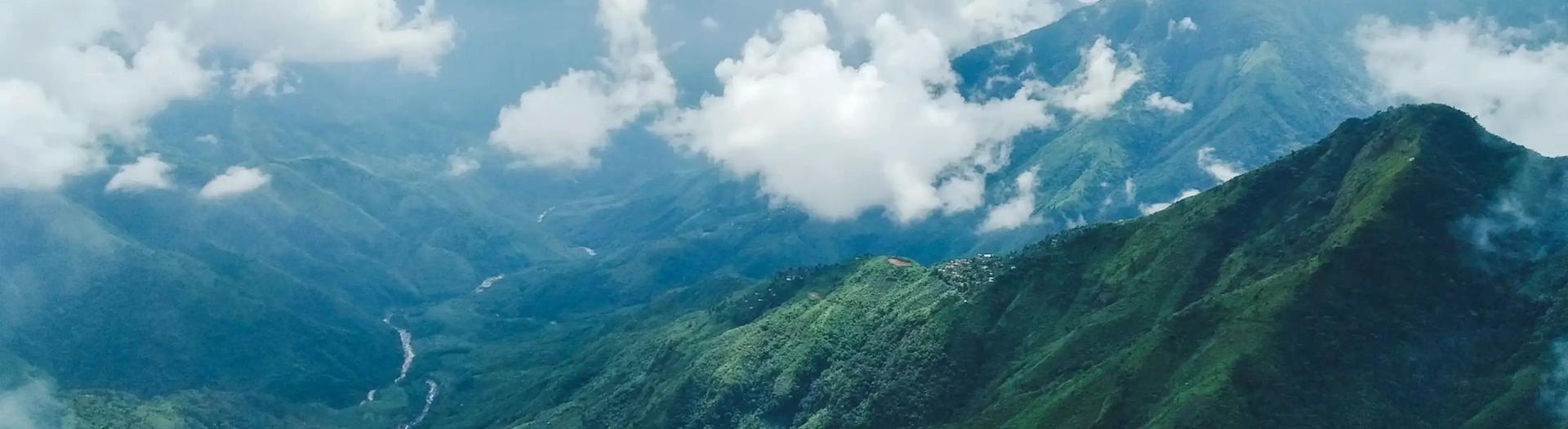
Meghalaya — the name translates from Sanskrit as "Abode of Clouds" — sits in Northeast India, sharing its borders with Assam and Bangladesh. It's a state that holds a genuinely absurd number of superlatives: the wettest place on earth, Asia's cleanest village, the world's longest natural cave systems, living bridges grown from tree roots across centuries. What it doesn't have is the tourist crowds most places this remarkable would have accumulated by now.
That's still changing. But right now, in 2025-26, Meghalaya is at that rare window in a destination's life where infrastructure has improved enough to be comfortable, but the roads aren't yet lined with souvenir shops every 10 meters. BizareXpedition built this guide for travelers who want to understand what they're walking into before booking their Meghalaya tour package — not just a list of waterfalls, but the full context.
What Makes Meghalaya Different from Every Other Northeast India Destination?
Meghalaya stands apart because it combines otherworldly landscapes with a living indigenous culture that hasn't been diluted into a museum exhibit — and does this in a geography so extreme (some areas receive over 11,000 mm of rainfall annually) that the land itself feels like a different planet. No other Indian state has living root bridges, a matrilineal society, and a claim to the wettest place on earth simultaneously.
The state is divided culturally and geographically into three broad regions based on its major tribal communities:
Khasi Hills — home to the Khasi tribe, centered around Shillong, Cherrapunji, Mawlynnong, and Dawki
Jaintia Hills (East Khasi Hills / Ri-Bhoi) — home to the Pnar (Jaintia) people, with the Krang Suri Falls, limestone caves, and the Nartiang monoliths
Garo Hills — home to the Garo tribe in western Meghalaya, with Nokrek National Park, Balpakram, and Tura town
Most short Meghalaya tour packages (4-6 days) cover the Khasi Hills circuit. A complete Meghalaya trip (8-10 days) reaches all three regions.
Top Places to Visit in Meghalaya
Shillong — The Scotland of the East
Shillong is Meghalaya's capital and most travelers' base for the state. The colonial nickname "Scotland of the East" comes from its rolling pine-covered hills, pleasant colonial-era architecture, and cooler temperatures — though the city has long since grown beyond Victorian-era lanes into a busy, music-infused, surprisingly cosmopolitan hill town.
Key stops in and around Shillong:
Ward's Lake — A colonial-era boating lake in the city center, surrounded by manicured gardens. Best for a leisurely morning start to the day.
Don Bosco Museum — Arguably Shillong's most substantive attraction: a seven-story museum dedicated to the indigenous peoples of Northeast India, with one of Asia's most comprehensive collections of tribal artifacts, textiles, and interactive exhibits. Budget at least 2-3 hours here.
Elephant Falls — A three-tiered waterfall about 12 km from Shillong, named by the British after an elephant-shaped rock (since destroyed by an earthquake). Still beautiful, still worth the quick detour.
Umiam Lake (Barapani) — A large reservoir about 15 km from Shillong on the Guwahati highway, surrounded by forested hills. Good for a sunset stop and water sports.
Laitlum Canyon — Translating roughly as "End of Hills," this viewpoint about 25 km from Shillong offers canyon views that most travelers don't expect to find in Meghalaya. Far fewer crowds than the main waterfall circuit.
Mawphlang Sacred Forest — An ancient forest preserved under Khasi sacred grove tradition (Law Kyntang), where nothing — not a leaf, not a stone — may be removed. Guided walks here cover both ecology and oral tradition.
Cherrapunji (Sohra) — The Wettest Landscape on Earth
Cherrapunji — locally and increasingly officially called Sohra — sits about 54 km from Shillong at an elevation of around 1,430 meters. For decades it traded the record for world's wettest place with its neighbor Mawsynram (just 15 km away). Between them, these two locations receive rainfall that makes everywhere else look like a desert by comparison.
Mawsynram recorded an average annual rainfall of 11,871 mm, while Cherrapunji has recorded single-month totals that exceed most cities' annual figures.
What this produces, over millennia, is a landscape of relentless green — moss-covered cliffs, valleys perpetually wrapped in cloud, waterfalls that appear from everywhere when the rains arrive and linger long after.
Must-visit around Cherrapunji:
Nohkalikai Falls — The 4th highest waterfall in the world at approximately 340 meters, plunging into a green pool at the base. Most dramatic from August to October when water volume is at its peak. Named after a tragic local legend about a woman called Ka Likai.
Mawsmai Cave — A limestone cave system with impressive stalactite and stalagmite formations, walkable for roughly 150 meters in a loop. Accessible for non-cavers; good introduction to Meghalaya's cave landscape.
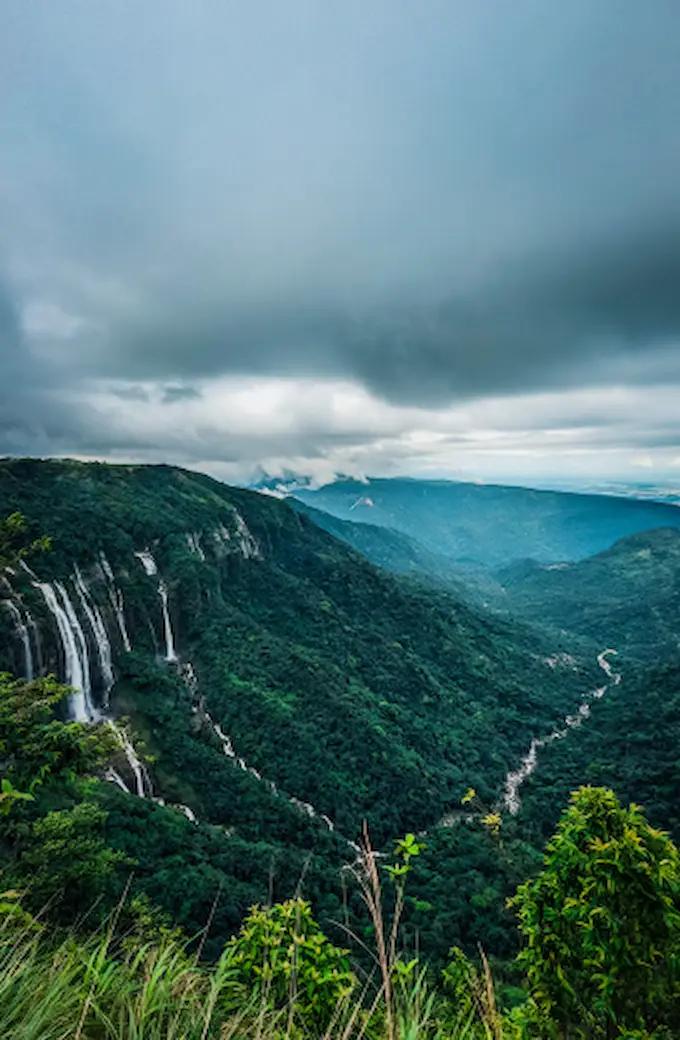
Seven Sisters Falls (Nohsngithiang Falls) — A segmented waterfall that fans into seven distinct streams over a wide cliff face during heavy rainfall. Best visibility in monsoon and post-monsoon.
Eco Park Sohra — A viewpoint complex with views across the Bangladesh plains from the cliff edge — on clear days (typically October to February) the view extends for extraordinary distances.
Arwah Cave and Garden of Caves — Less visited than Mawsmai, with longer passages and fossil formations; worth the extra effort.
Honest Note on Cherrapunji Timing: Visiting Cherrapunji during heavy monsoon is visually dramatic but operationally challenging — roads can wash out, and cloud cover can reduce visibility at falls to near zero for days at a time. The optimal balance is September–November, when rainfall has eased but the landscape is still lush and waterfall volumes are high.
Nongriat and the Double Decker Living Root Bridge
The Double Decker Living Root Bridge at Nongriat is the single most remarkable thing in Meghalaya, and that's saying something given the competition.
The Khasi people have been training the aerial roots of the Ficus elastica (rubber fig tree) across streams for generations — weaving, guiding, and waiting for the roots to take hold and strengthen into fully load-bearing bridges. The process takes 10-15 years to produce a usable bridge and another decade or two to reach full strength. The oldest root bridges in Meghalaya are estimated to be over 500 years old.
The Double Decker at Nongriat is exactly what it sounds like — two root bridges stacked vertically, spanning the same stream at different heights. Getting there requires descending roughly 3,500 stone steps from the village of Tyrna (about 45 minutes by road from Cherrapunji), crossing the bridges, and climbing back up. The round trip takes 4-6 hours depending on pace and fitness.
It is physically demanding. It is also, without exaggeration, one of the most memorable things you can do in India.
Trekking Note: The Nongriat hike is NOT recommended for individuals with serious knee problems — the stone steps are steep and the descent is harder on the joints than the ascent. Start early (by 7 AM from Tyrna) to avoid midday heat and afternoon cloud cover that can reduce the experience. Carry at least 2 liters of water per person.
Mawlynnong — Asia's Cleanest Village
About 90 km from Shillong near the Bangladesh border, Mawlynnong earned the title "Asia's Cleanest Village" from a magazine ranking in 2003, and the community has treated it not as a tourism hook but as a genuine standard to maintain. Bamboo dustbins appear at regular intervals on every path. Littering isn't just socially unacceptable here — it creates immediate community disapproval.
The village itself is small and genuinely picturesque — neat bamboo homes, flowering pathways, a balancing rock formation, and a sky walk overlooking the Bangladesh flatlands. It pairs naturally with a visit to the single-decker living root bridge here (a shorter, easier version of the Nongriat experience) and the nearby Dawki river.
Dawki and the Umngot River — The Glass River
Dawki is a small town about 95 km from Shillong on the Bangladesh border, and the Umngot River that flows through it is the photograph you've seen.
The river's extraordinary clarity is a function of two things: the minimal development and agriculture along its upper catchment, and the particular geology of the limestone plateau that filters the water before it reaches Dawki. The clarity peaks between November and April when rainfall is low and the river runs shallow enough for the riverbed to be fully visible even at depth.
Boat rides on the Umngot — either a coracle (round wicker boat) or a flat-bottom wooden boat — are the main activity. The rides are unhurried and the stillness is remarkable. Border trade between India and Bangladesh happens just downstream at the Dawki Land Port.
Avoid Dawki between June and September — monsoon rainfall muddies the Umngot completely and the famous clarity disappears entirely. The photographs you've seen only exist because someone went between November and April.
Jaintia Hills — The Road Less Taken
The Jaintia Hills region sits east of Shillong and is still significantly under-visited compared to the Khasi Hills circuit. It rewards travelers with longer itineraries.
Krang Suri Falls — Often cited as Meghalaya's most beautiful waterfall for its turquoise pool and swimming possibilities (accessible outside monsoon season). About 180 km from Shillong.
Nartiang — Contains the world's largest collection of monoliths, erected by the Jaintia kings as memorials or markers of royal events. Quietly extraordinary in their scale and number.
Syndai Caves — Part of the vast limestone cave system that makes Meghalaya one of the world's premier caving destinations; longer passages requiring permits and guides.
Garo Hills — For Travelers Who Want the Whole Picture
Tura, the main town in Garo Hills, is about 220 km from Shillong — a long drive on mountain roads. The payoff is a completely different cultural experience (Garo culture is distinct from Khasi and Jaintia in music, dress, and traditions) and access to:
Nokrek National Park and Biosphere Reserve — A UNESCO-recognized biosphere reserve and the world's last gene sanctuary for wild citrus species. Habitat for the Red Panda and the rare Hoolock Gibbon.
Balpakram National Park — Known locally as "Land of Perpetual Winds" and considered sacred Garo ancestral ground; remote and atmospheric.
Siju Cave — One of India's longest cave systems, along the bank of the Simsang River.
Meghalaya Food: Honest Eating Guide
Meghalayan food is pork-forward, rice-based, and uses fermentation techniques that produce complex, earthy flavors. It's genuinely one of the most distinctive regional cuisines in India — and almost entirely absent from mainland Indian restaurant menus, which makes trying it here all the more worthwhile.
Dishes to actively seek out:
Jadoh — The Khasi staple: red rice slow-cooked with pork and spices. Deeply satisfying, slightly earthy. The definitive Meghalayan meal.
Doh Neiiong — Pork cooked with black sesame seeds, creating a dark, nutty sauce. One of the most uniquely flavored dishes in Northeast India.
Tungrymbai — Fermented soybean preparation used as a condiment or flavor base. Pungent and complex; a genuine acquired taste that rewards the effort.
Nakham Bitchi — A soup made from dried fish (nakham) with vegetables; warming, brothy, and very typical of home cooking across Khasi communities.
Pumaloi — Steamed rice powder dish, often eaten with meat preparations; lighter than jadoh and commonly served at festivals and ceremonies.
Dohjem — Pork intestine preparation. For adventurous eaters. Not universally liked. Worth trying at least once if you're curious.
Woh — Crisped pork crackling, available as a street snack across Meghalaya.
Vegetarian travelers: Meghalayan traditional cuisine is heavily meat-based. Most restaurants in Shillong offer standard Indian vegetarian options, but authentic local food experiences are pork-centric. Communicate clearly with your guide and host about dietary preferences, and plan for slightly limited local cuisine options if you're vegetarian — it's honest to set that expectation upfront.
Drinks worth trying:
Chubitchi / Hariya — Fermented rice beer, consumed in Garo and Khasi communities during festivals and everyday occasions.
Local tea — Meghalaya grows some excellent tea in the Ri-Bhoi district, largely unknown outside the state. Look for it in local markets.
Meghalaya Festivals
Meghalaya's major festivals are among the most visually extraordinary in India — involving elaborate traditional costumes, communal dancing, and rituals that link seasonal cycles to cultural identity in ways that haven't been simplified for tourist consumption.
Shad Suk Mynsiem (April) The Khasi community's "Dance of the Joyful Heart" — a three-day thanksgiving festival in Shillong, held to pray for good harvest and prosperity. Young Khasi women in full traditional dress (silk garments, elaborate gold and coral jewelry) perform the dance in a large open field while young men play drum and pipe music. Spectators are welcome; respectful observation from the periphery is appropriate.
Behdienkhlam (July) The Pnar (Jaintia) community's most important festival, held to drive away plague and disease from the village through ritual and community dancing. Elaborate wooden structures called rots are carried through streets and ultimately submerged in water. Held in Jowai, the main Jaintia Hills town.
Wangala Festival (October–November) The Garo people's 100 Drums Festival — a thanksgiving harvest celebration with mass drum performances, horn blowing, and community dancing. The Wangala in Tura, the Garo Hills capital, is the largest gathering. The sound of a hundred drums played simultaneously is something you feel as much as hear.
Nongkrem Dance Festival (November) A five-day Khasi religious festival held in Smit village (about 11 km from Shillong) featuring the Nongkrem dance performed by Khasi virgins, accompanied by male warriors in traditional dress. One of the oldest and most sacred Khasi ceremonies, now also open to respectful outside observers.
Ka Shad Nongkynmaw (May) — A Khasi dance festival in Shillong's Polo Ground with roots in celebrating the unity of Khasi clans.
How to Reach Meghalaya: Flights, Trains, and Roads
What Is the Nearest Airport to Meghalaya?
The most practical entry point for Meghalaya is Lokpriya Gopinath Bordoloi International Airport in Guwahati (GAU), Assam — about 100 km and 2.5–3 hours from Shillong by road. Guwahati airport has direct flights from Delhi, Kolkata, Mumbai, Bangalore, Chennai, Hyderabad, and several other cities, including regular low-cost carrier connections.
Shillong Airport (Umroi Airport, SHL) does exist — it's about 30 km from Shillong — but serves limited routes (primarily Kolkata, with occasional Delhi services). It's worth checking for direct connections, but Guwahati remains the reliable primary gateway.
The Guwahati-to-Shillong road journey runs along NH6, passing the Meghalaya border town of Jorabat. Shared taxis (sumos) run this route regularly at very low cost; private taxis and premium cabs can be arranged through your tour operator for a direct, comfortable transfer.
Which Is the Nearest Railway Station for Meghalaya?
Guwahati Railway Station (GHY) is the primary railhead for Meghalaya — it's one of Northeast India's busiest junctions and well-connected to:
Delhi (Rajdhani/Saraighat Express — approximately 28-32 hours)
Kolkata (approximately 18-20 hours)
Mumbai and Chennai (with connections, 40+ hours)
After Guwahati, road is the only onward route into Meghalaya — there are currently no railway lines inside the state, though the extension of rail connectivity to Shillong has been a long-discussed infrastructure project.
Closer rail options for specific entry points:
Mendipathar station (in Meghalaya's Garo Hills) provides limited connectivity for travelers heading to northern Garo Hills specifically
For the Dawki/Jaintia Hills route, some travelers use Badarpur Junction in Assam, though connectivity and road conditions require prior planning
| Route | Distance from Guwahati | Approx. Travel Time |
|---|---|---|
|
Guwahati → Shillong |
~100 km |
2.5–3 hours |
|
Shillong → Cherrapunji |
~54 km |
1.5–2 hours |
|
Shillong → Dawki |
~95 km |
2.5–3 hours |
|
Shillong → Mawlynnong |
~90 km |
2.5 hours |
|
Shillong → Tura (Garo Hills) |
~220 km |
6–7 hours |
Meghalaya Road Access: Entry Points and Journey Times
Mountain road conditions, single-lane sections, and occasional landslides (especially post-monsoon) mean Google Maps estimates are optimistic. Build buffer time into daily itineraries.
Meghalaya Tour Package Cost: What to Budget Realistically
Meghalaya is one of India's more accessible Northeast destinations for independent budgeting, but "accessible" is relative to what your package includes. Here's what different budget levels genuinely look like:
Budget Packages (3 Nights / 4 Days — Shillong + Cherrapunji): ₹8,000 – ₹14,000 per person, covering basic hotel accommodation, shared transport for sightseeing, and breakfast. Root bridge trek not always included at this tier; check the itinerary.
Mid-Range Packages (4 Nights / 5 Days — Shillong + Cherrapunji + Dawki + Mawlynnong): ₹16,000 – ₹28,000 per person, with better accommodation, private cab, guide, and most entry fees. This is the most popular tier for group trips.
Extended Packages (6 Nights / 7 Days — Full Khasi + Jaintia circuit): ₹28,000 – ₹45,000 per person, including Krang Suri, Nartiang, and longer trekking options. Better suited to travelers who want depth over speed.
Premium / Luxury Packages: ₹45,000 and above, with boutique properties (Meghalaya has a small but excellent selection of heritage and eco-stay properties), private vehicles throughout, and curated cultural experiences including festival visits where timing allows.
Cost Reality Check: The Nongriat Root Bridge trek involves a guide fee and village entrance contribution (typically ₹500–₹800 per person) that isn't always visible in the base package headline price. Ask specifically whether the trek is included before booking.
Best Time to Visit Meghalaya: Season by Season
When Is the Best Time to Visit Meghalaya?
The best time to visit Meghalaya is between October and April, when rainfall is manageable, skies clear sufficiently for mountain views, and the Umngot River at Dawki achieves the glass-like clarity that makes it one of India's most photographed sights.
A fuller picture by season:
October – November (Post-Monsoon Peak) The landscape is intensely green from months of rain, waterfalls like Nohkalikai and Seven Sisters are still running at impressive volumes, temperatures are comfortable (14°C–22°C in Shillong), and the harvest festivals (Wangala, Nongkrem) make this one of Meghalaya's richest cultural travel windows. Strongly recommended for first-time visitors who want both natural beauty and festival experience.
December – February (Winter, Quietest Season) The coldest months — Shillong can drop to 4°C at night, and higher elevations are colder. Dawki river clarity is exceptional (the best photography conditions of the year). Christmas and New Year are celebrated visibly in Shillong, with church events, music, and a festive atmosphere that's quite different from most Indian cities. Hotel prices are generally lower outside the Christmas week itself.
March – May (Spring, Festival Season) Pleasant temperatures, blooming rhododendrons and orchids, and the Shad Suk Mynsiem festival in April. Popular season — book accommodation in advance. The root bridge trek is comfortable in this window before pre-monsoon heat arrives.
June – September (Monsoon) This is when Meghalaya does what it's geologically designed to do: rain, relentlessly, beautifully, and sometimes inconveniently. Cherrapunji receives the bulk of its 10,000+ mm annual rainfall in this window. Waterfalls are overwhelming in scale and drama. Roads require 4x4 or experienced local drivers in some areas. Dawki loses its clarity entirely. For travelers who specifically want to experience the world's wettest landscape at full force — this is that season. For first-timers, it's not the recommended window.
Meghalaya Tour Packages from Major Indian Cities
Meghalaya tour packages from Delhi: Most practical route is Delhi–Guwahati flight (about 2.5–3 hours, multiple carriers including IndiGo, Air India, SpiceJet) + road transfer to Shillong. Direct overnight trains from Delhi to Guwahati exist but take 28-32 hours — better for travelers combining with Assam (Kaziranga) on an extended Northeast circuit.
Meghalaya tour packages from Kolkata: Kolkata–Guwahati flight is under 1 hour, making this the shortest gateway route. Kolkata–Guwahati trains run frequently (approximately 18-20 hours) for travelers who prefer rail. Kolkata is the most natural hub for Northeast India circuit planning.
Meghalaya tour packages from Mumbai and Bangalore: Direct Guwahati flights from both cities run daily (2.5–3.5 hours). Meghalaya pairs well with Assam (Kaziranga National Park for rhinos, Majuli Island) on a 10-12 day Northeast India trip, which BizareXpedition can structure as a single combined itinerary.
Meghalaya tour packages from Guwahati: For travelers already in Guwahati or those who've combined Assam sightseeing, Shillong is just a 2.5-hour road transfer away. Short 2-3 day Meghalaya add-ons to an Assam base work well for this segment.
Why Book Meghalaya Tour Packages Through BizareXpedition
Meghalaya has some specific planning challenges that catch independent travelers by surprise: mountain roads that genuinely require local drivers who know conditions, trekking to Nongriat that needs physical preparation and timing, permit requirements for some caves and restricted areas, and festival dates that shift annually with the local calendar. BizareXpedition's Meghalaya tour packages are built around:
Local Meghalayan guides who know the difference between a viewpoint that's worth stopping for and one that only looks good in old travel blogs
Festival-timed departures for Wangala, Nongkrem, and Shad Suk Mynsiem — coordinated against the actual annual calendar rather than fixed dates
Flexible itinerary structures — from 4-day Shillong-Cherrapunji introductions to 10-day full-state deep dives covering all three hills regions
Honest Nongriat prep briefings — because sending someone to 3,500 steps without fitness expectations isn't good service
Frequently Asked Questions (FAQs) & People Also Ask — meghalaya Tour Packages
We help you prepare for your trip and ensure an effortless and enjoyable travel experience.