
Sikkim Tour Packages
Sikkim Tour Packages
Ask any well-travelled Indian to name the cleanest state in the country, and Sikkim comes up almost instantly. It was India's first fully organic state, it's home to the world's third-highest peak, and it somehow manages to feel like three different countries — Tibet, Nepal, and Bhutan — folded into one. If you're planning a trip to Sikkim, you're not alone: Sikkim welcomed over 17 lakh (1.7 million) tourists in 2025 alone. At BizareXpedition, our Sikkim tour packages are built around this exact variety, and this guide walks you through everything — history, culture, food, festivals, routes, permits, weather, and real costs — before you book.
About Sikkim
Sikkim is a small mountain state in India's Northeast, wedged between Nepal, Tibet (China), Bhutan, and West Bengal. Despite being one of India's smallest states by area, it packs in glacial lakes, alpine meadows, Buddhist monasteries, and Kanchenjunga — the world's third-highest mountain — all within a single day's drive of each other. Gangtok, the capital, sits at around 5,500 feet, while parts of North Sikkim climb past 17,000 feet.
For a first-time visitor who has never seen the high Himalayas, here's a simple way to picture it: if Darjeeling feels like a hill station, Sikkim feels like a small country. The roads wind higher, the air gets noticeably thinner, and by the time you reach places like Yumthang or Gurudongmar, you're standing at altitudes higher than most commercial flights cruise at over the plains.
A Short History of Sikkim
Sikkim wasn't always part of India. For over 300 years, it was an independent kingdom ruled by the Namgyal dynasty, with a Buddhist monarch called the Chogyal at its head. The kingdom's early rulers were closely tied to Tibetan Buddhism, and many of Sikkim's oldest monasteries — like Pemayangtse and Rumtek — date back to this royal era.
Sikkim became an Indian protectorate in 1950, meaning India handled its defence and foreign affairs while the Chogyal retained internal rule. That arrangement lasted until 1975, when, following a referendum, Sikkim formally merged with India and became its 22nd state — one of the more unusual and peaceful state formations in modern Indian history. A wave of Tibetan refugees also arrived after 1959 following the Dalai Lama's exile, adding to the state's Buddhist character and its Tibetan-influenced architecture.
If you want a nuance non-Sikkimese travellers usually miss: Nathu La Pass, now a major tourist attraction near Gangtok, was once a working section of the ancient Silk Route connecting India and Tibet. It was sealed for 44 years after the 1962 India-China war and reopened only in 2006 — so when you stand there today, you're standing on a border crossing that was frozen shut for over four decades.
Culture and People of Sikkim
Sikkim's culture is a genuine three-way blend of Lepcha (the original inhabitants), Bhutia (of Tibetan origin), and Nepali communities, with Buddhism and Hinduism coexisting comfortably across the state. Prayer flags fluttering over mountain passes, monastery bells at sunrise, and momos steaming in roadside stalls — this mix is what gives Sikkim its distinct identity compared to the rest of India.
Sikkim also holds a genuinely rare title: it became India's first fully organic state in 2016, after banning chemical pesticides and fertilisers across all its farmland. For someone unfamiliar with Sikkim, think of it this way — the vegetables on your plate at a Gangtok homestay were very likely grown within a few kilometres, without any chemical spray, on terraced hillside farms you can actually see from the road.
Best Places to Visit in Sikkim
Here are the destinations that most Sikkim tour packages, including ours at BizareXpedition, are structured around:
Gangtok — the capital, home to MG Marg (a pedestrian-only shopping street), Enchey Monastery, and the Ropeway offering valley views.
Tsomgo (Changu) Lake — a glacial lake at around 12,400 feet, often frozen in winter, roughly 40 km from Gangtok.
Nathu La Pass — the historic Indo-China border crossing on the old Silk Route, open to Indian nationals with a permit.
Rumtek Monastery — one of the largest and most significant Buddhist monasteries in Sikkim, seat of the Karma Kagyu lineage.
Pelling — in West Sikkim, famous for direct, unobstructed views of Kanchenjunga.
Pemayangtse Monastery — one of the oldest monasteries in Sikkim, close to Pelling.
Yumthang Valley — the "Valley of Flowers," a high-altitude meadow in North Sikkim famous for rhododendron blooms in spring.
Lachung and Lachen — remote North Sikkim villages that serve as base points for Yumthang and Gurudongmar Lake.
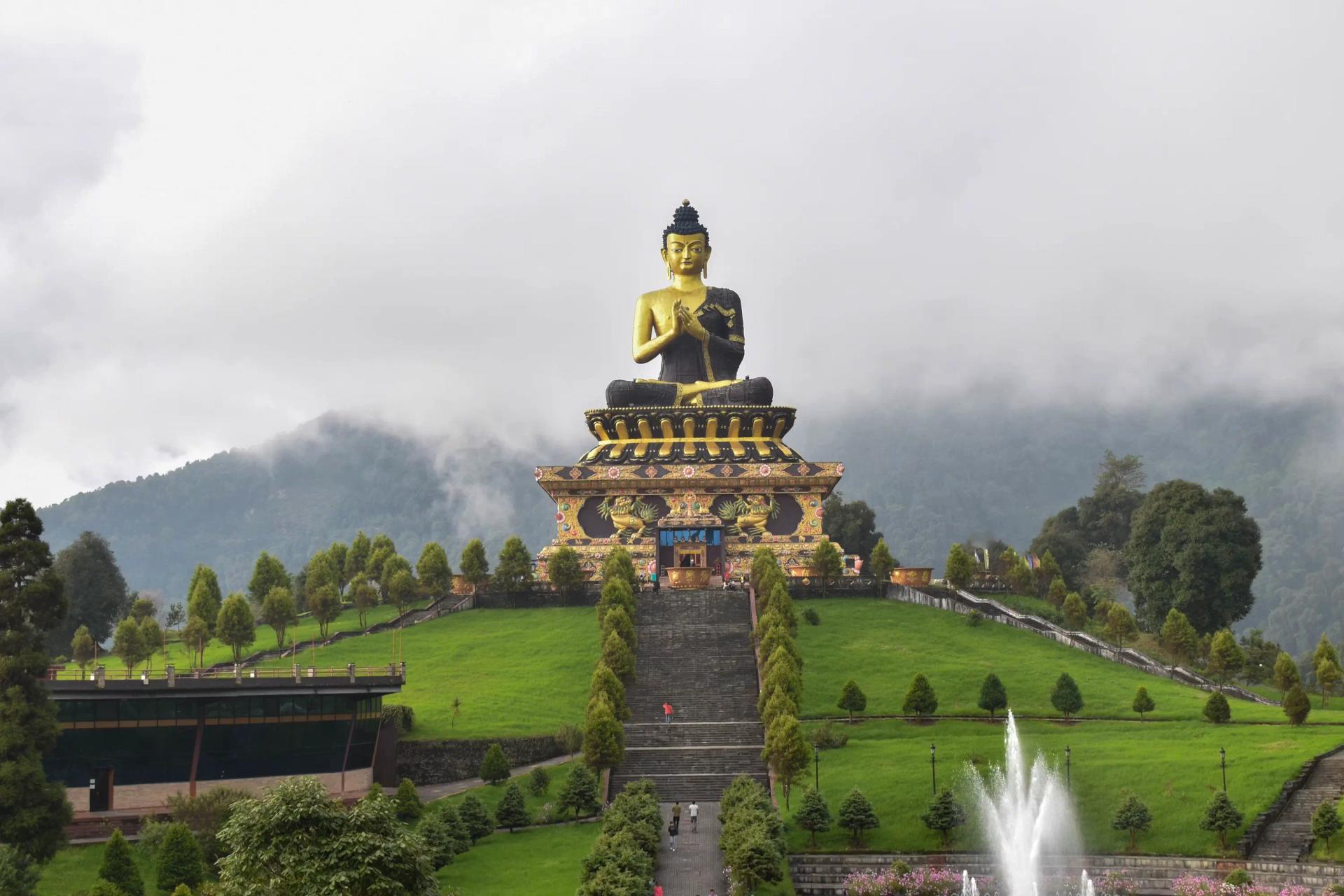
Namchi — home to the giant Chardham replica and the towering Guru Padmasambhava statue in South Sikkim.
Ravangla and Silk Route (Zuluk) — offbeat East Sikkim circuits known for zig-zag mountain roads and sunrise views of Kanchenjunga.
Because North Sikkim requires special permits and can shut temporarily due to landslides, most well-planned Sikkim tour packages build in buffer days — something BizareXpedition factors into every itinerary rather than treating it as an afterthought.
Sikkim Food — What to Eat
Sikkim's cuisine leans heavily on Tibetan, Nepali, and Lepcha influences, shaped by the cold climate and mountain terrain.
Momos — steamed or fried dumplings, the single most iconic Sikkim food, found at literally every street corner in Gangtok.
Thukpa — a hot noodle soup, ideal for the chilly evenings; the local answer to a warming bowl of ramen.
Gundruk — a fermented leafy-green dish, often turned into a soup or side, and a genuine Sikkimese specialty most visitors have never heard of before arriving.
Kinema — fermented soybean, usually cooked into a curry; an acquired taste but a real window into local food culture.
Chhurpi — a hard, chewy yak or cow milk cheese, often nibbled on slowly through the day like a snack.
Tongba — a warm, fermented millet drink served in a wooden vessel with a bamboo straw; popular among Nepali and Bhutia communities, especially in colder months.
BizareXpedition's Sikkim tour packages typically include at least one homestay meal, because the best versions of these dishes rarely show up on a hotel restaurant menu.
Festivals in Sikkim
Sikkim's festival calendar is dominated by Buddhist monastic traditions, alongside Hindu and Nepali celebrations:
Losar (Tibetan/Sikkimese New Year) — usually in February, marked with monastery dances, prayer rituals, and family gatherings.
Saga Dawa — a sacred Buddhist festival in May/June commemorating the birth, enlightenment, and death of Buddha, observed with processions around Gangtok.
Pang Lhabsol — a uniquely Sikkimese festival honouring Mount Kanchenjunga as the state's guardian deity, featuring masked warrior dances.
Bumchu Festival — held at Tashiding Monastery, where a sacred water vessel is opened to "predict" the year ahead — one of the more mystical events in the region.
Dashain and Tihar — the Nepali equivalents of Durga Puja and Diwali, celebrated widely across Sikkim's Nepali community.
If your travel dates align with Saga Dawa or Pang Lhabsol, it's genuinely worth structuring your Sikkim tour package around it — these aren't tourist-facing shows, they're real community festivals.
How to Reach Sikkim
Sikkim has no railway line of its own — it's entirely a road-and-air state — and North Sikkim additionally requires a permit. Here's the breakdown:
| Mode | Nearest Point | Distance to Gangtok | Travel Time |
|---|---|---|---|
|
Flight (direct) |
Pakyong Airport (PYG) |
~31 km |
1 – 1.5 hours by taxi |
|
Flight (via Bagdogra) |
Bagdogra Airport (IXB), West Bengal |
~124 km |
4 – 5 hours by road |
|
Train |
New Jalpaiguri (NJP), West Bengal |
~125–148 km |
4.5 – 6 hours by road |
|
Road / Bus |
Siliguri |
~115 km |
4 – 5 hours |
Sikkim Way to Reach
By flight: Pakyong Airport is Sikkim's only airport and one of the highest airports in India, sitting at roughly 4,500 feet. It runs limited flights, mainly from Kolkata and occasionally Delhi/Guwahati, and is weather-sensitive — flights sometimes divert to Bagdogra during low visibility. Bagdogra Airport, across the border in West Bengal, remains the more reliable option, with daily flights from Delhi, Mumbai, Kolkata, and Bengaluru, followed by a scenic 4–5 hour drive to Gangtok.
By train: There's no railway station inside Sikkim. New Jalpaiguri (NJP) in West Bengal is the nearest railhead, well connected to Kolkata, Delhi, and Guwahati, from where you'll continue by shared jeep or private taxi.
By road: Sikkim connects well with Darjeeling (roughly 3–4 hours) and Kalimpong (roughly 3 hours), which is why a Sikkim–Darjeeling combo is one of the most popular multi-destination tour packages BizareXpedition puts together.
A nuance worth knowing: All non-Sikkimese Indian citizens need an Inner Line Permit (ILP) to enter Sikkim, and a further Protected Area Permit (PAP) for North Sikkim regions like Lachen, Lachung, and Gurudongmar Lake. These are usually arranged by your tour operator — it's not a bureaucratic hurdle you need to solve on your own if you're booking a package.
Best Time to Visit Sikkim — Weather and Temperature
Sikkim's tourist season peaks around March to June and again September to November, when roads are clearest and mountain views are least obstructed by cloud cover.
| Season | Months | Gangtok Temperature | What to Expect |
|---|---|---|---|
|
Spring |
March – May |
8°C – 18°C |
Rhododendron blooms, clear skies, Yumthang at its best |
|
Summer/Monsoon |
June – August |
13°C – 22°C, heavy rain |
Landslide risk on hill roads, North Sikkim can shut temporarily |
|
Autumn |
September – November |
4°C – 15°C |
Crispest air, best Kanchenjunga visibility, festival season |
|
Winter |
December – February |
-2°C – 10°C |
Cold, occasional snowfall at higher altitudes, quieter roads |
Sikkim Best Time to Visit — Weather and Temperatur
Here's the nuance that surprises most first-timers: temperature in Sikkim doesn't just change by season, it changes dramatically by altitude within the same day. Gangtok might sit at a pleasant 15°C, while Tsomgo Lake, just 40 km away, can be near freezing, and Gurudongmar Lake in the far north regularly dips below 0°C even in "summer." Layered clothing isn't a suggestion here — it's the actual difference between an enjoyable day and a miserable one.
Why Book Your Sikkim Tour with BizareXpedition
Sikkim rewards good planning more than almost any other Indian destination — the wrong season closes North Sikkim entirely, permits take time to process, and altitude affects people differently depending on how fast you climb. At BizareXpedition, our Sikkim tour packages are designed around this reality: permits handled in advance, realistic altitude acclimatisation built into the itinerary, and homestay stops that actually show you Sikkimese culture rather than a repackaged hotel experience.
Whether you're looking at a quick Gangtok-Pelling getaway, a honeymoon trip built around Kanchenjunga views, or the full North Sikkim circuit to Lachung and Gurudongmar Lake, we'll help you plan it around the season, the permits, and the pace that actually suits you.
Frequently Asked Questions (FAQs) & People Also Ask — sikkim Tour Packages
We help you prepare for your trip and ensure an effortless and enjoyable travel experience.