
North East Wildlife & Conservation Circuit10N/11D
North East Wildlife & Conservation Circuit
Start & City : Guwahati
best deal price
₹
Without GST ₹1,48,869
per person on twin sharing
Choose your departure city, dates, and add guests to secure your tour.
Hurry, as seats fill up, prices rise! Book now!
1. Choose your departure date
Highlights
Drive through Manas to Mathanguri, where the Manas river leaves the hills of Bhutan and the forest on the far bank is another country's national park.
Meet members of a community group in Manas that includes former poachers, now working to protect the forest they once hunted in.
Cross the Jia Bhoroli by boat and walk into Nameri with an armed forest guard, one of the few parks in India where you explore on foot.
Look for the white-winged wood duck, critically endangered and Assam's state bird, on the forest pools of Nameri.
Take five jeep safaris in Kaziranga across the Western, Central, Eastern and Burapahar ranges, home to more than 2,600 greater one-horned rhinos.
Stand under the canopy at Hoollongapar at first light and listen for the hoolock gibbons' morning song.
Sleep in heritage tea-planter bungalows at Nameri and Jorhat, built when tea first turned Assam into a plantation economy.
Essence of Journey
The experiences that capture the true spirit of the entire trip.
| Day | Route | Distance | Major Highlights |
|---|---|---|---|
| Day 1 | Arrive Guwahati | Airport to hotel, about 45 min | Brahmaputra sunset cruise |
| Day 2 | Guwahati to Manas (Bansbari) | About 140 km, 3.5 to 4 hrs | Afternoon jeep safari, Bansbari range |
| Day 3 | Manas | Park drives | Mathanguri and the Manas river; community conservation meeting |
| Day 4 | Manas to Nameri (Potasali) | About 240 km, 6 to 6.5 hrs | North-bank drive through Bodoland and Udalguri |
| Day 5 | Nameri | On foot and by river | Guided forest walk, Jia Bhoroli river float, white-winged wood duck |
| Day 6 | Nameri to Kaziranga via Tezpur | About 100 km, 2.5 to 3 hrs | Western range jeep safari (afternoon) |
| Day 7 | Kaziranga | Park drives | Central range at dawn, Eastern range in the afternoon |
| Day 8 | Kaziranga | Park drives | Burapahar range; afternoon at leisure or a tea-garden walk |
| Day 9 | Kaziranga to Jorhat | About 100 km, 2.5 hrs | Tea-estate afternoon, heritage bungalow |
| Day 10 | Hoollongapar Gibbon Sanctuary | About 20 km each way | Dawn gibbon walk |
| Day 11 | Jorhat airport, fly out | About 15 to 20 km | Departure |
About
Seeing a one-horned rhino is special. Knowing that the rhino in front of you was brought back from the brink makes it even better.
This private 11-day North East India wildlife tour takes you across Assam, from the Bhutan border in the west to the tea gardens in the east, through four protected areas: Manas, Nameri, Kaziranga and the Hoollongapar Gibbon Sanctuary. You'll go on jeep safaris, walk through the forest with an armed forest guard, float down a Himalayan river, and listen to India's only ape singing at dawn.
The same expert naturalist is with you for most of the trip. Along the way, you'll meet some of the people who protect these parks, including former poachers who now guard the forest they once hunted in.
What Is This Tour?
The BizareXpedition North East Wildlife & Conservation Circuit is a private, 11-day Assam wildlife tour for international travellers. It covers Manas National Park, Nameri National Park, Kaziranga National Park and the Hoollongapar Gibbon Sanctuary. It includes lodges and heritage tea bungalows, a private car and driver, a naturalist guide from Day 2 to Day 10, nine wildlife outings (including five Kaziranga jeep safaris) and a meeting with a community conservation group. Prices start at about ₹148,869 per person, twin sharing. The tour runs from November to April.
Each park carries its own conservation story. Manas lost every one of its rhinos to poaching during years of armed conflict and was placed on UNESCO's World Heritage in Danger list in 1992. Rhinos were moved back from 2006, and many of the people who now protect the park are former poachers. Kaziranga grew from a reserve created in 1908 into the home of about two-thirds of the world's greater one-horned rhinos. Nameri is one of the last places to see the white-winged wood duck, Assam's state bird. Hoollongapar is a small forest island among tea gardens where India's only ape, the western hoolock gibbon, still sings at dawn.
The route runs one way, west to east, with no backtracking. You fly into Guwahati and out of Jorhat, which has direct flights to Delhi and Kolkata. As a North East conservation tourism package, it gives each park at least two nights and pairs each drive with the people behind the parks: forest guards, community rangers and tea-garden families. It is a North East wildlife tour international guests can book on its own or add to a wider India trip.
Four Parks, Four Conservation Stories
This isn't just a list of parks. Each one has a story about how its wildlife survived, and you'll hear those stories from the people who lived them.
Manas National Park: the comeback. Manas sits on the Bhutan border, and it's a UNESCO World Heritage Site. During years of armed conflict, poachers killed every rhino in the park. By 2001, none were left. Since 2006, rhinos have been brought back from Kaziranga, and the park came off UNESCO's "in danger" list. Manas is also home to the rare Bengal florican and the world's only wild pygmy hogs.
Nameri National Park: explore on foot. Nameri is one of the few parks in India where you can walk through the forest, with an armed forest guard. It's a stronghold of the critically endangered white-winged wood duck, Assam's state bird, and you'll also have the chance to spot hornbills and the ibisbill.
Kaziranga National Park: the rhino stronghold. Kaziranga started as a small reserve in 1908, when only a handful of rhinos were left. Today it holds 2,613 greater one-horned rhinos (2022 census), about two-thirds of all the wild rhinos of this species. It's also a UNESCO World Heritage Site.
Hoollongapar Gibbon Sanctuary: India's only ape. This small patch of forest is surrounded by tea gardens. It's the easiest place in India to see the western hoolock gibbon, and it's home to six other primates, including the capped langur and the Bengal slow loris.
SEASON ADJUSTMENTS
| Season | Months | What to expect |
|---|---|---|
|
Peak |
November to February |
All four parks open, cool mornings and dry roads. Best for birds at Nameri and wetland birds in Kaziranga. |
|
High |
Late December to early January |
Holiday demand. Lodges fill early; book well ahead. |
|
Shoulder |
October, March and April |
Parks open in stages in October. March and April bring warmer days and good wildlife viewing in Kaziranga once the old grass is burned back. |
|
Caution |
May |
Heat and pre-monsoon storms. Kaziranga and Manas begin closing. |
|
Monsoon |
June to September |
Manas, Nameri and Kaziranga are closed and much of the floodplain is under water. The trip is not sold in this period. |
North East Wildlife Season Adjustments
Who This Tour Is For
This trip suits you if you:
Love wildlife and birds, and want more than a quick safari
Care about how species are protected, not just about ticking them off
Enjoy walking in nature and don't mind early starts
Would like a private trip with an expert naturalist instead of a group tour
Are looking for an ethical wildlife trip with no elephant rides
ACCOMMODATION CATEGORIES
Tier labels follow the standard of the room and the property, not a star count. Manas, Nameri and Jorhat have small hotel markets, so some tiers use the same property in different room categories. Named properties are real places we plan to use, subject to availability; where none is named, the property is flagged honestly rather than guessed.
| Destination | Nights | Premium | Luxury | Ultra-Luxury |
|---|---|---|---|---|
|
Guwahati |
1 |
Novotel Guwahati GS Road |
Radisson Blu Hotel Guwahati |
Vivanta Guwahati |
|
Manas |
2 |
Musa Jungle Retreat, semi-deluxe cottage |
Musa Jungle Retreat, deluxe cottage |
Musa Jungle Retreat, Bansbari Villa |
|
Nameri |
2 |
Nameri Eco Camp, Potasali |
Wild Mahseer, Addabarie Tea Estate |
Wild Mahseer, Heritage Bungalow |
|
Kaziranga |
3 |
Iora – The Retreat |
Infinity Resorts Kaziranga |
Diphlu River Lodge |
|
Jorhat |
2 |
Best-available Jorhat hotel |
Burra Sahib's Bungalow, Gatoonga Tea Estate |
Thengal Manor |
North East Wildlife Accommodation Categories
WHY BOOK THIS WITH BIZAREXPEDITION
A west-to-east wildlife and conservation circuit across Assam, planned and run by BizareXpedition from start to finish.
Four parks, one direction. Guwahati to Manas, along the north bank to Nameri, across the Brahmaputra to Kaziranga, then east to Jorhat. You fly in to Guwahati and out of Jorhat, so no road is driven twice.
A naturalist from Day 2 to Day 10. The same naturalist joins every safari, walk and river trip, alongside the park's own guides and forest guards.
Nine wildlife outings, three ways. Two jeep safaris in Manas, a forest walk and a river float at Nameri, five jeep safaris in Kaziranga and a dawn walk at Hoollongapar. Permits and jeep slots are booked before you arrive.
Time with the people behind the parks. A meeting with Manas's community conservation group on Day 3, and tea-garden stays at Nameri and Jorhat, where the parks' neighbours live and work.
Routed around current travel advice. The route stays in Assam. Manipur is left out while the UK government advises against all but essential travel there.
A registered company, not a middleman. BizareXpedition Services Pvt. Ltd. (CIN U63090UR2016PTC007433), headquartered in Haridwar, plans and runs the trip itself.
This Circuit vs a Standard Kaziranga Trip
| Options | Standard Kaziranga Trip | North East Wildlife & Conservation Circuit |
|---|---|---|
|
Parks |
Kaziranga only |
Manas, Nameri, Kaziranga and Hoollongapar |
|
Safaris |
Usually 2 to 3 jeep drives |
9 outings, by jeep, on foot and by river |
|
Guide |
Park guide only |
Your own naturalist for 9 days |
|
Species |
Rhinos and grassland wildlife |
Add gibbons, rare birds, forest wildlife and the Bengal florican |
|
Conservation |
Rarely covered |
Meetings with community rangers and conservation stories at every park |
|
Best for |
A short wildlife stop |
Wildlife lovers who want depth |
North East Wildlife Circuit vs a Standard Kaziranga Trip
3-TIER PRICING SUMMARY
| Tier | Per couple | Per person | Standard |
|---|---|---|---|
|
Premium |
Rs.297,738 to Rs.321,557 |
Rs.148,869 to Rs.160,778 |
Good lodges, eco camp and standard rooms |
|
Luxury |
Rs.383,418 to Rs.414,091 |
Rs.191,709 to Rs.207,045 |
Superior rooms and heritage tea bungalows |
|
Ultra-Luxury |
Rs.522,648 to Rs.564,460 |
Rs.261,324 to Rs.282,230 |
Top rooms and the best property at each stop |
North East Wildlife 3-Tier Pricing Summary
The upper figure allows for date and season variance of about 8%. Prices are indicative and confirmed on request.
PRACTICAL NOTES
Safety. The route stays in Assam, on main roads, with a driver, a naturalist and confirmed lodges. Some foreign governments advise caution near inter-state borders in the North East and advise against travel to Manipur, which is not on this route.
Permits. No special permit is needed for foreign nationals in Assam. Park entries and safari slots are booked by BizareXpedition.
On foot in the parks. At Nameri and Hoollongapar you walk with forest guards. Follow their instructions, keep quiet and wear dull colours and closed shoes.
Sightings. Rhinos are very likely in Kaziranga. Tigers are present in Manas, Nameri and Kaziranga but rarely seen. No sighting is guaranteed.
Communities. Bodo villages around Manas and tea-estate families around Jorhat are lived-in communities. Ask before photographing people.
Drinking water. Drink sealed bottled water only. Your driver keeps a supply in the car.
Dress. Layers in neutral colours. Mornings in open jeeps are cold from December to February. A hat and insect repellent are useful.
Photography. Camera fees apply in the parks. Do not use flash near animals or play recorded bird or gibbon calls.
Connectivity. Mobile signal is weak or absent in parts of Manas, Nameri and Kaziranga.
Tipping. Appreciated but not required. Guests often tip drivers, naturalists and forest guards at the end of each park stay.
Booking Summary
Dept. City :
--
Dept. Date :
--
Traveller :
Adults: 2, Child: 0, Infant: 0
Rooms :
--
Basic Price :
--
Total Cost
--
GST
--
Grand Total
--
Itinerary (Day Wise)
This 11-day private trip crosses Assam from west to east through four protected areas, with the same naturalist beside you from Day 2 to Day 10. You start at Manas on the Bhutan border, a park that lost all of its rhinos to poaching and brought them back from 2006. There you'll meet a community group whose members include former poachers who now guard the forest. At Nameri you walk through the forest with an armed forest guard and float down the Jia Bhoroli, watching for the rare white-winged wood duck. Three nights at Kaziranga give you five jeep safaris across four ranges. The trip ends near Jorhat, where you stay in heritage tea bungalows and listen at dawn for India's only ape, the hoolock gibbon. There are no elephant rides and no backtracking. You fly into Guwahati and out of Jorhat, and the tour runs from November to April.
Day 1
ARRIVE GUWAHATI | ON THE BRAHMAPUTRA
Route: Arrive Lokpriya Gopinath Bordoloi International Airport, Guwahati; transfer to hotel
Your driver meets you at the airport. Guwahati is the gateway to Assam and sits on the south bank of the Brahmaputra, the river that shapes every park on this trip.
If you land by early afternoon, take the sunset cruise on the Brahmaputra. It lasts about two hours. In the dry season the river is broad and slow, with sandbanks, fishing boats and the first river birds of the trip.
Experience of the Day
Airport pickup and check-in
Brahmaputra sunset cruise
Briefing on the route ahead
Food
Recommended: Paradise, a long-running Guwahati restaurant, for an Assamese thali.
Must-Try: Masor tenga, a light, sour fish curry.
Activities to Do
Rest after the flight
Sunset cruise, if you arrive in time
Day 2
GUWAHATI TO MANAS | INTO THE BHUTAN FOOTHILLS
Route: Guwahati to Bansbari, Manas National Park, about 140 km, 3.5 to 4 hours
The road runs west and north across the Brahmaputra plain towards the Bhutan hills. Manas sits right on the border. Bhutan's Royal Manas National Park continues on the other side, so the two parks form one forest.
After lunch, the first jeep safari goes out from Bansbari, the park's central range. The mix here is grassland and forest. Wild elephants, water buffalo and gaur are common, and Manas holds the world's largest population of the Bengal florican, a rare grassland bustard. Jeep safaris in Manas run in the late morning and afternoon.
Note on the Manas season
Manas opens for visitors in October and closes for the monsoon from about June to September. November to April is the main season.
Experience of the Day
First sight of the Bhutan hills
Afternoon jeep safari in the Bansbari range
Evening at the lodge
Food
Recommended: Dinner at your lodge, where Bodo dishes are often on the menu.
Must-Try: Onla khari, a Bodo curry thickened with ground rice.
Activities to Do
Drive to Manas
Bansbari jeep safari
Day 3
MANAS | A PARK THAT CAME BACK
Route: Bansbari to Mathanguri and back, with a community visit
Today's safari runs deep into the park to Mathanguri, where the Manas river comes out of the Bhutan hills. The forest on the far bank is in Bhutan.
Manas was made a UNESCO World Heritage Site in 1985. During the armed conflict of the late 1980s and 1990s, poaching emptied it. By 2001 not a single rhino was left, and UNESCO had put the park on its World Heritage in Danger list in 1992. Peace came in 2003. Rhinos were moved in from Kaziranga from 2006, and hand-raised orphan calves were released too. UNESCO took Manas off the danger list in 2011. The park is also the only place in the world where the pygmy hog, the smallest wild pig, lives in the wild. Captive-bred hogs have been released here since the 2000s.
In the afternoon, meet members of the Manas Maozigendri Ecotourism Society. Local young people founded it in 2003, and it brought former poachers into forest protection and tourism.
The Human Story
Some of the people now guarding Manas once hunted in it. The community group they joined runs patrols with the forest department and earns from tourism, which gives villages around the park a stake in keeping it intact.
Experience of the Day
Safari to Mathanguri on the Manas river
Grassland birds, including the Bengal florican
Meeting with the community conservation group
Food
Recommended: Picnic lunch in the park, packed by the lodge.
Must-Try: Local rice beer is part of Bodo hospitality; ask your guide before you try it.
Activities to Do
Jeep safari to Mathanguri
Community conservation meeting
Evening talk with your naturalist
Optional Nearby Excursions
Birdwatching boat trip on the Manas river, when water levels allow
Day 4
MANAS TO NAMERI | ALONG THE NORTH BANK
Route: Bansbari to Potasali (Nameri), about 240 km, 6 to 6.5 hours
Today is the long drive of the trip. The road runs east along the north bank of the Brahmaputra through Bodoland, past rice fields, tea gardens and small market towns, with the foothills in view to the north.
You reach Nameri in the afternoon. The park sits at the foot of the Arunachal hills where the Jia Bhoroli river comes down onto the plain. Nameri joins Pakke Tiger Reserve across the state border, so the forest runs on into the hills.
Note on the long drive
About six hours of driving with stops. Road works on the highway can slow the day, so the start is early.
Experience of the Day
North-bank drive through Bodoland
First view of the Jia Bhoroli
Evening at the camp or bungalow
Food
Recommended: Dinner at your camp or bungalow.
Must-Try: Fish from the river, cooked simply with mustard, the Assamese way.
Activities to Do
Drive to Nameri
Evening walk by the river
Day 5
NAMERI | ON FOOT AND ON THE RIVER
Route: Potasali, Nameri National Park
The morning starts with a short boat crossing over the Jia Bhoroli. On the far bank you walk into the forest with an armed forest guard and your naturalist. Walking is the main way to see Nameri, and the pace is slow and quiet.
Nameri is a stronghold of the white-winged wood duck. It is critically endangered, with only a few hundred thought to be left in North East India, and it was made Assam's state bird in 2003. It feeds on quiet forest pools, often at dawn and dusk. Hornbills, the ibisbill and many forest birds are here too.
In the afternoon, float down the Jia Bhoroli on an inflatable raft. It is a gentle trip for birdwatching, not white-water.
Note on walking in Nameri
Walks are led by the forest department's armed guards, who set the route and pace. Wear dull colours and closed shoes, keep quiet, and follow the guard's instructions. Elephants live in this forest.
Experience of the Day
Boat crossing of the Jia Bhoroli
Guided forest walk with an armed guard
River float for birdwatching
Food
Recommended: Lunch at your camp or bungalow.
Must-Try: Assam tea from the gardens around Nameri.
Activities to Do
Forest walk in Nameri
Rafting float on the Jia Bhoroli
Birdwatching at dawn and dusk
Day 6
NAMERI TO KAZIRANGA | ACROSS THE BRAHMAPUTRA
Route: Potasali to Tezpur to Kohora, about 100 km, 2.5 to 3 hours
The road runs south to Tezpur and crosses the Brahmaputra. On the south bank it turns east to Kaziranga.
The afternoon jeep safari goes into the Western range at Bagori. It has the highest density of rhinos in the park, and the open grassland makes them easy to see. Kaziranga became a UNESCO World Heritage Site in 1985. The 2022 census counted 2,613 greater one-horned rhinos, about two-thirds of all that live in the wild.
Experience of the Day
Crossing the Brahmaputra at Tezpur
First Kaziranga safari, Western range
Rhinos, buffalo and swamp deer
Food
Recommended: Lunch and dinner at your lodge.
Must-Try: Duck with ash gourd, a traditional Assamese dish, where the lodge kitchen offers it.
Activities to Do
Drive to Kaziranga
Western range jeep safari
Optional Nearby Excursions
Agnigarh hill in Tezpur, a short stop with views over the river
Day 7
KAZIRANGA | CENTRAL AND EASTERN RANGES
Route: Kohora (Central range) and Agaratoli (Eastern range)
The dawn safari runs through the Central range from Kohora, the main gate, to open lakes where rhinos and wild buffalo come to drink.
Kaziranga looks the way it does because of the Brahmaputra. Every monsoon the river floods most of the park. The flood leaves fresh silt, and the silt feeds the tall grass that rhinos, buffalo and deer eat. The same flood closes the park from June to September, and it is why the grassland renews itself every year.
The afternoon safari goes to the Eastern range at Agaratoli, with large wetlands, nesting spot-billed pelicans and many water birds.
Note on safaris
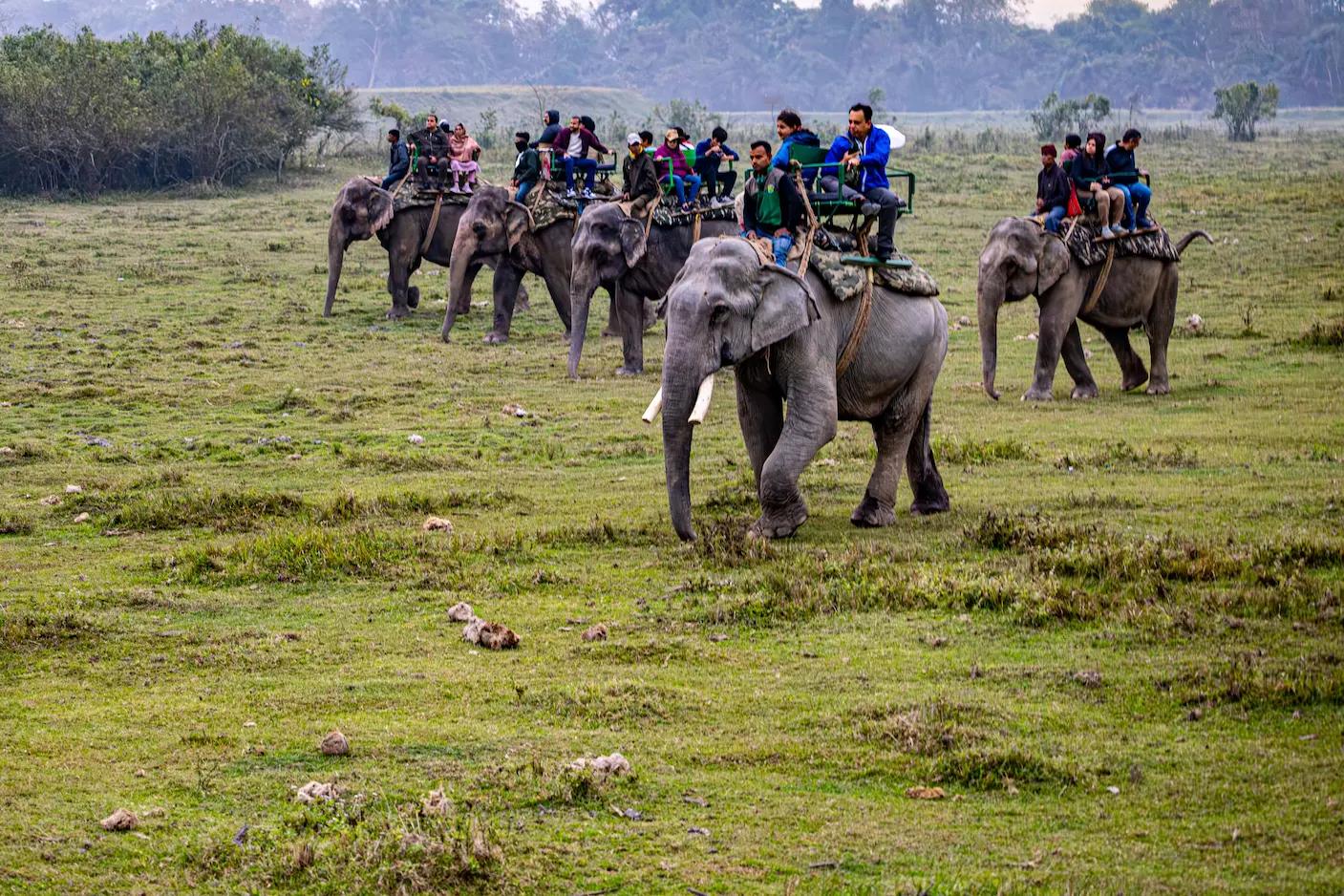
The forest department sets safari slots and routes, and sightings are never guaranteed. Elephant-back rides are offered in Kaziranga, but this plan uses jeep safaris only.
Experience of the Day
Dawn safari in the Central range
Afternoon safari in the Eastern range
Pelicans and wetland birds
Food
Recommended: Meals at the lodge.
Must-Try: Assam tea, plain or with milk, from the gardens around the park.
Activities to Do
Central range jeep safari
Eastern range jeep safari
Midday rest
Day 8
KAZIRANGA | BURAPAHAR AND A SLOWER AFTERNOON
Route: Ghorakati (Burapahar range), then back to the lodge
The last Kaziranga safari goes to the Burapahar range in the west. It is hillier and more forested than the grassland ranges, with a different mix of birds and a better chance of primates such as the capped langur.
Kaziranga grew from a small reserve. It was set aside as a reserve forest in 1908, when only a few rhinos were thought to survive there, and protection since then has turned it into the stronghold of the species.
The afternoon is free. Rest at the lodge, walk in a nearby tea garden, or visit the orchid park at Kohora.
Experience of the Day
Burapahar range safari
Forest birds and primates
Free afternoon
Food
Recommended: Meals at the lodge.
Must-Try: Pitha, Assamese rice cakes, often served at tea time.
Activities to Do
Burapahar jeep safari
Tea-garden walk, if you wish
Optional Nearby Excursions
Kaziranga Orchid and Biodiversity Park near Kohora (allow 1 to 2 hours)
Day 9
KAZIRANGA TO JORHAT | TEA COUNTRY
Route: Kohora to Jorhat, about 100 km, 2.5 hours
The road runs east along the south bank into Upper Assam, the heart of the tea country. Jorhat grew as a tea town, and old planters' bungalows still stand on the estates around it.
In the afternoon, visit a working tea estate with your guide to see how the leaf is plucked, withered, rolled and dried. The evening is at your heritage bungalow.
The Human Story
Tea gardens in Assam are worked mostly by families whose ancestors were brought from central and eastern India in the 19th century. Many live on the estates still. Your guide can explain how the gardens run today.
Experience of the Day
Drive into Upper Assam
Tea-estate visit
Evening at a planter's bungalow
Food
Recommended: Dinner at your bungalow, often an Assamese home-style meal.
Must-Try: Freshly made orthodox Assam tea, tasted at the estate.
Shopping
Loose-leaf Assam tea bought at the estate or in Jorhat town.
Activities to Do
Drive to Jorhat
Tea-estate and factory visit
Day 10
HOOLLONGAPAR | INDIA'S ONLY APE
Route: Jorhat to Hoollongapar Gibbon Sanctuary and back, about 20 km each way
Hoollongapar is a small forest, about 21 square kilometres, surrounded by tea gardens. It is home to the western hoolock gibbon, the only ape found in India. About 125 gibbons were counted here in 2023.
Gibbons live in the tree tops and almost never come down. They move by swinging from branch to branch, so they need an unbroken canopy. That is the problem at Hoollongapar. Tea gardens surround the forest, and a railway line runs through it, cutting off one group of gibbons in the smaller part. Early morning is the best time, when the family groups sing to mark their territory.
Six other primates live here, including the capped langur, stump-tailed macaque and the Bengal slow loris. The afternoon is free.
Note on the gibbon walk
Walks follow forest trails with a forest guide. Keep voices low and do not play recorded calls. Gibbons are usually seen, but sightings are never guaranteed.
Experience of the Day
Dawn walk in Hoollongapar
Gibbon song at first light
Free afternoon at the bungalow
Food
Recommended: Breakfast back at the bungalow after the walk.
Must-Try: Khar, a dish made with an alkaline extract from dried banana peel.
Activities to Do
Guided gibbon walk
Rest and pack
Day 11
JORHAT | DEPARTURE
Route: Jorhat to Jorhat airport (Rowriah), about 15 to 20 km
Your driver takes you to Jorhat airport for your onward flight. Jorhat has direct flights to Delhi and Kolkata.
Experience of the Day
Last morning in tea country
Airport drop
Food
Recommended: Breakfast at the bungalow.
Must-Try: A final cup of Assam tea on the verandah.
Activities to Do
Transfer to the airport
Onward flight

Tour Information
Your complete guide to a hassle-free and enjoyable trip.
Inclusion
Exclusion
Payment Terms
Important factors to consider before your trip!
Cancellation
Need To Know
Be Responsible Traveller
- Minimize Plastic Use : Bring a reusable water bottle, shopping bag, and utensils to reduce the need for single-use plastics. Many destinations have water refill stations and eco-friendly stores.
- Support Local and Sustainable Businesses : Eat at local restaurants, buy souvenirs from local artisans, and choose tour operators that prioritize sustainable practices and support the local community.
- Respect Wildlife and Natural Habitats : Avoid disturbing wildlife or their natural habitats. Stick to designated paths and observe animals from a distance without feeding or touching them.
- Dispose of Waste Properly : Follow local guidelines for recycling and waste disposal. If facilities aren't available, carry your waste with you until you can dispose of it responsibly.
- Educate Yourself and Others : Learn about the local environment, culture, and customs. Respect local practices and traditions, and share your knowledge about responsible travel with others.
- Choose Sustainable Activities : Engage in eco-friendly activities such as hiking, snorkeling, or visiting national parks. Avoid activities that exploit animals or damage the environment.
- Leave No Trace : Follow the principle of "Leave No Trace," which means leaving natural areas as you found them. Pack out all trash, avoid picking plants, and refrain from carving or writing on rocks or trees.
- Plant Trees Whenever Possible : Participate in local tree-planting initiatives or plant trees in your own community. Trees absorb carbon dioxide, provide oxygen, and help support biodiversity, making them vital for a healthy environment.
Connect
Share Itinerary
Email Itinerary
Frequently Asked Questions (FAQs) & People Also Ask — North East Wildlife & Conservation Circuit
We help you prepare for your trip and ensure an effortless and enjoyable travel experience.
How many days do you need for a wildlife tour of Assam?
Ten to eleven days is enough to see Assam's four main wildlife areas properly. This trip gives two nights each to Manas and Nameri, three to Kaziranga and two near Hoollongapar. With a week, it is better to focus on Kaziranga plus one other park.
What is the best time to visit Kaziranga and Manas?
November to April is the best time to visit Kaziranga and Manas. Both parks close for the monsoon from about June to September. November to February is cool and good for birds; March and April are warmer, with good visibility after the grass is burned back.
Is Manas National Park worth visiting?
Yes, Manas is worth visiting for its forest-and-grassland wildlife and for its recovery story. It is a UNESCO World Heritage Site on the Bhutan border, home to the Bengal florican and the only wild pygmy hogs. Rhinos were brought back after poaching wiped them out by 2001.
Will I see a one-horned rhino on this tour?
Rhino sightings are very likely in Kaziranga, though never guaranteed. The park counted 2,613 greater one-horned rhinos in 2022, and this trip includes five safaris there across four ranges. Rhinos also live in Manas, but in much smaller numbers.
Can you see tigers in Kaziranga or Manas?
Tigers live in Kaziranga, Manas and Nameri, but sightings are rare. The tall grass and forest make them hard to see. Treat a tiger as a bonus. The likely sightings are rhinos, elephants, birds and primates.
Where can you see the hoolock gibbon in India?
The Hoollongapar Gibbon Sanctuary near Jorhat in Assam is the easiest place to see the western hoolock gibbon, India's only ape. About 125 were counted there in 2023. Early morning is best, when the family groups sing.
Is the walking safari in Nameri safe?
Yes, walks in Nameri are led by the forest department's armed guards, who set the route and pace. You cross the Jia Bhoroli by boat and walk in a small group with your naturalist. Follow the guard's instructions, keep quiet and wear closed shoes.
Are elephant safaris in Kaziranga ethical?
Elephant-back safaris are offered in Kaziranga, and animal-welfare groups have raised concerns about riding elephants. This trip uses jeep safaris, boats and walks only. If you want an elephant ride, ask us and we will tell you what is involved.
Is there a Kaziranga Manas Loktak tour for foreigners?
This trip covers Kaziranga and Manas but not Loktak Lake in Manipur. The UK government currently advises against all but essential travel to Manipur, and foreign nationals need a Protected Area Permit there. We will offer Loktak and Keibul Lamjao again when the advice changes.
Do foreigners need a permit to visit Assam's national parks?
No special permit is needed for foreign nationals to visit Assam or its national parks. You pay park entry and safari fees, which are included here. Most overseas visitors need an Indian visa, often available online as an e-visa.
Is Assam safe for tourists?
Yes, Assam is a reasonable choice for wildlife travellers, and its national parks receive many international visitors. This route stays on main roads with a driver, a naturalist and confirmed lodges. BizareXpedition checks local conditions before each road day.
How much does a North East wildlife tour cost?
This 11-day North East wildlife tour costs about Rs.297,738 to Rs.321,557 per couple at the Premium tier, or Rs.148,869 to Rs.160,778 per person. Luxury runs Rs.383,418 to Rs.414,091 per couple, and Ultra-Luxury Rs.522,648 to Rs.564,460. Prices include lodges, the car, the naturalist, safaris and GST, but not flights
BizareXpeditionTMReviews
Let's go, pack up, and hit the road!
Similar Tour Packages
Explore other exciting options for your next adventure!
Trusted Paths, Bold Journeys — Inside BizareXpedition
From humble beginnings to a trusted name in the industry, BizareXpedition's story is one of purpose-driven growth, community connection, and a relentless pursuit of excellence that speaks for itself.














North East Wildlife & Conservation Circuit
best deal price
Without GST
₹1,48,869
per person on twin sharing
Book Now